Beautiful Unmadini
A king refuses another man's wife though she is offered to him freely, and dies of the longing. Who stood higher: the king, or the loyal general?
A merchant's daughter of matchless beauty is kept from the king by a protective lie, and married instead to his commander. When the king later sees her and is consumed by longing, the general offers her freely, and the king refuses rather than take another man's wife, and dies of it. The general follows him into the fire. Which of the two stood higher in virtue? You judge first, then the king does.
The Burning Ground
Back the corpse went to its branch, and back the king climbed after it. Bound, shouldered, carried once more across the ash: the pattern was old now, and Vikramaditya kept his patience. The Vetala waited until the grey was underfoot again, and then it began.
Unmadini
In a city called Kanakapura on the bank of the Ganga there ruled a king named Yashodhana, and in that city lived a merchant whose daughter was named Unmadini. Her beauty was of a kind the world rarely makes; it was said she could unsettle the mind of the god of love himself.
When she came of age, her father went first, as was proper, to the king, and offered her as a bride. Yashodhana sent learned men to look at her and read the marks of her body, as kings did before a marriage. But when those men saw her, a fear took hold of them. A beauty like this, they thought, will swallow the king whole; he will forget his kingdom and his duty, and the realm will fall. So, meaning to protect him, they told the king a lie: her marks are inauspicious, do not take her. And the king, trusting them, refused the match.
So the merchant gave his daughter instead to Baladhara, the commander of the king's army, and she became the general's wife.
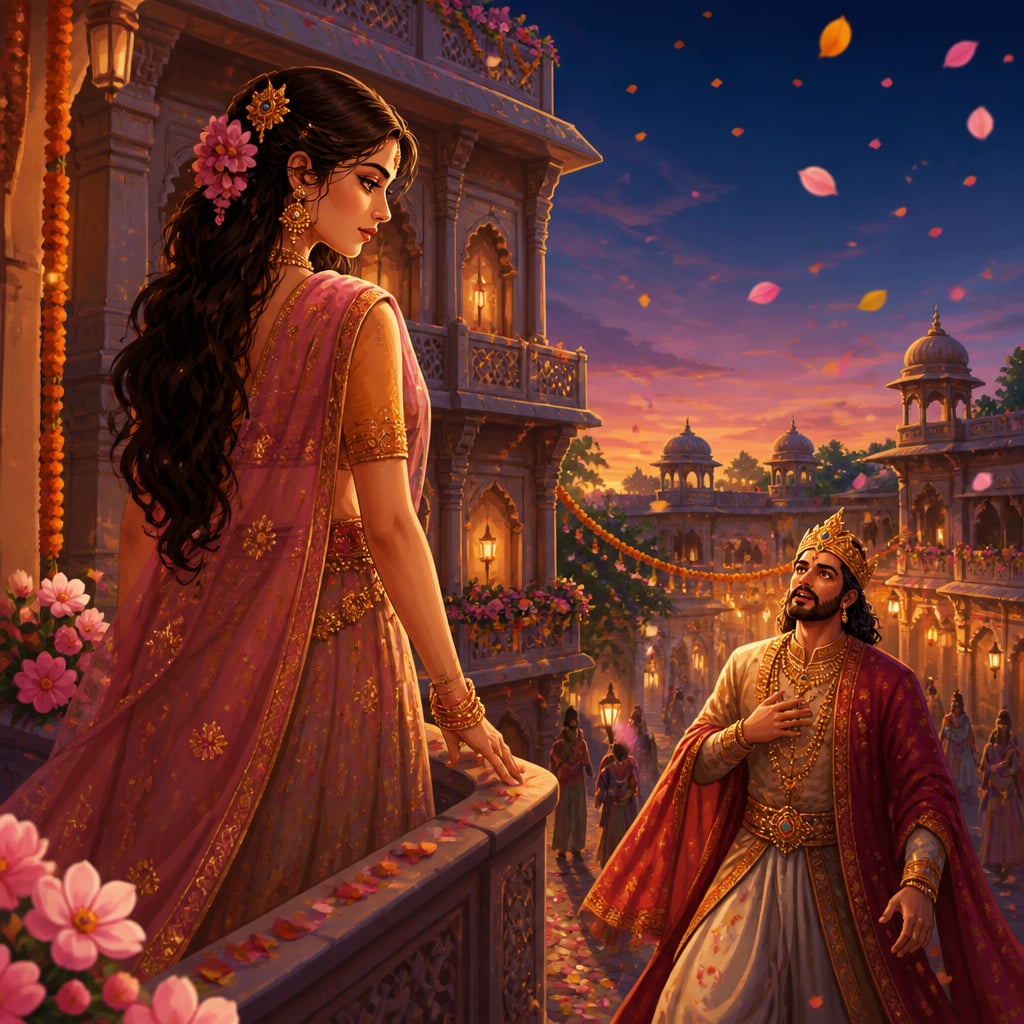
Unmadini had not forgotten the slight. One day, at the spring festival, as the king was passing below, she let herself be seen on the rooftop of her husband's house. Yashodhana looked up, and saw her, and swooned where he stood. When he learned that this was the very maiden he had once been told to refuse, something came loose in him that he could not put back.
He told no one, and he asked for nothing. He knew whose wife she was. But the longing burned in him without rest, and his body began to waste under it.
Baladhara saw his king dying and guessed the cause. He came, and bowed to the ground, and said what a devoted servant might say: she is yours, I give her to you freely. Or, if you will not take her from my hand, I will set her aside in the temple, and then she is no man's wife, and you may do as you wish.
The king refused, and there was anger in his refusal. How could I do such a thing, he said. She is another man's wife, and he my own loyal servant. If I, the king, leave the path of dharma, who in this kingdom will keep to it? Better that I die.

And die he did. The fever of a longing he would not act on consumed him slowly, until only his name and his good repute were left. And Baladhara, unable to live having been the unwilling cause of his king's death, entered the fire after him.
The Betaal's Riddle
"So, king," said the Vetala. "Two men, and each in the end gave up his life. The general offered away his own wife, and then followed his master into death. The king gave up his life rather than take another man's wife. Which of the two stood higher: the servant, or the king?
Answer, if you know. You know the rules."
You Be the Judge
Weigh it yourself before the king answers. One man offered away the person he loved most, and then followed his master into the fire. The other refused a gift laid freely at his feet, and let a longing kill him rather than act on it.
Both died. Which one, would you say, stood higher?
Vikram's Verdict
"The king stood higher," said Vikramaditya. "And I do not say it to slight the general, whose devotion was real and whose death was noble.
"But weigh what each man had to overcome. The general did the duty of a devoted servant. It is a high duty, and he met it fully, yet it is the very thing loyalty asks: to place the master above even what one holds dear. His act, great as it was, ran with the grain of his role.
"The king's act ran against the strongest current there is. He desired her past bearing. The husband himself was offering her. No law of the land, no man in the kingdom, could have stopped him or even blamed him much, for who calls a king to account? Everything pushed him toward taking her: his power, his pain, the open door. And still he would not, because she was another's and dharma forbade it. A king is the one person who can do wrong and face no consequence, and that is exactly why a king who masters himself has done the harder and the higher thing. He conquered not another man, but himself, with every reason in the world not to."
The corpse slipped from his shoulder, gone again to the tree, and the king turned to climb.
The Dharma
The name for what the king held is dama, self-restraint, and the tradition prizes it most exactly where it is hardest: in the powerful, who are the least compelled to show it. Anyone can keep a rule that is enforced. The rare thing is to keep it when nothing but your own character stands between you and the thing you crave.
And notice the reason the king gave, which was not about himself at all. If I leave the path, who will keep to it? He understood that the one at the top sets the floor for everyone below. His restraint was not only a private virtue; it was the thing that held the whole order together. That is maryada, the honoured line one does not cross, the boundary that keeps a person, and a people, from coming apart.
In Your World
The real test of what you are is not what you do when someone is watching, or when the rules will catch you. It is what you do when you could take the thing, and no one would know, and no one could stop you. The unwatched moment is the true measure.
And the more power you hold, over a team, a household, a company, a room, the more this is so. Those below you will not rise above the standard you quietly set for yourself. A leader who bends the rule in private, sure that their position protects them, hands everyone below the same permission. A leader who holds the line when they could easily cross it holds far more than their own integrity; they hold the trust that lets everyone else stay honest too. Restraint at the top is not weakness. It is the quiet strength that keeps the whole thing from falling apart.
Reflection
- You judged the two men before the king spoke. Did you rank them by how much each one lost, or by how much each had to overcome?
- When have you held to a line no one was enforcing, simply because it was right? What did it cost you, and what did it protect?
- Where do you hold power over others, however small, and what standard does your own private conduct quietly set for them?