The Three Fastidious Men
Three brothers of impossible refinement each detect a flaw no one else can. One smells corpses in the rice, one goats on a lady, one feels a hair beneath seven mattresses. Which is the most fastidious?
Three brothers, each supremely fastidious, come to a king's court to settle which of them is the finest. One refuses rice that faintly smells of the burning-ground; one rejects a beautiful woman who faintly smells of goat; one wakes welted by a single hair hidden under seven mattresses. All three are proven right. Which is the most fastidious of all? You judge first, then the king does.
The Burning Ground
The king climbed for the corpse, cut it loose, and carried it back across the ash. The Vetala, comfortable again, told a tale to match the last: not of delicate bodies now, but of impossibly delicate tastes.
The Three Who Could Not Be Pleased
Three brothers, the sons of a brahman named Vishnusvamin, were each so fastidious, each so impossibly refined in one thing, that they could not agree among themselves which of them was the finest. So they came to the court of King Prasenajit to have the matter settled.
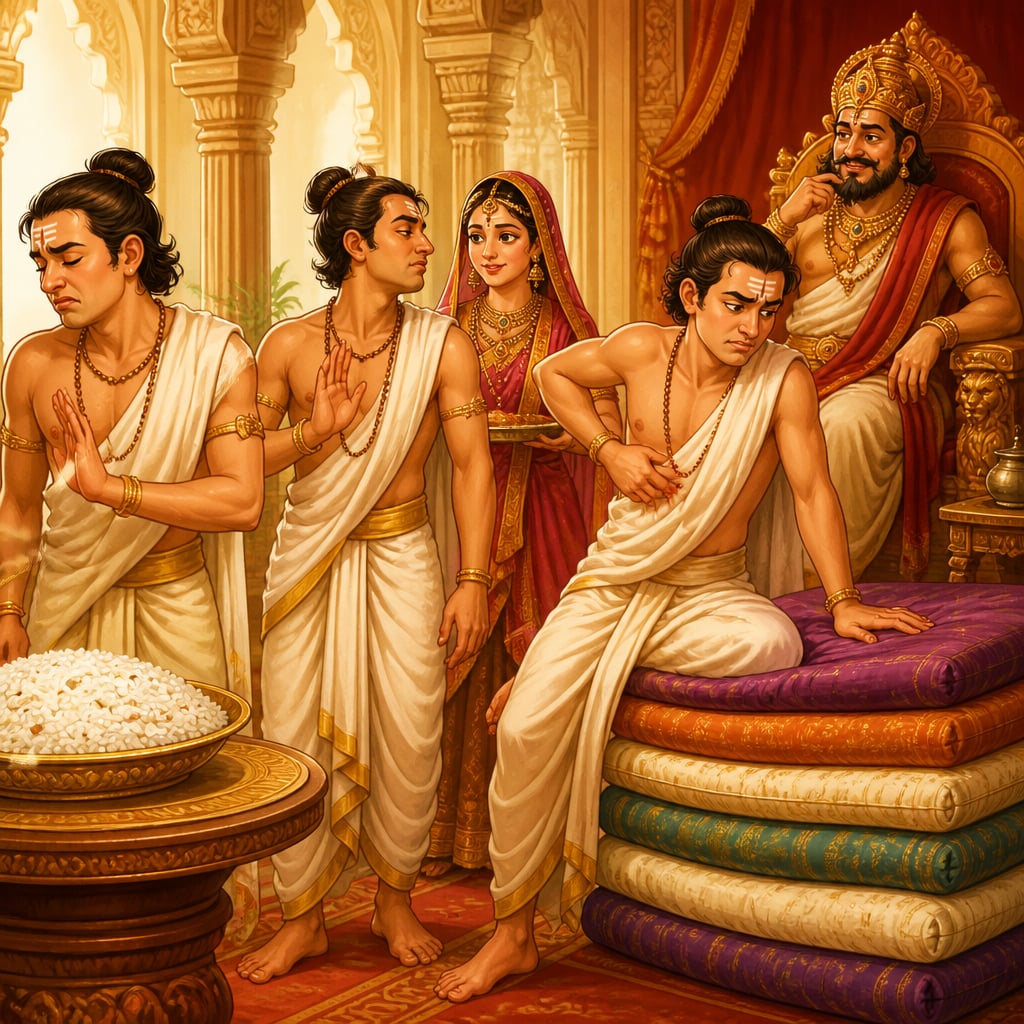
The eldest was fastidious about food. The king had a splendid meal set before them, rice cooked to perfection with every flavour. The other two ate, but the eldest would not touch the rice. There is the smell of corpses about it, he said, I cannot eat it. It seemed an absurd insult to the king's kitchen, until they made inquiry, and found that the rice had indeed been grown in a field beside the burning-ground of a village.
The middle brother was fastidious about women. A beautiful lady, richly adorned, was brought to attend him, and any man would have thought himself blessed. But he drew back from her. She has the smell of a goat, he said. Again it seemed madness, and again they inquired, and found that the woman had been raised, as an infant, on goat's milk.
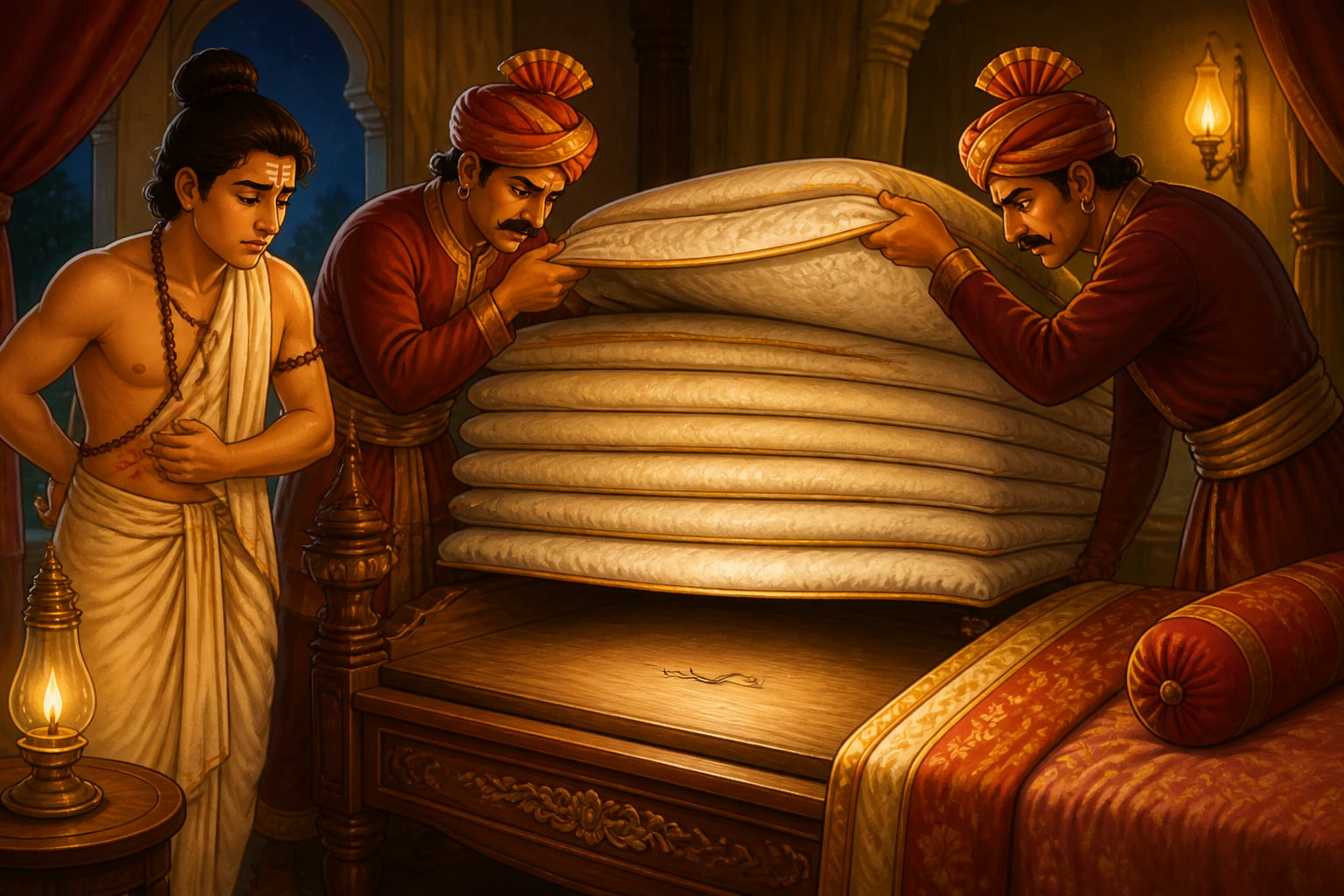
The youngest was fastidious about beds. They laid him down to sleep on seven soft mattresses piled one upon another. In the night he woke crying out in pain, and on his side there was a red crooked mark, as though a hair had been pressed deep into his flesh. They searched, and beneath all seven mattresses, at the very bottom, they found a single hair.
Each brother, then, had been proven right. The question was only which of the three was the most fastidious of all.
The Betaal's Riddle
"So, king," said the Vetala. "One smelled the burning-ground in a bowl of rice. One smelled goat's milk on a perfumed woman. And one felt a single hair through seven mattresses, and wore its mark on his body. Which of these three was the most fastidious?
Answer, if you know. You know the rules."
You Be the Judge
Wait before the king answers. All three were proven right; all three sensed what no one else could. But two of them made a judgment with their noses, and one of them woke up marked. Is there a difference between them that lets you rank the three, or are they simply equal?
Vikram's Verdict
"The youngest, the one fastidious about beds," said Vikramaditya. "He was the most fastidious of the three, and here is why.
"The other two were right, I do not doubt it. But think about how they knew. The eldest said the rice smelled of the burning-ground, the middle one said the woman smelled of goat. Those are things a man could have heard. Someone might have told either of them where that rice was grown, or how that woman was raised, and then a clever man could announce the flaw and seem to have smelled it. I am not saying they cheated. I am saying their proof rests on their word, and their word alone.
"But the youngest brother could not have arranged his proof, and could not have learned it from anyone. A single hair lay hidden at the very bottom of seven mattresses, where no one knew it was, and it pressed a mark into his flesh while he slept. His own body bore the evidence, plainly, and no report and no cleverness could have produced that mark. His fastidiousness was not claimed; it was demonstrated, on his own person, past any doubt. That is why his stands above the other two."
The weight left his shoulder, and the corpse hung in the tree again.
The Dharma
Notice the exact ground of the king's judgment. He did not doubt that all three were refined. He ranked them by the quality of the proof. Two of the brothers pronounced a verdict, and their verdict happened to be correct, but a pronouncement can be borrowed; a man can repeat what he was told and pass it off as his own perception. The third brother did not pronounce anything. His body simply showed the truth, involuntarily, in a way no hearsay could have faked. Demonstrated always outranks asserted.
This is why the tradition prizes pratyaksha, direct perception, the first and firmest of all the means of knowledge, above the mere word of another. And it is why it insists on pariksha, on testing, before belief. Two things can look identical on the surface, and both the crane and the swan are white. It is only under the right test, the old verse says, when milk is mixed with water, that the swan is proven a swan and the crane a crane, for the swan alone can draw the milk from the water. All three brothers looked equally fine while they were only talking. It took a test that could not be faked, a hidden hair and a sleeping body, to show which refinement was real beyond any doubt.
In Your World
We are surrounded by people announcing their own fine qualities: their exquisite taste, their sharp judgment, their unshakeable principles, their expertise. And most of the time we have only their word for it. The lesson of the three brothers is not to call them liars. It is to know the difference between a quality that has been claimed and a quality that has been demonstrated, and to trust the second far more than the first.
When it matters, look for the mark on the body, the proof that could not have been arranged or borrowed. Not what a person says about their judgment, but the hard call they actually made when it cost them something. Not what someone claims about their character, but how they behaved when they thought no one was watching. Not the credential, but the work. The one to trust is the one who woke up marked by a hair he could not have known was there.
And turn it, finally, on yourself. It is easy to announce the person you mean to be, and to believe your own announcement. The harder and truer thing is to let your conduct be the test, and to watch what mark it leaves. Do not tell yourself you are honest, or generous, or brave. Set yourself where those qualities are tested, and see what your own body and behaviour reveal. The proof of what you are was never in the claiming. It is in the mark left by the trial.
Reflection
- You judged the three before the king spoke. Did you credit the most striking claim, or the one whose refinement was proven directly on his own body where it could not be faked?
- Where do you accept people's claims about themselves, their taste, their skill, their principles, on their word alone, when only a test would show the truth?
- When has your own quality, or its lack, been revealed under a test you could not have talked your way through? What did the mark it left tell you?