The Parrot and the Mynah
A wise parrot and a wise mynah each tell a tale to prove which sex is the more treacherous. The Betaal asks the king to settle it, and the wisest answer is to refuse the question.
Two wise birds quarrel over which sex is worse. The parrot tells of a wife who betrayed her innocent husband; the mynah tells of a husband who murdered his trusting wife. Both crimes are the same. When the Betaal demands to know which is worse, men or women, Vikramaditya refuses the frame itself. You judge first, then the king does.
The Burning Ground
Once more the corpse hung waiting in the branches, and once more the king brought it down onto his shoulders. The Vetala settled behind his ear and told a tale of two birds and an old, dangerous argument.
The Parrot and the Mynah
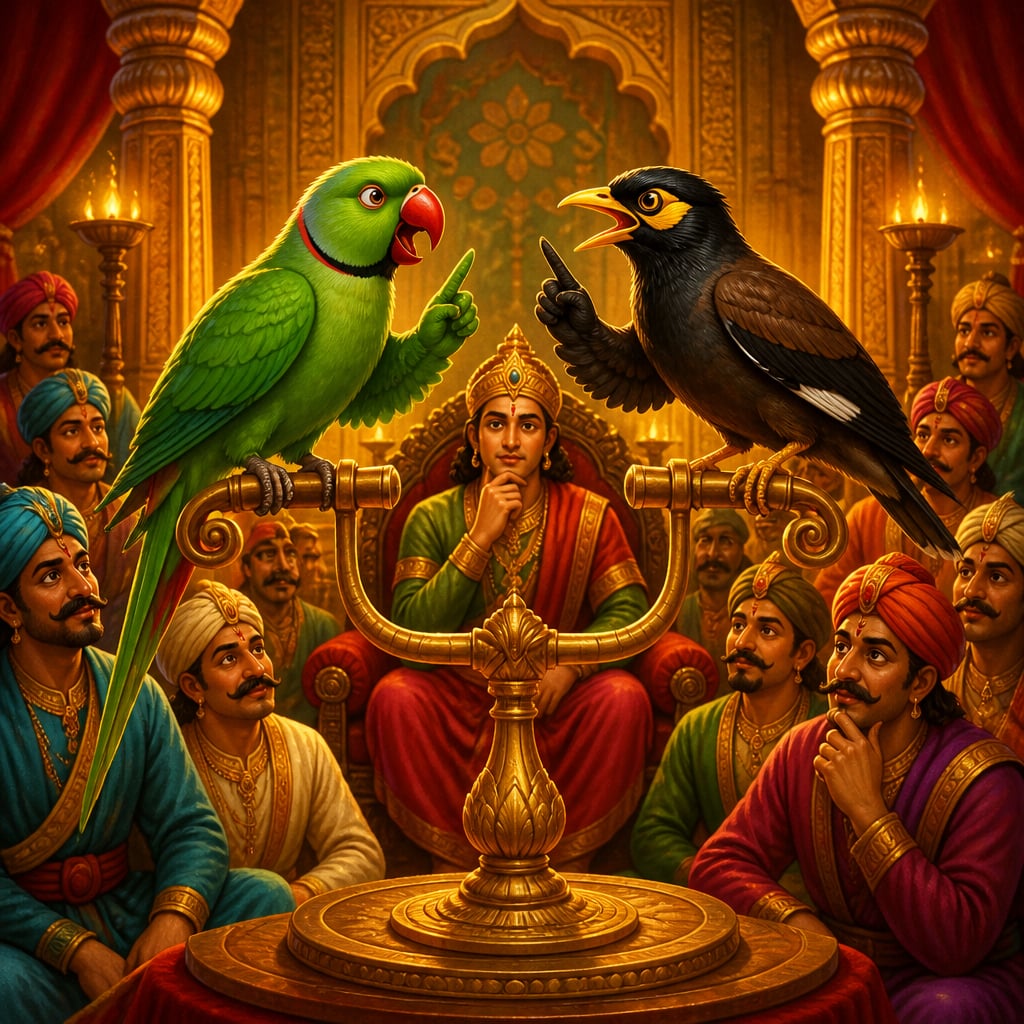
A king once kept a parrot named Vidagdhachudamani, so wise that he knew all the sacred books, for he was a celestial being living out a curse in the body of a bird. In time a wise mynah named Somika came to the same court, and she too was a cursed celestial, as sharp and learned as the parrot.
The two birds fell to quarreling, as the clever will. The parrot said that women are cruel and false. The mynah said that men are wicked and ungrateful. Neither would yield, and so they agreed to settle it with a story apiece, and let the court decide.
The parrot told his tale first, to prove women false. There was a merchant's wife named Vasudatta, whose husband was a good man. While he was away, she took a secret lover. When misfortune fell and the lover died, her grief turned to cunning: to hide her own guilt, she disfigured herself and then accused her innocent, sleeping husband of the injury. He was seized and dragged toward execution for a crime he had never even known of, and only a witness who had seen the whole truth saved his life at the last. The treachery, from first to last, was hers.
Then the mynah told her tale, to prove men false. There was a merchant's son named Dhanadatta who gambled away his fortune, and then married a good woman named Ratnavali for the wealth she brought. Taking her on a journey, he robbed her of her jewels and threw her into a ravine to die. But she survived, and made her way home. And when this same husband came back to her, ruined again, she took him in without a word of reproach and cared for him. He lived on her kindness. And then one night, as she slept trusting in his arms, he killed her for her ornaments, and vanished. The treachery, from first to last, was his.

Two tales, and two monsters: one a wife, one a husband. When the tales were done, the curses upon the two birds were spent, and they turned back into the celestials they had been and rose to heaven, and the quarrel between them was never settled.
The Betaal's Riddle
"So, king," said the Vetala. "The parrot proved a woman false beyond all doubt, and the mynah proved a man false beyond all doubt. So settle what the birds could not. Which are worse, when you weigh the whole of them: men, or women?
Answer, if you know. You know the rules."
You Be the Judge
Hold the question a moment, before the king speaks. The Vetala wants you to pick a side, exactly as the two birds did. One villain was a woman; one was a man; and now you are asked to say which whole half of the world is the worse. But look hard at the question in your hand before you try to answer it. Is it a question that has an answer at all?
Vikram's Verdict

"Neither," said Vikramaditya. "The question itself is wrong, and I will not answer it as it is asked.
"See what the two birds actually did. Each of them found one wicked person, a false wife, a false husband, and from that single person condemned half of all the people in the world. But one treacherous woman proves nothing whatever about women, and one treacherous man proves nothing whatever about men. You could pile up a thousand such tales on either side and still have proven nothing, because wickedness is not a property of being a woman, or of being a man. It is a property of a particular heart. Look again at the two villains: each betrayed the one who trusted them, each was ready to kill for gain. The fault in both was the very same fault, and it had nothing to do with which of them was a man and which a woman.
"To ask which half of humanity is worse is to ask a broken question. There are false women and true women, false men and true men, and the only line that matters runs between the false and the true, not between the women and the men. A judge who lets himself be pushed into condemning a whole people is no longer judging at all. I will name the wicked wherever I find them, one by one. I will not condemn a sex."
The Vetala could find no fault in that answer, and slipped away, back to its tree.
The Dharma
This is the oldest trap in the world, and the king refused to step into it. Take one real example of a bad person from some group, a woman, a man, a people, a trade, a place, and stretch it to cover everyone in that group. It feels like reasoning, because the example is real. But it is not reasoning; it is the engine that drives every prejudice ever held. One villain who happens to be a woman tells you about that woman, and nothing at all about women.
The wise eye does not sort the world this way. The tradition holds up as its ideal samadrishti, equal vision: the impartial sight that does not rank whole classes of beings above and below one another, but looks past the label to the particular person, and past the person to the one Self alive in all. What the two birds had instead was pakshapata, partiality, each pleading for its own side, and the question they left behind was built entirely of that bias. The king's wisdom was not to argue the opposite side. It was to see that the whole frame was rotten, and to step out of it.
And notice the sharpest point of the tale. The parrot's wicked wife and the mynah's wicked husband committed the very same crime: each betrayed a trusting heart and was willing to kill for gain. The story that was meant to divide women from men ends by showing that the worst of both are identical. The betrayer's heart has no sex.
In Your World
You will be handed this question again and again, in a hundred forms. Which group is lazier, which is more dishonest, which cannot be trusted, this kind of person or that. And there will almost always be a real example ready to hand, a true story of someone from that group behaving badly, held up as the proof.
Learn the king's move. When someone offers you a villain and asks you to convict a whole class of people with it, refuse the frame. Say: that tells me about that person, and nothing about all of them. Judge the individual in front of you by what that individual actually does, and let every group keep its full range of saints and scoundrels, because every single group contains both. This is not softness, and it is not evasion. It is the harder, fairer path: to keep judging people one at a time, by what they themselves do.
Reflection
- You judged the birds' debate. Did you find yourself leaning toward one side, before you noticed that the question itself was the trap?
- Where do you carry a quiet 'those people are all like that' belief, built from a few real examples generalised into a whole group?
- When has someone tried to draw you into a 'which of them is worse' argument? What would it have looked like to refuse the frame instead of picking a side?