Talapatram

The Ascetic Who Wept and Then Danced

A master who could leave his own body at will weeps, and then dances, in the instant before trading his old form for a young one. What do the two feelings mean?

An aged ascetic has the yogic power to leave his own body and enter another. Longing for youth, he prepares to abandon his worn-out form for that of a boy who has just died, and at the last moment he weeps aloud and then dances. The Betaal asks why. You judge first, then the king does, and the answer is the truest thing the cycle says about change.

The Burning Ground

Across the ash the king walked, the corpse on his shoulders once more. The Vetala settled behind his ear and told the chapter's strangest tale, and its most tender.

The Ascetic Who Changed Bodies

In a city of Kalinga there lived a wealthy brahman named Yajnasoma, who had one beloved son, Devasoma, gentle and gifted, and who died of a fever at the age of sixteen. And in the cremation ground of that same city there lived an old Pashupata ascetic named Vamasiva, worn to the bone by age and long austerity, who had gained through his practice a rare and secret power: he could leave his own body and enter another.
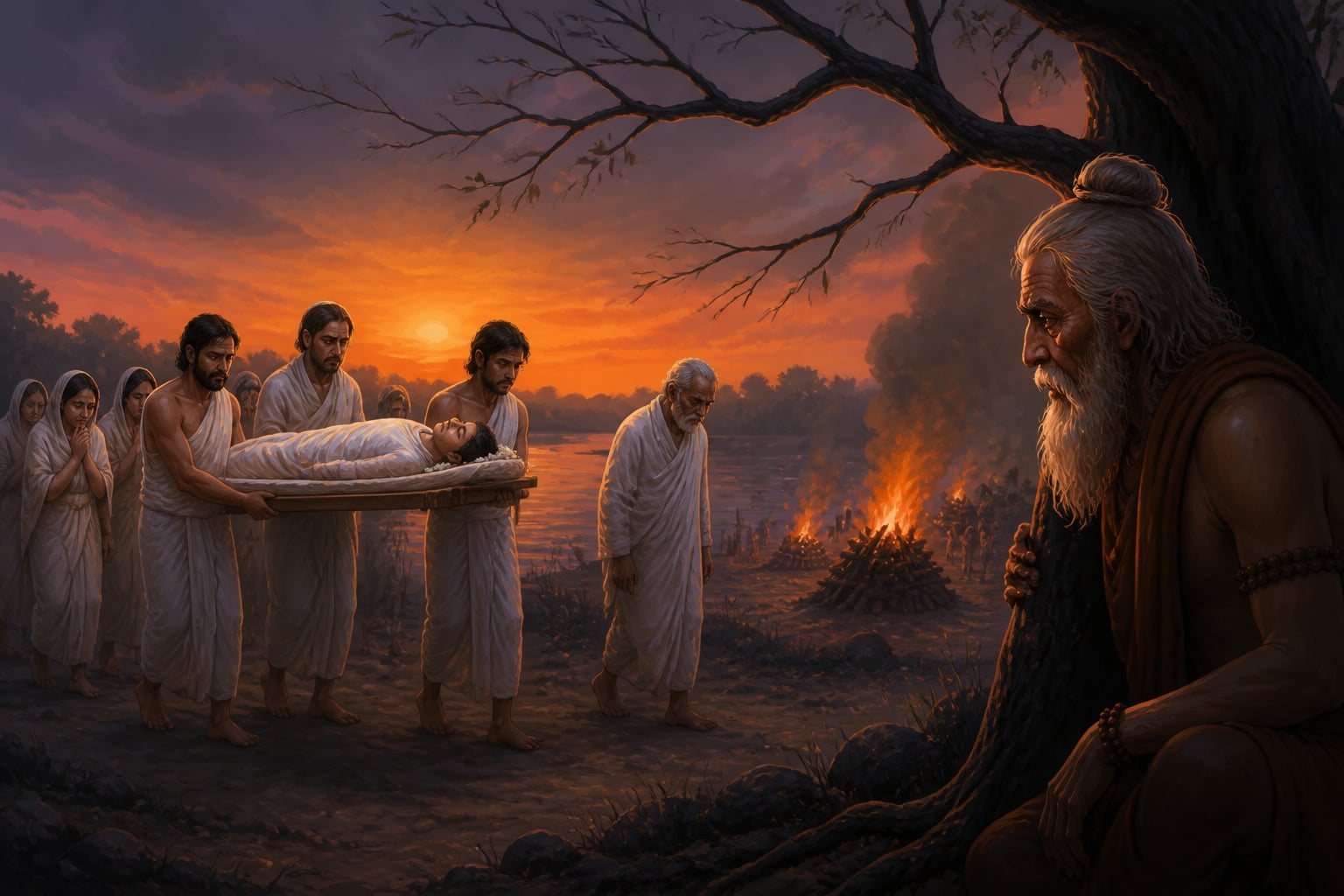
Devasoma's family carries him to the cremation ground

Watching the grief-struck family carry young Devasoma to the burning ground, the old ascetic felt his own great age lie heavy upon him, and a longing rose in him to be young once more. Here, in this fresh sixteen-year-old body, was his chance.
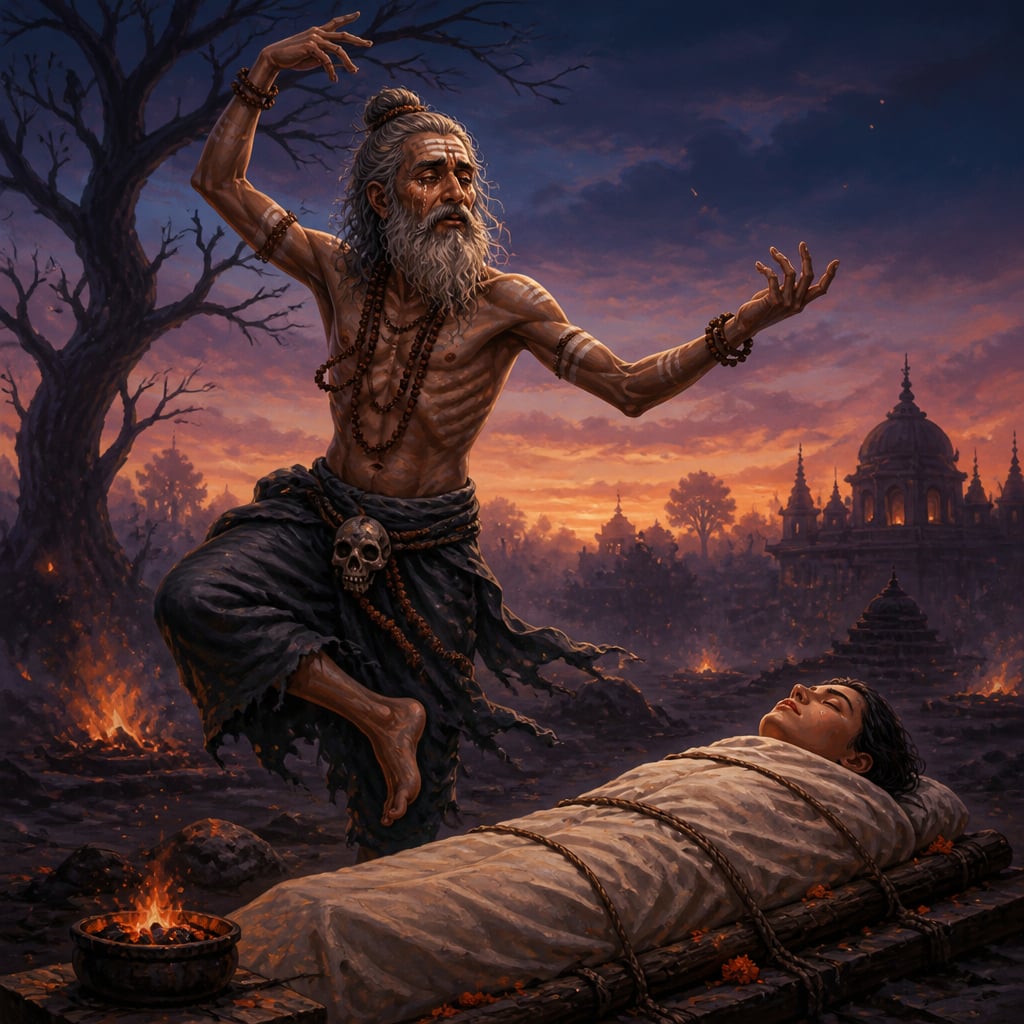
The ascetic caught between weeping and dancing

He waited for his moment. And then, at the cremation ground, in the instant before he made the leap, he did a strange thing. He wept aloud, bitterly. And then, at once, he danced, with the gestures of pure joy. And only then did he leave his own old body where it stood, and by his power enter the body of the dead young man, which rose up alive. He told the grieving family a false tale to explain the boy's return, and he cast his own abandoned old body into a ravine, so that he could never go back to it.

The Betaal's Riddle

"So, king," said the Vetala. "Here was a master who could shed a body like an old coat and step into a new one. And yet, in the very moment before he did it, he first wept, and then he danced. Why? Why the tears, and why the dancing, from a man about to gain youth again, and powers greater than any he had ever held?

Answer, if you know. You know the rules."

You Be the Judge

Weigh it yourself, before the king does. A man is about to trade an old and failing body for a young and powerful one. By every measure it is a gain. So why would he weep at all? And having wept, why would he then dance? Sit with the two feelings before the king names them.

Vikram's Verdict

"He wept for the old body, and he danced for the new," said Vikramaditya. "Both feelings were true, and there is no contradiction between them.

"He wept because that worn-out old body was the one he was about to leave forever, and it was no ordinary thing to him. It was the body he had lived his whole long life inside, and in which, through years of hardship, he had earned every power he possessed. A man does not shed such a thing lightly. The affection we hold for our own body, the form we have lived within from the very beginning, is among the most deeply rooted feelings there is, and even a master who could leave it at will felt the wrench of the parting, and wept.

"And he danced for what was coming: a young body, strong and fresh, and through it powers greater than any he had known, and youth itself again, which is sweet to everyone. In one breath he grieved all that he was losing, and in the next he rejoiced in all that he was gaining. That is not a divided heart, nor a foolish one. It is simply what it feels like to leave one life and step into another."

In an instant the corpse was off his shoulder, back up into the branches.

The Dharma

The king's verdict is gentle, and easy to pass over, but it holds one of the truest observations in the whole cycle: that every real change is a loss and a gain at the same time, braided so tightly that we feel both in a single breath. The tradition calls these the dvandvas, the pairs of opposites, joy and grief, gain and loss, that do not come to us cleanly one at a time, but arrive holding hands. The ascetic wept and danced together because he was doing one thing that was also two: leaving, and arriving.

And see what it was he grieved. Not the flesh itself, which was old and failing, but the body as the home of his whole becoming, the place where all his years and all his hard-won growth had happened. We are the same. When we leave an old life, a house, a role, a season, a former self, we rarely grieve the thing for what it plainly was. We grieve it for who we became inside it. That is why even a change we chose, a change that is clearly for the better, can still bring real tears: we are parting from the vessel of our own becoming.

In Your World

You will change bodies many times in a life, not by magic, but simply by living. The child's world you left behind. The city you moved away from. The job, the role, the version of yourself you outgrew. And nearly every one of those changes, even the ones you longed for, even the ones that were plainly for the better, will carry this same strange double feeling: real grief riding alongside real gladness, tears and dancing in the very same week.

Do not read that as a sign that you chose wrongly, or that something is the matter with you. It is only the shape of change itself. Let yourself weep for what you are leaving, the old body, the old life, the old self, and understand that the tears are not regret but love: love for the place where you became who you are. And let yourself dance too, for what is coming, without any guilt that you are glad. The wise do not demand that a change be only one thing. They weep, and they dance, and they walk on into the new life carrying an honest heart.

Reflection

  • You judged the ascetic's two feelings before the king spoke. Did they seem contradictory to you, or did you recognise the double feeling of every real change?
  • What old self, home, or role have you left that you still grieve, even though leaving it was right and you gained by it? What did you actually miss?
  • The master wept for the body he had chosen to leave. Where does attachment to the familiar run deeper in you than you like to admit?

More in The Finest Distinctions

All lessons in The Finest Distinctions ยท Vikram & Betaal ebook course