Talapatram

The Transposed Heads

Two men, one swapped head, and a wife who must judge.

A young woman's husband and brother lose their heads before the Goddess, and when she is granted a boon to restore them, her trembling hands set each head on the wrong body. Two men rise alive, each half husband and half brother. Which one is her husband? You judge first, then the king does.

The Burning Ground

The corpse was back in its tree, turning slowly in the still air, exactly as before. Vikramaditya did not sigh and did not curse. He climbed, cut it loose, bound it tight, and swung it onto his shoulder, and set off again across the cold ash. The Vetala settled in behind his ear like a traveller glad of company on a long road, and began a new tale.

The Two Heads

In a town beside a river lived a young woman named Madanasundari. She loved two men, and there was no quarrel in her heart between them: one was her husband, and one was her younger brother. On a festival morning the three of them climbed a hill to a temple of the Goddess.
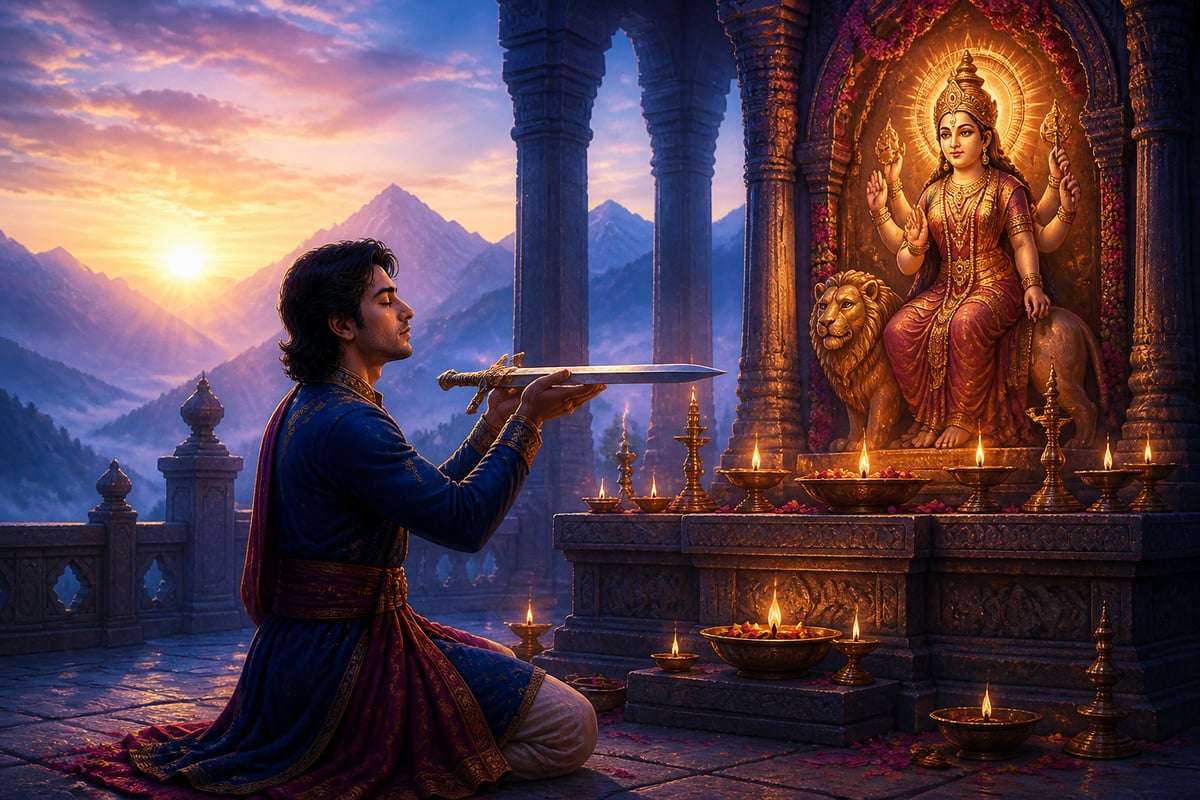
The husband kneels in vow before the Goddess

While Madanasundari rested in the courtyard, her husband went in alone to bow before the image. What moved him next no one could ever explain. Perhaps a rush of devotion, perhaps a vow he had made and half forgotten. He took up the sword that lay at the altar and offered the Goddess his own head.

When he did not come out, the brother went in to look for him. He found his sister's husband dead before the Goddess, the sword still bright beside him. Grief seized him, and with it a cold fear: that the world would say he had killed his own sister's husband and come away alone with her. He took up the same sword and laid his head down beside the other.

At last Madanasundari came in. She saw the two men she loved most in the world lying there, and she could not bear to live in the world without them. She made a rope of her garment and turned to a beam.
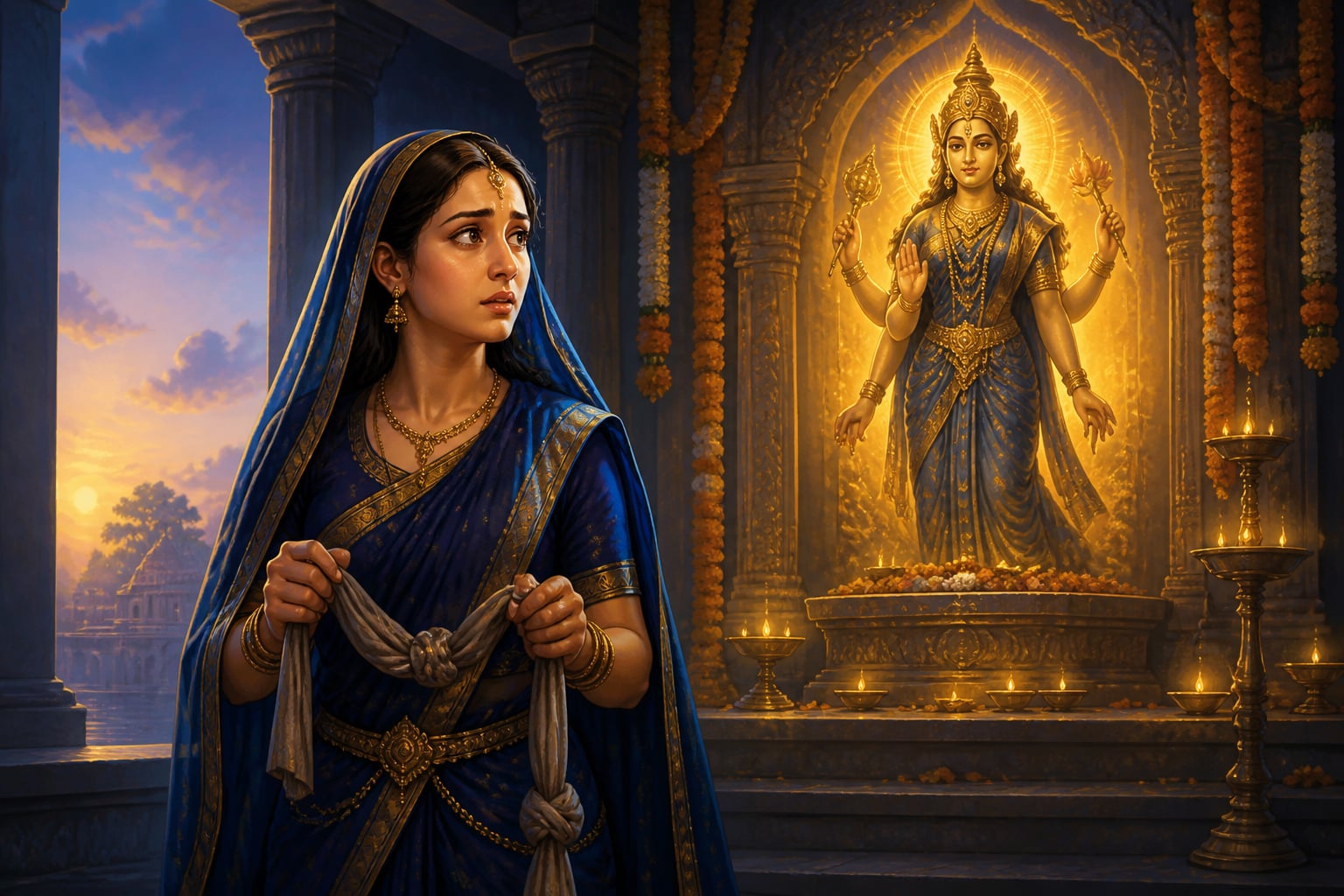
The Goddess halts Madanasundari's grief

Then the Goddess spoke. "Stop. Your grief is true, and it moves me. Set each head back upon its body, and both these men will live."

Madanasundari realizes the two heads are swapped

Madanasundari's hands were shaking. She lifted the heads, she set them to the bodies, she stepped back to look. And only when the two men rose alive before her did she see what her trembling hands had done. She had set her husband's head upon her brother's body, and her brother's head upon her husband's body.

Two living men stood in the lamplight. Each was half her husband and half her brother. And she could be wife to only one.

The Betaal's Riddle

"So, king," said the Vetala, comfortable on his shoulder. "The heads are joined and cannot be moved again; the Goddess grants one boon, not two. One of these men is Madanasundari's husband, and one is her brother. Which is the husband: the man who wears her husband's head, or the man who wears her husband's body?

You know the rules. Answer, if you know."

You Be the Judge

Stop here, before the king speaks, and picture the two men.

One has her husband's face and her husband's voice, set upon her brother's shoulders. The other has her brother's face, upon the body she was wedded to.

Which one is her husband, and why?

Vikram's Verdict

Vikramaditya answered without breaking his stride. "The man who wears her husband's head.

"The head is not one limb among many. It is the chief of them. It carries the face and voice by which we know a person, and the mind that remembers and decides. When you point to a person, you point to the head, not the hand or the foot. The body serves; the head is the one it serves.

"So the man who wears her husband's head is her husband, whole and entire, whatever body now carries him about. The other is her brother. There is no puzzle in it, once you ask where a person truly sits."

The word was scarcely out of his mouth before the corpse slipped from his shoulder, laughing, and rose back into the dark. The king turned and began the walk again.

The Dharma

See how the king cut the knot. Half of each man was the husband, so counting the parts gave no answer at all: it came out even. Vikramaditya did not count parts. He asked which part a person actually is.

The head is the seat of the self, the face we are known by and the mind that chooses. The body is where the self lives; it is not the self. So the person goes where the head goes. This is discernment, viveka: reasoning from what a thing essentially is, instead of from how it happens to be divided.

In Your World

We forget this and relearn it the hard way. A person is remade by age, by illness, by the years, and we half wonder whether they are still the same person. They are. The self rides in the head, in the memory and the character and the choices. That is what makes someone them, not the body that keeps changing around it.

And it holds for far more than people. Ask which of two merged companies is really the old one, and do not weigh the buildings and the machines, the body of the thing. Look for the head: whose judgment runs it, who decides. Whatever you are trying to name truly, a person, a team, an institution, a tradition, find the head. The thing is wherever its mind is seated.

Reflection

  • You judged before the king spoke. Did you choose by counting the parts of each man, or by asking where the person really sits?
  • What makes you 'you'? If your body were completely changed but your mind and memories stayed, would you still be yourself? Why?
  • Madanasundari's trembling hands shaped the outcome of a perfect gift. When has how carefully you handled an opportunity decided what it became?

More in The Bargain, and Whose Is It?

All lessons in The Bargain, and Whose Is It? ยท Vikram & Betaal ebook course