Talapatram

The Bargain, and the Three Suitors

A king, a corpse, and the first of twenty-five riddles.

Ten years of quiet gifts bind King Vikramaditya to a holy man's strange request, and he finds himself carrying a riddling spirit across a cremation ground. Its first tale: three men who each gave everything for the same woman, now returned from death. Which of them is her husband? You judge first, then the king does.

The Bargain

For ten years, the same holy man came to the court of Ujjain at dawn. Each morning he bowed to King Vikramaditya, placed a single fruit in the king's hand, and left without asking for anything. Vikramaditya heard a hundred petitions a day. A silent man who wanted nothing was easy to forget.
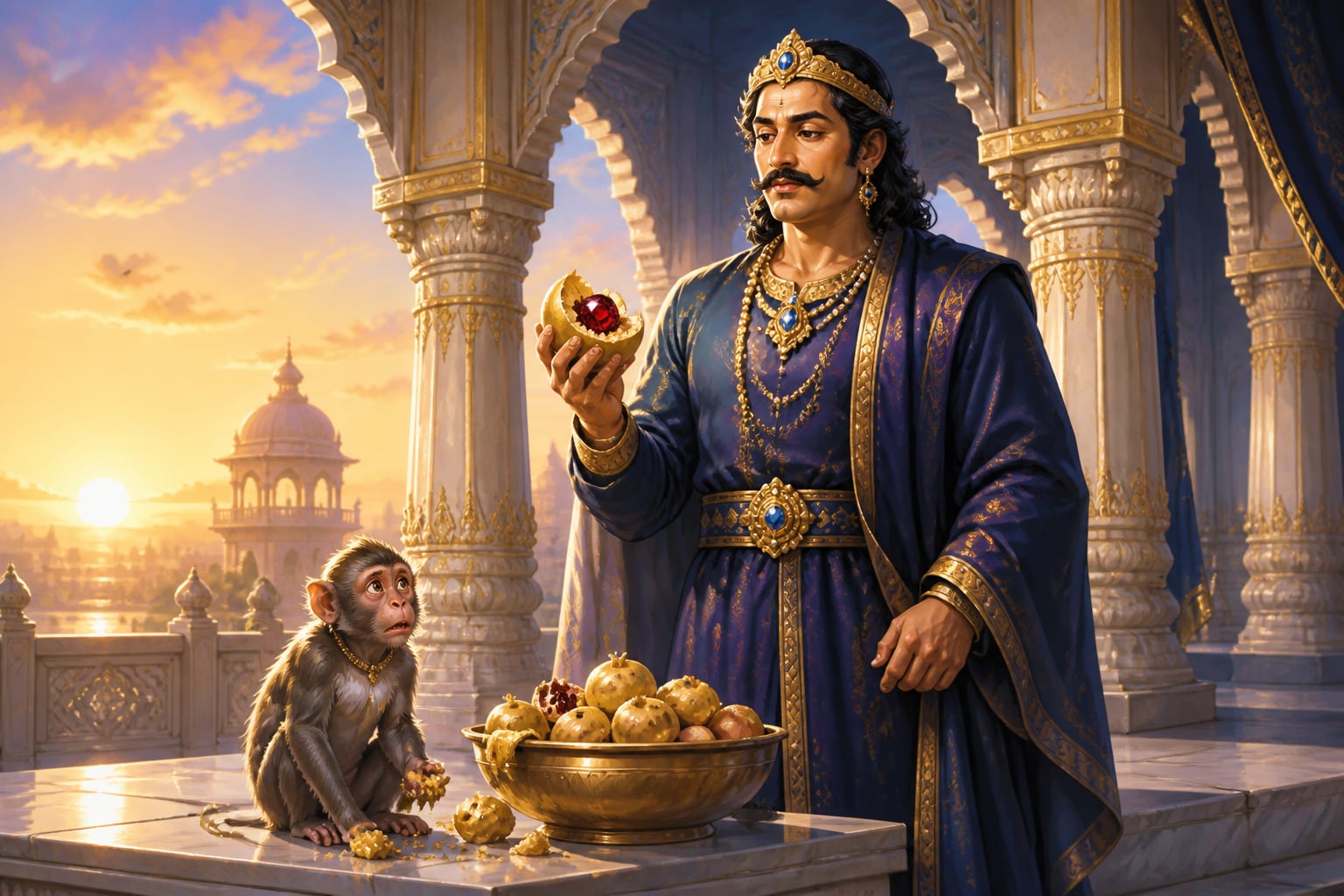
Vikramaditya discovers a jewel inside the fruit

One morning the fruit slipped and rolled across the marble, and a pet monkey snatched it up and bit down. The fruit broke open. Where the seed should have been sat a jewel, deep red, worth more than most men earn in a lifetime.

The king sent for the others he had carelessly given away. Every fruit, ten years of them, had carried a gem inside.

When the holy man arrived the next dawn, Vikramaditya did not take the fruit. "You have handed me a fortune and asked for nothing," he said. "No one does that without a reason. Name what you want."

The holy man smiled. His name was Kshantishila. "A small thing, great king. On the coming night of the dark moon, come alone to the cremation ground beyond the river. There is a rite I cannot finish without a man who does not frighten. You are that man."

A king who accepts gifts cannot refuse the giver. Vikramaditya gave his word.

The Cremation Ground

The night of the dark moon was black and starless. The king found Kshantishila seated before a low fire at the edge of the burning ground, tracing shapes in the ash. The holy man did not look up.

"Far out among the pyres stands an old tree," he said. "A body hangs from its highest branch. Bring it to me, and my rite is complete. Go alone. Speak to no one on the way."

Vikramaditya walked out among the cold ashes and found the tree. High in its branches hung a shrouded corpse, turning slowly though there was no wind. The king climbed, cut the rope, and let the body fall. As it struck the ground it began to laugh, a dry and delighted laugh, and rose back into the branches of its own accord.

Vikramaditya carrying the shrouded Vetala corpse

Inside the corpse lived a Vetala, a spirit that takes a dead body for its home. The king climbed again. And again. Each time he seized the body it slipped his grip, until at last he bound it tight, swung it onto his shoulder, and began the long walk back.

The Rules of the Game

As they walked, the Vetala spoke from just behind the king's ear, friendly as an old companion.

"The road is long and you are stubborn, so let me tell you a story to pass the time. But I will bind you first. At the end I will ask a question. If you know the answer and keep silent, your head will burst into a hundred pieces. And if you answer, watch what happens."

The king said nothing, and walked. The Vetala began.

The Tale of the Three Suitors

In a certain city there lived a young woman, gentle and much sought after, and three young men courted her, each as worthy as the next. Her family could not choose among them, and while they delayed, the woman fell ill and died on the eve of what might have been her wedding.

The three men were broken by it, and in their grief they parted ways.

The first could not leave her. He gathered her ashes, built a small hut on the cremation ground, and lived there among them.

The second gathered her bones, carried them far to the sacred river, and gave them to the water, performing the last rites owed to the dead. Then he became a wanderer.

The third left the country altogether, and after long years learned from an old hermit a mantra with the power to raise the dead.

In time the third came home with his art. The second returned from his wandering. The first still kept his watch beside the ashes. And there, together, the third spoke his mantra, and the young woman rose alive again, exactly as she had been.

The revived woman between her three arguing suitors

At once the three fell to quarreling. Each said she was his. One had loved her enough to live in a graveyard. One had carried her remains to the holy water. One had crossed the world and brought her back from death. Each had given everything he had. And she could belong to only one.

The Betaal's Riddle

"So, king," said the Vetala. "She lives again because all three loved her past reason. But she can be wife to only one man. Which of the three is her husband: the one who kept her ashes, the one who gave her bones to the river, or the one who gave her back her life?

Answer, if you know. You know the rules."

You Be the Judge

Before the king speaks, weigh it yourself.

The man who would not leave her ashes. The man who carried her bones to the sacred river. The man who brought her back from death.

Which one is her husband, and why?

Vikram's Verdict

Vikramaditya answered without slowing his stride, because a king who knows the law does not pretend he does not.

"The man who brought her back to life is like a father to her," he said. "To give someone life is what a parent does. He made her live, as surely as a father gives a child its birth. A father cannot be a husband.

"The man who carried her bones to the sacred river did the work a son does for a parent. He performed her last rites. He stands to her as a son, not a husband.

"But the man who could not leave her ashes, who lived on the cremation ground beside all that remained of her, did what only a husband does. He kept the grief-watch of a widowed spouse. The other two acted and moved on. He stayed and mourned as a husband mourns. She is his wife."

The last word had barely left his mouth when the corpse was gone from his shoulder, laughing, back to its branch in the dark.

The king turned, and walked back to the tree.

The Dharma

Notice what settled the case. Not who suffered most, not who traveled farthest, not who claimed the loudest. Vikramaditya asked a colder and truer question: what did each man actually do, and what relationship does that deed create? The role follows the deed, not the feeling behind it. This is nyaya, judgment by reason rather than by sentiment.

In Your World

Think about how we hand out credit, and how often we get it backward. The title goes to whoever claims it hardest, or grieves most visibly, or asked first. Vikramaditya gives it instead to whoever did the thing.

The friend is the one who showed up, not the one who calls himself your friend. The leader is the one who carried the weight, not the one standing at the front of the photograph. The next time you have to judge where someone truly stands with you, borrow the king's question. Set the claims aside, look at what was actually done, and let the deed name the role.

Reflection

  • You were the judge before Vikramaditya spoke. Which man did you choose as the husband, and did the king's reasoning change your mind?
  • The king judged each man by his deed, not his claim. Think of a relationship in your own life. Does the person's title match what they actually do?
  • The king lost his prize rather than win it by staying silent. When has honesty cost you something you wanted?

More in The Bargain, and Whose Is It?

All lessons in The Bargain, and Whose Is It? ยท Vikram & Betaal ebook course