Talapatram

Somaprabha and Her Three Suitors

Three marvels, one rescue, and only one claim that counts.

A young woman is stolen by a demon, and three suitors, each with a wondrous gift, join to bring her back: one finds her, one carries them across the sea, one fights the demon and bleeds to free her. When she is home safe, whose gift has truly earned her hand? You judge first, then the king does.

The Burning Ground

The Vetala was in its tree again, and again the king went up to fetch it. He knew the weight of the thing now, the cold and the stillness of it, and he no longer wasted breath on anger. He tied it fast, took it onto his shoulder, and walked. Behind his ear the spirit stirred and began to talk.

The Three Gifts

In a great city lived a young woman named Somaprabhā, daughter of the minister Harisvāmin. She was much sought after, and she had set a hard condition of her own: she would wed no man who was not a master of one great thing, matchless in valour, or in knowledge, or in magic craft. Three young men came, each claiming one of these, and each was remarkable in his own way.

The first was a seer. He could tell where any lost thing lay, and what any distant hour held, whether past or still to come.

The second was a builder of wonders. He could make a chariot that crossed the sky and set you down anywhere in the world in the space of a breath.

The third was a warrior. No swordsman living could stand before him.
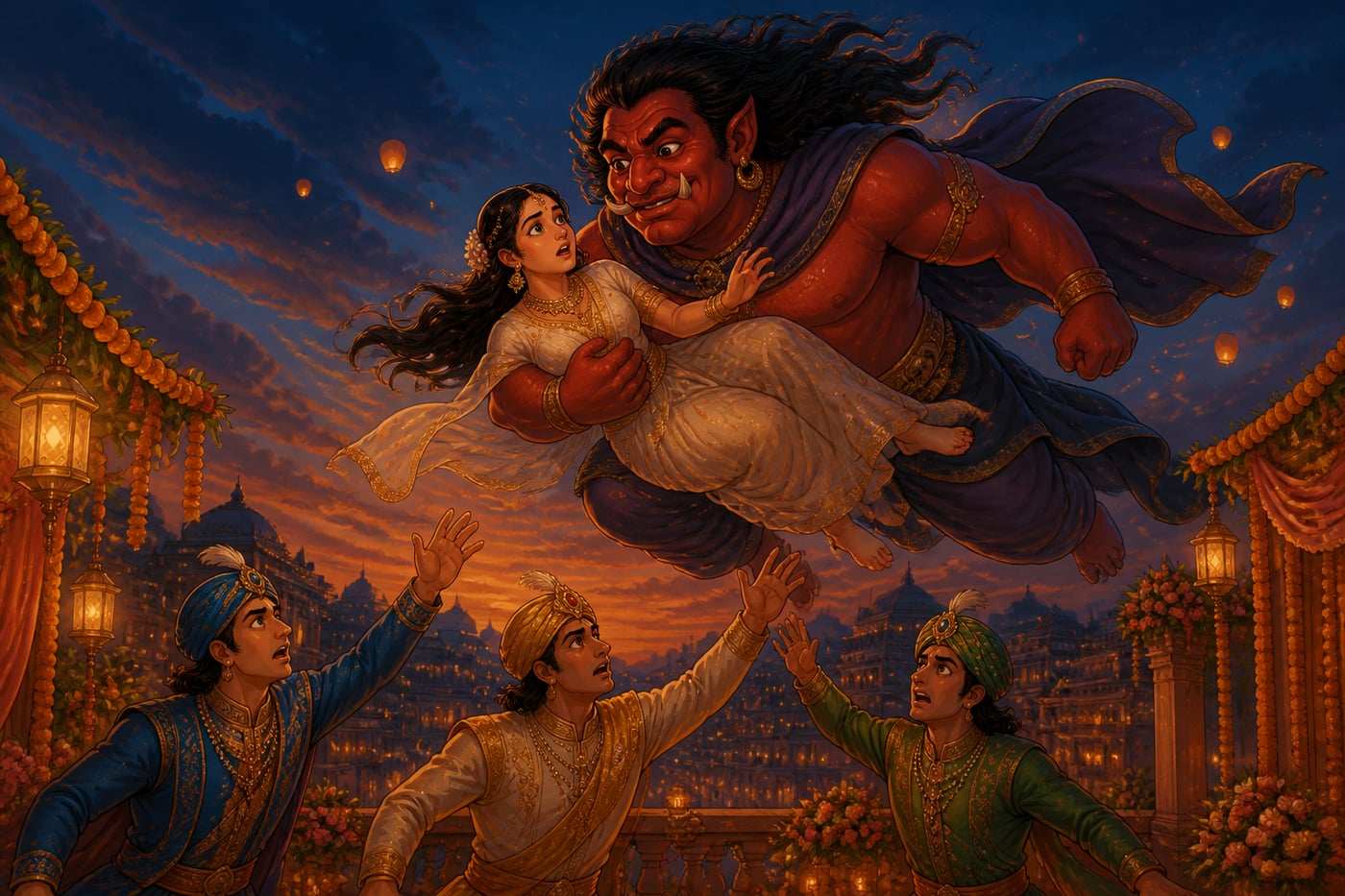
The rakshasa Dhumrasikha carries off Somaprabha

On the very day the three were to be wed to her by turns, the rakshasa Dhūmraśikha came and carried Somaprabhā away to his fortress beyond the sea.
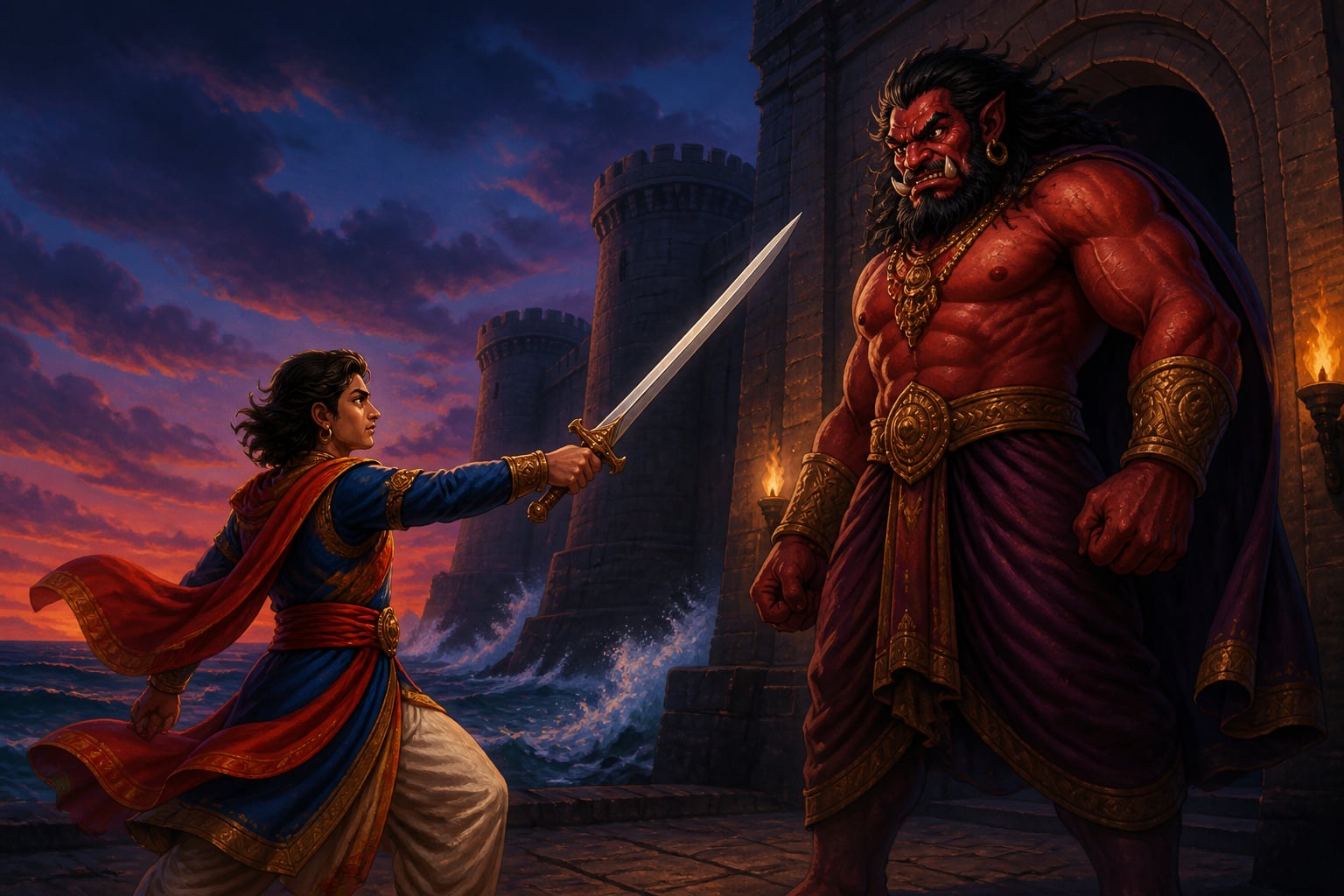
The warrior faces the demon at the gate

The three suitors met in their grief and did the one thing that only the three of them together could do. The seer looked into the distance and named the demon's fortress. The builder raised his flying chariot, and it bore all three across the sea in a moment. And at the gate the warrior went in alone, and fought the rakshasa, and killed it, though it nearly killed him first, and carried Somaprabhā out alive.

Somaprabha reunited with her three quarreling suitors

They flew home. And the moment her feet touched her own city, the three men began to argue. Each said he was the one who had saved her, and so each said she was his.

The Betaal's Riddle

"So, king," said the Vetala. "The seer found her when she was lost past finding. The builder's chariot closed a whole sea in a single breath. And the warrior walked in alone and killed the thing that held her. Each will swear that he is the one who saved her. But she can wed only one. Which of the three is her husband?

Answer, if you know. You know what waits if you stay silent."

You Be the Judge

Three men, three gifts, one rescue. Stop and decide before the king does.

The one who knew where she was. The one who carried them to her. The one who fought the demon and bled to bring her out.

Whose wife is Somaprabhā?

Vikram's Verdict

"The warrior," said Vikramaditya, and did not slow his step.

"The seer gave his knowing, and the builder gave his craft, and both are worth honouring. But each gave a skill and kept himself safe. The seer was in no danger at a distance, nor the builder in his chariot. They helped, the way a good friend or a good servant helps.

"The warrior gave something else. He walked in alone and set his own life against the demon's for her sake. That is not a servant's help. That is the husband's part: to stand between the one he loves and the thing that would destroy her, and to pay for it in his own blood. The one who bore the risk is the husband. The other two are the friends who helped him do it."

The corpse laughed and was gone, back to its branch. The king turned and walked back the way he had come.

The Dharma

Notice what the king weighed, and what he refused to weigh. He did not ask whose gift was rarest, or which one the rescue could least spare. By that measure the three tied exactly, for remove any one of them and she is lost. That path gives no answer at all.

Vikramaditya asked a different question: who put himself at stake? Knowledge and craft were lent from safety; only the warrior staked his own life. And the claim follows the risk, because to stand in the breach and pay in your own person is the very thing a husband does. This is nyaya once more, judging by the essential act rather than the merely useful one.

In Your World

Think about who you count as truly close to you. When life runs smoothly, plenty of people will lend a hand from a safe distance: advice, an introduction, a kind word, a clever idea. Far fewer step into the hard place beside you and put their own money, time, name, or comfort on the line. It is easy to confuse the two, and to hand your trust to whoever was simply around, or whoever sounded the most caring.

So when you want to know who has really stood by you, do not count the gestures. Go back to the moments when it went hard, and ask who was exposed alongside you and who watched from safety. The one who carried the cost is the one who was actually with you.

Reflection

  • You judged before the king spoke. Did you reward the biggest risk, or the rarest gift, and why did that feel right to you?
  • Think of a success you shared with others. Who actually bore the risk if it had failed, and did the credit go to them?
  • Where in your own life are you lending a gift from safety, when the thing you care about actually needs you to step into the breach?

More in The Bargain, and Whose Is It?

All lessons in The Bargain, and Whose Is It? · Vikram & Betaal ebook course