Anangarati and the Four Suitors
Four masters, four wonderful arts, one bride. Which art wins a wife?
A princess will marry only the finest master of one great art, and four suitors come: a weaver of priceless cloth, a man who knows the speech of every creature, an unbeatable swordsman, and a man who can raise the dead. No demon steals her; the question is simply which of the four she should marry. You judge first, then the king does.
The Burning Ground
The corpse went back to its tree, and the king climbed up after it once more. He bound it, shouldered it, and set off across the ash. The Vetala, riding easy behind his ear, began again.
The Four Arts
There was a king named Viradeva whose daughter, Anangarati, was so lovely that no prince of the earth seemed a fitting match. So her father let her set her own terms, and her terms were these: she would marry the young man who was the finest in all the world at one great art.
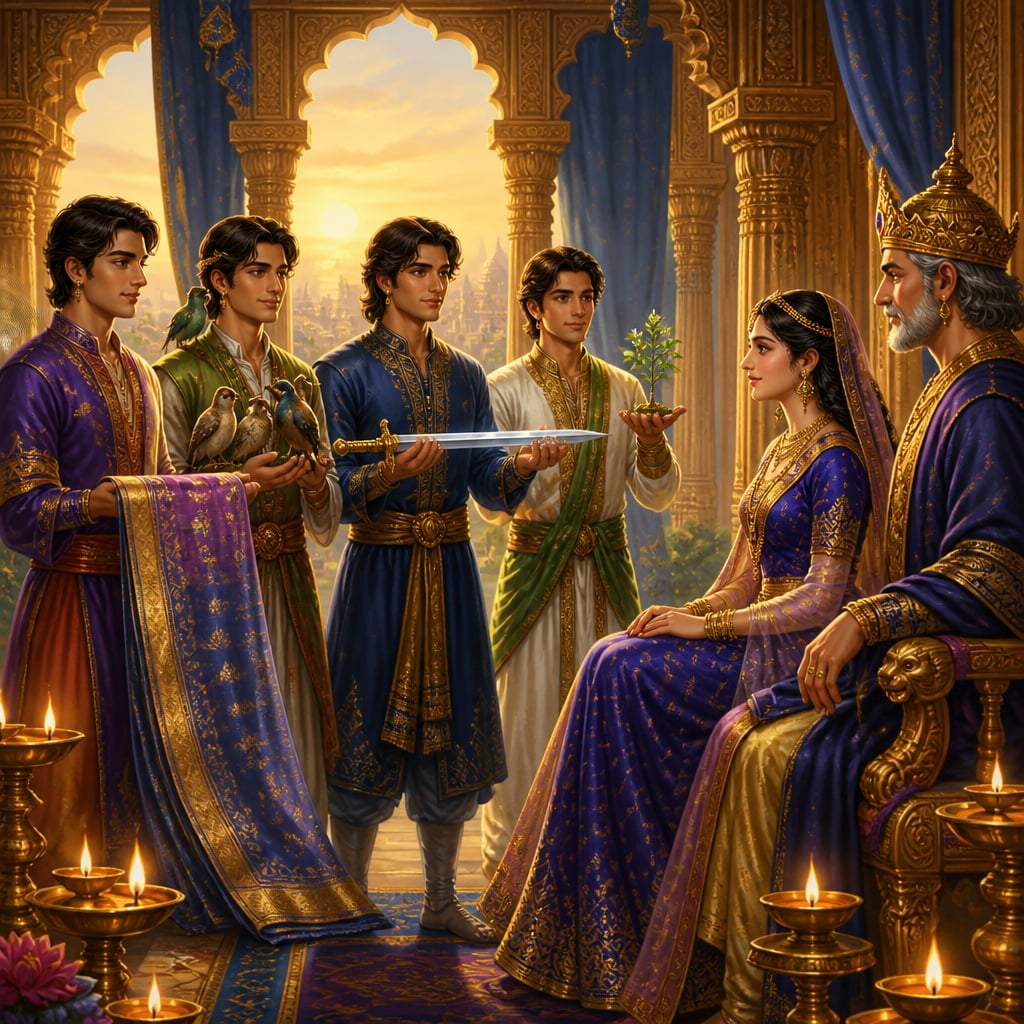
Word went out, and four suitors came, each a master of one thing.
The first was a weaver. His loom turned out five flawless garments in a single day, cloth so fine that kings would empty their treasuries for a single length of it.
The second understood the speech of every creature that walks or swims or flies. No bird's warning and no beast's grief was hidden from him.
The third was a swordsman named Khadgadhara. No fighter alive could stand before his blade.
The fourth was named Jivadatta, and his power was rare and solemn: he could call the dead back to life.
Four young men, four wonderful arts, and one bride. Her father could not choose, and neither could she.
The Betaal's Riddle
"So, king," said the Vetala. "Each of the four is the best in the world at what he does, and each wants Anangarati. She can marry only one. To which of them should she be given: the weaver, the one who knows the speech of animals, the swordsman, or the man who raises the dead?
Answer, if you know. You know the rules."
You Be the Judge
Pause before the verdict. This one is not settled by a rescue, and no demon has carried her off. Four men simply stand before her, each a master of his art.
Which art wins a wife: the maker of priceless cloth, the reader of every creature's tongue, the unbeatable sword, or power over death itself?
Vikram's Verdict
"The swordsman, Khadgadhara," said Vikramaditya, and did not slow.

"Do not mistake me. All four arts are real and rare, and I take nothing from any of them. But a marriage is not a prize handed to the most dazzling skill. It is a joining to a life and its duties. So ask what a husband owes a wife, first and above everything: to stand between her and harm, and to keep her and all that is theirs safe. That is the husband's dharma.
"Now hold each art against that duty. The weaver can clothe her in splendour, but splendour does not guard her. The man who knows the speech of animals can hear every warning in the world, but hearing a danger is not meeting it. The man who raises the dead is a wonder, yet a husband who can only mend what is already lost has failed at the thing before it was lost. Only the swordsman's art is the very thing the duty asks. His nature and her need are made for one another. He is the man."
The corpse was gone before he finished, laughing its way back to the branch. The king turned and walked on.
The Dharma
Notice what the king refused to do. He did not rank the four men, and he called no art low. He honoured all four. Then he asked a sharper question than "which art is the most impressive?" He asked "which nature fits this role?"
This is svadharma: each person has their own true work, the function their nature is shaped for, and things go right when nature and role are matched. A husband's duty carries protection at its heart, and protection is the swordsman's whole nature, so of the four suitors only his nature is made for the role he asks to fill. The weaver, the linguist, and the healer are not lesser men; their gifts are simply made for other roles than this one.
In Your World
It is easy to be dazzled by the brightest talent and forget to ask what the task in front of us actually needs. The most brilliant person in the room is not always the right one for the work in the room.
When you are choosing, for a job, a team, a partnership, a task, resist the pull of the flashiest skill and ask the quieter question: what does this role truly require, and whose nature is made for that? The young company does not need the most decorated engineer; it needs the one built for uncertainty. The crisis does not need the cleverest voice; it needs the steady one. Match the nature to the need. A brilliant gift in the wrong role helps no one, so pick for fit, even when someone else looks more impressive.
Reflection
- You judged before the king spoke. Did you reach for the most impressive art, the power over death, or for the art that actually fit the role?
- Where have you seen the flashiest talent chosen for a role it did not fit, and what happened?
- What is your own svadharma, the work your nature seems made for, and are you placed where that work is actually needed?