Talapatram

The Murti No One Carved

The svayambhu tradition, the strangest iconography in India, and the dispute Ramanuja settled with a locked door

At the center of the world's most-visited shrine stands an image the tradition insists no human hand ever made. Its features fed centuries of argument: matted locks and serpent ornaments that looked Shaiva, a goddess on the chest that looked Vaishnava, a form some even read as Devi or Skanda. The dispute could have torn the hill apart. Instead, tradition says, it ended with a sealed sanctum, one night, and a resolution both sides could live with. This lesson is about the murti, its identity, and how you settle a conflict so that it stays settled.

The Sealed Door

The tradition of the hill remembers a night, somewhere in the early twelfth century, when the identity of the most worshipped image in India was decided behind a locked door.

In the court of the local ruler, remembered as the Yadava Raya, two groups of devotees had pressed their claims for years. The Shaivas looked at the murti in the sanctum and saw their god: matted locks falling to the shoulders, serpent-like ornaments on the arms. The Vaishnavas looked at the same stone and saw theirs: the goddess Lakshmi carved on the chest, the tall marks of Vishnu on the forehead. Some looked at the form and saw Devi. Others saw Skanda, the warrior son of Shiva. The stone said nothing.

Into this dispute, the Sri Vaishnava tradition says, walked Ramanuja, the philosopher you met two chapters ago, already old, already famous, and proposed something remarkable. Not a debate. Not a royal decree. A procedure. Place the emblems of both gods inside the sanctum, before the image. Seal the doors for the night, with the king's own guard upon them. Let the deity choose.

The doors were sealed. The court waited until dawn. What the guards found when the doors opened would settle six centuries of worship, and the way it was settled matters more than what was found.

The Image That Was Simply There

Start with the stone itself, because everything on this hill starts there.
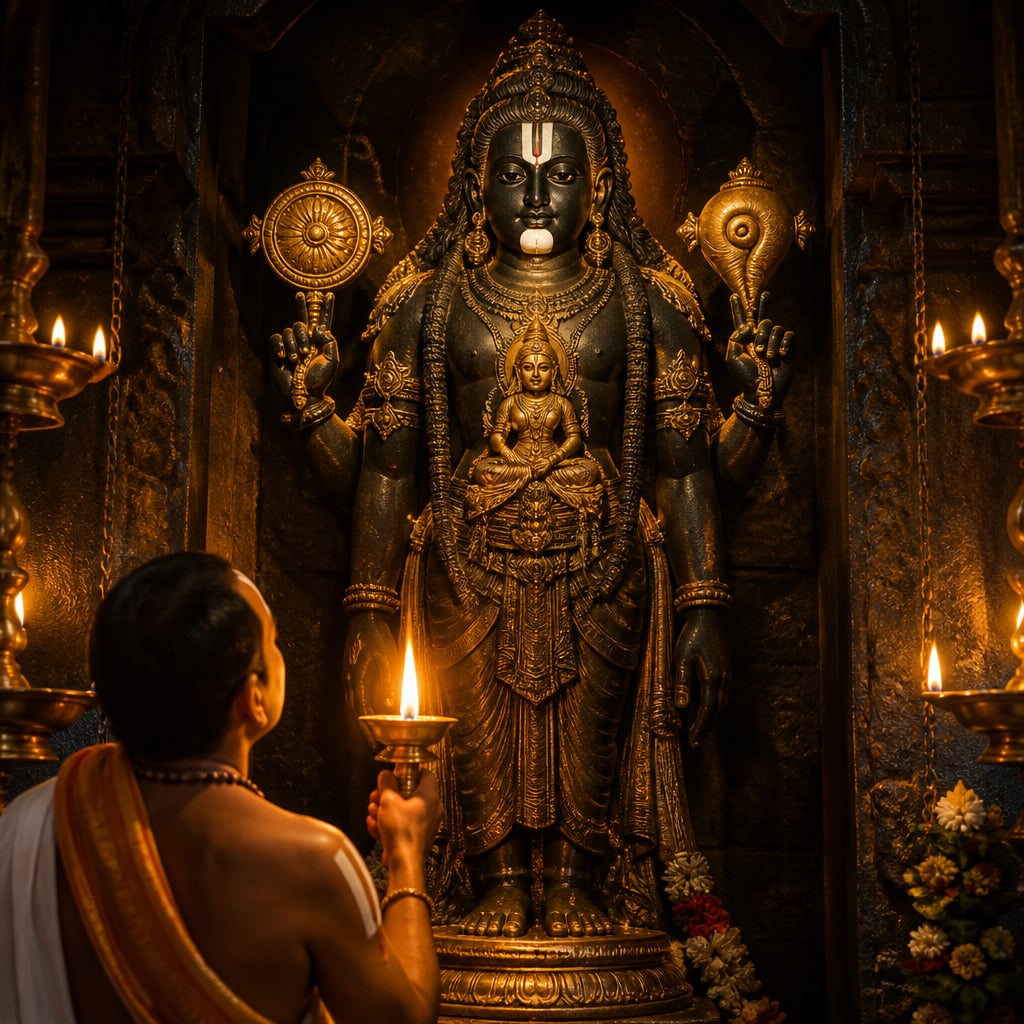
The self-manifest murti of Venkateswara

The murti of Venkateswara stands about eight feet tall in the small dark sanctum under the golden dome. The tradition is emphatic on one point: no sculptor made it. It is held to be svayambhu (self-manifest), an image that was simply there, found and not fashioned. The Venkatachala Mahatmya, the same cycle of stories you read in Chapter 1, narrates the god taking this stone form on the hill at the end of those stories: the loan unpaid, the two households unreconciled, the god standing still between them.

Legend is legend, and this course has kept the two ledgers separate from the first lesson. What history can say is narrower and, in its own way, just as striking. The image is old enough that no record of its making survives. The earliest inscriptions on the hill, from the ninth and tenth centuries, already treat the shrine as ancient. Samavai's endowment of 966 CE, the one you read about in Chapter 2, funded worship for an image that was already there, already famous, with a past nobody could document even then.

And the image is strange. That strangeness is the engine of this lesson.

Whose God Is This?

Stand where the archakas (the hereditary priests) stand, and look at the murti the way a medieval pilgrim would have.

A stone god with an ascetic's hair, a serpent's coils, a goddess on his heart, and detachable weapons. For centuries, every sect could look at the image and see its own supreme deity, and each did. Twentieth-century scholars joined the argument late, some reading the original image as Harihara (Shiva and Vishnu in one body), some as an early Devi, some as Skanda. The scholarly debate, like the medieval one, remains open. The worship never stopped for a single morning while anyone argued.

The Procedure

Now return to the sealed door, and watch what the tradition says Ramanuja actually did, because it is a small masterclass in ending a conflict.

He did not hold a debate, though he was the finest debater of his age and would very likely have won. A won debate produces a loser, and a loser waits for a rematch. He did not ask the king to rule by force. A decree lasts exactly as long as the dynasty behind it. Instead he designed a procedure that both sides agreed to before knowing the outcome: the emblems of both claims placed in the sanctum, the doors sealed and guarded, the result accepted in advance by everyone, whatever it turned out to be.

The sealed doors opened at dawn

At dawn, the tradition says, the doors were opened, and the image bore the conch and discus of Vishnu. The Shaiva devotees accepted the result, because they had accepted the procedure. The hill has been served in the Sri Vaishnava manner from that day to this.

Mark what the story is and is not. As history, it is unverifiable: a sectarian tradition, told by the winners, and this course labels it as exactly that. But as a memory of how the dispute ended, it preserves something real and rare. Sectarian disputes over shrines have burned down centuries elsewhere. This one left no burned record, no broken image, no rival shrine in schism. However the argument actually ended, it ended in a way that let both communities keep worshipping on the same hill. The tradition chose to remember the ending as a fair procedure rather than a victory, and that choice of memory is itself the teaching.

And the settlement wears a visible sign. The conch and discus remain separate golden pieces to this day. Each week, in the temple's regular practice, the ornaments come off for the deity's bath and flower service, and the murti stands as bare stone, saying nothing, exactly as it did before the doors were sealed. Then the emblems are restored, and the settlement is, in effect, quietly renewed. A conflict resolved by procedure, re-affirmed by routine, for nine hundred years.

वेङ्कटाद्रिसमं स्थानं ब्रह्माण्डे नास्ति किञ्चन । वेङ्कटेशसमो देवो न भूतो न भविष्यति ॥

veṅkaṭādri-samaṁ sthānaṁ brahmāṇḍe nāsti kiñcana veṅkaṭeśa-samo devo na bhūto na bhaviṣyati

In all the universe there is no place equal to Venkatadri; there has never been, nor will there be, a god equal to Venkatesha.

Puranic verse in praise of the hill (Venkatachala Mahatmya tradition)

The verse claims uniqueness for the hill. The history gives the claim an unexpected meaning: what is genuinely unique is not the stone but the settlement around it.

Synthesis Over Victory

Why does the resolution hold for nine centuries when so many imposed settlements collapse in one generation?

Look at what each side kept. The Vaishnavas got the identification: the deity is Vishnu, served by Vaishnava rite. But nothing that fed the other readings was removed. The jata was not chiseled off. The image was not recut to match a textbook Vishnu. The form stayed exactly as strange as it always was, and the tradition even kept affection for the strangeness: the god of this hill is Venkateswara, a name and a form belonging to no other shrine, worshipped by pilgrims of every sect, school, and language with no membership test at the door. A Shaiva family from Karnataka and a Vaishnava family from Tamil Nadu climb the same steps and see the same god, and neither is asked to convert at the sanctum.

That is the difference between victory and synthesis. Victory removes what the other side loved. Synthesis finds a settlement in which what each side loved survives. Victory needs enforcing forever. Synthesis, once accepted, enforces itself, because nobody is waiting for a rematch.

The Constituent Assembly forging the language compromise

India's founders faced a dispute of the same shape in September 1949, when the Constituent Assembly nearly split over one question: what language would the new republic speak? Hindi speakers wanted Hindi supreme. The South saw the disappearance of its own tongues and refused outright. The settlement, remembered as the Munshi-Ayyangar formula, gave neither side victory. Hindi became the official language; English stayed alongside it for official use; and the Constitution's Eighth Schedule named the other great languages of India as national treasures to be developed, not rivals to be retired. Everyone kept what they could not live without. Seventy-five years later the settlement still holds, grumbling and imperfect and unbroken, the way the hill's settlement holds.

The keepers of any shared thing, a shrine, a constitution, a company, a family, eventually face the dispute that cannot be won. The murti's lesson is that such disputes should not be won. They should be settled: by a procedure agreed before the outcome, with terms that let every party keep worshipping.

Back in the sanctum, the stone still says nothing. The golden conch and discus come off for the bath and go back on after, week after week, century after century. The image no one carved holds the settlement no one broke. The next lesson steps back from the stone to the building that shelters it, a golden dome that every ruling power of the South has maintained and none has replaced, and asks what a thousand years of re-gilding teaches about the difference between maintaining something and owning it.

Case studies

The Munshi-Ayyangar Formula: A Language Settlement That Held

September 1949, Constitution Hall, New Delhi. The Constituent Assembly, which had held together through Partition and the integration of five hundred princely states, came nearest to breaking over language. One bloc wanted Hindi declared the national language of the new republic, with numerals and a deadline to retire English. Members from the South heard, in that demand, the erasure of Tamil, Telugu, Kannada, and Malayalam from public life, and said so on the floor in words that made national headlines. Neither side could outvote the other without losing the country the Constitution was for.

The Assembly's way out was the murti's way out: a settlement designed so that each side kept what it could not live without. K. M. Munshi and Gopalaswami Ayyangar drafted the compromise: Hindi in the Devanagari script became the official (not national) language; English would continue for official purposes for fifteen years, extendable, and it has been extended ever since; and the Eighth Schedule listed India's great languages as treasures the state must develop. Nobody won. Nothing anyone loved was chiseled away. That is samanvaya, applied to a constitution instead of a sanctum.

The formula passed without splitting the Assembly, and its architecture survives after seventy-five years: official Hindi, continuing English, and a schedule of protected languages that has grown from fourteen entries to twenty-two. When the fifteen-year deadline approached in 1965 and agitation flared in the South, the settlement bent, English was assured indefinitely, and did not break. The republic still argues about language, and still holds.

A dispute between things people cannot stop loving is not a debate to win but a settlement to design. The test of the design is whether both sides can keep worshipping.

Every plural institution, a nation, a company after a merger, a family firm across generations, eventually faces its language question: a conflict where victory for either side destroys the whole. The Assembly's answer, like the hill's, is the standing template: procedure agreed first, essentials preserved for everyone, outcome accepted in advance.

The Eighth Schedule adopted in 1950 listed 14 languages; amendments in 1967, 1992, and 2003 grew the list to 22, the settlement expanding rather than eroding across seven decades.

The Codebase War Nobody Won

Two companies merge, and Meera, the new head of engineering, inherits two proud teams and two codebases that do the same job. The Pune team's system is older, battle-tested, and written in a language half the industry calls legacy. The Hyderabad team's system is modern, elegant, and has never survived a real festival-season load. Each team believes, sincerely, that choosing the other's system means their years of work were worthless. Meetings turn into trials. Two senior engineers quietly update their resumes. Meera knows that whichever system she picks by decree, she loses the other team within a year.

Meera does what the tradition says Ramanuja did: she replaces the verdict with a procedure agreed before the outcome. Both teams jointly write the test: the real festival-load replay, the failure drills, the cost model, and both sign that the results will decide, whatever they show. Crucially, she also designs the settlement so no one's essential work dies: the losing system's best components will be ported into the winner, with their original authors leading the port, credited by name in the architecture record.

The trial runs for three weeks under both teams' hands. The older system survives the load replay; the newer one fails at peak but its deployment tooling and monitoring outclass anything the old system has. The combined system ships with the old core and the new tooling, and the two lead engineers who were about to resign end up co-owning the merged architecture. Two years later nobody under thirty in the company knows there was ever a war, which is what a settled settlement looks like.

When both sides have something true, design the decision so the truth on the losing side survives the loss. People accept outcomes they helped adjudicate; they only re-litigate verdicts imposed on them.

Merged teams, rival departments, families dividing a business: the pattern repeats wherever identity is welded to work. Procedure before outcome, essentials preserved on both sides, authorship honored, that is how a codebase war, or a sanctum dispute, stays ended.

Living traditions

The murti's settlement quietly underwrites the temple's modern scale: an institution serving tens of millions of pilgrims a year across every sect and region could not function atop an unresolved identity dispute. The sealed-door tradition is also cited in modern Indian discourse as a model of indigenous dispute resolution: procedure over polemic, synthesis over victory, and a result renewed by routine rather than enforced by power.

  • The Weekly Undressing of the Emblems: In the temple's regular weekly cycle, the deity's jeweled coverings are removed for the flower-only adornment, and ahead of the Friday abhishekam (ceremonial bath) the detachable golden conch and discus are taken off, leaving the stone form bare. After the bath, the emblems and ornaments are restored, quietly re-enacting the settled identity.
  • Darshan Across Sects: Pilgrims of every sampradaya, Shaiva, Vaishnava, Smarta, Shakta, and of every Indian language region, worship at the same sanctum with no sectarian test. The queue on the hill is one of the most sect-blind spaces in Indian religious life.
  • The Sanctum and the Sealed Door: The sanctum whose doors, tradition says, were sealed for the night that settled the deity's identity remains the destination of every pilgrim on the hill: a small dark chamber under the golden vimana where the eight-foot image stands as it has since before records began.

Reflection

  • The murti's strangeness let every tradition see its own god in the same stone, and the settlement never removed that strangeness. Is there something in your own life whose refusal to fit one category is exactly what lets different people love it?
  • Recall a dispute you won outright. Who is still waiting for the rematch, and what would it have cost you, honestly, to design a settlement instead?
  • The tradition chose to remember the dispute ending in a fair procedure rather than a conquest. What does a community's choice of how to remember its victories tell you about what it actually values?

More in The Temple: Stone, Ritual, and the Murti

All lessons in The Temple: Stone, Ritual, and the Murti · Tirupati Balaji ebook course