A Day on the Hill
From Suprabhatam at half past two to the midnight lullaby: one full turn of the world's oldest running schedule
Every morning before three, singers stand at the golden doorway and wake the god with a verse borrowed from the Ramayana. Every night after midnight, descendants of Annamacharya sing him to sleep with a lullaby their ancestor wrote five centuries ago. Between the two lies a ritual day that has run, on essentially the same procedure, since Ramanuja's era: garlands, court session, meals, weddings, rest. This lesson follows one full turn of that clock and asks what a daily non-negotiable, kept without exception for centuries, does to an institution, and to a person.
Half Past Two in the Morning
It is dark on the hill, and cold, the way seven hundred meters of altitude keeps even an Andhra night cold. At the Bangaru Vakili, the golden doorway you crossed in the last lesson, a small group has assembled: archakas (the hereditary priests), temple officers, and the singers whose duty this hour is. Inside, past the door, the sanctum is shut. The god, by the tradition's tender arithmetic, has been asleep for barely ninety minutes.
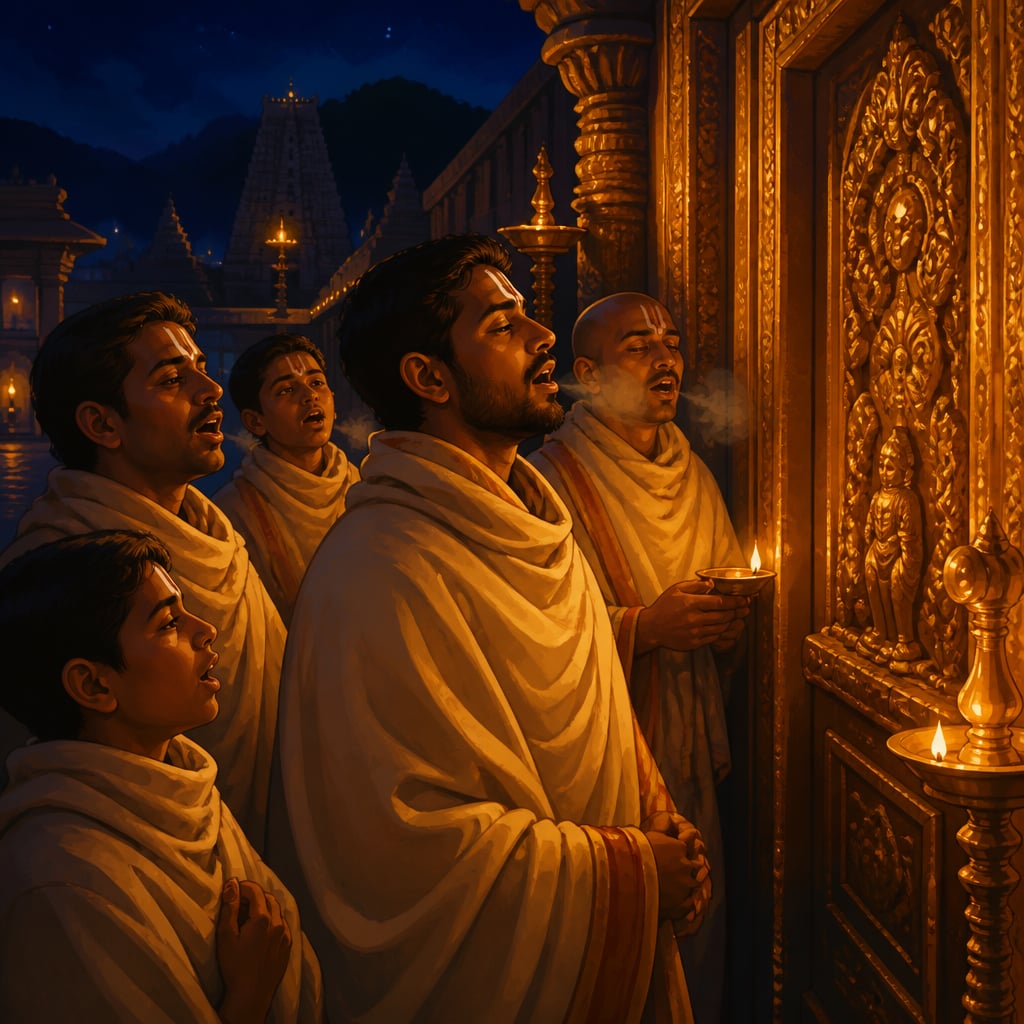
At half past two, the singing begins.
कौसल्या सुप्रजा राम पूर्वा सन्ध्या प्रवर्तते । उत्तिष्ठ नरशार्दूल कर्तव्यं दैवमाह्निकम् ॥
kausalyā suprajā rāma pūrvā sandhyā pravartate uttiṣṭha naraśārdūla kartavyaṁ daivam āhnikam
O Rama, blessed son of Kausalya, the eastern sky brightens. Arise, tiger among men: the day's sacred duties await.
Sri Venkateswara Suprabhatam, opening verse
Listen to what is actually being sung, because the choice is extraordinary. The verse is not originally about Venkateswara at all. It is from the Ramayana: the words with which the sage Vishvamitra woke the young Rama at dawn. Around the 1430s, a scholar named Prativadi Bhayankaram Annan composed the Suprabhatam, the wake-up hymn of the hill, and set this borrowed verse at its head. Since then, the god of Tirumala has been woken every single morning with the words once used to wake a prince of Ayodhya.
Every single morning. That phrase is the entire lesson. Hold onto it.
The Clock Nobody Stops
What follows the Suprabhatam is a day scheduled as tightly as a railway, and much older than railways.
The doors open. Thomala Seva: the deity is adorned with garlands, tulasi and flowers arranged by hands that learned the arrangement from their fathers. Then a scene that should sound familiar to anyone who has ever run anything: Koluvu, the court session. The deity is seated as a king holding morning durbar. The day's panchangam (almanac) is read aloud to him: the date, the star, the auspicious hours. And the previous day's accounts, the temple's own income, are formally reported. The god of the hill begins his working day, as the tradition frames it, with a calendar review and a finance briefing.

Then the Sahasranama Archana: his thousand names recited one by one. Then the first naivedyam, the food offering, announced by the temple bell, the cooked offerings carried from the ancient kitchen. Through the day, the general darshan queues flow past the sanctum in their unbroken river. Midday brings the Kalyanotsavam, the deity's wedding, performed not annually but daily, pilgrims sponsoring the marriage of Srinivasa and Padmavati every single afternoon, the unresolved domestic story of Chapter 1 celebrated rather than concluded.
Evening: more offerings, more archana, the night bell. And then, past midnight, the day's most tender procedure: Ekanta Seva. The small processional form of the deity, Bhoga Srinivasa, a silver image that has stood in for the immovable stone murti in these intimate rites for a thousand years, is laid in a cradle-cot. Milk and fruit are set beside him. And a lullaby is sung:

జో అచ్యుతానంద జో జో ముకుందా । రావె పరమానంద రామ గోవిందా ॥
jō acyutānanda jō jō mukundā rāve paramānanda rāma gōvindā
Sleep, Achyutananda, sleep, Mukunda. Come, highest bliss, Rama, Govinda.
Annamacharya, Jo Achyutananda
The lullaby was written by Annamacharya, the composer whose story you know from Chapter 3. Five centuries later, the singing of it at Ekanta Seva remains with his family: descendants of the Tallapaka line have held the honor of singing their ancestor's lullaby to the deity, night after night, in an unbroken family duty. Around one in the morning the temple closes. Ninety minutes later, at the golden door, the Suprabhatam begins again.
Never a Missed Morning
Now step back from the schedule's charm and look at its spine, because the spine is made of iron.
The procedure is not improvised and never was. Worship here follows the Vaikhanasa agama, one of the ancient liturgical codes of Vishnu temples, administered by hereditary archaka families, and the operating system was reorganized and fixed in the era of Ramanuja, nine centuries ago, as Chapter 2 told. What Chapter 2 stated as history, this lesson lets you feel as practice: the same sequence, dawn hymn to lullaby, executed daily since before the Delhi Sultanate existed, before printing, before the modern calendar that schedules everything else you know.
And it does not skip. Dynasties changed: the ritual ran. The administration passed from kings to Mahants to a statutory board: the ritual ran. In 2020, a pandemic closed the temple to pilgrims for the first extended stretch in living memory, and the world's most crowded shrine stood empty, and inside the sealed complex the archakas still woke the deity, fed him, married him at midday, and sang him to sleep, every single day, to an audience of no one. The schedule, it turned out, was never for the crowd. The crowd was always optional. The discipline was the institution.
Economists and historians who study Tirumala's endowments can trace, through the inscriptions, provisions for daily offerings running back a thousand years: Samavai's grant of 966 CE, which you read in Chapter 2, specified offerings and lamps in perpetuity. Perpetuity was not a figure of speech. The lamps are lit. It is one of the longest continuously executed operating procedures documented anywhere on earth.
What a Non-Negotiable Does
The keeper's question of this chapter asks how anything runs for a thousand years without a missed morning. The ritual day answers with a mechanism, and the mechanism transfers.
Notice first what the schedule refuses to do: it refuses to scale its standard to the day's importance. There are no big days and small days at the sanctum. The Suprabhatam on an empty pandemic morning and the Suprabhatam on the most crowded festival dawn are the same thirty verses, sung the same way, at the same hour. The day's meaning comes from the practice, never from the attendance. This is precisely backwards from how most modern effort works, where energy follows audience, and it is the temple's deepest trick: a practice that varies with the audience is a performance; a practice that ignores the audience is an identity. Performances get cancelled. Identities do not.
Notice second the load-bearing role of smallness. Nothing in the daily round is heroic. Garlands, a read calendar, meals, names recited, a lullaby: each unit is almost trivially small, executable by ordinary people on their worst day. That is not a weakness; it is the design. A ritual that required greatness would have died in its first bad decade. The thousand-year run is made entirely of days easy enough to never skip.
The transfer to a human life is direct, and one modern career makes it vivid. For twenty-four years, across roughly 664 international matches, Sachin Tendulkar kept a training routine, the nets, the same drills, the same preparation, whose whole character was that it did not vary with occasion: the nets before an unremarkable league game and the nets before a World Cup final were the same nets. Commentators marveled at the longevity; the longevity was the routine. A daily non-negotiable, small enough to survive bad days and immune to the size of the audience, is how a career, or a temple, gets to be very old while its rivals burn out young.
Writers know the same arithmetic: the working ones mostly keep a fixed daily word count, unimpressive on any single day and unanswerable across a decade. The practice is the Suprabhatam principle in another costume: show up at the same hour, do the same small sacred thing, whether or not anyone is watching, whether or not it is a big day. There are no big days. There is only the day, and the day has duties: the verse itself said it at half past two, kartavyam daivam ahnikam, the day's sacred duties await.
On the hill, the night's last visitor has gone, and the Tallapaka singer's lullaby has faded behind the closing doors. In ninety minutes, in the cold dark, a small group will assemble again at the golden doorway, as it did yesterday, as it did when Vijayanagara stood, as it did when nobody was allowed in at all. Tomorrow is already scheduled. It has been scheduled for a thousand years.
But once a year, this quiet clock faces its opposite: nine days when the whole hill becomes a sea of lakhs, processions in the streets, the largest single-day crowds in the temple's calendar. How a system built on unvarying dailiness handles a hundred-fold surge without breaking, and what the Brahmotsavam teaches about peak load, is the next and final lesson of this chapter.
Case studies
Tendulkar's Nets: Twenty-Four Years of the Same Morning
Sachin Tendulkar's international career ran from 1989 to 2013: twenty-four years, roughly 664 international matches, and more runs than anyone who has played the game. The statistics are famous; the mechanism was almost boring. Through injury, fame, slumps, and age, his preparation stayed essentially constant: the nets, the repeated drills, the fixed pre-match routines, maintained with the same seriousness before a bilateral league fixture as before a World Cup final. Teammates across three generations described the same sight: the most celebrated player on earth doing the unglamorous basics, daily, long after nobody could have made him.
Tendulkar's routine is the Suprabhatam principle in secular dress. The temple's clock refuses to scale its standard to the day's importance: no big days, only the day and its ahnika. His nets refused the same scaling: preparation was identity, not performance, so it could not be cancelled by an empty stadium or inflated by a full one. And like the ritual's units, garlands, a lullaby, each session was small enough to survive his worst days, which is why the chain never broke for twenty-four years.
One hundred international centuries, a career spanning four decades of teammates, and a longevity that outlasted two full generations of rivals who had matched or exceeded his talent. When he retired in 2013, the tributes converged on the same point from every direction: the gift was real, but the twenty-four years were built out of identical, unskipped mornings.
Longevity is not sustained brilliance; it is an unbroken chain of small, unvarying, skippable-but-never-skipped days. The practice that ignores the audience is the one that survives the audience.
Every field has its Suprabhatam question: what is the small daily practice you would keep on an empty morning, with no match, no audience, no deadline? Whatever answers that question honestly is your actual profession; everything else is scheduling.
A 24-year international career (1989 to 2013) across approximately 664 matches, the longest sustained run in modern cricket, built on a preparation routine that observers across three decades described as essentially unchanged.
Five Hundred Words Before the World Wakes
Revathi is a claims processor in Vijayawada who wants to be a writer. She has no evenings, a long commute, a full household, and a decade of failed grand plans behind her: the November novel attempts, the weekend writing retreats, the surges of two thousand inspired words followed by six dead weeks. After reading about the temple's clock, she makes the opposite bet: five hundred words, every morning, at 5:30, before the household stirs. The rule has one clause that matters: the quota never changes. Not for festivals, not for fights, not for feeling empty, and equally, not upward for feeling inspired.
Revathi has stopped performing and started keeping ahnika. Her old pattern scaled effort to enthusiasm, which is scaling the standard to the day, the exact move the sanctum refuses. The new practice is ritual-shaped: fixed hour, fixed size, small enough to survive her worst morning, and closed to negotiation, which removes the daily re-decision where practices actually die. The lullaby insight applies too: she ends each session mid-sentence, putting the work to bed gently so tomorrow's waking is easy.
The first weeks feel absurdly small: five hundred words is one page. But the chain does not break, and arithmetic does what inspiration never did: a year on, she has roughly 180,000 words, a finished draft and half of the next. More striking is the identity shift her family notices before she does: the question 'will you write today?' has simply left the house, the way nobody asks whether the temple will open. In year three a small press takes her novel; the press assumes discipline like hers is rare talent. It is rarer: it is a clock.
Make the daily unit small enough to survive your worst day, fix its hour, and close the negotiation forever. A practice re-decided daily is a performance; a practice beyond decision is an identity, and identities compound.
The mechanism is domain-blind: language learning, fitness, prayer, code, a business's customer calls. Whatever you would build over a decade, the hill's advice is identical: choose a unit trivially small, schedule it before the world wakes, and let a thousand identical mornings do what no heroic month can.
Living traditions
The temple's clock scaled into the TTD's modern operations without changing its spine: the same daily sequence now coexists with electronic seva booking, timed darshan tokens, and live broadcast of key rites, and the 2020 closure proved the order of priority, the rituals ran unbroken in an empty temple. The schedule has also become secular shorthand: Indian writing on discipline and deep work regularly reaches for Tirumala's unmissed mornings as the civilizational example of the daily non-negotiable.
- The Daily Seva Cycle: The full daily sequence, Suprabhatam, Thomala Seva, Koluvu, Sahasranama Archana, naivedyam offerings, Kalyanotsavam and the arjita sevas, and the night's Ekanta Seva, runs at Tirumala every day of the year, with pilgrims able to book participation in several of the sevas.
- Suprabhatam at Dawn, Everywhere: Far beyond the hill, the Suprabhatam is played at first light in homes, temples, and radio stations across South India and the diaspora, most often in M. S. Subbulakshmi's 1963 recording, synchronizing millions of household mornings with the sanctum's.
- The Bangaru Vakili at 2:30 AM: The daily station of the Suprabhatam singers: archakas, officers, and singers assemble at the golden doorway in the pre-dawn dark, and the temple's day formally begins with the first verse sung to the closed door.
Reflection
- During the 2020 closure the full ritual day ran for an audience of no one, and it turned out the crowd had always been optional. Which of your own practices would survive the removal of every witness, and which would quietly stop?
- The god's own day begins with a calendar reading and yesterday's accounts at the morning Koluvu. If you held a two-minute durbar with yourself each morning, today's realities, yesterday's honest accounts, what would you have to stop pretending not to know?
- The tradition gives its omnipotent god a bedtime, a lullaby, and ninety minutes of sleep: infinite power, voluntarily poured into a finite daily form. Why might a civilization insist that even God keep a schedule, and what is it teaching about freedom and form?