Talapatram

Ananda Nilayam

The gold-sheathed dome, the temple's layered layout, and seven centuries of rulers who maintained instead of replacing

The golden dome over the sanctum is not one gift but a ledger. A Yadava king gilded it in the thirteenth century; Krishnadevaraya renewed the gold in 1518 and had the act inscribed; the TTD renewed it again in living memory. Around it, the temple grew outward in layers, doorway by doorway, courtyard by courtyard, without ever tearing down its core. This lesson walks the layout from the outer gate to the golden doorway and reads the building the way the inscriptions ask it to be read: as proof that the highest form of respect for something is maintaining it.

The King Who Gilded Another King's Work
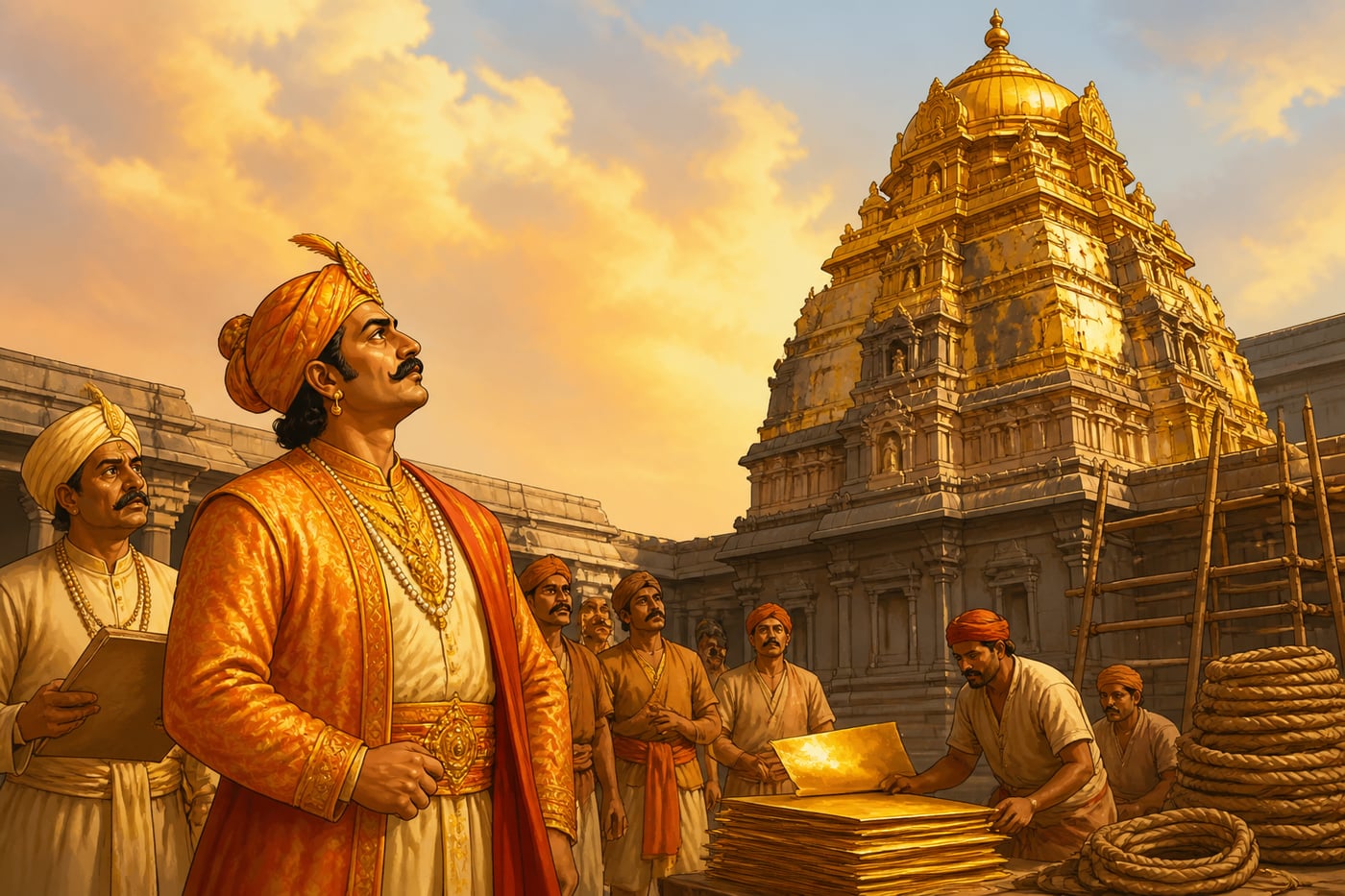
Krishnadevaraya deciding to regild the dome

In the year 1518, an emperor stood in a courtyard on this hill and paid for something a rival dynasty had built.

Krishnadevaraya of Vijayanagara, whom you met in Chapter 2, had a decision in front of him that every powerful patron faces. The golden covering of the Ananda Nilayam, the sacred dome above the sanctum, was nearly three centuries old. It had first been gilded, the temple's records hold, in the thirteenth century under Vira Narasingadeva, a ruler of the Yadava line that governed these hills long before Vijayanagara rose. The gold was worn. The emperor of the South, at the height of his power, could have torn the old vimana down and raised a grander one with his own name on it. Emperors do this. It is half of what emperors are for.

He did not. He paid to re-gild the existing dome, layer upon the old layer, and the work was recorded in stone among the temple's inscriptions, the same thousand-inscription ledger you read about in the history chapter. The most powerful man in South India chose to be, for this building, a maintainer.

Why would an empire-builder make that choice? The answer is the building itself, and what a building like this actually is.

A House That Grew in Rings

Walk the temple the way a pilgrim walks it, and you walk through time in layers.
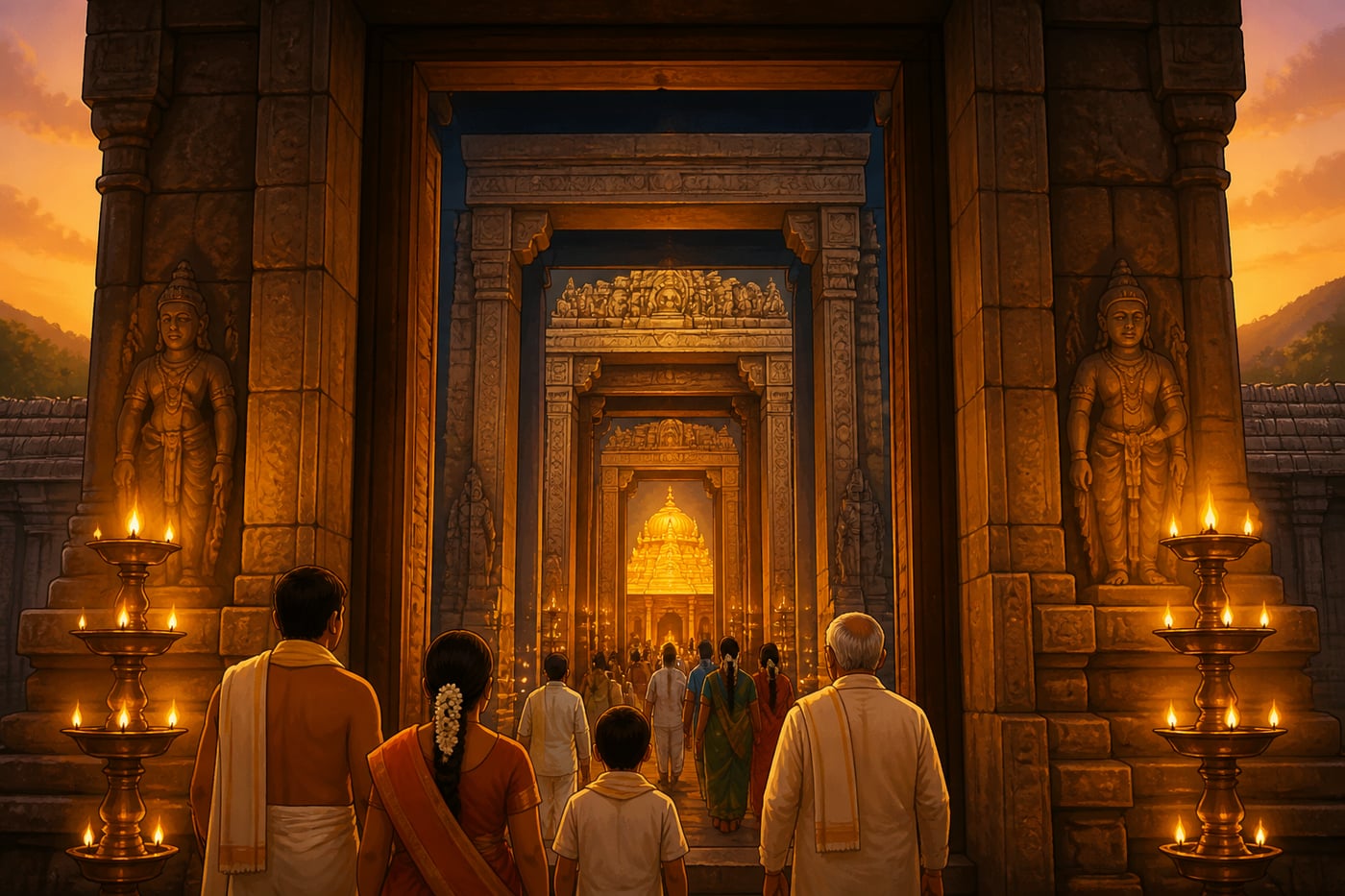
The nested gateways of the temple

You enter through the Mahadwaram, the great outer doorway under its gopuram (tower), and you are standing in the outermost courtyard, the Sampangi Pradakshinam. Deeper in, a second enclosure: the Vimana Pradakshinam, the circuit around the sanctum itself. Between them, doorways with names the tradition uses like old friends: the Vendi Vakili, the silver doorway; and finally the Bangaru Vakili, the golden doorway, its frame sheathed in gilt, beyond which stands the small dark room where the murti from the last lesson has stood since before records began.

The style is Dravida, the southern temple grammar: walled enclosures (prakaras) nested one inside another, towers over the gateways, and above the sanctum not the tallest structure but the holiest, the vimana. Tirumala's vimana is modest in height and immodest in surface: the Ananda Nilayam, the abode of bliss, a three-tiered tower sheathed in gilded copper plates that catches the sun and can be seen far down the queue lines.

Here is the detail to hold onto: the layers are not a single design executed at once. They are growth rings. The sanctum is the oldest thing, its origins beyond the records. The enclosures, doorways, pavilions, and kitchens accreted around it across a thousand years, funded by the Pallava queen Samavai, by Chola and Pandya donors, by the Yadava rayas, by Vijayanagara, by the Mahants, by the TTD. Each era added a ring. No era demolished the core. A pilgrim in the queue today walks, in one direction, through the accumulated respect of forty generations.

అదివో అల్లదివో శ్రీహరి వాసము । పదివేల శేషుల పడగల మయము ॥

adivō alladivō śrīhari vāsamu padivēla śēṣula paḍagala mayamu

There, look, there it is: the abode of Sri Hari, wreathed in the ten thousand hoods of Adisesha.

Annamacharya, Adivo Alladivo

Annamacharya sang this pointing at the hill from the pilgrim path: the first sight of the shrine, the moment the golden dome comes into view. Five centuries of pilgrims have had the song in their mouths at exactly that turning. The dome he pointed at is the one Vira Narasingadeva gilded; the gold he saw was the layer Krishnadevaraya paid for, eighteen years after the singer's death.

The Ledger of Gold

The Ananda Nilayam at sunrise

Read the Ananda Nilayam the way Chapter 2 taught you to read inscriptions, and the dome becomes a document.

The thirteenth-century gilding under the Yadava rulers is the first recorded layer. The 1518 renewal under Krishnadevaraya is the second, inscribed and dated. In the twentieth century the TTD renewed the covering again, in connection with the great re-consecration ceremonies of the modern era, most famously the Maha Samprokshanam of 1958. Each renewal laid new gilded plates over the same three-tiered form. The shape underneath has not changed in the entire documented history of the hill.

Think about what the dome therefore records. Not one dynasty's glory: every era's willingness to keep another era's promise. The Yadavas gilded a shrine they did not found. Vijayanagara re-gilded Yadava work. The TTD, a modern statutory body of engineers and administrators, re-gilds imperial work. Dynasties fell, the language of administration changed from Tamil to Telugu to English, the very form of government changed from kingdom to colony to republic, and through all of it, someone kept signing the same maintenance contract.

There is a Sanskrit word for this, and it is one of the most important words in this course: jirnoddhara, the restoration of the worn. The temple texts treat renovation not as an admission that something decayed but as an act of worship in its own right, with its own rites, its own merit, its own inscriptions. In this tradition, maintenance is not the absence of building. It is the highest form of building.

Why Maintenance Beats Monuments

The modern world largely believes the opposite, and it is worth pausing on why the temple's instinct is the sounder one.

A new monument buys its patron glory once. Maintenance buys the institution continuity forever, but it pays the maintainer almost nothing: no ribbon to cut, no name in lights, a plaque at most. So rational glory-seekers build new and let the old rot, and the landscape of history is littered with the result: capitals abandoned for newer capitals, palaces stripped for newer palaces, each generation's ambition cannibalizing the last generation's.

Against that pattern, consider what the unglamorous choice produced here. Because no ruler replaced the core, the sanctum's sanctity was never interrupted, and an unbroken ritual line, the subject of the next lesson, became possible. Because each era added rings instead of starting over, the temple could absorb a thousand years of growth, from a hilltop shrine to an institution serving tens of millions, without ever closing. The building's continuity IS the institution's continuity. They are the same fact, seen from outside and inside.

Krishnadevaraya, who built magnificently elsewhere and knew exactly what glory cost, understood this. At Tirumala he chose the maintainer's role, and the choice has aged better than conquest: his empire is gone, his capital at Hampi is a ruin tended by archaeologists, and the dome he re-gilded still shines over a living institution, wearing his gold under newer gold.

The same understanding built the other great survivor of the South. The Brihadeeswara temple at Thanjavur, raised by Rajaraja Chola around 1010 CE, has been maintained, repaired, and re-consecrated for a thousand years, and in 2010 it celebrated its millennium not as a ruin but as a working temple, still holding daily worship. UNESCO lists it as a World Heritage Site; the deeper wonder is that the heritage never stopped being used. India's temple tradition, almost uniquely among the world's building cultures, treats a thousand-year-old structure as infrastructure, not exhibit.

The Keeper's Question

The chapter's spine asked how you run something every day for a thousand years. This lesson gives the physical half of the answer: you resist, generation after generation, the temptation to replace what only needs keeping.

The temptation is real and it is permanent, because replacement flatters the replacer. Every leader inherits systems built by predecessors: codebases, curricula, institutions, houses, family practices. The heroic move is the rewrite, the relaunch, the new building with the new name. The keeper's move is jirnoddhara: study what stands, restore what is worn, add your ring around the outside, and put your gold on top of the older gold.

Modern engineering has slowly rediscovered the principle. The most consequential software systems in the world, banking cores, airline reservations, the internet's own protocols, are decades old and maintained rather than replaced, because the industry learned by expensive failure what the temple knew by instinct: a working system's greatest feature is that it works, and continuity, once broken, cannot be re-purchased at any price. Martin Fowler, whose book Refactoring became the standard text on improving code without replacing it, built a career on the software version of the golden dome: change the surface as much as you like, keep the living core intact.

Back on the hill, the sun comes up the valley and finds the gilded plates, as it has since the Yadava king's workmen came down their scaffolds seven centuries ago. Somewhere under the newest layer is the gold an emperor bought, and under that, the gold of a dynasty almost nobody remembers, and under that, the dome itself, unchanged. The building keeps the score honestly: the replacers got ruins, and the maintainers got this.

The stone and the gold, though, are the still half of the temple. The next lesson enters its moving half: the ritual day that begins before three in the morning with a hymn that was first sung five centuries ago, and has not missed a dawn in living memory.

Case studies

Brihadeeswara at One Thousand: The Maintained Monument

Around 1010 CE, Rajaraja Chola completed the Brihadeeswara temple at Thanjavur: a vimana over sixty meters tall, capped by a massive stone shikhara, the most ambitious building the South had ever seen. Empires that followed had every opportunity to let it decay, quarry it, or overwrite it with their own glory, the standard fate of great buildings everywhere. Instead, across Chola, Nayaka, Maratha, colonial, and republican rule, the temple was repaired, re-consecrated, and kept in daily worship. In September 2010, the temple marked one thousand years, not with an excavation report but with a working festival, live rituals, and a commemorative celebration attended by lakhs.

Brihadeeswara is jirnoddhara's thousand-year receipt. The tradition's radical position, that restoring the worn earns merit equal to or greater than building the new, meant every succeeding power could gain by maintaining what it did not build, exactly as the Yadavas, Vijayanagara, and the TTD each added gold to Tirumala's dome. The building survived because the culture around it made maintenance honorable, not because any single dynasty was virtuous.

A UNESCO World Heritage Site since 1987 that has never stopped being what it was built to be: a functioning temple with daily worship. Its millennium in 2010 was celebrated with consecration rituals and cultural festivals, and conservation work continues under the Archaeological Survey and temple authorities, the maintenance contract still being signed a millennium on.

Buildings do not survive by being well built; they survive by being continuously kept. A culture that honors maintainers gets thousand-year institutions. A culture that only honors founders gets ruins with impressive plaques.

Every organization owns a Brihadeeswara: the core system, process, or relationship everything else rests on. The thousand-year question is never 'who built it' but 'who is keeping it', and whether keeping it is honored enough that anyone competent wants the job.

Brihadeeswara's vimana has stood for roughly 1,015 years with its ritual life essentially intact, spanning at least five changes of ruling power, each of which chose maintenance over replacement.

The Rewrite That Wasn't

Deepak becomes CTO of a fifteen-year-old logistics company whose booking engine, half a million lines written by people who have long since left, processes every order the company has. The code is ugly, poorly documented, and profitable. His star engineers pitch the heroic move: an eighteen-month ground-up rewrite in a modern stack, a clean break with the past. The board likes the sound of it. Deepak has read the industry's casualty lists: rewrites that ran three times over schedule while the old system rotted from neglect, taking companies down with them. But 'we will carefully maintain the old thing' has never once excited a board.

Deepak chooses jirnoddhara and, crucially, does what the temple tradition does: he makes maintenance honorable. He names the effort, gives it a budget and a stage, and staffs it with his best rather than his newest. The old engine is refactored module by module while it keeps running, its worn parts restored, new capabilities added as rings around the working core, gold laid on top of older gold. The rewrite energy goes into the ten percent of the system where a clean break genuinely pays.

Two years later the engine handles four times the load, deploys weekly instead of quarterly, and never had a migration outage, because there was never a migration. The engineers who did the restoration present it at conferences: the unglamorous project became the resume line. A competitor that chose the full rewrite is eleven months late, running two systems in parallel, and bleeding senior staff.

The heroic rewrite flatters the rewriter; the restoration serves the institution. A leader's real leverage is not choosing maintenance once but making maintenance prestigious, so the choice keeps being made after them.

The pattern generalizes past software: curricula, brands, family homes, constitutions. When you inherit something working and unfashionable, the temple's question applies: is this worn, or is this wrong? Restore the worn. Replace only the wrong.

Living traditions

The TTD today maintains the complex with a permanent establishment of engineers, sthapatis (traditional temple architects), and conservators, continuing the ledger of maintenance in reinforced concrete, queue complexes, and periodic re-gilding. The temple's growth-ring pattern, expand outward, never through the core, now governs its modern infrastructure too: vast queue and accommodation systems ring the hill while the sanctum and its immediate enclosures remain untouched, the thousand-year-old design principle applied at twenty-first-century scale.

  • Pradakshina of the Enclosures: Pilgrims circumambulate the temple's nested courtyards, the Sampangi Pradakshinam and the Vimana Pradakshinam, walking clockwise around the sanctum through the enclosures that successive eras added, before approaching the golden doorway for darshan.
  • Darshan of the Vimana: Pilgrims pause in the Vimana Pradakshinam to behold the gilded Ananda Nilayam and the Vimana Venkateswara form upon it, many offering the same prostrations given to the sanctum image.
  • The Bangaru Vakili (Golden Doorway): The gilt-sheathed doorway through which pilgrims pass for darshan, the last threshold between the accumulated outer rings and the unchanged inner chamber where the murti stands.

Reflection

  • The dome's newest gold hides every older layer, including the emperor's. Whose invisible maintenance are you standing on right now, and who will ever know what you yourself have quietly kept from falling apart?
  • Where in your life are you currently tempted by the heroic rewrite, the clean break, the new building with your name on it, and what would jirnoddhara, honest restoration of the worn, look like there instead?
  • A culture that honors maintainers gets thousand-year institutions; a culture that only honors founders gets ruins. What does your own culture, national, professional, or familial, actually hand out its honors for, and what is that buying it?

More in The Temple: Stone, Ritual, and the Murti

All lessons in The Temple: Stone, Ritual, and the Murti · Tirupati Balaji ebook course