Talapatram

Brahmotsavam

Nine days, a golden eagle, and the once-a-year northern gate: how the steadiest system on earth handles its biggest days

Once a year a flag rises on the golden staff and, the tradition says, the gods themselves are invited to Tirumala. For nine days the deity who is woken with a lullaby rides out morning and evening on serpent, swan, lion, and, on the greatest night, the golden eagle Garuda, before crowds that reach into lakhs. And through all nine days, inside the sanctum, the ordinary clock of the last lesson never misses a beat. This closing lesson of the temple chapter is about peak load: how a system survives its hundred-fold surge by refusing to become a different system.

The Flag Goes Up

On the first morning, before anything else can happen, a flag must rise.
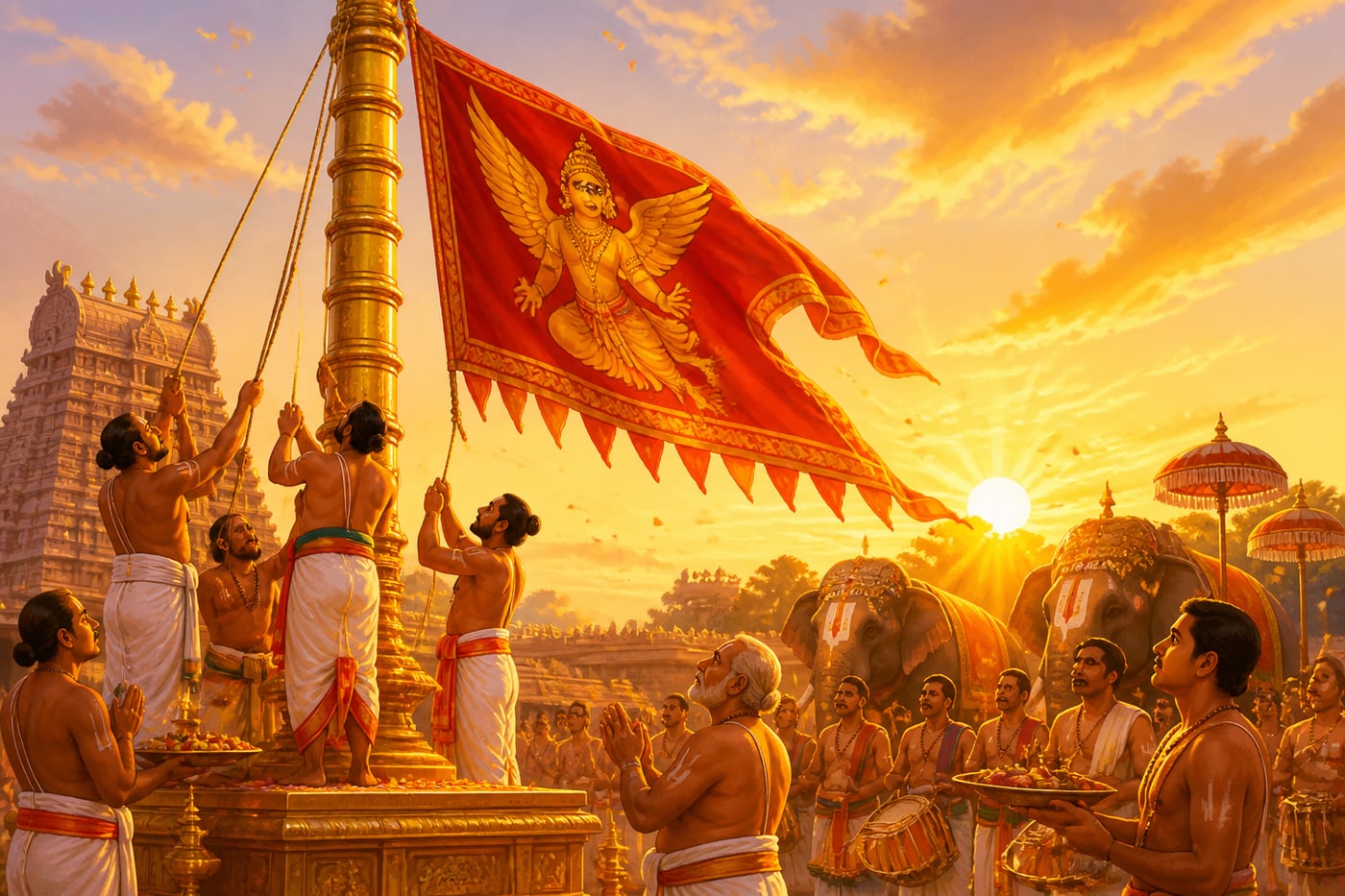
The Garuda banner rising on the flagstaff

At the Dhvajastambham, the gilded flagstaff that stands before the sanctum, archakas hoist a banner painted with Garuda, the golden eagle who carries Vishnu. The rite is called Dhvajarohanam, the raising of the flag, and the tradition is precise about what it means: the flag is an invitation. Garuda is dispatched, the liturgy says, to summon the devas themselves, all the gods of all the worlds, to attend the festival of festivals. For nine days, the tradition holds, everyone who matters in the cosmos is on this hill.

The name of the festival records its first host. Brahmotsavam means Brahma's festival: the legend, told in the Venkatachala Mahatmya cycle, says the creator god himself conducted the first one, in gratitude to Vishnu standing on the hill for the rescue of the world in Kali Yuga. Legend, as always in this course, labeled as legend. What the inscriptions can say is that annual festivals with processions were being endowed and conducted on this hill a thousand years ago, provided for in the same epigraphic ledger that recorded Samavai's lamps and offerings in 966 CE.

And here is the fact this whole lesson turns on: during those nine days, the most crowded days of the temple's year, when the town below and the hill above fill with pilgrims in numbers that reach into the lakhs, the daily schedule you followed in the last lesson does not change. The Suprabhatam is still sung at half past two. The naivedyam bell still rings. The lullaby is still sung after midnight. The festival is not a replacement for the ordinary day. It is laid on top of it, like gold on older gold.

Nine Days, Two Processions a Day

The festival's engine is the vahana (the ceremonial mount). Each morning and each evening, the processional form of the deity, Malayappa Swami, the festival image that goes where the stone murti cannot, is carried around the temple's streets on a different mount, each one an argument in sculpture.

The deity riding Garuda over the festival crowd

But one night stands above all the others. On the fifth evening comes Garuda Seva: the deity rides the golden eagle himself, wearing the hill's most treasured ornaments, and the crowd that gathers for those few hours is the largest single-day gathering in the temple's calendar, lakhs of people packed along one processional street for one slow circuit. Ask any regular pilgrim which darshan they would cross the country for, and the answer, more often than any other, is this one.

కొండలలో నెలకొన్న కోనేటి రాయడు వాడు । కొండలంత వరములు గుప్పెడు వాడు ॥

koṇḍalalō nelakonna kōnēṭi rāyaḍu vāḍu koṇḍalanta varamulu guppeḍu vāḍu

He is the king of the sacred lake, enthroned among the hills; he pours out boons as vast as the hills themselves.

Annamacharya, Kondalalo Nelakonna

Annamacharya's song catches the festival's whole theology in one image: the god who is enthroned among the hills comes down into the street. For nine days the darshan is reversed. All year, pilgrims climb to the god. During Brahmotsavam, the god processes to the pilgrims, past the shops and the houses, at eye level, close enough for a grandmother who cannot stand in a queue to see him from her doorstep.

The Once-a-Year Gate

The festival calendar holds one more crowd, and it teaches with a door.

In the winter month of Dhanurmasa falls Vaikuntha Ekadasi, the eleventh day held to be the year's most auspicious. On that day, and only around that day, a special entrance is opened: the Vaikuntha Dwaram, the northern passage around the sanctum. The tradition is simple and enormous: to pass through the northern gate on Vaikuntha Ekadasi is to pass, symbolically, through the door of Vaikuntha itself, Vishnu's own realm. The queue for that one doorway, on that one day, is among the longest the hill ever sees.

A cynic sees crowd management theater. Look closer and you see the same design intelligence that runs the whole festival. The temple could open the northern passage every day; nothing physical prevents it. It does not, because the tradition understands something about value and time: a door that is always open is a corridor; a door that opens once a year is an event. Scarcity here is not manufactured to exploit, it is structured to sanctify. The calendar itself is an instrument: the year is given a shape, a peak, a once, and lakhs of lives organize themselves around it.

Peak Load Without Panic

Now put the two halves of this chapter together, because Brahmotsavam is where they meet.

The last lesson showed you a system with no big days: the same thirty verses on an empty morning as on a crowded one. This lesson shows you the same system's biggest days, a surge from the daily rhythm to lakhs, the town's population multiplying, every queue, kitchen, and cottage strained. How does an institution built on unvarying dailiness absorb a hundred-fold spike?

The answer is the least dramatic sentence in this course: by running the ordinary system, bigger. The festival's units are the daily units, scaled. The processions follow the same agama procedures as the daily sevas; the same hereditary archakas serve them. The annadanam kitchens that feed pilgrims daily feed more of them. The queue system that manages every ordinary Tuesday manages the Garuda Seva night. Nothing fundamental is invented for the peak; the peak is met by the practiced. The nine days are not an exception to the temple's discipline. They are its examination, and the daily clock is the preparation, the way Tendulkar's nets were the preparation for the World Cup final: same drills, bigger stadium.

Modern India runs an even larger version of the same principle. The Kumbh Mela, the periodic gathering at the sacred river confluences, is the largest assembly of human beings on earth: the 2019 Prayagraj Kumbh was estimated at over 20 crore visitors across its weeks, with single days in the crores. Study after study, including a well-known Harvard University project on the 2013 Kumbh, found the same unglamorous secret: no miracle technology, but ordinary, repeatable systems, grid layouts, sector officers, water lines, patient rehearsed process, deployed at extraordinary scale by people who had done it before. The world's biggest crowd is handled the way the hill handles Garuda Seva: with boring competence, practiced daily, scaled calmly.

The keeper's lesson generalizes to any life that has seasons. Your Brahmotsavam, the product launch, the wedding, the exam, the harvest, is not the time to become a different person running different systems. If the daily practice is sound, the big day is the daily practice with more people watching; if the daily practice is hollow, no heroics invented that week will hold. Institutions, and people, meet their peaks with whatever they practiced in their ordinary time. The nine days simply publish what the three hundred and fifty quiet days built.

The Sudarshana discus bathed in the temple tank

On the ninth evening comes Chakrasnanam: the deity's discus, Sudarshana, is bathed in the temple tank as thousands enter the water with it, the festival's closing immersion. Then the Garuda flag comes down from the golden staff, Dhvajavarohanam, the guests of nine days formally seen off. The town empties. The hill grows quiet.

And at half past two the next morning, in the cold dark, the singers are at the golden doorway as if nothing had happened, because, in the sense that matters most, nothing had: the clock never stopped. The chapter asked how something runs every single day for a thousand years. You have now seen the whole answer: a settled identity no dispute could break, a building maintained instead of replaced, a day too small to skip, and a peak met by practice.

But watch the festival's last practical detail as the crowds leave: the hundis, the offering vaults, are fuller than at any other time of year, and somebody must now count, account for, and spend all of it well. Who guards the guards of the world's richest temple, how a laddu got its own court protection, and what happens when a sacred institution becomes the size of a state enterprise, that is the final chapter.

Case studies

Kumbh Mela: The World's Largest Crowd, Run on Boring Systems

The Kumbh Mela at Prayagraj is the largest gathering of human beings on earth: the 2019 edition was estimated at over 20 crore visitors across its weeks, with peak bathing days in the crores, a temporary city of tents, roads, hospitals, and police raised on a river floodplain and dismantled weeks later. Observers arriving to study it, including a multi-year Harvard University research project on the 2013 Kumbh, expected to find either chaos or some secret technology. They found neither.

What the researchers documented is the Brahmotsavam principle at maximum scale: the peak met by the practiced, not the invented. The mela's administration uses ordinary, repeatable instruments, a grid of numbered sectors, experienced officers with clear jurisdictions, redundant water and power lines, rehearsed crowd-flow plans, run by cadres who have done previous melas. The extraordinary outcome is composed entirely of unextraordinary, well-drilled parts, exactly as the hill meets Garuda Seva night with the same agama procedures, kitchens, and queues that run every ordinary Tuesday.

The temporary city functions: crores bathe on the peak days, epidemics do not break out, and the operation has become a global case study, the Harvard project published its findings as a book on pop-up megacities, and administrators from other nations now visit the Kumbh to study crowd governance. The 2019 mela's logistics were cited by management schools as a benchmark in scaling ordinary process.

Scale is not survived by heroics; it is survived by rehearsed ordinariness. The organizations that handle the biggest days are the ones for whom the big day is the daily system, run bigger.

Every operations team staring at its own festival spike, an election, a product launch, a holiday sale, faces the Kumbh's choice: invent a heroic special system for the peak, or scale the practiced daily one. The evidence from the riverbank and the hill points the same way.

Kumbh Mela 2019, Prayagraj: an estimated 20-crore-plus total attendance over roughly seven weeks, managed through a sectored temporary city, among the largest planned deployments of civic infrastructure in history.

The Sale Day That Was Just Tuesday, Bigger

Kavitha runs engineering at a mid-size e-commerce company whose festival-season sale is its Brahmotsavam: thirty times normal traffic for seventy-two hours, a year of revenue concentrated in three days. Her predecessor treated each sale as a heroic exception: special war rooms, code freezes broken by panic patches, engineers sleeping in the office, a different playbook every year, and, twice in three years, a crash at peak hour. Kavitha's first decision is the unfashionable one: there will be nothing special about sale day.

She rebuilds the ordinary instead. Load tests run weekly all year at sale-day volumes, not once in October. The deployment, monitoring, and rollback drills that sale day needs become the standard drills of every normal week. On-call rotations rehearse failure scenarios monthly, the daily clock, kept strictly enough that the peak is just the daily clock with more zeros. Her rule to the team borrows the sanctum's: the standard does not scale with the audience. If a practice matters on sale day, it runs every day; if it is not worth running every day, it will not save you on sale day.

The next festival sale is, by the war-story standards of the industry, boring: traffic peaks at thirty-two times baseline, the system flexes exactly as it has flexed in fifty-two weekly rehearsals, and the graveyard-shift heroics have nothing to do. Two engineers complain, half-seriously, that sale day has become just Tuesday, bigger. Finance notices what boring means: zero downtime at the year's revenue peak, for the first time in company history.

If you meet your peak with a special system, you are betting the year on your least practiced process. Make the daily system peak-shaped, and the big day loses its power to break you, and its power to frighten you.

The pattern is domain-blind: a surgeon's checklist is the same on the celebrity patient, an airline's procedures are the same in the storm, the hill's Suprabhatam is the same on Garuda Seva morning. Whatever your seasonal peak is, the preparation season is called every day.

Living traditions

Brahmotsavam is now one of India's largest annually recurring religious operations: the TTD coordinates queue systems, accommodation, annadanam at festival scale, medical posts, and live broadcasts watched by crores, while the ritual core remains the agama procedure conducted by hereditary archakas. The festival has also entered management literature alongside the Kumbh Mela as an Indian case study in peak-load governance: extreme scale handled by rehearsed ordinary systems rather than invented heroics.

  • The Vahana Processions: Across Brahmotsavam's nine days, Malayappa Swami processes each morning and evening on a different vahana, Sesha, hamsa, simha, the pearl canopy, kalpavriksha, Mohini, Garuda, Hanuman, elephant, sun and moon chariots, the great ratha, along the mada streets around the temple, watched by crowds that peak in the lakhs on Garuda Seva night.
  • Vaikuntha Dwara Darshanam: Around Vaikuntha Ekadasi in the winter month of Dhanurmasa, the Vaikuntha Dwaram, the northern passage around the sanctum, is opened, and pilgrims queue through the night for the once-a-year passage that tradition equates with entering Vishnu's own realm.
  • The Dhvajastambham: The gilded flagstaff where Brahmotsavam formally begins and ends: the Garuda banner raised in Dhvajarohanam opens the festival and its descent nine days later closes it, the temple's mast marking sacred time for the whole hill.

Reflection

  • On the ninth evening the flag comes down, the crowds leave, and at half past two the singers are at the doorway as if nothing had happened. After your own life's biggest days, what do you return to, and is it solid enough to return to?
  • Where in your life are you planning to be a different person on the big day, the interview, the performance, the crisis, instead of making your daily self the person the big day needs?
  • The tradition opens the northern gate once a year and calls it Vaikuntha's door. Is sanctity something places and moments have, or something a community's shared attention creates, and does the answer change what the door is worth?

More in The Temple: Stone, Ritual, and the Murti

All lessons in The Temple: Stone, Ritual, and the Murti · Tirupati Balaji ebook course