Talapatram

The Pilgrim's Path

Alipiri's steps, the fairest queue in the world, and what a thousand documented years finally prove

Before dawn, at the foot of the hill, a family touches the first of 3,550 steps and begins to climb, as families have climbed since before the records began. At the top waits the most designed queue on earth, built around one promise: the last person in line is owed the same twenty seconds before the murti as the first. This closing lesson walks the pilgrim's path from the first step to the sanctum and out to Pittsburgh, and lands the course's final thesis: whatever one believes about the god on the hill, the hill itself is a thousand-year, continuously documented, continuously functioning institution, and that continuity is the civilizational story.

The First Step

It is not yet five in the morning at Alipiri, at the foot of the hill, and a family is taking off its slippers.
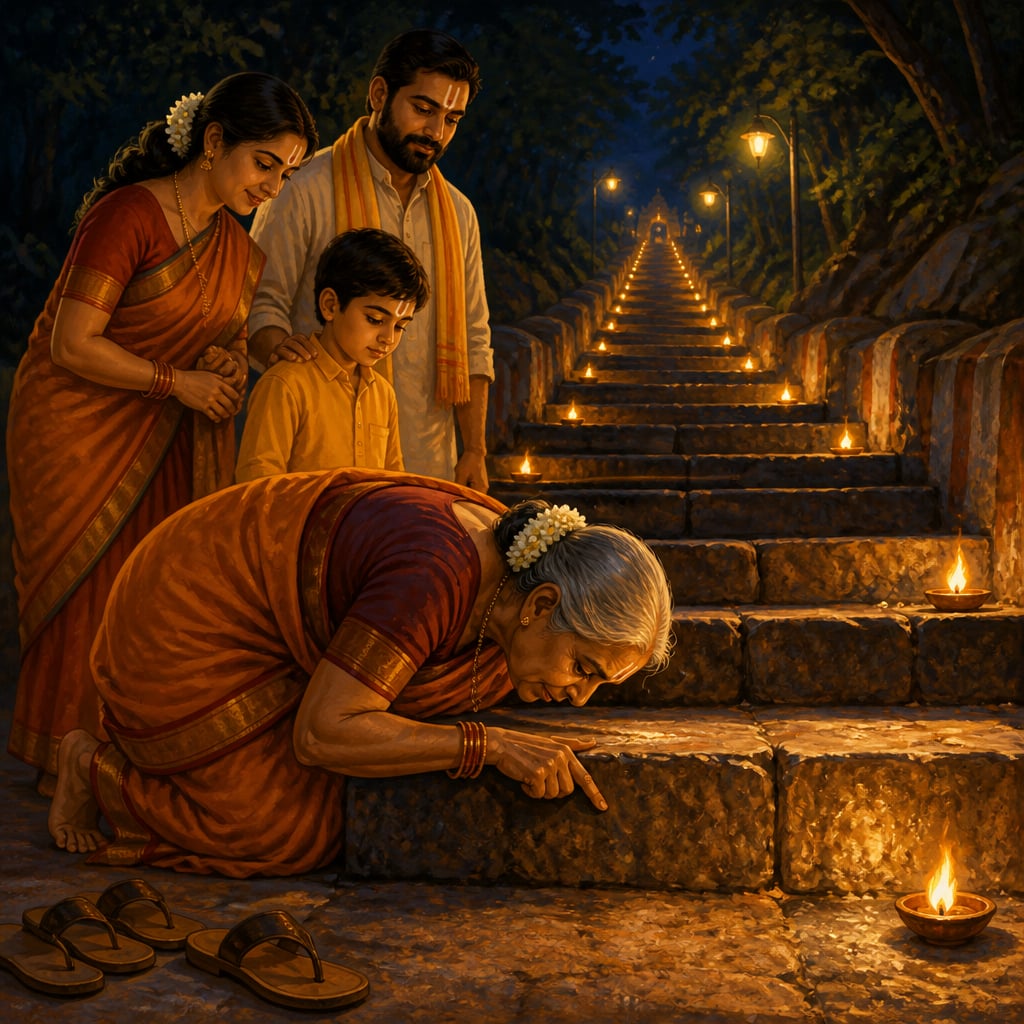
A family touching the first step at Alipiri

A grandmother, two parents, a boy of eight. They touch the first stone step with their fingers and then their eyes, the way their people have greeted thresholds forever. Ahead of them, rising into the dark, are 3,550 steps, about eleven kilometers of climbing path under old trees, past shrines and rest pavilions. Around them, other families are doing the same thing, and from somewhere up the path floats the cry that will accompany them all the way: Govinda! Go-o-vinda! The boy will count steps until he loses count. The grandmother has made this climb nine times. Some pilgrims light small camphor flames on the early steps; some smear them with vermilion and sandalwood, honoring the stones themselves.

There is a second, older footpath on the other side, the Srivari Mettu, shorter and steeper at about 2,388 steps, the route tradition associates with the deity's own ascent and with centuries of pilgrims from the western villages. Buses and cars now carry most visitors up the ghat roads in forty minutes. The family could afford the bus. They are walking because the walk IS the offering: the vow was made on foot, and this course has taught you the word for what they are doing, yatra, the journey that is itself the worship.

Every institution this course has shown you, the stories, the singers, the golden dome, the kitchen, the vault, exists for what happens at the top of these steps. So the course ends where every pilgrim ends: in the queue, and then before the god, and then going home. Walk it with them.

The Fairest Queue in the World

At the top, the family joins the largest standing crowd-management system in religious life.

Pilgrims waiting in the Vaikuntam Queue Complex

The Vaikuntam Queue Complex, built in the 1980s and expanded since, is a building that exists entirely to hold a line: halls where pilgrims sit in numbered compartments, released in batches toward the sanctum, with free meals served in the waiting halls, milk for children, medical posts along the way. Time-slotted tokens, introduced and refined over the decades, let a laborer's family book their hour the way the wealthy once booked influence. The climbers of the footpaths have their own darshan line, the walk earning a small precedence. And beneath all the engineering sits one persistent, radical promise: Sarva Darshan, the free general darshan, open to absolutely anyone, however long the line, always.

Understand what this system is actually managing. On an ordinary day, tens of thousands of strangers, on festival days close to a lakh, of every language, caste, class, and country, all want the same twenty seconds in front of the same eight-foot image in the same small dark room. There is no way to give everyone more time; there is only the question of whether the little there is gets distributed fairly. The temple's answer has been refined for centuries and it is the steward's final teaching: design for the last person in the queue. The grandmother from the bus and the day-laborer who climbed, the NRI software engineer and the boy of eight, funnel at last into the same stone corridor, past the golden doorway, into the presence, where every one of them, whoever they are outside, receives the same thing: a few seconds of the still, dark, ancient face, and the priests' call, already moving them on: jarugandi, jarugandi, keep moving, keep moving.

படியாய்க் கிடந்து உன் பவளவாய் காண்பேனே ॥

paḍiyāyk kiḍandu un pavaḷavāy kāṇbēnē

Let me lie as the doorstep at your shrine, and gaze forever on your coral mouth.

Kulasekhara Alvar, Perumal Tirumoli (the Tiruvenkatam decad)

Twelve centuries ago, a king from Kerala, Kulasekhara Alvar, one of the twelve Alvar poets from Chapter 2, sang that he wanted no throne on this hill: let me be the doorstep, he sang, so every pilgrim's foot falls on me and my eyes never leave the lord. The tradition answered him literally. The threshold at the sanctum's golden doorway is called the Kulasekhara padi, the Kulasekhara step, and every pilgrim in the queue, for centuries, has crossed the king who wanted to be crossed. It is the queue's own theology: on this hill, the highest ambition ever recorded was to lie down where everyone walks.

And the song the whole hill sings answers him. Annamacharya, five centuries ago, set the queue's truth to a dance-beat that Telugu children still learn: brahmam okate, the Absolute is one and the same, kanduvagu heenadhikamu indu levu, there is no high and low here; the same Hari dwells in everyone. Chapter 3 gave you the composer; the queue gives you what he was describing.

What the Hill Finally Proves

The family has had its twenty seconds. The boy got the laddu. They are going down the hill, lighter than they came. Now step back, all the way back, and look at what this course has actually shown you, because the closing thesis does not require you to believe anything the tradition believes.

Count only what the documents count. A shrine already famous when the earliest surviving inscriptions were cut in the ninth and tenth centuries. An endowment from a queen in 966 CE whose lamps are still, in the accounting sense, burning. A worship procedure organized nine centuries ago that ran this morning at half past two. A thousand inscriptions of donors and dittams; poets from the 800s whose songs are on this evening's concert programs; a family that has sung the same lullaby at the same door for five hundred years; a treasury counted daily in public; a kitchen whose recipe has the force of law; and through every dynasty, invasion, colonial handover, litigation, Act of legislature, and pandemic, not one missed morning that anyone can find in the record.

There are older buildings in the world, and there are older texts. What is vanishingly rare, what may be unique at this scale, is unbroken institutional function: the same organization, doing the same thing, at the same place, continuously documented, for a millennium, and currently operating at the largest scale in its history. Rome's temples are museums. The library of Alexandria is a metaphor. The hill is open tomorrow at half past two.

That is the rationalist's takeaway this course promised in its first lesson, and it needs no miracle: continuity itself is the civilizational story. A civilization is not proven old by its ruins; every land has ruins. It is proven alive by its unbroken threads, and this hill is the thickest one there is: legend and ledger, side by side, both still running.

The Venkateswara temple on a Pittsburgh hillside

The thread now runs past the hill itself. In 1976, in Pittsburgh, Pennsylvania, of all places, a community of Indian immigrants consecrated a Sri Venkateswara temple on a wooded hillside, among the first major Hindu temples in America, its deity and rites modeled on Tirumala's. Half a century later it is a pilgrimage site in its own right, and Venkateswara temples stand across the Americas, Europe, and Asia wherever the diaspora settled. The god who, in the stories, left Vaikuntha and crossed into Kali Yuga has kept crossing: the institution learned to travel, and the queue now forms in every time zone.

Where the Course Ends

End where Chapter 1 began. At the dawn of Kali Yuga, the sages asked which god could handle the age of quarrel, and the answer the tradition built is the one you have now walked through end to end: a god who lost his home, broke his family, borrowed for his wedding, and stood still on a hill between two households, unresolved, approachable, still paying his interest, still woken with a borrowed verse, still put to sleep with a lullaby. The Kali Yuga man's problems, the builder's, the creator's, the keeper's, the steward's: five chapters, five mirrors, one hill that has held them all for a thousand years, and holds them still.

At the bottom of the steps, the family is putting its slippers back on. The grandmother looks up once at the hill, the way you look at a member of the household. The boy asks whether they will come again. She says what nine climbs have taught her, and what the whole record of the hill says under oath: it will be here.

Case studies

One Voter in the Gir Forest: Fairness Designed for the Last Person

Deep inside Gujarat's Gir forest, at a place called Banej, lived a single registered voter: Mahant Bharatdas Darshandas, priest of a remote Shiva temple. Under Indian election law, no voter should have to travel beyond a prescribed distance to vote, so for election after election, the Election Commission of India dispatched a full polling team, officials, security, machines, into lion country, to set up a complete polling station for exactly one elector. The team traveled a day each way. The booth opened on time, observed every procedure, and closed having recorded, at most, one vote.

The Banej booth is sama-darshana as state practice, and the hill's queue ethic at national scale: a system's fairness is measured not at its center but at its farthest edge, by what the last, least, most inconvenient person receives. The Vaikuntam complex is built on the identical judgment: Sarva Darshan for absolutely anyone, free meals in the waiting halls, the laborer's family funneled into the same corridor as the industrialist's, the design cost of fairness paid without asking whether the last person 'justifies' it.

The one-voter booth became one of Indian democracy's most retold facts, cited by the Election Commission itself as the expression of its founding principle: no voter left behind, whatever the arithmetic. The mahant voted in election after election until his death, and the story outlived him as the standing answer to every argument that fairness should be rationed by cost-efficiency.

A system's real values are revealed at its edge cases. Design for the last person in the queue, and the design for everyone else takes care of itself; design for the average, and the edges, which is to say the vulnerable, quietly fall off.

Every service, product, and institution faces its Banej test: the customer the process was not built for, the user at the end of the worst connection, the patient farthest from the hospital. The queue on the hill and the booth in the forest give the same verdict on what to do about them.

For multiple general and state elections across the 2000s and 2010s, the ECI staffed a complete polling station at Banej, Gir forest, for an electorate of exactly one, likely the world's most famous single-voter booth.

The Clinic Where the Poorest Patient Isn't the Loser

Dr. Anjali runs a free evening clinic in a Hyderabad basti, and her queue is being gamed. Tokens are handed out at five, so daily-wage workers, who cannot leave work early, arrive to find the tokens gone, taken by those with flexible hours, some of whom could afford private care. The neediest patients are structurally last, every single day. Her volunteers propose the obvious fixes: come earlier, first-come-first-served is fair. Anjali knows better: first-come-first-served is only fair among people whose time is equally their own, and her queue contains no such people.

Anjali redesigns the way the hill designs: for the last person, not the average one. A block of tokens is reserved for after-seven arrivals, protecting the daily-wage worker's slot before he leaves the site; the oldest and sickest are triaged past the line entirely; a volunteer walks the queue with water and biscuits, the clinic's annadanam, because waiting itself has costs the poorest pay most. And one rule is painted on the wall in three languages: everyone sees the same doctor, for the same time, in the order of need and arrival, nothing else.

The gaming collapses within weeks: with the evening block protected, arriving at four buys nothing. The patient mix shifts visibly toward the workers the clinic existed for, follow-up compliance rises because patients trust they can return without losing a day's wages, and two other free clinics in the city copy the token design. The queue itself, patients notice, has become part of the treatment: the first place in their week where being poor does not mean being last.

First-come-first-served is only fair among equals; where people's time is unequally their own, honest fairness must be designed, deliberately, around the constraints of the least free.

Token systems, appointment apps, ration lines, school admissions, government counters: most Indian queues silently favor those with the freest time and the most information. The hill's Sarva Darshan and Anjali's evening block share the correction: find who is structurally last, and build their door first.

Living traditions

Tirumala's queue and pilgrim-services system, tokens, waiting halls, annadanam, volunteer seva, is studied in Indian operations and public-administration literature as the standing model of fairness engineering at scale, cited alongside the Kumbh Mela's crowd governance. The diaspora thread keeps lengthening: from Pittsburgh (1976) onward, Venkateswara temples across the Americas, Europe, and Asia reproduce the darshan, the prasadam, and increasingly the queue discipline, making the pilgrim's path the temple tradition's most successfully exported institution.

  • The Footpath Yatra: Pilgrims climb the Alipiri steps (3,550) or the Srivari Mettu (about 2,388) as vow and offering, many barefoot, with rest pavilions, shrines, and the Govinda chant accompanying the ascent; footpath climbers receive their own Divya Darshan queue entitlement.
  • Sarva Darshan and the Queue Complex: The free general darshan remains open to anyone without payment or booking, managed through the Vaikuntam Queue Complex's waiting halls with free meals, milk for children, and medical posts; time-slotted tokens and the volunteer Srivari Seva keep the line humane at up to festival-day scale.
  • The Kulasekhara Padi: The sanctum threshold named for Kulasekhara Alvar, honoring his sung wish to lie as the doorstep of the shrine; every pilgrim's darshan path crosses it, twelve centuries after the verse.

Reflection

  • The family walks eleven kilometers up 3,550 steps when a bus is available, because the walk is the offering. What in your life do you still do the long way on purpose, and what did you lose when you last accepted the shortcut?
  • In the queue, the industrialist and the day-laborer receive the identical twenty seconds. Where in your life do you receive unearned precedence, and where are you structurally last, and which of the two do you think about more?
  • The course's closing thesis is that continuity itself, a thousand documented years of unbroken function, is the civilizational story, needing no miracle. Is that a rationalist's consolation prize, or is it actually the larger claim?

More in The Living Institution: From Mahants to TTD

All lessons in The Living Institution: From Mahants to TTD · Tirupati Balaji ebook course