Hair and the Hundi
Tonsure, the Neela Devi legend, and where the world's largest temple treasury proves, daily, that the money goes where it should
Every morning, in a hall the public can watch, sealed bags from the temple's offering vault are emptied onto counting tables and tallied under cameras, coin by coin, note by note. A few streets away, thousands of pilgrims sit before barbers and give away the one ornament every human owns. The hundi and the tonsure are the temple's two great intakes, and the story behind them runs straight back to Chapter 1: the god's wedding loan, whose interest, the tradition smiles, is still being paid. This lesson follows the money and the hair, and asks the steward's hardest question: how do you handle wealth that is not yours, at a scale where nobody could check you, and stay checkable anyway?
The Counting Hall
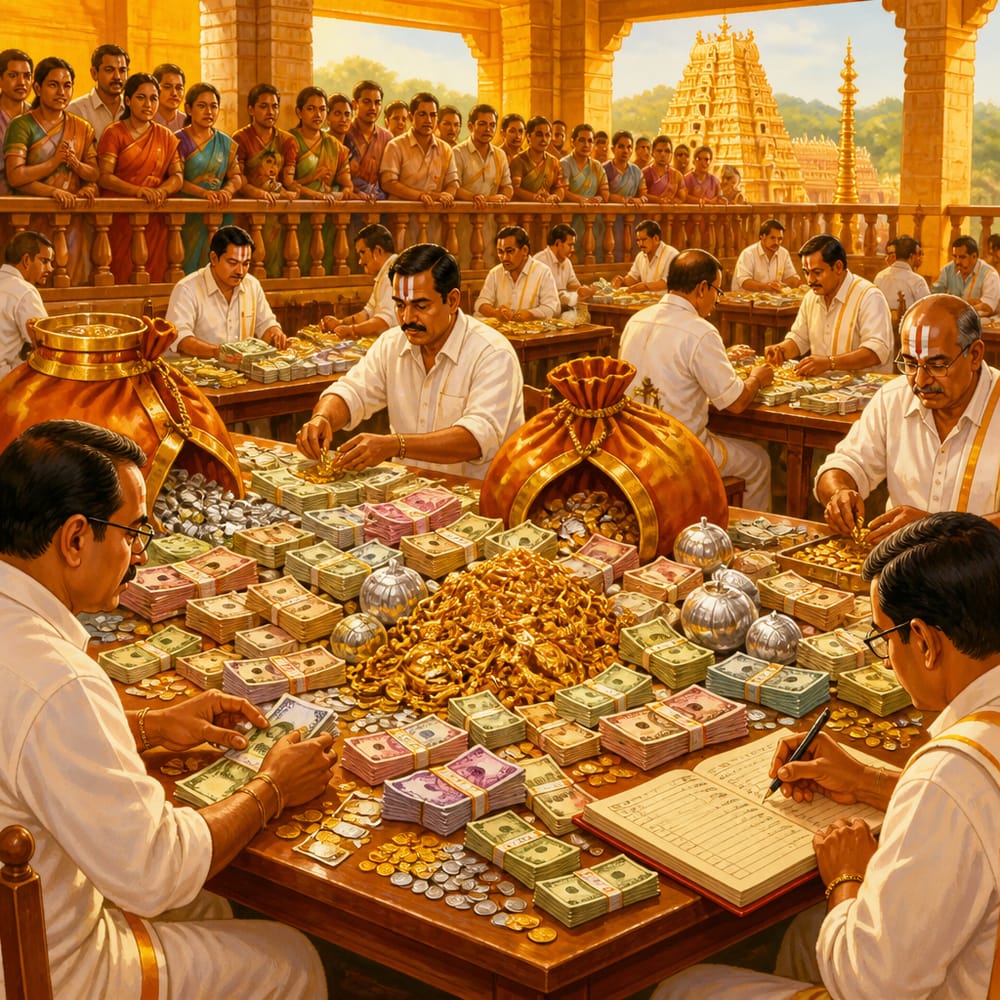
Every morning on the hill, after the crowds have surged toward the sanctum, a quieter procession happens in a room most pilgrims never think about. Sealed bags are carried from the Srivari hundi, the great offering vault that stands near the sanctum, to a counting hall called the parakamani. There, under cameras and supervisors, staff empty the bags onto broad tables and begin to count.
What comes out is India in miniature: bundled notes and single rupees, gold chains and silver coins, foreign currency, the occasional property deed, wedding jewelry given whole. The counters work in full view, in garments designed without folds or pockets, watched by officers, auditors, and closed-circuit cameras. Visitors can observe the counting through viewing arrangements. The day's total is recorded, reconciled, and published. Then it happens again tomorrow. The hundi's collections in recent years have run to over a thousand crore rupees annually, figures that vary year to year and are announced, year by year, by the administration itself.
Hold that image: the world's largest religious cash intake, counted daily, in public view. Nobody made the temple do this. That is the puzzle, and the teaching, of this lesson.
The Loan Behind the Vault
Why do lakhs of ordinary families, many far from rich, drop their savings into a brass-bound vault on a hill? The tradition's answer is a story you already know, because this course opened with it.
In Chapter 1, the god of the hill could not afford his own wedding. He borrowed from Kubera, the treasurer of the gods, with Brahma and Shiva as witnesses, on documented terms: the principal to be repaid by the end of Kali Yuga, the interest to be paid until then. The tradition holds, with a straight face and a smile at once, that the hundi is that repayment: every coin a devotee gives is helping the lord of the hill service his wedding debt. He is called, in Telugu, with real affection, the god who took a loan, vaddi kasula vadu, the one of the interest coins.
Enjoy the theology under the humor, because it is precise. The story makes the deity a debtor, permanently, publicly, until the end of the age. The greatest being in the tradition's universe is shown living inside obligation, servicing his commitments era after era, and every family that gives is not a beggar before a king but a creditor's helper, a participant in an honorable repayment. Giving here is not tribute extracted by power. It is solidarity with a god who understands EMIs.
श्रद्धया देयम् । अश्रद्धयाऽदेयम् । श्रिया देयम् । ह्रिया देयम् । भिया देयम् । संविदा देयम् ॥
śraddhayā deyam | aśraddhayā adeyam | śriyā deyam | hriyā deyam | bhiyā deyam | saṁvidā deyam
Give with faith; do not give without faith. Give with abundance, give with modesty, give with awe, give with understanding.
Taittiriya Upanishad 1.11
The Upanishad's instruction on giving is the hundi's user manual, three thousand years early: the gift's worth lies in the spirit of the giver, not the size of the coin. The vault takes the widow's rupee and the industrialist's gold on identical terms, and the counting hall weighs them identically: as trust.
The Hill of Hair
A few streets from the vault stands the temple's other great intake, and it takes something stranger than money.

At the Kalyanakatta, the tonsure halls, thousands of pilgrims a day, men, women, children, sit before barbers and give up their hair. On peak days the number runs into tens of thousands. The vow is old and the logic is the tradition's economics of sincerity: gold measures what you have, but hair, the one ornament every human owns equally, measures what you will surrender of yourself. A billionaire and a farm laborer are, for once, offering the identical thing.
The legend attached is tender, and this course labels it as legend. When the cowherd's blow struck the lord on the hill, the story goes, a princess named Neela Devi cut her own hair and gave it to cover his wound. Moved, the deity declared that whatever hair his devotees offered would be credited to her. One of the seven hills, Neeladri, carries her name. The offering every pilgrim makes at the Kalyanakatta is, in the story's accounting, still being forwarded to her.
And then legend hands over to ledger, in the pattern this course has followed from its first lesson. The hair does not vanish into sentiment. It is collected, sorted by length and grade, warehoused, and sold by the administration through open e-auction to the wig and hair-products trade, in which Indian temple hair, with Tirumala the largest single source, supplies markets around the world. The auctions have earned the temple hundreds of crores across recent years. The sincerest offering in the tradition is also a professionally managed commodity chain, and the temple sees no contradiction, because there is none: reverence for the gift and rigor about its value are the same respect. Sentiment without accounting would waste what the pilgrim gave; accounting without sentiment would forget why it was given.
Trust, Proven Daily
Now put the two intakes together and ask the steward's question directly. The temple handles other people's money at a scale, over a thousand crore a year in hundi offerings alone, plus the hair, the laddu counters, the endowments, at which no outsider could realistically check it. Why does it submit to daily public counting, annual audits, published budgets?
Because the administration understands what the money actually is. Every rupee in the vault is nyasa, the sacred deposit from the last two lessons: given to the deity, held by the institution, owned by no living person. And a deposit's keeper has exactly one asset: being believed. The lakhs who give do so because they believe the surplus becomes what the institution says it becomes, and on the hill the becoming is visible: the annadanam kitchens feeding every pilgrim free, the SVIMS hospital and the BIRRD orthopedic institute treating patients regardless of means, the schools and pathashalas, the university at the foot of the hill. The temple's transparency is not a compliance cost. It is the production of its only real capital, renewed daily, in public, on the counting tables.

The same understanding built one of modern India's most admired institutions. Aravind Eye Care, founded in Madurai in 1976 by Dr. Govindappa Venkataswamy, a retired army surgeon, runs on the hundi's economics: patients who can pay, pay; patients who cannot, are treated free or nearly free, funded by the paying stream, and the system publishes its outcomes and its numbers with unusual candor. On that trust engine Aravind grew into one of the largest eye-care networks on earth, performing lakhs of surgeries a year, the majority free or steeply subsidized. Cross-subsidy at scale runs on exactly one fuel, the payers' belief that the surplus truly reaches the poor, and Aravind, like the hill, learned that the belief must be earned continuously, with open books, or not at all.
The transferable law is short. Handling money that is not yours, the keeper's only protection, and the institution's only foundation, is proof, offered before anyone demands it. Trust demanded is suspicion deferred; trust proven daily compounds like the hundi itself.
Back in the parakamani, today's bags are empty, today's total is on its way to the ledger, and tomorrow's pilgrims are already climbing the hill with their offerings and their vows, still helping a god pay off his wedding, still trusting the counting hall with the result. One thing remains to be seen on this hill: the pilgrims themselves, lakhs of strangers, moving through one small ancient doorway with fairness. The last lesson of this course walks the pilgrim's path, from the first step at Alipiri to the twenty seconds before the murti, and asks what a thousand years of queues prove about the civilization that keeps them.
Case studies
Aravind Eye Care: Cross-Subsidy on Open Books
In 1976, Dr. Govindappa Venkataswamy, a retired army eye surgeon in Madurai, opened an eleven-bed clinic with a radical funding model: patients who could pay would pay, and their fees would fund free or nearly free surgery for those who could not. The model's weakness was obvious to every skeptic: why would the paying patients keep paying, at a hospital where most beds earn nothing, unless they were certain the surplus truly reached the poor and the quality never split into two tiers?
Aravind answered the way the parakamani answers: with proof offered before demand. One quality standard across paying and free patients, the same surgeons rotating across both, outcome and volume numbers published with unusual candor, and costs driven down relentlessly (including manufacturing its own intraocular lenses through Aurolab) so the cross-subsidy arithmetic stayed visibly honest. The paying patient at Aravind, like the pilgrim at the hundi, gives inside a system that shows its books.
Aravind grew into one of the largest eye-care networks in the world, performing lakhs of surgeries annually, the majority free or steeply subsidized, while remaining financially self-reliant, a case taught at Harvard Business School and studied worldwide as the standard demonstration that transparency is what makes cross-subsidy scale. Dr. Venkataswamy worked until his death in 2006; the institution, structured well past its founder, kept growing.
Cross-subsidy runs on exactly one fuel: the payers' proven confidence that the surplus reaches the poor. Publish the books, keep one quality standard, and the model compounds; hide either, and it dies in a generation.
Every institution that pools money across the fortunate and the needy, hospitals, schools with scholarships, cooperative funds, temples, lives or dies by Aravind's rule: the generosity of the many is a renewable resource only where the accounting is visible to the many.
Founded 1976 with 11 beds; Aravind now handles millions of outpatient visits and performs several lakh surgeries a year, with roughly half or more provided free or at deep subsidy, funded by the paying stream without dependence on donations.
The Man Who Published Every Rupee
Raghav, a soft-spoken accounts clerk, is volunteered into managing his apartment community's common fund in Kochi: maintenance dues from ninety flats, a corpus for repairs, festival collections. His predecessor, a respected retired banker, kept honest books that nobody ever saw, and left amid murmurs anyway: the lift contract that went to a relative's firm, the festival accounts that were 'all settled, don't worry'. Nothing was ever proven, and that was exactly the problem: nothing was ever provable, either way. Raghav inherits the ledger, the corpus, and the residue of suspicion.
Raghav applies the parakamani principle: proof before demand. He publishes the full accounts monthly on the notice board and the residents' group, every rupee in and out, named and dated; he moves all payments to traceable transfers; he institutes two-signatory withdrawals (the second key from this chapter's first lesson); and he opens the quarterly review to any resident who wishes to sit through it. Some months, nobody comes. He publishes anyway, because the point is not attendance. The point is that anyone COULD check, any month, and everyone knows it.
The change is slow and then total. Dues compliance rises because nobody can suspect the fund; the murmuring stops because there is nothing unprovable left to murmur about; and when a major roof repair needs a special collection, ninety flats pay within three weeks, an outcome the previous committee, with its honest but invisible books, could never have achieved. When Raghav hands over four years later, the transparency practices, not the corpus, are what the residents insist the successor continue.
For a keeper of others' money, honesty is necessary but not sufficient: honesty must be inspectable. Invisible integrity and invisible fraud look identical from the outside, and communities can only fund what they can see.
Housing societies, school committees, temple funds, chit groups, family pools: India runs on small shared treasuries, and most of their conflicts trace to unprovable stewardship rather than actual theft. The daily-counted hundi is the scalable answer, at every scale: publish before asked, and suspicion has nowhere to live.
Living traditions
The hundi-to-hospital circuit, anonymous giving counted in public and spent on annadanam, SVIMS, BIRRD, schools, and the university, has made the TTD a standing case study in Indian public finance and nonprofit governance: proof at the largest scale that religious giving, transparently handled, functions as public infrastructure. The e-auctioned hair trade likewise appears in economics writing as the textbook example of an institution holding reverence and market rigor together without letting either corrupt the other.
- The Daily Parakamani Counting: Sealed bags from the Srivari hundi are carried to the counting hall and tallied daily under cameras, supervisors, and audit, with totals recorded and periodically announced; the practice runs every day of the year, festival or ordinary.
- Tonsure at the Kalyanakatta: Pilgrims fulfill hair-offering vows at the Kalyanakatta complex and its satellite halls, served by thousands of barbers in shifts; the hair is collected, graded by length, warehoused, and sold through periodic e-auctions.
- The Srivari Hundi: The great cloth-and-brass offering vault into which pilgrims drop cash, gold, silver, documents, and vows, emptied under seal for the daily counting; its collections in recent years have exceeded a thousand crore rupees annually, alongside the hair, prasadam, and endowment streams.
Reflection
- The hundi accepts the widow's rupee and the industrialist's gold anonymously, on identical terms, and the Upanishad grades gifts only by the spirit of the giver. When you give, anywhere, how much of the gift is the giving, and how much is being seen to give?
- Where do you currently hold something that is not yours, money, authority, another's secret, a family's trust, and if someone asked you to prove your stewardship today, could you? Would you volunteer the proof before being asked?
- The tradition could have imagined a god beyond all need, and instead gave Kali Yuga a god in debt, paying interest until the age ends. What does a civilization gain by worshipping obligation honorably carried, rather than perfection untouched by need?