The Birth of TTD
From the Hathiramji Mahants to the 1932 Act: how a temple outgrew every form of ownership
In 1843, a colonial government that no longer wanted to run a Hindu temple handed the hill to the head of a mutt founded in a dice-player's name. For ninety years the Mahants of the Hathiramji Mutt administered the shrine, and the shrine kept growing until no single man could be trusted with it, however honest. The 1932 Act that created the Tirumala Tirupati Devasthanams answered the question every founder eventually faces: when does the thing you built need governance bigger than you?
The Government That Wanted Out
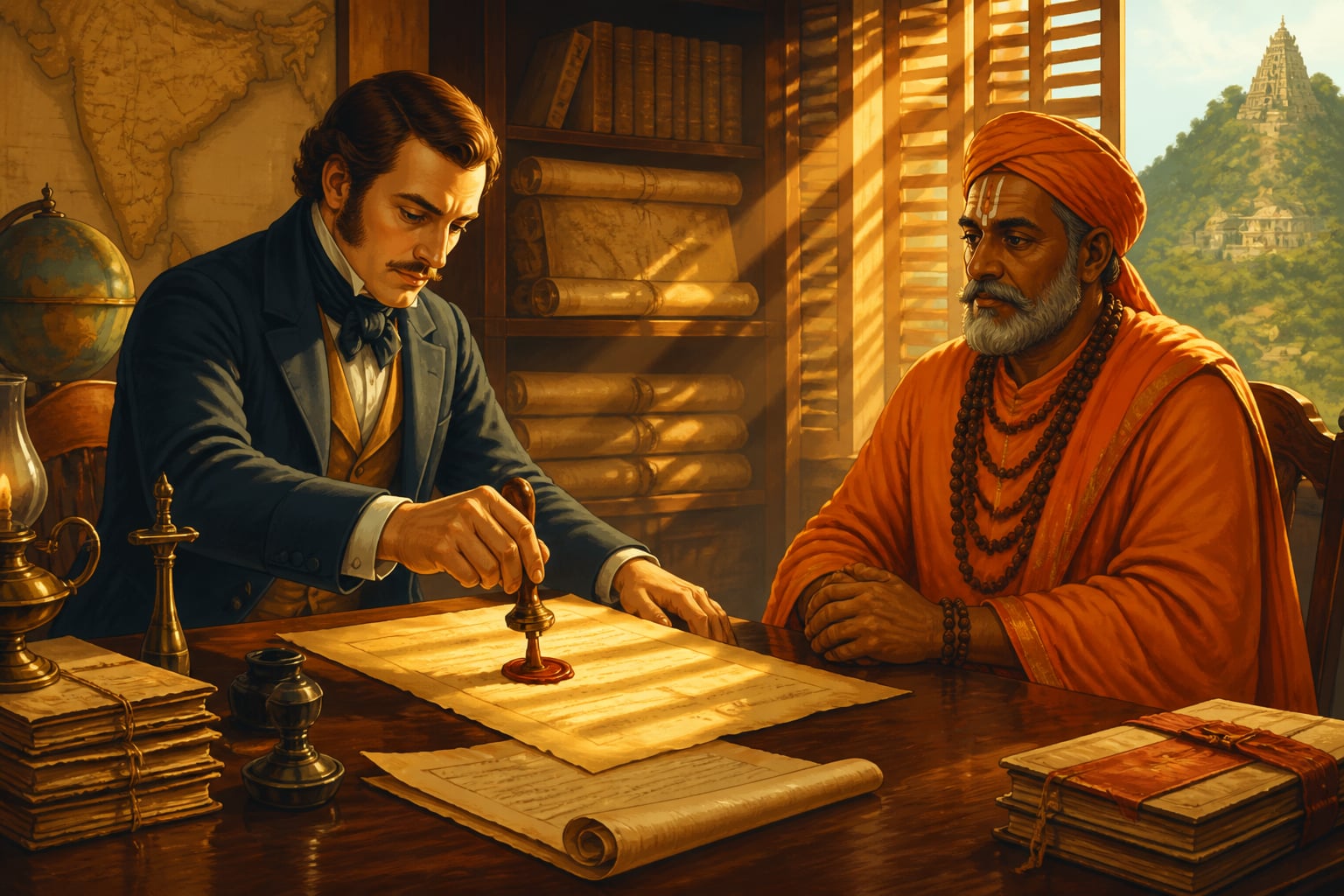
In 1843, in the offices of the East India Company's Madras administration, a strange transfer was drawn up: a colonial government was giving away the richest temple in its territory.
For decades after taking this part of the country, the Company had administered Tirumala itself, collecting the pilgrims' offerings and paying the temple's costs, because the revenue was too large to ignore. Then the pressure reversed. Missionary societies and officials in London objected loudly to a Christian trading company managing the shrine of what they saw as a rival faith. The Company decided to wash its hands. But you cannot simply drop the busiest temple in the South. Someone must hold it.
The someone they chose was Seva Dossji, head of the Hathiramji Mutt, the monastery founded in the name of the dice-playing sadhu you met in Chapter 3. The transfer made him vicharanakarta, the administering trustee of the hill. From 1843 to 1933, for ninety years, the Mahants of this mutt ran the temple of Venkateswara: its rituals, its lands, its treasuries, its disputes.
Hold the strangeness of that morning in view. A foreign trading company, by walking away, made a single line of monks the keepers of the subcontinent's greatest sacred treasury, with no board above them, no published accounts, and no exit clause. What happens next is the steward's story this whole chapter tells.
Ninety Years of Mahants
The Mahant era was not a dark age, and this course will not tell it as one. The Mahants kept the rituals running, and the daily clock of Chapter 4 did not miss its mornings on their watch. Some were able administrators. Under their long tenure the pilgrim traffic grew, the choultries (rest houses) multiplied, and the temple's fame spread on the new railways.
But the arrangement had a flaw that had nothing to do with any individual Mahant's character, and everything to do with design. The institution had one keeper, and the keeper had no keeper. Everything depended on who the Mahant happened to be. The nineteenth and early twentieth centuries brought what that design always brings: succession disputes inside the mutt, litigation over temple lands and funds, allegations answered by counter-allegations, courts asked again and again to settle what the structure itself could not. Some Mahants served with distinction. Others left the courts busy. The record, preserved in decades of Madras legal proceedings, is exactly the record you would predict: a lottery, drawn once a generation, with a civilization's shrine as the stake.
Meanwhile the thing being kept had changed size. By the 1920s the hill's annual income had grown far beyond what any nineteenth-century arrangement had imagined. The offerings of lakhs of pilgrims were flowing through structures built for a monastery's simplicity. The question was no longer whether the current Mahant was honest. The question was why the honesty of one man should ever be the load-bearing wall of something this large.
तेन त्यक्तेन भुञ्जीथा मा गृधः कस्यस्विद्धनम् ॥
tena tyaktena bhuñjīthā mā gṛdhaḥ kasyasvid dhanam
Enjoy it by renouncing it. Do not covet: whose is this wealth?
Isha Upanishad, verse 1
The Upanishad's question, whose is this wealth, is the exact question the 1920s were asking about the hill. The pilgrims' offerings belonged to the deity, which is to say: to no living person at all. And property that belongs to no living person is precisely what the law calls a trust, and precisely what needs a structure, not a saint.
The 1932 Act

The answer came from the Madras legislature. After years of inquiry and debate, the Tirumala Tirupati Devasthanams Act of 1932 ended the Mahant administration and created something the hill had never had in its thousand documented years: a governing institution that was not a person.
Read what the Act actually built, because its architecture is the lesson. Not a new owner, a structure: a committee of trustees to hold the temple, a paid commissioner accountable to the government for its administration, and, in the decades that followed, through successor Acts of 1951 and 1987, the modern form: a Board of Trustees that sets policy and an Executive Officer, a civil servant, who runs the machinery and can be audited, transferred, and replaced. Power was split from execution. Tenure was made temporary. Accounts were made inspectable. No individual, however holy, would ever again hold the hill alone.
In 1933 the last Mahant handed over charge, and the Tirumala Tirupati Devasthanams, the TTD, took up the administration it holds today. Note carefully what did NOT change: the archakas kept their hereditary service, the agamas kept the ritual, the Suprabhatam was sung the next morning at the same hour. The 1932 Act did not touch the garbha-griha, the untouchable core from Chapter 4. It rebuilt only the outermost ring: who guards the treasure, and who guards the guards.
What Governance Bought
Skeptics of committees, and every founder is one, should look at what the structure made possible, because none of it was possible under one-man keeping.

Under TTD administration the hill became the platform for institutions at a scale no Mahant could have attempted: a university at its feet, Sri Venkateswara University, founded in 1954 with the temple's support; hospitals, including the SVIMS medical sciences institute and the BIRRD orthopedic hospital, treating lakhs; schools and Veda pathashalas; a publishing house; the reforestation of the once-bare hills into protected green cover; and the annadanam that feeds every pilgrim without charge. The next three lessons walk through the machinery: the kitchen, the treasury, the queue. All of it stands on the unglamorous legal architecture of 1932.
Here is the steward's principle underneath, and it transfers to everything you will ever build. Founding and governing are different skills, and the transition between them is a design problem, not a betrayal. A founder's discretion is exactly right when the thing is small: fast, personal, whole-hearted. The same discretion becomes the single point of failure when the thing grows past one lifetime's honesty. The mark of a mature institution is that it no longer requires its leaders to be saints, because the structure itself, split powers, short tenures, open books, does the work that sainthood was doing.
Modern India learned the same lesson in its corporate age. Infosys, built by N. R. Narayana Murthy and his co-founders into the flagship of Indian software, faced its version of 1932 in 2014: the founders' generation stepped back and the board appointed Vishal Sikka, the company's first chief executive from outside the founding families. The handover was imperfect and publicly argued over, real transitions are, but the underlying judgment was the one the Madras legislature made: a great institution must be able to outlive the people who made it great, and that ability has to be designed, in writing, before it is needed.
Back on the hill, the 1843 transfer paper has long since yellowed in the archives, and the office it created is gone. What remains is the thing both the Mahants and the Act were trying, in their different centuries, to serve: the temple, still open, still solvent, still singing at half past two. The institution finally learned to guard its guards. How it guards a recipe, of all things, with courtrooms if necessary, is the next lesson.
Case studies
Infosys, 2014: The Founders Step Back
Infosys was built from a 1981 apartment startup into the flagship of Indian software by N. R. Narayana Murthy and his co-founders, who for three decades passed the chief executive's chair among themselves. By the 2010s the arrangement was straining: the founder bench was aging, growth had slowed, and the question every founder-led institution eventually faces had arrived: is this company a family possession or a public institution? In 2014 the board appointed Vishal Sikka, the first CEO from wholly outside the founding group, and the founders' generation formally stepped back from management.
This is the 1932 moment in corporate form. The Madras legislature's judgment about the hill, that no institution of public trust should have its honesty depend on who its keeper happens to be, is the same judgment a board makes when it professionalizes succession: separate ownership from execution, make tenure temporary, make performance inspectable. And like the Mahant transition, it tested whether the founders meant the institution's independence or merely announced it.
The transition was real and imperfect, exactly as the lesson predicts transitions are: Sikka's tenure ended in 2017 amid public disagreement with the founders over governance style, the board held, a successor (Salil Parekh) was appointed through process rather than bloodline, and the company, worth many times its 2014 value since, has now outlived its founders' management for over a decade. The structure absorbed even the quarrels about the structure.
An institution has truly been founded only when it can survive its founders, and that survival must be designed in writing, before it is needed, not improvised in a crisis.
Every family firm, startup, NGO, and temple trust hits its 1932: the moment the thing outgrows the honesty of one bench. The choice is never whether the founders were good, it is whether the structure stops needing them to be.
Infosys has been led by non-founder CEOs continuously since 2014, following 33 years (1981 to 2014) in which every chief executive was a co-founder.
The NGO That Outgrew Its Family
Sarla founded a school-lunch NGO in Nagpur twenty-two years ago with her husband's savings and her sister's kitchen. It now feeds forty thousand children a day across three districts, employs two hundred people, and receives government grants and CSR money that dwarf its founding corpus. The board is Sarla, her son, her sister, and two old friends. Nothing is wrong, yet: accounts are honest, the food is good. But a grant officer has flagged the governance structure, her son and a senior cook disagree about who decides menus, and Sarla is sixty-eight and tired. Well-wishers tell her the family board IS the organization's soul. The grant officer tells her it is now the organization's biggest risk.
Sarla's NGO is the hill in 1925: nothing has failed, and everything depends on nothing failing. The steward's question is not whether Sarla is honest, she is, but why forty thousand children's lunches should have her honesty as their single load-bearing wall. The dharmakarta frame dissolves her guilt: handing over is not abandoning the child she raised; it is completing the founding, because what she holds was always a nyasa, a trust, never a possession.
Sarla does her own 1932 while she is still strong enough to shape it: an independent board with a majority of outside members, a hired chief executive answerable to it, term limits that apply to family and outsiders alike, and published annual accounts. Her son leads one district on merit and reapplies like anyone else. When Sarla dies six years later, the kitchens do not miss a single day, which her obituaries correctly report as her greatest achievement.
The kindest time to build governance bigger than yourself is while you are still there to teach it what you know. Founders who wait for the crisis leave their successors both the crisis and the structure-building.
India's charitable and religious institutions hold enormous public trust in family hands. The Tirumala precedent is the hopeful one: the handover from persons to structure, done deliberately, is how the founding generation's work becomes permanent instead of mortal.
Living traditions
The TTD is now among the most studied religious administrations in the world: its Acts, board structure, and audit practices are cited in Indian law and public administration as the template for governing sacred institutions at scale. The deeper legacy is the precedent itself: that a sacred trust CAN move from personal keeping to designed governance without breaking its ritual continuity, the hill having run the experiment for nine decades and counting.
- The Board and the Executive Officer: The TTD continues to operate under the split structure this lesson describes: a government-appointed Board of Trustees setting policy and an Executive Officer, a serving civil servant, administering the temple, its institutions, and its finances under statutory audit.
- The Hathiramji Mutt Today: The mutt that once administered the hill continues as a religious institution in Tirupati, its history intertwined with the temple's; its founding legend and its ninety years of administration are both part of the hill's told story.
- The Institutions on the Hill's Account: Sri Venkateswara University (1954), the SVIMS medical institute, the BIRRD orthopedic hospital, schools, Veda pathashalas, museums, and the reforested Seshachalam slopes all operate under or trace their founding to TTD administration: the deity's surplus converted into public infrastructure.
Reflection
- The Isha Upanishad asks: whose is this wealth? Take an honest inventory of what you 'own', roles, money, even relationships, and ask which of them you actually hold in trust for someone or something beyond you.
- Where in your own life are you the Mahant: the single trusted keeper of something with no structure around you? What would building your own 1932, voluntarily and early, look like?
- The 1932 Act bet that structure could do what sainthood had been doing. Can institutions actually substitute design for virtue, or do even the best structures quietly depend on enough people being good?