The Laddu
The potu kitchen, the dittam that fixes the recipe like ritual law, and the prasadam that won its own court protection
Before most of India wakes, the fires of the potu, the temple's ancient kitchen, are already lit, and cooks are shaping a sweet whose recipe has the force of ritual law. The dittam, the fixed schedule of ingredients and proportions, is a document with centuries of ancestors in the temple's inscriptions. And in 2009 the Tirupati laddu received a Geographical Indication tag, making a prasadam a legally protected name. This lesson follows the sweet from the kitchen to the courtroom and asks the steward's question at its center: how do you protect quality at scale, and when does a tradition need a legal fence?
Four in the Morning, in the Potu
The deepest room of the temple after the sanctum is a kitchen.
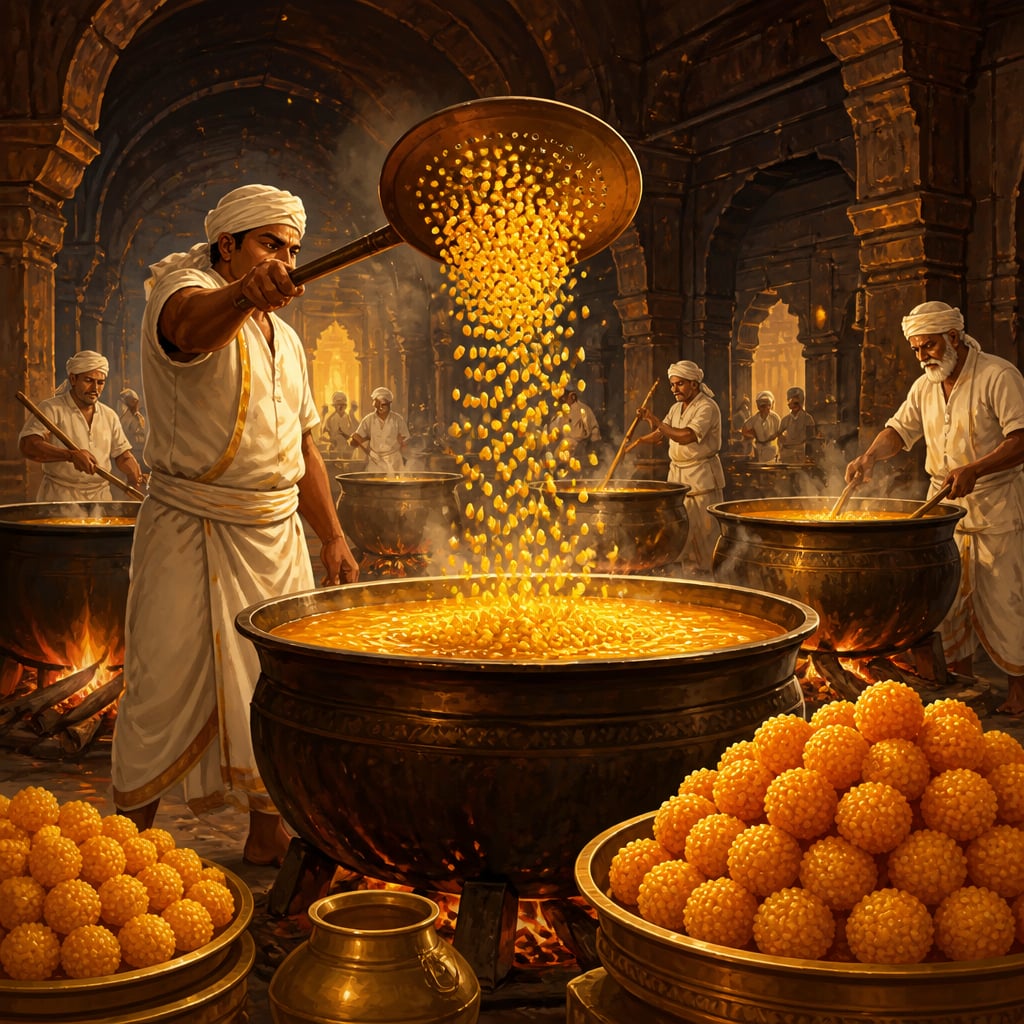
It is called the potu, and its fires are lit before most of India wakes. Step inside, as far as anyone but its cooks may: the air is thick with ghee, woodsmoke, and cardamom. Great iron pans the width of a man's arms hiss as batter streams through perforated ladles into hot ghee, forming the golden droplets called boondi. Along the walls, men whose fathers and grandfathers worked these same fires fold the boondi with sugar syrup, cashews, raisins, and crystal sugar, and press it by hand into spheres. Each sphere must satisfy a scale and a standard older than anyone in the room.
By day's end, the potu will have made roughly three lakh of them. Tomorrow, the same. The sweet is the Tirupati laddu, and if you have ever met anyone who visited the hill, you have probably met the laddu, because the pilgrimage is not felt to be complete until the prasadam reaches the family at home.
Here is the puzzle this lesson exists to solve. Every cook knows recipes drift. Every family knows the grandmother's dish is never quite the same in the granddaughter's kitchen. Every business knows quality erodes at scale, quietly, corner by corner. The laddu has been made at industrial volume, by hand, for generations, and it has not drifted. Why not?
The Dittam: A Recipe with the Force of Law
The answer is a document, and the document has a name: the dittam.
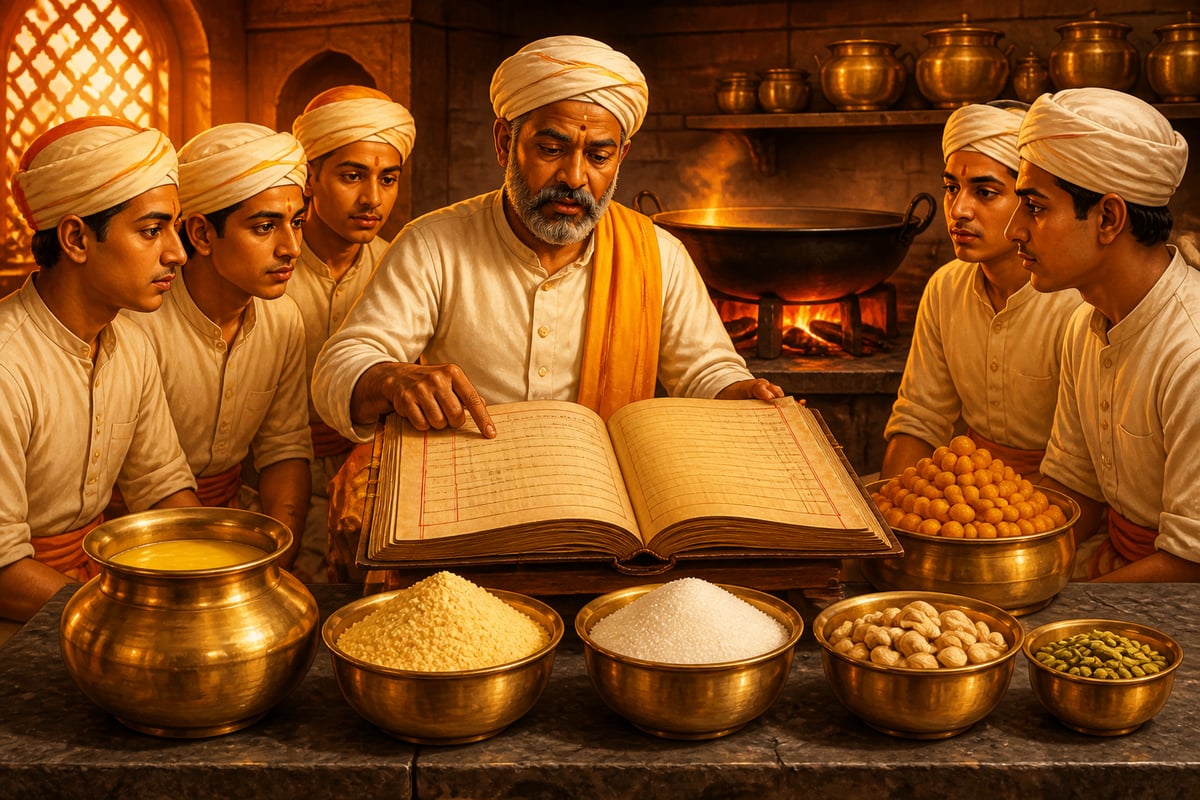
The dittam is the fixed schedule of the offering: which ingredients, in what proportions, in what quantities, prepared in what manner. Besan (gram flour), ghee, sugar, cashews, raisins, cardamom, sugar candy, in ratios that are not the head cook's opinion but the institution's law. Changing the dittam is not a kitchen decision. Historically it required the temple administration's formal sanction, and the temple's inscriptions, the same thousand-record stone ledger you know from Chapter 2, preserve centuries of exactly such sanctions: endowments specifying naivedyam offerings down to measures of rice, ghee, and pulses, dated and signed. Samavai's grant of 966 CE specified offerings; a fifteenth-century record attests a fried prasadam of the boondi family; the laddu in its familiar modern form has been the hill's signature since about 1940.
Pause on what the dittam actually is, because it is the steward's first tool. A standard is a promise written down so that no individual can lower it, and no individual has to defend it. The head cook of the potu never has to argue with a supplier about cheaper ghee, or with a manager about stretching the cashews in a lean month. The dittam has already had that argument, once, for everyone, forever. The cook's job is not to decide the standard; it is to meet it. That separation, standard-setting above, execution below, is exactly the split you saw in the last lesson between the Board and the Executive Officer. The potu had the architecture first.
यज्ञशिष्टाशिनः सन्तो मुच्यन्ते सर्वकिल्बिषैः । भुञ्जते ते त्वघं पापा ये पचन्त्यात्मकारणात् ॥
yajña-śiṣṭāśinaḥ santo mucyante sarva-kilbiṣaiḥ bhuñjate te tv aghaṁ pāpā ye pacanty ātma-kāraṇāt
The good, who eat what remains of the offering, are freed from all faults; but those who cook for themselves alone eat their own wrongdoing.
Bhagavad Gita 3.13
The Gita's verse is the theology under the kitchen: food cooked as offering first, for eating only afterward, is a different category of thing from food cooked for sale. The laddu is naivedyam, offered to the deity before a single pilgrim receives one. That is why the recipe is ritual law rather than product specification, and why the cooks' families have treated tending the dittam as seva, worship, for generations. The quality control was never really the document. It was what the document was FOR.
The Sweet That Went to Court
Now move from the kitchen to a very different room: the office of the Geographical Indications Registry, Chennai, in the late 2000s.

A Geographical Indication, a GI tag, is a legal protection invented for things like Champagne and Darjeeling tea: names that belong to a place, where the place itself, its materials, methods, and community of makers, is what guarantees the quality. Only makers in that place, following the registered specification, may use the name.
In 2009, the Tirupati laddu received its GI tag. The application, made by the TTD, did what GI law requires: it put the potu's craft into legal language, the place of making, the method, the standard. From that point, 'Tirupati laddu' ceased to be a name anyone could print on a box. Sweet shops around the temple towns had long sold imitations trading on the name; the tag gave the institution a legal fence around what the dittam had always protected in fact.
The decision drew argument, and the argument is worth teaching honestly. Critics asked whether a prasadam, a sacred gift, should be an intellectual-property asset at all: does a blessing need a trademark? The institution's answer was the steward's answer. The protection was not commercial ambition; the laddu is sold at subsidized prices, and lakhs are simply given away. The fence exists because the name carries a promise, that this sweet was made in the potu, offered in the sanctum, to the standard of the dittam, and a promise that anyone may counterfeit is no promise at all. A pilgrim's grandmother in Vijayawada, handed a fake in a look-alike box, is not a trademark statistic. She is a broken trust.
India had tested this logic before, on a hillside crop instead of a hilltop sweet. Darjeeling tea became India's first registered GI in 2004, after decades in which the world market sold several times more 'Darjeeling' than the Darjeeling hills actually grew. The GI, and the certification regime around it, gave one word back its meaning: tea from those slopes, made by those gardens, to that standard. The laddu's tag stands in the same line: the law catching up to what a community of makers had always known, that the name IS the standard, and losing control of the name means losing the standard silently, everywhere, at once.
Quality at Scale: The Steward's Second Answer
Step back and assemble the lesson's machinery, because together the dittam and the GI answer one of the hardest questions any maker faces.
Everyone who makes something good eventually meets the temptation of scale, and scale kills quality through a hundred small mercies: the slightly cheaper ingredient no one will notice, the step skipped on the busiest day, the licensee who mostly follows the method. Each mercy is invisible; their sum is the grandmother's dish that no longer tastes like anything. The potu's answer has two halves, and both transfer:
- Inside the walls: a dittam. Write the standard down, above any individual's authority to lower it, and make meeting it a matter of identity, seva, not negotiation. The busiest festival day, you already know from Chapter 4, uses the same recipe as the emptiest Tuesday.
- Outside the walls: a fence. Where the standard travels under a name, protect the name legally, because outside your walls the dittam cannot see, and the counterfeit spends YOUR centuries of trust.
Notice also what the potu refused: it never franchised. The laddu is made in one kitchen, on one hill, by one community of cooks, at whatever volume that kitchen can honestly sustain. Growth pressed against the standard, and the standard won: the TTD expanded the potu itself, mechanized the peripheral steps, and kept the shaping hands and the dittam. Scale bent around quality, not the reverse. That choice, boring, expensive, permanently tempting to reverse, is why the promise is intact after generations at three lakh a day.
Back in the potu, the morning's boondi is streaming into the ghee, under a recipe with the force of ritual law and, since 2009, of civil law too. The sweet in the pilgrim's cloth bag going down the hill carries all of it: the dittam, the tag, the fires, the promise kept. And it was paid for, most of it, by the little cloth-wrapped bundles going the other way, into the temple's offering vault. What happens to those, the hair, the hundi, and the world's most transparent sacred treasury, is the next lesson.
Case studies
Darjeeling Tea: Giving a Word Back Its Meaning
By the late twentieth century, the Darjeeling hills' tea gardens produced a limited crop of one of the world's most distinctive teas, and the world market sold a multiple of that volume under the name 'Darjeeling'. Blends with little or no Darjeeling content wore the name freely across Europe and beyond. The gardens' generations of craft, high-altitude plucking, orthodox processing, the muscatel character no other terroir produces, were being spent by strangers, and the price premium the name earned was flowing to counterfeits. The Tea Board of India responded with certification marks and, when India's GI Act came into force, registered Darjeeling tea as the country's first Geographical Indication in 2004.
Darjeeling's problem was the potu's problem at national scale: the standard lived inside the gardens, but the NAME traveled the world unguarded, and outside the walls the dittam cannot see. The GI is the legal fence this lesson describes: it binds the name to the place, the method, and the community of makers, so the word itself becomes uncounterfeituable. The tea's protection and the laddu's 2009 tag are the same steward's move, five years apart.
The GI and certification regime gave the Tea Board standing to pursue misuse of the name in markets worldwide, including protracted, partly successful campaigns in Europe, where 'Darjeeling' later gained EU protected-status recognition. Misuse persists and enforcement is a permanent expense, which is itself the honest lesson: a fence is not a wall, it is a right to keep defending, and the alternative, an undefended name, loses its meaning silently and forever.
When your quality travels under a name, the name is the asset: protect it legally before strangers spend it, and budget for defending it forever after.
Every maker whose reputation outgrows their walls, a region's crop, a temple's prasadam, a studio's craft, a family firm's label, faces Darjeeling's arithmetic: the better the name, the bigger the incentive to fake it, and the fence must arrive before the fakes do.
Darjeeling tea became GI No. 1 in India's registry (2004); estimates during the campaign held that 'Darjeeling' sold worldwide exceeded the hills' actual annual production severalfold, the gap being counterfeit trading on the name.
The Sweet Shop That Almost Franchised
Bhagyamma's sweet shop in Rajahmundry has made one thing supremely well for forty years: a bobbatlu (stuffed sweet flatbread) people drive across districts for. Her grandson Karthik, home with an MBA, brings a franchising proposal: forty outlets across Andhra in three years, a central commissary, licensed operators, projected revenue that would make the family wealthy. The bank is willing. The family is dazzled. Bhagyamma reads the operations manual's line, 'operators shall substantially follow the standard recipe', and asks Karthik one question: who, in outlet number thirty-one, on a busy Tuesday, argues with the supplier about the ghee?
Bhagyamma has spotted what the potu's design solves: a standard is only as strong as the authority that refuses to lower it, and 'substantially follow' is a dittam with the force of a suggestion. The potu's counterexample is precise: it never franchised; it scaled the one kitchen it could govern, mechanized the periphery, and kept the shaping hands and the fixed recipe under one roof where the standard could see.
The family compromises, in the potu's direction. No franchises: instead a single larger kitchen in Rajahmundry, a written dittam of the recipe that only Bhagyamma (and later, a family standards council) may amend, refrigerated dispatch to a handful of company-run counters, and a registered trademark so the name cannot be borrowed by the imitators who have already appeared. Growth is slower than Karthik's projections and the quality is identical everywhere, which, five years on, turns out to be the projection that mattered: the counters sell out daily on reputation the franchises would have spent.
Scale is a decision about what bends: either growth bends around the standard, or the standard bends around growth. Choose consciously, in writing, while the choice is still yours.
The franchising fork faces every craft that gets famous: restaurants, tutors, clinics, studios. The potu model, one governed kitchen, mechanized periphery, protected name, honest ceiling on volume, is the tradition's tested answer, and its costs are real, visible, and worth pricing before signing the other path.
Living traditions
The laddu's GI made it the standing case study, cited in Indian IP law teaching and policy discussion, for whether and how sacred and community goods should use intellectual-property protection. The potu's operating model, one governed kitchen, written standard, protected name, scale bent around quality, has likewise entered management discussion as the counter-template to franchise-led growth: proof at three lakh units a day that hand-made and standardized are not opposites.
- The Daily Naivedyam and Laddu Distribution: The potu prepares the day's offerings for the naivedyam bell, and laddus are distributed to pilgrims at dedicated counters after darshan, subsidized as prasadam, with volumes rising during festivals; the pilgrimage is customarily completed by carrying laddus home to family.
- Annadanam: The Free Kitchen: The TTD's annadanam serves free meals daily to pilgrims in the thousands, funded by endowments and the hundi surplus, alongside free milk, and expanded feeding during festivals.
- The Potu: The sacred kitchen stands inside the temple's ritual boundary, its fires and cooks part of the shrine's ritual life; its location is now also written into the laddu's GI specification, making the room itself part of the legal definition.
Reflection
- The Gita says food cooked for offering and food cooked for oneself are different things, whatever the ingredients. Across your own work, what are you cooking for the offering, and what are you cooking only for yourself?
- Where in your life is a standard currently eroding through small mercies, the skipped step, the stretched batch, the busy-day exception, and what would writing its dittam cost you?
- Critics asked whether a prasadam should ever be an intellectual-property asset: does a blessing need a trademark? The institution answered that a promise anyone may counterfeit is no promise at all. Who is right, and can both be?