Two Homes, Seven Hills
Lakshmi returns, Padmavati stays at Tiruchanur, the god stands as stone, and Sheshachalam coils beneath it all
The chapter's finale refuses to end the way stories are supposed to. Lakshmi arrives from Kolhapur to find her husband married; the confrontation between the goddess who left and the bride who came resolves nothing, and the god caught between them turns to stone on the spot. The lesson reads the tradition's most honest ending, two households, an unresolved bind, a deity who stays anyway, and the seven hills that hold it all up.
The Knock at the Door
News travels between worlds faster than repair does. In Kolhapur, where she had turned her hurt into tapasya, Lakshmi heard it the way the wronged always hear such things: from someone else. Her husband, the one who had left heaven to search for her, had married.
She came to the hill to see for herself.
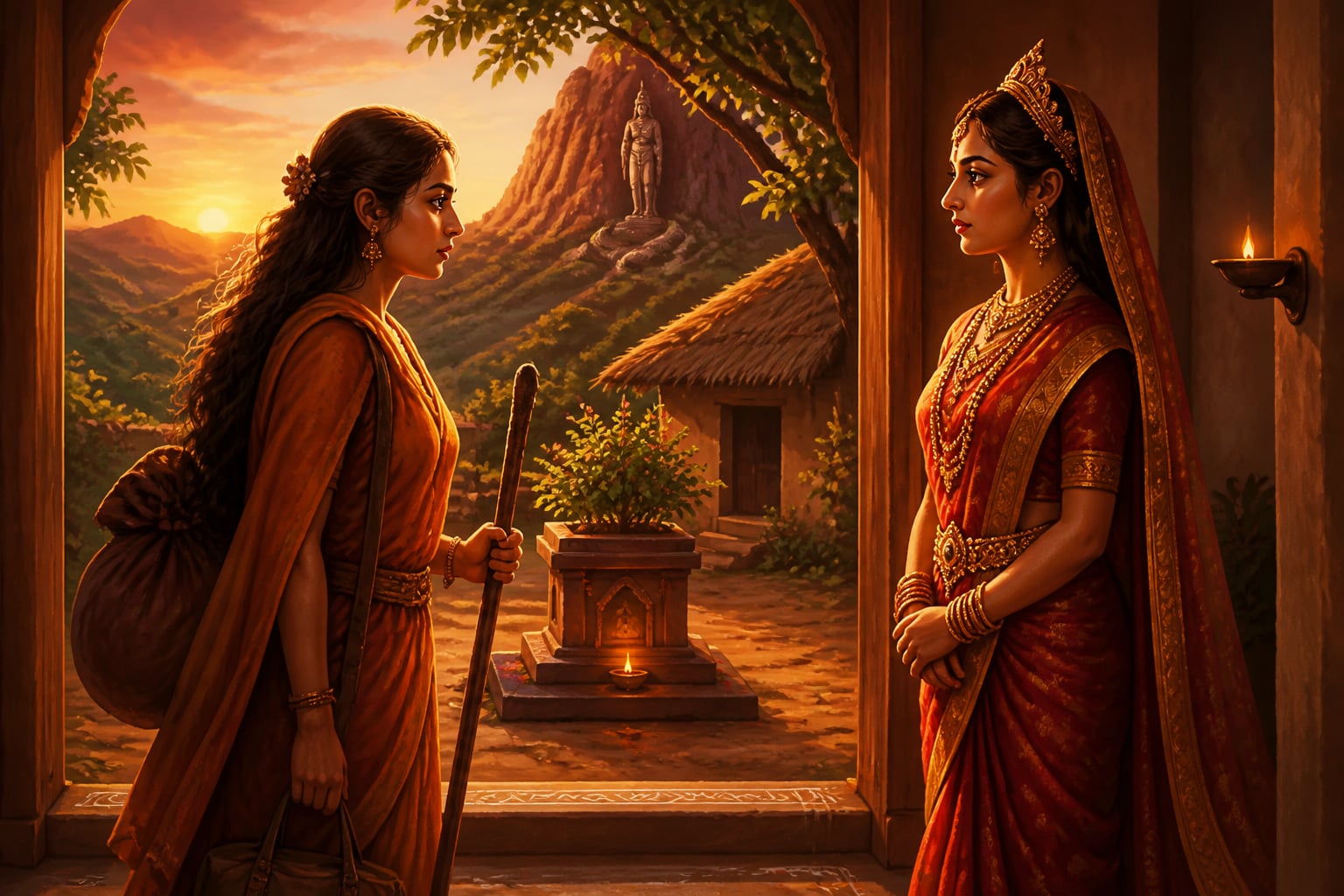
The Venkatachala Mahatmya stages the arrival without softening it. Lakshmi, who walked out of Vaikuntha over an unnamed injury, now stood on the Venkata hill facing two people: the husband whose search for her had somehow ended in a wedding pavilion, and Padmavati, the young bride who had done nothing wrong and married a god in good faith. Three people. Three positions, each unanswerable:
- Lakshmi's: I left over one dishonor, and you have answered it with a larger one.
- Padmavati's: I married you honestly, before my family and the fire. My place is not negotiable.
- Srinivasa's: caught between a wife he had wronged and searched for, and a wife he had vowed to, with witnesses, in dharma, artha, and kama.
The texts record the meeting as heat: accusation, grief, two goddesses face to face, and a god being asked, by both, the one question with no answer. Choose.
The God Who Turned to Stone
What Srinivasa did next is the single most famous moment in the entire cycle, and the most misread.
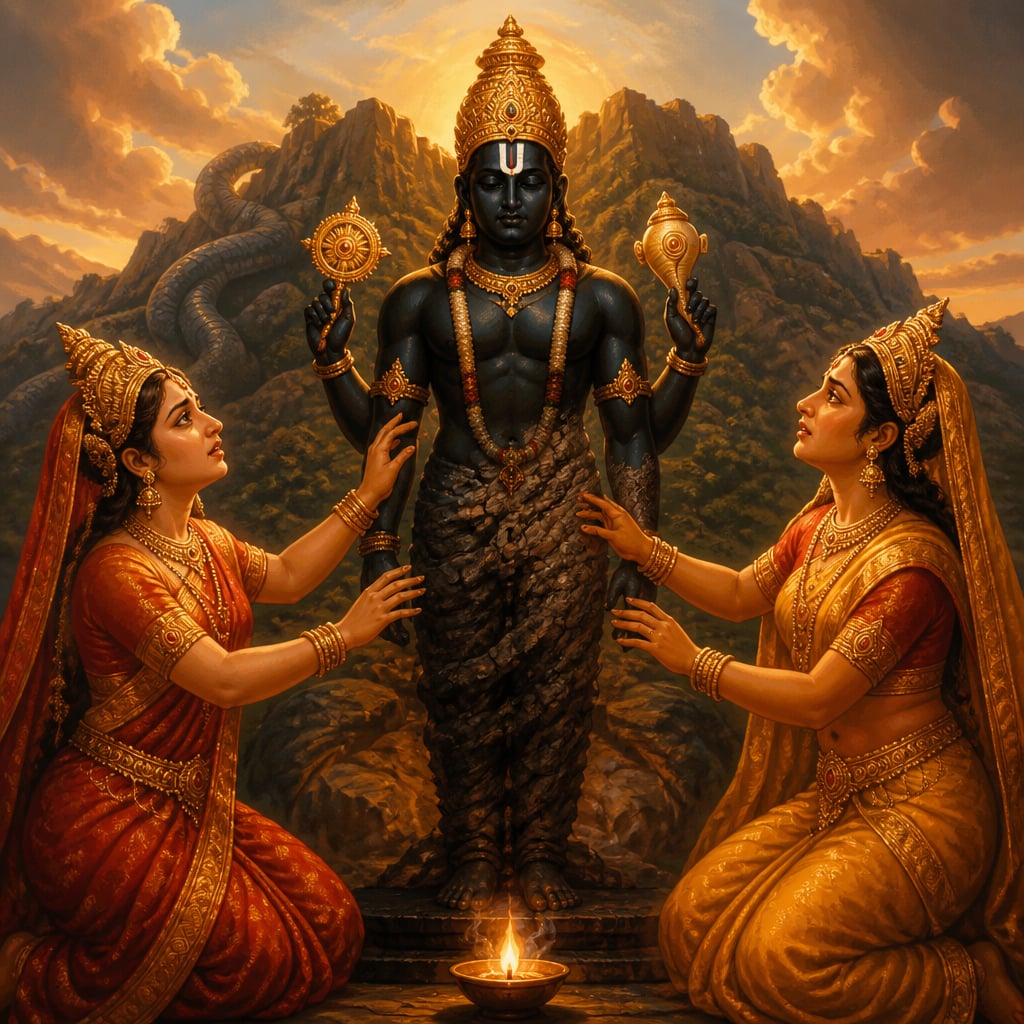
He did not choose. He did not conjure a compromise, did not split time between households with an almanac, did not deliver a speech that made everyone whole. Caught between two rightful claims that could not both be satisfied, the tradition says, he turned to stone where he stood.
That stone is the murti in the Tirumala sanctum: the deity that 24 million people a year queue to see. Read plainly, the tradition is saying something almost unbearably honest. The most visited sacred image on earth is a man standing motionless between two households, holding a bind he could not resolve, refusing to abandon either side of it.
And the goddesses? The tradition gives each her seat, and neither the same one. Lakshmi took her place where she had always lived: on his chest, as Vyuha Lakshmi, present in the murti itself. To this day, at the Friday abhishekam, when the deity is bathed and the ornaments come off, what the priests reveal on the stone chest is her image, home again at the srivatsa where the kick once landed. Padmavati settled in the valley below, at Tiruchanur, in her own temple, her own household, five kilometers and one unresolvable history away from her husband's hill.
Two homes. Both honored. Neither dissolved into the other. The tradition looked at the ending it had written itself into and refused to fake a reconciliation it did not have.
ईशानां जगतोऽस्य वेङ्कटपतेर्विष्णोः परां प्रेयसीं तद्वक्षःस्थलनित्यवासरसिकां तत्क्षान्तिसंवर्धिनीम् ।
īśānāṃ jagato'sya veṅkaṭapater viṣṇoḥ parāṃ preyasīṃ tad-vakṣaḥsthala-nitya-vāsa-rasikāṃ tat-kṣānti-saṃvardhinīm |
To the queen of this world, the most beloved of Vishnu, lord of Venkata: she who delights in her eternal home on his chest, she who nurtures his forbearance.
Sri Venkatesha Prapatti, opening
Look at what the tradition's own prayer does. The Prapatti, recited at Tirumala daily, salutes Lakshmi first, before Venkateswara himself, and names her 'tat-kshanti-samvardhini': the one who nurtures his forbearance. The temple's daily prayers have quietly completed the repair the story could not. The kshama that once cost Lakshmi her dignity is now described as her gift to him. The injury of lesson two is answered, not in the story, but in the daily prayers: she is saluted first, forever.
The Serpent Under Everything
And what holds up this unresolved household? The tradition's answer is underneath the story, literally.

The seven hills are not hills, the texts say. They are Adisesha, the thousand-hooded serpent on whose coils Vishnu slept in Vaikuntha, descended to earth to carry his lord through the age. The range is called Sheshachalam, the Sesha mountains, and pilgrims name the seven crests like a rosary: Seshadri, Neeladri, Garudadri, Anjanadri, Vrishabhadri, Narayanadri, Venkatadri, each carrying its own story, Neeladri for the princess who gave her hair, Anjanadri for Hanuman's mother, Garudadri for the eagle who serves.
The Sanskrit word 'shesha' means the remainder: what is left when everything else is subtracted. The tradition's naming is exact. When the marriage broke, when the wealth left, when the choice proved impossible, what remained, what bore the weight of a god who could not move, was Shesha: the old, patient support that was there before the crisis and is there after it. Every family that survives an unresolvable bind knows its own Sheshachalam: the grandmother, the routine, the land, the daily bread, the thing that holds while nothing is solved.
An Age of Imperfect Endings
Stand back now and look at what this chapter has actually taught, because the finale makes the design visible.
Every epic before this one ends in resolution. Rama returns to Ayodhya and is crowned. The Pandavas win the war and the throne. The tradition knew how to write triumphant endings; it had been writing them for millennia. Here, deliberately, it wrote something else: a family that does not fully reconcile, a husband between two households, a debt that outlives the age, a god who resolves the unresolvable by standing still inside it and not leaving.
That is the Kali Yuga signature, and it is this chapter's final mirror. The age's people live inside exactly such endings: the brothers who split the house and never fully spoke again; the man sustaining his mother in one city and his in-laws in another, loved in both, whole in neither; the marriage that survives on honored distance rather than resolution. The psychologist Pauline Boss spent a career naming this condition 'ambiguous loss', the grief that has no closure and must be lived with rather than solved; the hill had already carved the condition in stone and built a queue to it. The tradition has an old name for his situation: dharma-sankata, a clash of two duties, where both sides are right and both cannot be fully served. Yudhishthira faces such moments in the Mahabharata; every householder faces smaller ones. This course offers a simple way to think about it: a problem has a solution, so go solve it; a bind has only rightful claimants, so it must be held, not solved. The murti's real promise to the age is not 'your problems will resolve'. It is: some binds are held, not solved, and holding them faithfully is not failure. It is what the god of this age is doing, this very day.
And yet, notice what the unresolved ending built. The god stood still, and around his stillness grew the largest pilgrimage on earth: the hundi that services his loan, the kitchens that feed his queue, the two goddess households that each receive their honors, the silks that travel every year from Tirumala to Tiruchanur at Panchami Teertham, the husband's house sending its respects to the wife's, forever. Nothing was resolved. Everything was honored. The tradition's last word on the age of quarrel is that this, done faithfully for centuries, is enough.
Back on the Saraswati riverbank, an old sage once kicked a sleeping god to find out who could hold the age of quarrel without quarrelling. The answer is still standing on the seventh hill, between two homes, interest paid up, door open before dawn.
The stories end here. What the stones say, the inscriptions, the queens, the emperors, the thousand-year paper trail, is Chapter 2.
Case studies
Patel and Nehru: The Partnership That Never Resolved
From 1946 to 1950, India's government was headed by two men who disagreed on almost everything that mattered: Jawaharlal Nehru and Vallabhbhai Patel. Their differences were structural, not petty: economics, Kashmir, China, the civil services, the pace of socialism. Both had wanted the top job; Congress committees had favored Patel, and Gandhi's word gave it to Nehru. The two men repeatedly drafted resignation letters, clashed in cabinet, and privately despaired of each other. Yet neither walked out. Gandhi, days before his death, told them plainly that India needed them yoked together; both obeyed. They built the ministries, absorbed 560 princely states, and wrote a constitution, all inside a partnership that never became a friendship and never resolved its core disputes.
This is the murti's teaching in the historical record: some binds are held, not solved. Patel and Nehru's disagreement had no resolution available; the choices were to hold the bind faithfully or break the household, and the infant republic could not survive the break. Like the god between two homes, each man stood still inside an arrangement that satisfied neither, honored the other's separate domain (Patel the states and services, Nehru the world and parliament), and let the crossing rituals, cabinet, correspondence, public courtesy, do the work reconciliation could not.
The unresolved partnership delivered more than most resolved ones in history: a united territory, a functioning administration, and a constitution, in under four years. Patel died in December 1950 with the disputes still standing; Nehru governed on. Historians still argue over who was right, which is the point: the republic they built did not require the argument to be settled.
Do not measure a partnership by whether its conflicts resolve; measure it by what gets built while the conflicts are held with discipline. Some of history's most productive households, political and domestic, ran on honored disagreement.
Co-founders, coalition partners, and joint families all face the Patel-Nehru condition: a bind with no clean resolution and too much at stake to break. The template holds: separate honored domains, disciplined crossings, and the work continuing above the unresolved floor.
Between August 1947 and 1950, the States Ministry under Patel integrated over 560 princely states into the Indian Union while Nehru led the government: the largest peaceful political consolidation of the twentieth century, executed by two men in standing disagreement.
Suresh Between Two Cities
Suresh, thirty-eight, works in Chennai, where he lives with his wife Revathi and their daughter, close to Revathi's aging parents. His own widowed mother lives in Vijayawada in the family home she will not leave: her temple, her sisters, her language, her fifty years of roots. She needs increasing support; so do Revathi's parents. Every option has been argued in circles for two years: moving his mother to Chennai (she withers in the visits she has tried), moving the family to Vijayawada (Revathi's job and her parents' care make it impossible), a paid caretaker (his mother calls it abandonment). Suresh spends two weekends a month on the highway, is accused gently in both cities of belonging to the other, and lies awake doing arithmetic that never balances. He has started to believe he is failing everyone.
Suresh is standing where the god stood: between two rightful claims that cannot both be fully satisfied, being asked by both sides, in effect, to choose. The lesson's teaching is that his situation has no solution, and that this is not his failure: it is the structure of the bind. The murti's move is available to him: stop treating the bind as a problem he is failing to solve, and start treating it as a commitment he is holding, with rituals that honor both households, the way Tirumala's silks travel to Tiruchanur, regularly, visibly, forever.
What changes is not the arithmetic but the frame. Suresh names the arrangement out loud to both households as permanent, not provisional: two homes, both his, each with fixed honors, the monthly visits, the daily call at a set hour, the festivals split by a published pattern rather than annual renegotiation. The accusations soften once the pattern is seen to be a structure rather than a preference. Nothing is resolved. The guilt, which fed on the belief that a solution existed and he was failing to find it, loses most of its food.
Distinguish problems from binds. Problems have solutions and deserve them; binds have only faithful holding, and the person holding one is not failing. He is doing the age's hardest ordinary work.
The sandwich generation, adults supporting parents and children (and often two sets of parents) across cities, is now a mass condition in urban India. The lesson's protocol travels: name the bind as permanent, fix the honors, publish the pattern, and retire the fantasy of the balancing solution.
Living traditions
The chapter's finale lives in everyday South Indian speech and practice: the Friday Lakshmi darshan, the insistence of elders that a Tirupati trip is incomplete without Tiruchanur, and the affectionate theology of a god still standing between two homes, paying off his wedding loan. The deeper legacy is the template itself, now cited far beyond religion: some binds are held, not solved, and holding them faithfully is a form of greatness.
- Friday Abhishekam and Vyuha Lakshmi Darshan: Each Friday before dawn, the murti receives its full ceremonial bath, and with the ornaments removed, devotees may see Vyuha Lakshmi on the deity's chest. It is among the most coveted sevas at Tirumala, booked far in advance.
- Completing the Yatra at Tiruchanur: Longstanding pilgrim custom holds that a Tirumala pilgrimage is complete only after darshan of Padmavati at Tiruchanur, the wife's household receiving its honors after the husband's. Many pilgrims visit Tiruchanur first, honoring the bride first.
- The Two Households: Tirumala and Tiruchanur: The paired temples are this lesson's geography made permanent: two sovereign households, each with its own festivals, kitchens, and honors, joined by scheduled ritual crossings rather than merger. Together they form a single pilgrimage in the devotee's itinerary.
Reflection
- The tradition made its most worshipped image a man standing still between two homes. What does it change to see the murti not as serene transcendence but as held tension?
- What is the bind in your own life that you have been treating as a problem you are failing to solve? Who are its rightful claimants, and what would 'holding it faithfully' look like this month?
- The Prapatti resolves in daily prayer what the story leaves unresolved in plot: Lakshmi is saluted first, forever. Can ritual honor genuinely repair what narrative cannot? Or is it only a beautiful bandage?