The Wedding Loan
No money for his own wedding: Kubera's loan, Brahma and Shiva as witnesses, and interest due until Kali Yuga ends
The wedding date is fixed and the groom is broke. What follows is unique in world religion: a god takes a documented loan, with named witnesses, stated terms, and an interest schedule that runs to the end of the age. The lesson follows the tradition's frankest teaching on money, marriage, and debt, and explains why the temple's hundi is, in the story's accounting, the repayment counter for a wedding loan still being serviced.
The Groom Has No Money
The date was fixed. Akasha Raja's court had consented, Brihaspati had matched the horoscopes, and Narayanavanam had begun preparing for a royal wedding. Which left one problem, and the tradition states it with no embarrassment at all.
The groom was broke.
Not short. Broke. Srinivasa lived on rented land, in a hermitage kept by his foster mother. The milk that had fed him was charity. A princess's wedding needs a feast for kingdoms, silks, ornaments, gifts for the bride's household, and the groom's side is expected to arrive looking like an equal. He could produce none of it. The Venkatachala Mahatmya, which has already made its god homeless, wounded, and a tenant, now makes him something even more familiar: a man who cannot afford his own wedding.
Sit with how strange this is, and how deliberate. In every other tradition's stories, divine weddings are conjured: golden cities appear, treasuries open, wish-trees bloom. This story slams that door on purpose. Srinivasa does not conjure wealth, because the age he presides over cannot conjure it either. In Kali Yuga, the money has to come from somewhere. And when the money has to come from somewhere, there is only one somewhere.
A lender.
The Loan
Srinivasa went to Kubera, lord of the yakshas, treasurer of the gods, the tradition's banker. And here the story does something found nowhere else in the world's mythologies: it slows down and does the paperwork.
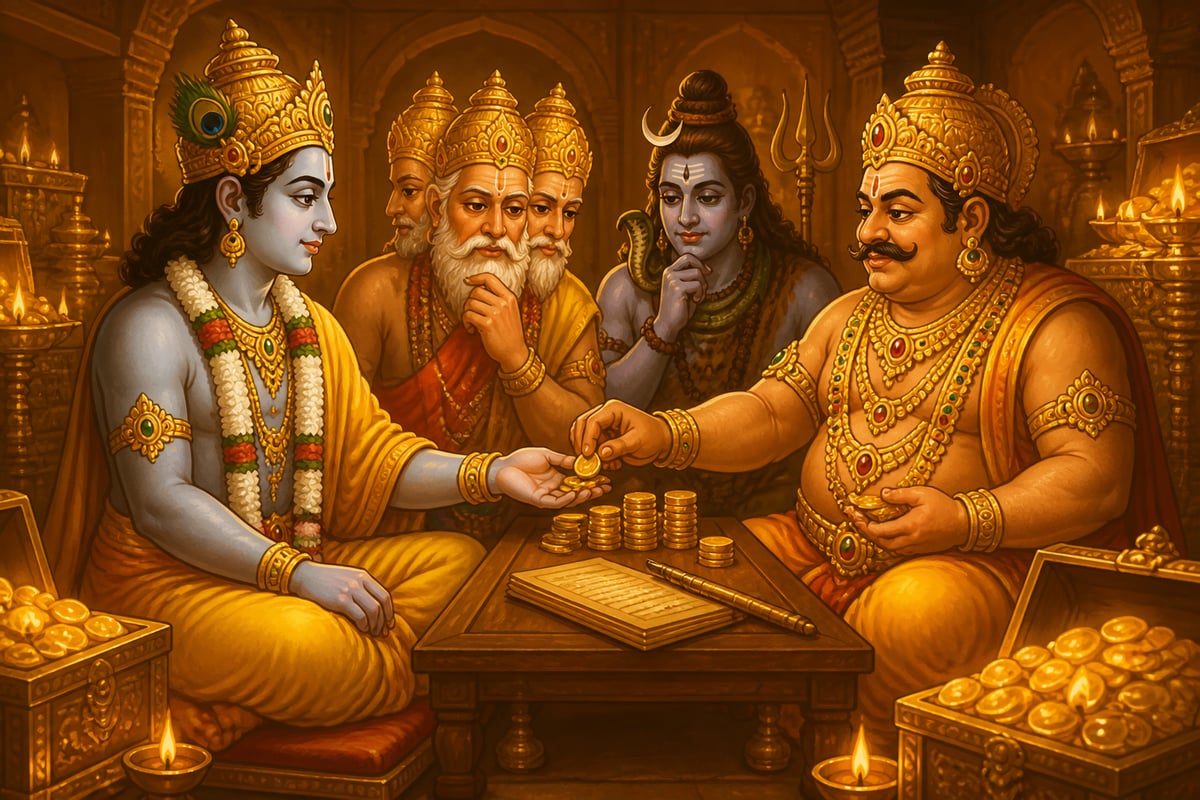
This was not a boon, not a gift between gods, not a blessing. It was a loan, and the tradition insists on the full grammar of one:
- A stated purpose: the expenses of the wedding to Padmavati, feast, ornaments, ceremony, gifts.
- A principal: the figure most tellings quote is 14 lakh gold coins stamped with Rama's own seal, the Ramamudra. Treat the number as the tradition's number, not an audited one; what matters is that there IS a number. The debt is specific.
- Witnesses: not clerks. Brahma signed as the first witness and Shiva as the second. The tradition put the creator and the transformer of the universe on a loan document, which tells you exactly how seriously it wants you to take loan documents.
- Terms: the principal to be repaid by the end of Kali Yuga; until then, interest to be serviced continuously. Not waived. Not forgiven. Serviced.
Read that last term again, because the whole temple stands on it. The most powerful being in the tradition negotiated a loan he knew he could not quickly repay, and the lender, dealing with god himself, still charged interest. The story is many things, but on money it is a realist: capital has a cost, even for Vishnu, and agreeing to terms you must carry for an age is what marriage-season desperation actually looks like.
ऋणकर्ता पिता शत्रुर्माता च व्यभिचारिणी । भार्या रूपवती शत्रुः पुत्रः शत्रुरपण्डितः ॥
ṛṇakartā pitā śatrur mātā ca vyabhicāriṇī | bhāryā rūpavatī śatruḥ putraḥ śatrur apaṇḍitaḥ ||
A father who leaves behind debt is an enemy to his children...
Chanakya Niti 4.15 (first line)
Chanakya's blunt line, a father's debt is an enemy in the house, is the tradition's standing warning about exactly the instrument Srinivasa signed. The story does not contradict the warning. It shows the one honest way through it: if you must borrow, borrow openly, with witnesses, stated terms, and the intention of servicing every installment. The enemy is not the loan. The enemy is the loan taken in shadow.
The Wedding
With Kubera's coins, the wedding the age remembers was mounted. The tradition spends entire chapters on it: the invitations carried to every world, Vakula Devi presiding from the groom's side with a mother's terrifying competence, Akasha Raja spending like a man repaying a cosmic debt, which he was. Brahma himself, the texts say, conducted the rites as priest.

At the center of it, two foster children from assembled families took the seven steps, and the groom spoke the vow every Hindu wedding still speaks:
धर्मे च अर्थे च कामे च नातिचरामि ॥
dharme ca arthe ca kāme ca nāticarāmi ||
In dharma, in wealth, and in desire, I will not transgress against you.
Traditional vivaha vow
Notice the vow's second word. Arthe: in matters of wealth. The oldest Hindu marriage vow makes money an explicit clause of the marriage, co-equal with duty and desire. A groom who had just signed a fourteen-lakh loan spoke it with unusual authority: his artha was already mortgaged to this marriage, witnesses and all.
The celebrations, the tradition notes with a wink, ran on borrowed money and were worth it. Some tellings say the marriage festivities lasted months. Nobody in the story suggests the couple should have waited until the groom saved up. The tradition's realism cuts both ways: debt is dangerous, AND some occasions are worth documented, serviceable debt. The skill is not avoidance. The skill is terms.
The Repayment Counter
Now for the part that turns this story from a charming legend into the operating system of the world's most visited shrine.
The loan has not been repaid. By the story's own terms it cannot be, until Kali Yuga ends. Which means that inside the tradition's accounting, the deity standing in the Tirumala sanctum right now is a god in active debt, servicing interest, this year, this day. And his devotees decided, somewhere across the centuries, that they would help.

That is the hundi: the great cloth-hooded collection vessel in the temple courtyard into which pilgrims drop money, gold, and everything else. Ask the tradition what the hundi is for and it does not say 'donations'. It says: we are helping Govinda repay Kubera. Every rupee is framed as a contribution to the interest on a wedding loan. The temple's kitchen even serves the theology in edible form: a prasadam called vaddi kasula vada, 'the vada of the interest coins', the daily installment rendered as food.
Stop and admire the psychological design, because nothing else in world religion works quite like it. Charity flows down, from the strong to the weak, and taking charity marks you as weak; that is why pride refuses it. The hundi inverts the geometry. The pilgrim who drops a hundred rupees into it is not a supplicant tipping a powerful god. He is a creditor's ally, helping a friend through his EMIs. The poorest farmer in the queue stands, for that one moment, as the god's benefactor. The tradition took the age's most crushing, most shameful experience, debt, and built out of it the most dignified transaction its poorest devotee would ever make.
A God Who Knows What EMIs Are
Step out of the story and look at who it was built for.
India's wedding economy runs at roughly ten lakh crore rupees a year, by a widely cited 2024 Jefferies estimate the country's second-largest industry, and the same report reckons an Indian couple spends about twice their household's annual income on a wedding. A large share of that gap is bridged the way Srinivasa bridged his: borrowed, from banks, apps, relatives, and lenders whose terms have no Brahma witnessing them. The marriage-season loan is not a folk memory. It is this quarter's data.
The tradition saw the pattern early and did the boldest thing available: it put its own god through the transaction. He needed the wedding, lacked the money, borrowed at interest before witnesses, and is still paying. Whoever stands in the Tirumala queue with a wedding loan of their own, or an education loan, or a home loan stretched across a working life, is looking at the one deity in world religion who is, in his own story, in the middle of the same repayment schedule. The hill's claim, made once more: the god of this age has the age's own problems, and this is the age's biggest one.
Back in Narayanavanam, the feast is eaten, the guests have gone home to their various worlds, and the account book is open on Kubera's table with an age of interest ahead of it. The couple is married. The debt is signed. Everything, at last, seems settled.
Except that news travels. And in Kolhapur, doing tapasya with her hurt still unhealed, Lakshmi has just heard that her husband got married. The last lesson of the stories is what happens when she comes to see for herself.
Case studies
Ela Bhatt: Lending Dignity at SEWA
In 1974 Ahmedabad, Ela Bhatt had organized thousands of self-employed women, vegetable vendors, rag pickers, garment stitchers, into the Self-Employed Women's Association. Their most crushing recurring problem was not wages but credit: weddings, illnesses, and stock purchases were financed by street moneylenders at interest that could run into double digits per month, with no documents, no witnesses, and terms that changed at the lender's mood. Banks would not touch them: no collateral, no literacy, no salary slips. Bhatt's answer was to make the women their own Kubera: SEWA Bank, a cooperative bank owned by 4,000 self-employed women shareholders, lending small sums on written, fixed, witnessed terms.
Bhatt's insight is this lesson's insight: the enemy is not the loan, it is the loan taken in shadow. Wedding and crisis borrowing were facts of her members' lives, as the tradition accepts them as facts of Srinivasa's; moralizing against the borrowing helped no one. What transformed lives was converting shadow debt into documented debt: stated principal, stated interest, witnesses, and a lender whose terms could not shift. The loan deed with Brahma and Shiva as sakshins is exactly the instrument SEWA gave its members, minus the gods.
SEWA Bank became one of the world's earliest and most studied microfinance institutions, decades before the word was fashionable, with repayment rates that embarrassed commercial banks and a model copied across continents. Bhatt's larger organization grew past two million members, and her core demonstration stood: the poor do not default more than the rich when the terms are honest; they had simply never been offered honest terms.
Access to documented, fixed-term, witnessed credit is not a luxury layered on top of dignity; for households that must borrow for weddings and crises, it IS dignity. The moral line runs not between borrowers and savers, but between credit in daylight and credit in shadow.
India's wedding and crisis borrowing has moved from street lenders to apps, and the shadow-versus-daylight line has moved with it: instant-loan apps with opaque terms are the new undocumented Kubera. The SEWA test still applies to any loan: is the principal stated, the interest fixed, the term written, and a witness possible?
SEWA Bank was founded in 1974 with share capital contributed by roughly 4,000 self-employed women, each buying shares of ten rupees; it remains a regulated cooperative bank run by and for its member-owners.
Kiran and Sneha's Wedding Budget
Kiran and Sneha, both twenty-seven, both software engineers in Hyderabad, are planning their wedding. The families' combined expectations, venue, five functions, five hundred guests, gold, run to about forty-five lakh rupees: almost exactly two years of the couple's combined take-home. Their savings cover a third. The remaining thirty lakhs is available three ways: a personal loan at 11 percent over five years; an instant-app loan stack with teaser rates and terms nobody has fully read; or an undocumented 'family loan' from Sneha's uncle, interest-free in name, repayable in lifelong obligation and Diwali-dinner reminders. Kiran wants to postpone the wedding two years and save. Sneha wants the wedding this year and the smaller version of it. Both sets of parents want the full version, this year, whatever it takes.
The lesson refuses the two easy answers, never borrow (the wedding matters; even god borrowed for his) and borrow whatever it takes (Chanakya: inherited debt is an enemy in the house). Its actual teaching is the loan deed's anatomy: purpose stated, principal specific, interest fixed, term written, witnesses present. Run the three options through that filter: the bank loan passes; the app stack fails on unread terms; the uncle's loan fails on the most important clause, no stated terms at all, which is how family loans convert money-debt into unpayable relationship-debt.
They take the middle path the deed implies: cut the budget to thirty lakhs by dropping one function and renting jewellery, cover twenty from savings and a documented ten-lakh bank loan at fixed EMI, and decline the uncle's money with a family lunch and full honors instead. The EMI is cleared in three years. What they notice afterward: the loan they chose never once appeared in an argument, because its terms had no room for interpretation. The uncle's loan would have appeared in every argument for a decade.
Size the wedding to the marriage, not the audience, and if you borrow, borrow like Srinivasa: specific amount, fixed terms, real witnesses, and a repayment schedule you would sign in front of Brahma.
A widely cited 2024 Jefferies analysis put India's wedding industry near ten lakh crore rupees a year, with couples spending roughly twice annual household income. The gap is bridged by exactly Kiran and Sneha's three doors, and the deed's five-clause filter, purpose, principal, interest, term, witness, is a one-minute test any couple can run.
Living traditions
The loan story supplies living Indian idiom: Venkateswara is affectionately called the god still paying off his wedding, and elders bless wedding loans with the consolation that even Govinda borrowed for his kalyanam. Beneath the affection sits the lesson's discipline, quoted just as often: he borrowed with witnesses, and he has never missed an installment.
- The Hundi Offering: Pilgrims at Tirumala drop cash, gold, and valuables into the great hooded hundi in the temple courtyard, by tradition framed not as donation but as help toward the interest on Kubera's wedding loan. Many devotees keep household 'Venkateswara hundi' boxes at home, accumulating small sums between pilgrimages.
- Kalyanotsavam Seva: The divine wedding is re-performed daily at Tirumala as the Kalyanotsavam, with sponsoring couples participating as the ritual's householders. Sponsorship is among the temple's most sought-after sevas, booked months ahead.
- Srivari Hundi, Tirumala: The great collection vessel that receives the pilgrim offerings framed as loan-interest help. Its counting operation, conducted publicly under audit, is continuous, and its receipts fund the institution examined in Chapter 5.
Reflection
- The tradition could have let its god conjure the wedding's cost. Instead it wrote him a loan with witnesses and an age of interest. What does a civilization gain by keeping its god in debt?
- Run your own largest debt, or the largest you are considering, through the deed's five clauses: purpose, principal, interest, term, witness. Which clause is weakest, and what would strengthening it cost you?
- The hundi reframes charity so the giver feels like the benefactor of god himself. Is dignity that depends on framing real dignity, or a benevolent illusion? Does it matter?