A God for the Age of Quarrel
The sages' yagna at the dawn of Kali Yuga, Bhrigu's test of the Trimurti, and why the calm response won
At the dawn of Kali Yuga, sages on the banks of the Saraswati faced a practical question: in the hardest of the four ages, which god should people call? The sage Bhrigu designed a dangerous test. He would insult the three greatest gods and watch what each did next. What his test measured, and who passed it, explains why the tradition calls Venkateswara the god of Kali Yuga.
The Fire on the Riverbank
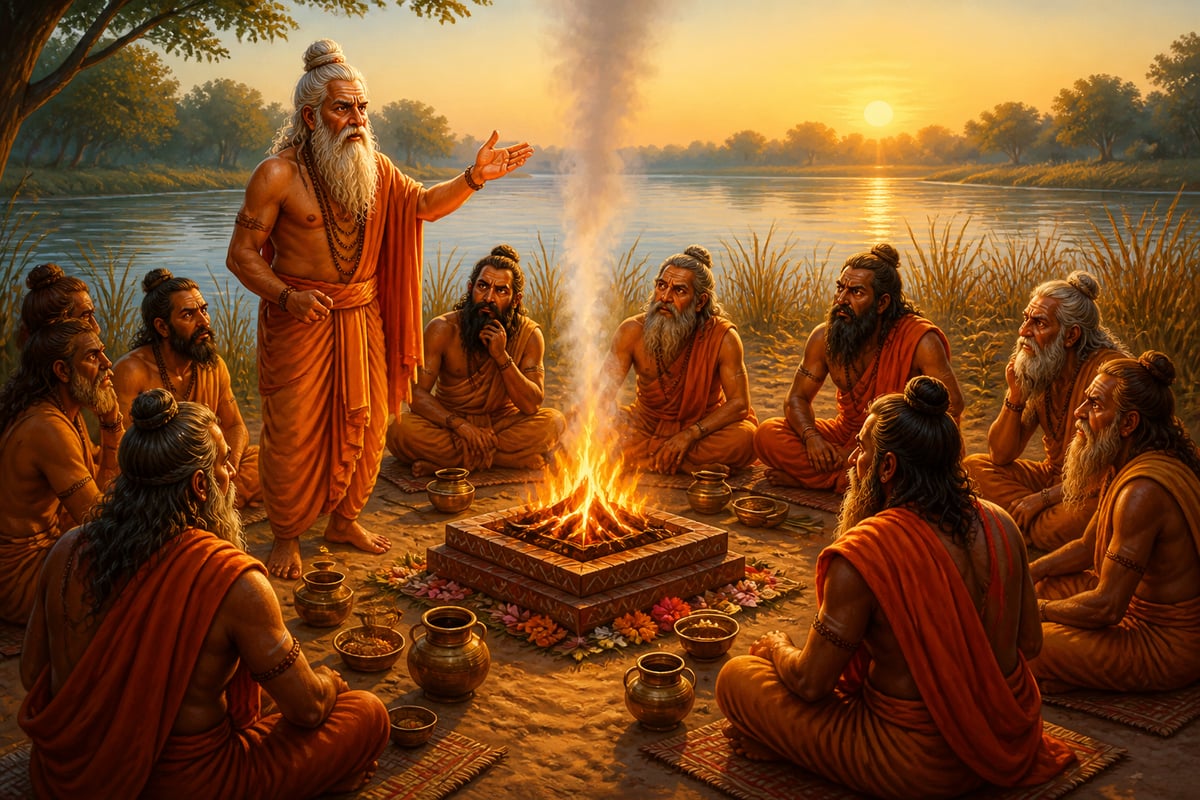
At the beginning of the age called Kali Yuga, a group of sages gathered on the banks of the Saraswati river. They had begun a great sattra (a fire ritual meant to run for years). Smoke drifted over the cold water in the early morning. Firewood crackled. The chanting had continued for days without a break.
Then, one morning, the chanting stopped.
An argument had broken out. The final offering of a yagna must be dedicated to one god. But which one? Brahma the creator, Vishnu the preserver, or Shiva the transformer? This was not an idle question. A new age had just begun, and the Puranas describe it as the hardest of the four: an age of short tempers, broken promises, and quarrels over small things. If the people of this age could reach for one god in their trouble, the sages wanted to know who it should be.
An old sage named Bhrigu rose from the circle. He was famous for two things: his learning and his temper. "I will test all three," he said. "I will find out who is worthy."
The test he chose was strange and dangerous. He would not measure their power. He would insult them, and watch what each god did next.
Three Doors, Three Tempers
Bhrigu went first to Satyaloka, the realm of Brahma. Brahma sat surrounded by scholars and the sound of Vedic chanting. Bhrigu walked in and offered no bow, no greeting, no word of praise. In an assembly where every visitor bowed, the insult was public and deliberate.
Brahma's face darkened. The Bhagavata Purana says his anger rose like a fire, and that he forced it down slowly, the way a man forces down water rising in a flooding room. He said nothing. But everyone in the assembly had seen the struggle on his face.

Bhrigu went next to Kailasa. Shiva rose warmly, arms open, to embrace an old friend. Bhrigu stepped back and turned his face away. Shiva's welcome turned to rage in a single breath. He reached for his trishula (trident). Parvati caught his arm, and Bhrigu left the mountain alive.
Two tests. Two failures. One god had swallowed his anger with visible effort. One had reached for a weapon.
The Kick
Bhrigu came at last to Vaikuntha. There he found Vishnu asleep on the coils of the great serpent Adisesha, with Lakshmi seated near his feet. The scene was everything the tradition means when it describes this god:
शान्ताकारं भुजगशयनं पद्मनाभं सुरेशं विश्वाधारं गगनसदृशं मेघवर्णं शुभाङ्गम्
śāntākāraṃ bhujagaśayanaṃ padmanābhaṃ sureśaṃ viśvādhāraṃ gaganasadṛśaṃ meghavarṇaṃ śubhāṅgam
His form is peace itself, resting on the serpent; lord of the gods, support of the universe, vast as the sky, dark as the rain cloud.
Traditional Vishnu dhyana shloka
What Bhrigu did next shocks even the texts that record it. He walked up to the sleeping god and kicked him in the chest.
Think about what was at stake in the next few seconds. Bhrigu had just struck the preserver of the universe, in his own home, in front of his wife. Any response was available to Vishnu: fury, a curse, instant destruction.

Vishnu woke, saw the sage, and sat up. He took Bhrigu's foot gently in both hands and began to press it. "Sage, my chest is hard as stone," he said. "Your foot is soft. I hope it is not hurt."
Bhrigu had brought the deadliest weapon in the world into that room: a provoked ego. It found nothing to burn. The old sage, who had stood unmoved before Brahma's struggle and Shiva's trident, broke down and wept.
What the Test Measured
Bhrigu returned to the Saraswati and gave his verdict. The offering went to Vishnu. But notice carefully what his test had measured:
- Not power. All three gods could unmake worlds. Power was never in question.
- Not knowledge. Brahma sat at the center of all learning. It did not help him in the moment of insult.
- Only this: what a being does in the exact second when disrespect lands on him.
The sages had asked the right question for their age. Kali Yuga, the age of quarrel, would run on provocation. Its people would be tested by insult daily, in markets, in families, in courts. The age of quarrel needed a god who does not quarrel. The tradition's word for what Vishnu showed is kshama: forbearance. Not weakness, and not the absence of strength, but strength that stays calm because it has nothing to prove.
The Bhagavata Purana's telling of this story ends at the riverbank. But the Venkatachala Mahatmya, the temple tradition of Tirumala, remembers one more detail from that room in Vaikuntha. The kick had landed on the srivatsa, the mark on Vishnu's chest that is Lakshmi's own seat. Hold that detail. It returns in the next lesson, and it changes everything.
The God Who Moved In
Why does a story about a kick in Vaikuntha open a course about a temple in Andhra Pradesh? Because of what the tradition says happened next. The god who passed the test for Kali Yuga did not stay in Vaikuntha, far from the age he had been chosen for. He came down to live in it.
कृते नारायणो देवः त्रेतायां रघुनन्दनः । द्वापरे वासुदेवश्च कलौ वेङ्कटनायकः ॥
kṛte nārāyaṇo devaḥ tretāyāṃ raghunandanaḥ dvāpare vāsudevaś ca kalau veṅkaṭanāyakaḥ
In the Krita age, god is Narayana; in Treta, Rama; in Dvapara, Krishna; in Kali, the Lord of Venkata.
Traditional verse of the Tirumala tradition
This is why pilgrims call Venkateswara Kaliyuga Pratyaksha Daivam: the god who is present and visible in Kali Yuga. The claim is specific. Other ages met god in avatars who finished their work and left. This age, says the tradition, gets a god who stays, on a hill you can climb, behind a door that opens every morning.
And here is the remarkable part, the part this chapter will unfold story by story. He does not come down in glory. The god chosen for the age of struggle goes on to live the struggles of the age. In the lessons ahead he will lose his home, sleep in an anthill, be struck by a stranger, fall in love, fail to afford his own wedding, and sign a loan whose interest he is still paying. The tradition did not give Kali Yuga a distant god. It gave the age a god with the age's own problems.
The Same Test, Every Day
Bhrigu's test never stopped running. It reaches most of us several times a day now: the insulting message in a group chat, the credit taken by a colleague, the stranger's comment written to make you burn. Every notification can be a small Bhrigu, checking what you do in the second after the kick lands.
The modern world occasionally rediscovers the sages' answer. When Satya Nadella took over Microsoft in 2014, the company was famous for internal warfare; its engineers joked about org charts drawn with guns. Nadella made listening before reacting the working rule of the company, and wrote in Hit Refresh (2017) that the culture change mattered more than any product. It is a thinner, later echo of what the sages measured on that riverbank: in an environment built for quarrel, the decisive strength is the temper that does not take the bait.
Back on the Saraswati, the smoke rose again and the chanting resumed. The sages had their answer, and the age of quarrel had its god. What they did not know was the price. Far away in Vaikuntha, Lakshmi had watched her own seat take the kick, and her husband press the feet of the man who delivered it. She was already at the door.
What happens when she walks out of it is the next lesson.
Case studies
Shastri in the Pressure Cooker: 1965
In 1965, Lal Bahadur Shastri was eighteen months into his term as India's second Prime Minister, and almost nobody rated him. He had followed Nehru, a giant. Opponents mocked his small frame and soft voice. Pakistan's leadership read him as weak and launched Operation Gibraltar, expecting the quiet man to fold. Through the war that followed, colleagues recorded the same pattern: in meetings where generals and ministers ran hot, Shastri absorbed provocation, asked questions, and never raised his voice. His calm was widely misread as passivity, right up until his decisions proved otherwise: he authorized the army to cross the international border toward Lahore, a move bolder than anything his louder critics had proposed.
Shastri's conduct is kshama in the precise sense of this lesson: not the absence of force, but force held by a person who does not need to perform anger. Like the god in the story, he was tested through insult, by opponents and allies alike, and the test-setters mistook composure for weakness. The tradition's point is that in an age that runs on provocation, the one who does not take the bait keeps his judgment, and the one who keeps his judgment wins.
The 1965 war ended with Pakistan's strategic aims defeated, and Shastri's standing transformed. The man dismissed as a stopgap gave the country a slogan that outlived him, 'Jai Jawan Jai Kisan', and a template of quiet authority that Indian politics still references. He died months later at Tashkent, his reputation made not by a single dramatic outburst but by its complete absence.
Calm under provocation is not the opposite of strength; it is what strength looks like when it has nothing to prove. Every environment that runs on provocation, a war cabinet or a group chat, hands the advantage to the person whose judgment survives the insult.
Outrage is now an industry with revenue models. The Shastri pattern, absorb, think, then act harder than anyone expected, is the working counter-strategy to an attention economy that profits every time you take the bait.
Shastri served as Prime Minister for just 19 months (June 1964 to January 1966), yet consistently ranks among India's most respected Prime Ministers in retrospective surveys.
The Kick in the Company Channel
Meghana leads a six-person platform team at a mid-size software company. On a Tuesday afternoon, a senior manager from another team posts in the company-wide channel: 'Third outage this quarter caused by the platform team. Maybe we need people who can actually run infrastructure.' It is factually unfair: two of the three outages traced to his own team's code. Four hundred colleagues have seen it. Three of her engineers are typing replies. Meghana's cursor is blinking in the reply box. She has the receipts, the logs, and the anger to end him publicly.
This is Bhrigu's kick with a keyboard. The insult is public, partly false, and designed to provoke; any response made in the first hot minute will be the anger choosing, not her. Krishna's chain in Gita 2.63 maps the risk exactly: anger, then delusion, then lost judgment. The Vishnu move is not silence or surrender. It is refusing the fight's terms: respond to the person's underlying concern, on facts, without matching the tone.
Meghana waits forty minutes and posts two sentences: the outage timeline with links, and an offer to walk any team through the post-mortem on Thursday. She messages the manager privately to ask what specifically broke his trust. In the version where she posts the hot reply instead, she wins the thread and loses the quarter: the story becomes 'platform team is defensive', and every future incident is read through it.
In public provocation, the audience is not judging who is right. It is judging who kept their judgment. The forty-minute wait is not weakness; it is taking the test the situation is actually running.
Slack, X, and family WhatsApp groups all run Bhrigu's test daily at zero cost to the kicker. A written norm of never replying to provocation in the first hour is kshama turned into an operating procedure.
Living traditions
The Bhrigu test has quietly become a shared cultural reference for composure under provocation, invoked in Telugu and Tamil discourse, harikatha performance, and even management talks in South India. More broadly, the lesson's theme runs the temple itself: staff and volunteers managing 60,000+ pilgrims a day treat unprovokability as a working skill, not just a virtue.
- Govinda Namasmarana: Pilgrims climbing the footpaths to Tirumala chant 'Govinda! Govinda!' continuously, and the cry ripples through the queue lines all day. The name invokes Vishnu as the approachable cowherd-protector rather than the remote cosmic lord, which is exactly the theme of this lesson: the god of Kali Yuga is the one you can call out to.
- Reciting the Yuga Verse: The verse 'krite narayano devah... kalau venkatanayakah' is recited in temple discourses, harikathas, and homes across South India when explaining why Venkateswara worship defines this age. Many families teach it to children as the one-line answer to 'why Tirupati?'
- Sri Venkateswara Temple, Tirumala: The temple at the center of this course, standing on the seventh of the seven hills. Every story in this chapter is part of its sthala purana (foundation narrative), and the temple's daily life still answers to details of these stories, from the hundi that repays the loan to the first worship offered to Varaha.
Reflection
- Vishnu's first words after being kicked were about Bhrigu's foot, not his own chest. What would have to be true inside a person for that response to be genuine rather than performed?
- Recall the last time an insult found something to burn in you. What exactly did it ignite: a doubt you already carried, a status you feared losing, or an old wound the insulter could not have known about?
- The sages chose a god for the age rather than asking people to rise above the age. Is meeting people inside their weakness a compromise of the ideal, or the highest form of it?