The Kick That Broke a Home
Bhrigu's foot on Vishnu's chest, Lakshmi's walkout, and a god who leaves Vaikuntha to search for her
The same kick, seen from the other side of the bed. Vishnu's forbearance won him the age; it cost him his marriage. Lakshmi watched her own seat take the blow and her husband honor the man who delivered it, and she walked out of heaven. This lesson follows the tradition's most honest portrait of a family rupture: two people, both right, and a home that breaks anyway.
The Other Person in the Room
Go back into that room in Vaikuntha, seconds after the kick. The last lesson watched Vishnu. This one watches the person beside him.
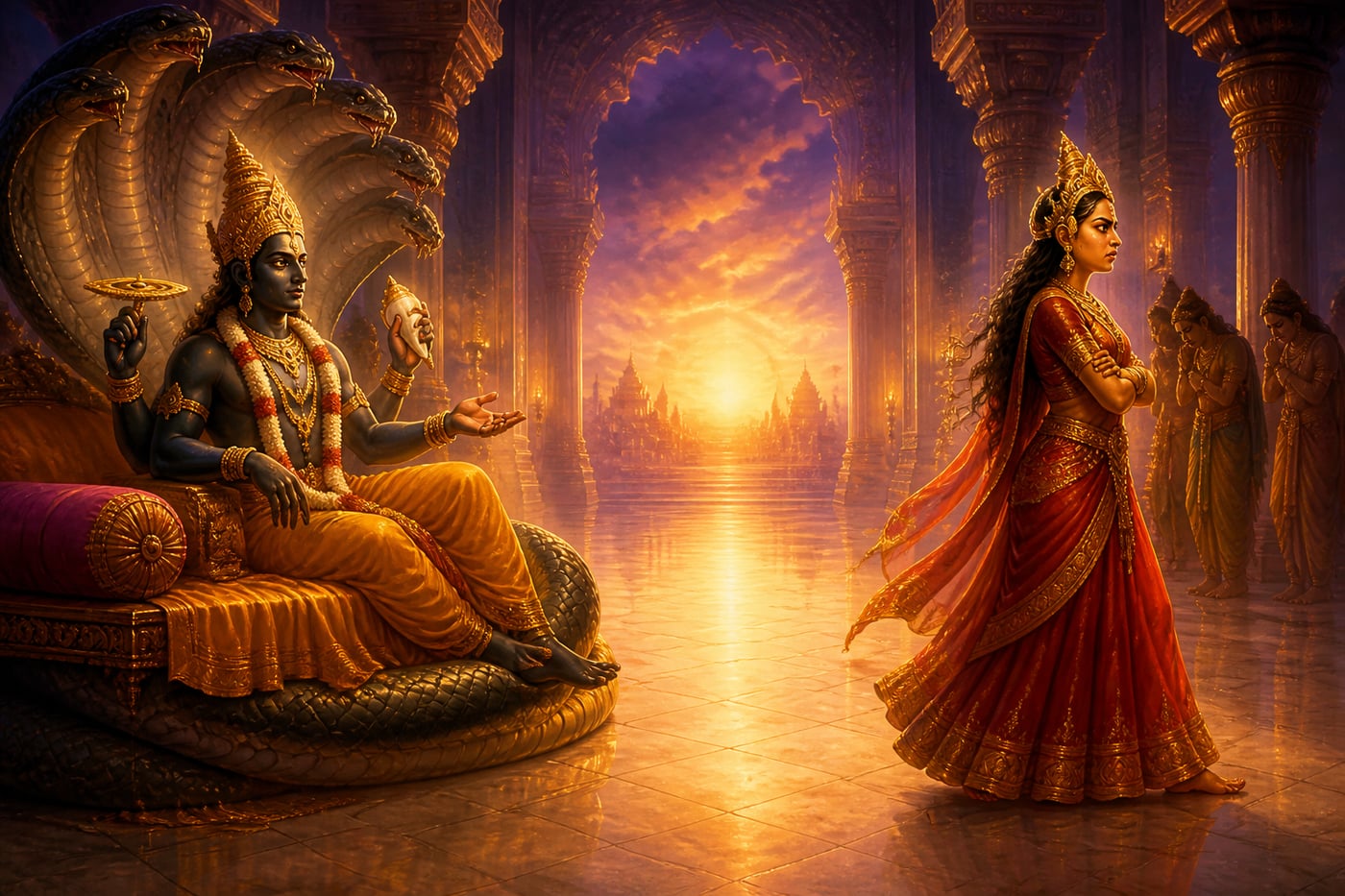
Lakshmi had been sitting near her husband when Bhrigu's foot came down. It did not land on neutral ground. It landed on the srivatsa, the mark on Vishnu's chest that the whole tradition knows as her seat, her place, her home on his body. A stranger had walked into her house and struck the exact spot that belonged to her.
Then she watched her husband's response. He did not defend the spot. He did not even name the offense. He took the sage's foot, the foot that had just struck her seat, into his own hands and pressed it with respect. He asked if it was hurt.
The Venkatachala Mahatmya, the temple tradition of Tirumala, remembers her words. "You honored the man who struck me," she said. "The insult landed on my home, and you worshipped the foot that delivered it. A husband who will not stand up for his wife's honor in her presence has made his choice."
Vishnu answered as the god who had just passed the test of the age: the sage was a guest, anger would have destroyed him, forbearance is the higher dharma. Every word of it was true.
It did not matter. She left.
Two People, Both Right
Stop here, because this is the part the tradition refuses to simplify.
Vishnu was right. His kshama (forbearance) had just been declared the one quality the new age needed. If he had burned Bhrigu to ash, the sages would have crossed him off the list, and Kali Yuga would have had no god at all. His calm was not cowardice. It was the whole point.
Lakshmi was also right. Forbearance is a virtue when the insult lands on you. When the insult lands on someone under your protection, and you respond by honoring the attacker, your virtue is being paid for with the other person's dignity. She was not asking him to fail the test. She was asking him to notice that the fee for passing it had been charged to her account.
The story does not award the argument to either side. That is what makes it the sharpest portrait of a family rupture in the tradition:
- No villain. Bhrigu leaves the story. The rupture is entirely between two people who love each other.
- No misunderstanding. Each fully understands the other's position. Understanding is not the problem.
- A collision of two dharmas. His duty as host and as the age's chosen god, against his duty to the person whose honor lived on his chest. Both real. Both binding. Not both satisfiable in the same second.
The Walkout

Lakshmi did not negotiate and did not threaten. The texts give her departure a terrible quietness. She left Vaikuntha, left the wealth of heaven, which is another way of saying the wealth of heaven left with her, and descended to the earth. Tradition places her at Karavirapura, today's Kolhapur in Maharashtra, where she sat in tapasya (sustained spiritual discipline), turning her hurt inward into austerity rather than outward into revenge.
The tradition preserved her side of the story in stone. The great Mahalakshmi temple of Kolhapur stands where she is said to have settled, and it is not a footnote shrine. It is one of the most important Lakshmi temples in India, alive with worship today. The goddess who walked out was not written out of the story. She was given her own address.
Meanwhile, Vaikuntha changed. The texts describe what a home is like after the walkout, and anyone who has lived through one will recognize it. The palace was intact. Nothing was missing except everything. Vishnu sat in a heaven that had stopped being one, because a home is not a place, it is a person who has decided to stay in it.
यत्र नार्यस्तु पूज्यन्ते रमन्ते तत्र देवताः । यत्रैतास्तु न पूज्यन्ते सर्वास्तत्राफलाः क्रियाः ॥
yatra nāryastu pūjyante ramante tatra devatāḥ | yatraitāstu na pūjyante sarvāstatrāphalāḥ kriyāḥ ||
Where women are honored, there the gods rejoice. Where they are not honored, no ritual bears fruit.
Manusmriti 3.56
Read that verse against this story and it stops being an abstract principle. In the one house where a woman's seat was struck and the striker honored, no ritual could bear fruit any longer. Even Vaikuntha went barren. Even for Vishnu.
The God Who Went Looking
What Vishnu did next is the hinge of this entire course.

He did not send an emissary. He did not wait for her to cool down and return, which is what the powerful usually do, because waiting costs them nothing. The preserver of the universe left Vaikuntha himself. He walked out of heaven after his wife.
Hold the image, because the tradition holds it deliberately: the god of the age of quarrel, homeless by his own choice, wandering the earth looking for the person his rightness had cost him. His search brought him south, to a range of hills wrapped in forest above the plains of Andhra. There, exhausted, with nowhere left to go, he did something no story had ever asked a god to do.
He crawled into an anthill and stayed there.
That anthill is the next lesson. For now, notice what the story has already done. Lesson one gave Kali Yuga a god who could not be provoked. This lesson takes away his home, his wife, and his address. The god of this age does not arrive on the seven hills in a golden chariot. He arrives the way people arrive in a new city after their life has broken: alone, homeless, and looking for someone.
The Anatomy of a Rupture
Why does the tradition tell this story about its own supreme god? Because the diagnosis inside it is precise, and it is aimed at every household.
The fatal wound was not the kick. Lakshmi had absorbed insults to her husband's house before; the goddess of fortune is not fragile. The wound was the honor shown to the kicker, in her presence, while her own hurt went unnamed. The rupture came not from the offense but from watching her person treat the offense as beneath mention.
The marriage researcher John Gottman spent four decades filming couples in conflict and found that the strongest predictor of a marriage ending was not anger, which honest couples show plenty of, but contempt: the signal that the partner's hurt does not merit acknowledgment. The Venkatachala Mahatmya staged the same finding as a story three ways more memorable. Vishnu never felt contempt for Lakshmi. But by honoring Bhrigu and never naming her injury, he produced its exact effect, and the effect is what she had to live with.
The story's second diagnosis is just as sharp: being right is not a defense of a relationship, and can be the instrument that breaks it. Vishnu wins the argument in every retelling. He also sits alone at the end of it, in a heaven that no longer works.
Back in Vaikuntha, the room where the test was passed stands empty now. The sages got their god. The god lost his home. On a forested hill far to the south, an anthill is about to receive the strangest resident in the history of heaven.
What happens to a god with no house, no wife, and no plan is the next lesson.
Case studies
The Ambani Split: When the House Divided, 2005
When Dhirubhai Ambani died in 2002 without a will, his sons Mukesh and Anil jointly inherited Reliance, then India's largest private company. Within two years the brothers were not speaking. The dispute was nominally about control and gas pricing, but those who watched it closely described a rupture of abhimana: each brother felt his standing, his projects, and his public dignity had gone undefended or actively diminished in the other's rooms. In November 2004 Mukesh admitted 'ownership issues' on national television. The quarrel spilled into boardrooms, courts, and eventually the Prime Minister's office, until their mother Kokilaben brokered a formal split of the empire in June 2005.
The pattern is the Bhrigu story's second act at corporate scale. The original offense (whatever memo, snub, or boardroom slight started it) mattered less than what followed: injuries left unnamed, dignity undefended in front of others, each side winning arguments while the household kept breaking. And as in the story, the wealth followed the rupture: the fortune of an undivided house had to leave its home and take up two new addresses. It took the mother, holding the role the tradition gives to the one who still honors both sides, to negotiate what the courts could not.
The 2005 settlement gave Mukesh the flagship petrochemicals and refining business and Anil the telecom, power, and financial arms. The subsequent decades made the point brutally: the divided halves fared utterly differently, and observers estimate the feud years consumed enormous value and management attention that an intact house would have kept. A partial public reconciliation came only in 2018, when Mukesh's family cleared Anil's dues to keep him out of jail.
In family ruptures, the provocation is rarely the cause of death; the handling is. Unnamed injuries compound like debt, and by the time the argument reaches lawyers, the question of who was right about the original offense has stopped mattering entirely.
Most Indian family businesses still die of succession, not competition. The story and the case agree on the vaccine: name injuries when they happen, defend each member's dignity in front of others, and treat 'being right' as the beginning of repair work, not the end of it.
Reliance was split in June 2005 after a roughly seven-month public feud; the mediated settlement divided a business house whose combined revenues then accounted for about 3 percent of India's GDP.
The Joke at the Dinner Table
At a family gathering, Arjun's uncle makes a cutting joke about Arjun's wife Divya: her cooking, her job, delivered smoothly enough that half the table laughs. Divya goes quiet. Arjun laughs along, partly from shock, partly to keep the peace at his parents' table, and moves the conversation on. He tells himself he handled it maturely: no scene, no spoiled evening. In the car, Divya says nothing. She says nothing for three days. When it finally surfaces, Arjun defends himself with perfect logic: it was one joke, the uncle is old, making a scene would have embarrassed everyone, including her. Every word is true. The distance keeps growing anyway.
Arjun is running Vishnu's error in miniature. The wound Divya carries is not the uncle's joke; jokes from that uncle are priced in. The wound is watching her person laugh with the room, in the moment her dignity was the entertainment, and then hearing the incident defended as good manners. His peace-keeping was paid for from her account, exactly as Vishnu's forbearance was paid from Lakshmi's. And like Vishnu, he cannot argue his way back, because she never disputed his logic; she disputed what it cost her.
What repairs it is not the winning argument but the Vishnu move from the end of the story: leaving the high ground. Arjun names it without being asked: 'The joke was at your expense and I laughed. I left you alone in that room. That was wrong, and next time it happens I will say something at the table.' Then, at the next gathering, he actually does. The repair is the walk to Kolhapur, not the lecture on kshama.
When someone under your protection is diminished in front of you, neutrality is not neutral. The relationship registers exactly one fact: whose side your silence served.
Every couple has a dinner-table moment: the joke, the dismissive in-law, the friend who crosses a line. The tradition's protocol is teachable: name the injury in the moment or soon after, to the injured person first, without waiting to be prosecuted for it. Defense of dignity delayed is read as dignity denied.
Living traditions
The story's vocabulary is still the working language of Indian family life: 'grihalakshmi' for the woman whose honor is the home's fortune, 'Lakshmi left that house' as the standard idiom for a family whose prosperity followed its broken relationships out of the door. The idiom encodes the lesson's whole claim: wealth follows dignity, and both leave together.
- Friday Lakshmi Worship: Friday is Lakshmi's day across Hindu households: lamps, rangoli at the threshold, and Sri Suktam recitation to invite the goddess in. At Tirumala, Friday is also the day of the full abhishekam of the main murti, the one time each week the deity's chest, bearing Lakshmi's srivatsa seat, is ceremonially bathed and shown.
- Kolhapur-Tirupati Paired Pilgrimage: Devotee custom in Maharashtra and the southern states links the Mahalakshmi temple at Kolhapur with Tirumala: pilgrims visit the goddess who left alongside the god who searched. The pairing keeps both sides of the rupture story alive in geography.
- Mahalakshmi (Ambabai) Temple, Kolhapur: The temple tradition identifies Kolhapur (Karavirapura) as the seat Lakshmi took after leaving Vaikuntha; the shrine has been in continuous worship for over a millennium, with structural portions attributed to Chalukya-era construction. It is counted among the Shakti Peethas in regional tradition.
Reflection
- The story lets Vishnu and Lakshmi both be right, and lets the home break anyway. Why might the tradition have refused to name a winner?
- Whose dignity has quietly paid for one of your virtues: your patience, your peace-keeping, your professionalism? Would they say you have ever named it?
- The goddess of fortune leaves the house where her dignity went undefended. Taken as a claim about the world, what would it mean for the link between how a household treats its women and how it prospers?