Talapatram

The Alvars Sang First

Tiruvenkatam in the oldest Tamil memory, and the poets who made the hill famous before any king gave it gold

Long before Tirumala had money, it had songs. The oldest Tamil texts name the Venkata hill as the northern edge of the Tamil world. Then, between roughly the sixth and ninth centuries, twelve poet-saints called the Alvars sang it into pan-South fame, in over 200 verses, in the people's own language. The first recorded gift of wealth came centuries later. The order matters: reputation came before resources, and this lesson is about why that order still works.

The King Who Wanted to Be a Doorstep
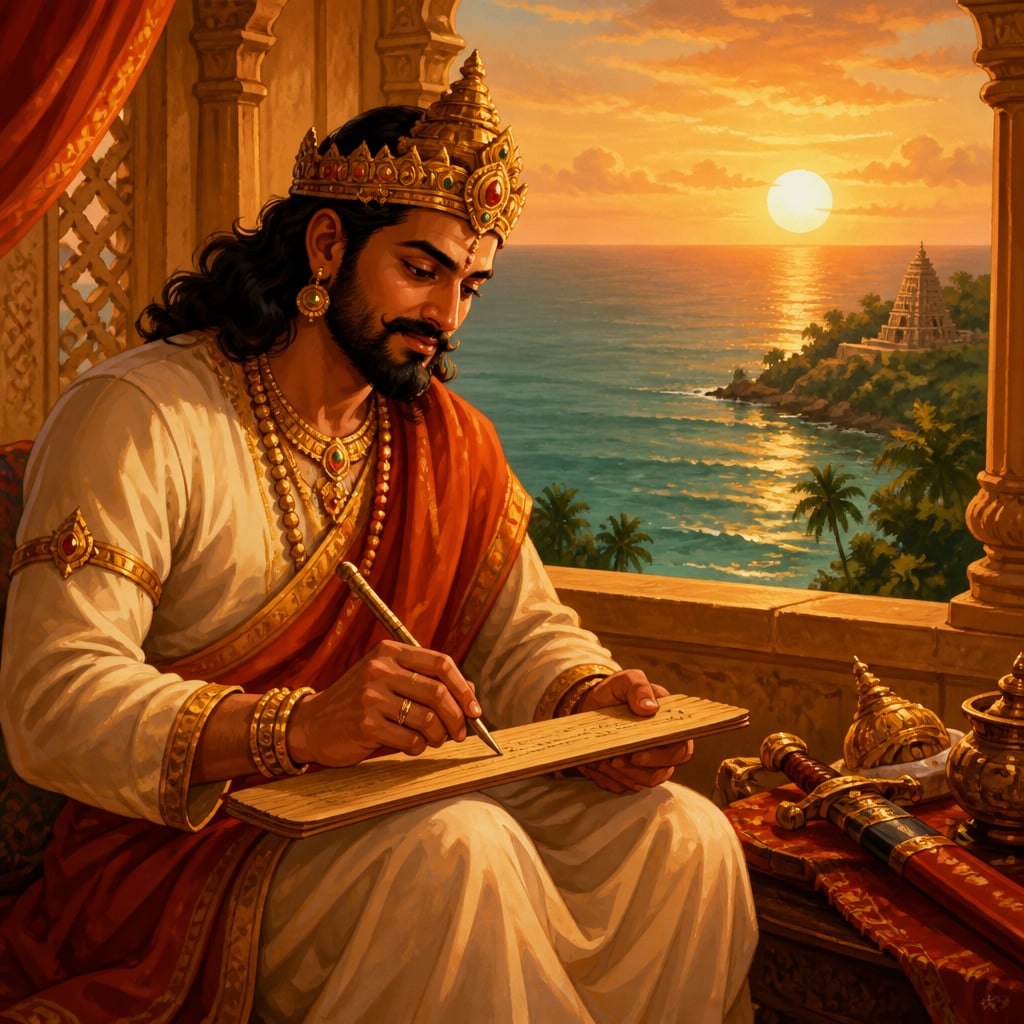
King Kulasekara composing verse on palm leaf

Around the eighth century CE, in the Chera country of present-day Kerala, a king sat with a palm leaf and a sharp iron pen. His name was Kulasekara. He had armies, elephants, and a treasury. Court poets were paid to compare kings like him to the sun.

But the verse he was cutting into the leaf that day was not about his own glory. It was a list of things he would rather be than a king. Let me be a bird on the Venkata hill, he wrote. A fish in one of its ponds. A tree on its slopes. A pillar in its temple. And then the line the tradition never forgot: let me lie as the doorstep at your temple gate, and watch your coral-red mouth as the devotees walk over me.

Go to Tirumala today, and at the entrance to the innermost shrine you will cross a threshold step that lakhs of feet touch every week. Priests and pilgrims call it the Kulasekarappadi: Kulasekara's step. Twelve centuries later, the king has his wish.

Now notice the strange part. The world's richest temple gave its most honored doorstep to a man who, as far as the records show, never gave it gold. He gave it a sentence. This lesson is about why that was the better gift, and about the two or three centuries in which poets built this hill's fame before any recorded money arrived.

A Hill on the Edge of the Map

The Venkata hill enters Tamil literature not as a temple but as a map edge. The oldest Tamil grammar tradition defines the Tamil land by its two ends:

வடவேங்கடம் தென்குமரி ஆயிடைத் தமிழ்கூறும் நல்லுலகம்

vaṭa vēṅkaṭam ten kumari āyiṭait tamizh kūṟum nallulakam

From Venkatam in the north to Kumari in the south: the good world where Tamil is spoken.

Panamparanar's preface to the Tolkappiyam

For the poets of the Sangam era (roughly 300 BCE to 300 CE), Vengadam was the northern frontier: a hill country of elephants, waterfalls, and forest tribes, where the world they knew came to an end. By around the fifth century CE, the Tamil epic Silappadikaram describes a god standing on that frontier hill: dark as a rain cloud, eyes like red lotus, bearing the conch and the discus. The map edge had become an address of god.

But an address is not fame. Fame needed singers.

The Immersed Ones

Between roughly the sixth and ninth centuries CE, twelve poet-saints appeared across the Tamil country, one or two in a generation. The tradition calls them the Alvars, "the immersed ones," from a Tamil root meaning to dive deep. They were a deliberately mixed group: a king (Kulasekara), a temple bard from a community others refused to touch (Tiruppan Alvar), a baby found under a tamarind tree and raised by farmers (Nammalvar), and one woman (Andal). Their verses are called pasurams, and around the tenth century the scholar Nathamuni gathered them into one collection of 4,000: the Divya Prabandham.

Two choices made these poets unstoppable. First, they wrote in Tamil, not Sanskrit. Sanskrit was the language of scholars; Tamil was the language of the kitchen, the field, and the lullaby. A farmer's wife could not read a scripture, but she could sing a pasuram while drawing water, and she did. The songs needed no priest to carry them.

Second, they wrote about specific places. An Alvar rarely praises god in general. He praises the god of this hill, that river-island, this grove: 108 shrines in all, which the tradition calls the Divya Desams, the sacred addresses. And of all 108, the address they returned to most hungrily was the frontier hill of Vengadam. Ten of the twelve Alvars sang it, in more than 200 pasurams.

Andal telling her friends of her dream

Andal, the one woman among the twelve, told her friends of a dream in which she married the lord of Vengadam. And Nammalvar, whom the tradition ranks highest of all, made the hill a family matter:

ஒழிவில் காலமெல்லாம் உடனாய் மன்னி வழுவிலா அடிமை செய்ய வேண்டும் நாம் தெழிகுரல் அருவித் திருவேங்கடத்து எழில்கொள் சோதி எந்தை தந்தை தந்தைக்கே

ozhivil kālamellām uṭanāy manni vazhuvilā aṭimai seyya vēṇṭum nām tezhikural aruvit tiruvēṅkaṭattu ezhilkoḷ cōti endai tandai tandaikkē

Without a break, for all time, staying near, we must do faultless service to the beautiful radiance of Tiruvenkatam of the roaring waterfalls: my father's, my father's father's god.

Nammalvar, Tiruvaymoli 3.3.1

Read that last line again. Nammalvar does not say "I discovered this hill." He says his father served this god, and his father's father before that. By the time the greatest of the Alvars sang about Vengadam, it was already old family memory. The fame had been compounding for generations.

Fame Before Money

Now put two dates side by side.

Between the singing and the first recorded money lie two to four centuries. That gap is the real subject of this lesson.

The poets were not paid by the temple. They sang because the hill had caught them, and their songs traveled on quality alone: memorized, sung at festivals, carried up and down the Tamil country in the mouths of pilgrims. By the time queens and emperors arrived with gold, they were not creating Tirumala's fame. They were buying a place inside a story the poets had already built. Reputation came first. Resources followed it. Every builder since has faced the same order, whether they knew it or not.

Modern India ran this pattern at national scale. In November 1963, young engineers at a fishing village called Thumba in Kerala carried rocket parts on bicycles, assembled them inside a church building, and launched India's first small research rocket. For decades ISRO had thin budgets and no glamour. What it had was results, delivered visibly and cheaply, year after year, under Vikram Sarabhai's rule that the work must speak first. The big budgets and the Mars missions came after the reputation, not before. The engineers at Thumba were doing what the Alvars did on the hill: building the story first, with the only currency they had, which was the quality of the work itself.

The Doorstep Today

The poets' songs never became museum pieces. Every year in the Tamil month of Margazhi (December to January), the Suprabhatam, the famous morning wake-up hymn of Tirumala, is set aside, and Andal's Tiruppavai is sung to wake the god instead. A woman's Tamil verses, over a thousand years old, open the day at the most-visited shrine on Earth for a full month. Through the year, trained reciters chant the Divya Prabandham before the deity daily. The tradition's name for the collection says everything about its rank: the Dravida Veda, the Tamil Veda.

The threshold step worn smooth by pilgrim feet

And Kulasekara's step is still there, worn smooth, crossed by every pilgrim who reaches the door. The king who asked to be a doorstep is touched by more people every single day than any emperor of his century.

But songs alone do not run a temple. Somebody has to decide who opens the door, who cooks the offering, who keeps the keys, and what happens when the priest dies. About two centuries after the last Alvar, an old philosopher climbed the hill to answer exactly those questions. What he built was not verses. It was procedures, and they are still running. That is the next lesson.

Case studies

Rockets on Bicycles: ISRO Before the Budgets

In November 1963, India's space program was a borrowed church building in Thumba, a fishing village near Thiruvananthapuram. Engineers carried rocket parts on bicycles; a famous photograph shows a rocket nose cone on a bicycle carrier. The first launch was a small American-supplied research rocket sent up to study the atmosphere. The country was poor, and space was widely mocked as a luxury it could not afford. Vikram Sarabhai's team had no way to win that argument with words. They could only win it with delivered results: launch after launch, satellite after satellite, each visibly cheaper than anyone thought possible, for decades.

This is the Alvar order of operations. The poets sang for two or three centuries before the first recorded endowment reached Tirumala; the singing made the hill worth endowing. ISRO built kirti, reputation spoken by others, through work whose quality traveled on its own, and only then did the large budgets and political backing arrive. In both cases the story was built before the structure, by people who treated thin resources as a constraint to design around, not a reason to wait.

The organization that started in a church became the first in the world to reach Mars orbit on its first attempt, in 2014, at a cost of about 450 crore rupees, famously less than the budget of a Hollywood space film released the year before. By then, ISRO's reputation preceded every proposal it made: decades of visible, frugal delivery had done the persuading in advance.

When you lack resources, the work itself is your only spokesman, so make the work speak clearly and often. Reputation built that way arrives slowly but compounds, and money follows reputation far more reliably than reputation follows money.

Every underfunded team faces the Thumba choice: spend energy complaining about the missing budget, or ship small visible results the budget-holders cannot ignore. The second path is slower and the only one that compounds.

India's first rocket launch from Thumba took place on 21 November 1963. The Mars Orbiter Mission launched 50 years later, in November 2013, and entered Mars orbit in September 2014 at roughly one tenth the cost of comparable missions.

The Maintainer Nobody Paid

Anand, a backend developer in Coimbatore, spends his evenings maintaining a small open-source library that handles date and calendar quirks for Indian payroll systems. For six years nobody pays him a rupee for it. He answers issues within a day, writes honest release notes, documents every breaking change, and turns down two offers to stuff the library with a sponsor's branding. The library becomes the quiet default: fintech startups adopt it, then two banks, then a government portal. Anand's name appears nowhere except the commit history. Then a payments company opens a senior platform role, and three separate engineers on the hiring panel realize they have depended on his judgment for years.

Anand is running the pasuram economy. A pasuram had no budget and no distribution; it traveled because people who met it wanted to pass it on, and the Divya Desam list was fixed strictly by what the poets had actually sung. Anand's library spreads the same way: on quality, judgment, and consistency visible in public, compounding for years before any money appears. Like the Alvars, he is building the reputation layer first, and like the hill, he does not control when the endowment arrives, only whether the work deserves one.

He gets the role without a single algorithm-puzzle interview; the panel treats six years of public work as the interview. The company also becomes the library's first corporate sponsor. The reputation he never monetized turns out to be the most valuable asset he owns, precisely because everyone can verify it and nobody can fake it.

Public work of consistent quality is a reputation ledger that others write for you. It pays nothing for a long time, and then it pays in doors that money cannot open.

In any field with public output, code, writing, teaching, design, the Alvar path is open: do excellent work where it can be seen, credit others honestly, and let the record compound. The budgets, when they come, will come to the reputation.

Living traditions

The Alvars' method, quality work in the people's language, compounding in public, has become a shorthand in South Indian cultural memory for fame that is earned rather than bought. Their verses still run daily at Tirumala, and their sequence, songs first, gold later, is quietly repeated by every builder who ships visible work before asking for a budget.

  • Daily Divya Prabandham Recitation: Trained reciters called adhyapakas chant the Alvars' Tamil pasurams before the deity at Tirumala every day, alongside the Sanskrit Vedas. The tradition ranks the collection as the Dravida Veda, the Tamil Veda, and the daily recitation keeps the twelve poets in the temple's working schedule thirteen centuries after they sang.
  • Tiruppavai in Margazhi: Through the month of Margazhi, Andal's thirty Tiruppavai verses are sung at dawn in homes and temples across South India, and at Tirumala they replace the Suprabhatam as the deity's wake-up hymn. Children in many families learn one verse a day through the month.
  • Srivilliputhur Andal Temple: The temple of Andal's birthplace, built where the poet was found as a baby in a tulasi garden. Its towering gopuram is among the tallest in Tamil Nadu and appears on the official emblem of the Tamil Nadu government, a state symbol built around the one woman Alvar.

Reflection

  • The Divya Desam list was fixed by what the Alvars sang: a shrine entered only if a poet had actually praised it. What would your life's 'sung record' contain, the things others would praise unprompted, and how different is it from your resume?
  • Kulasekara would rather be a doorstep near what he loved than a king far from it. Where in your life have you chosen position over nearness, and what did the choice cost you?
  • The hill's fame was built by poets who were never paid, and later funded by donors whose gifts are recorded in stone. Which contribution was greater, and by what measure?

More in The History: Carved in Stone

All lessons in The History: Carved in Stone · Tirupati Balaji ebook course