Talapatram

Ramanuja on the Hill

How an aging philosopher gave Tirumala the operating system that has run for nine hundred years

In the early 1100s, the hill's shrine was famous, increasingly wealthy, and loosely run. Then India's greatest organizer of temples climbed it. Ramanuja settled a dispute over who the deity even was, defined who does what inside the temple, and set a monk who owns nothing to watch over it all. The dynasties that funded the temple are gone. His procedures still run every morning at 3 a.m. This lesson is about building things that work without you.

The Locked Door

Early in the twelfth century, the tradition tells, the shrine on the Venkata hill had a problem money could not solve. Different groups of worshippers claimed the deity as their own. Some said the lord of the hill was Shiva. Others said Shakti. Others said Vishnu. The image itself, ancient and self-formed, carried marks each side could read its own way. The local king, Yadava Raja, had to decide, and could not.

Into this dispute came an old man from Srirangam named Ramanuja: the greatest Vedanta philosopher of his age, and, less famously, the greatest organizer of temples India has produced. His proposal was startlingly simple. Place the emblems of Shiva and the emblems of Vishnu together inside the sanctum. Lock the door. Post guards. Let the deity choose.
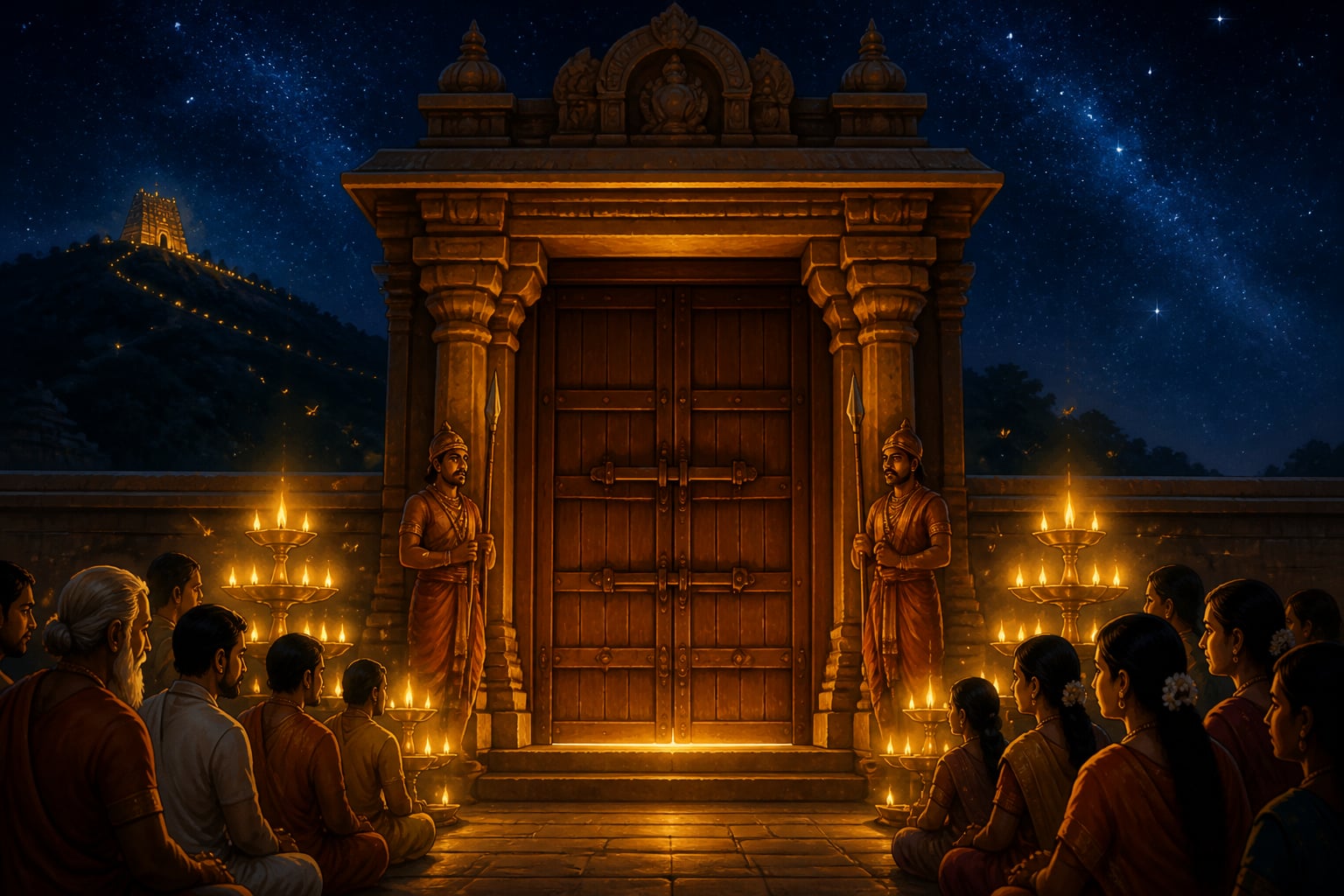
Lamps burning outside the sealed sanctum door

That night, lamps burned outside a sealed door while two traditions waited. At dawn the king broke the seal. The story says the image stood wearing the conch and the discus, Vishnu's own emblems, as if it had picked them up in the dark. The dispute was over. The lord of the hill was Srinivasa.

It is a legend, and this course tells it as one. But notice what kind of solution it is. Ramanuja did not win the argument by shouting louder or by borrowing the king's soldiers. He designed a procedure both sides agreed to in advance, with witnesses, a seal, and a clear way to read the result. That instinct, replace argument with procedure, is what he brought to everything on the hill. And it is why this lesson about a philosopher is really a lesson about operations.

The Philosopher Who Wrote Procedures

Ramanuja (by tradition, 1017 to 1137 CE) is remembered as the master of Visishtadvaita Vedanta and the systematizer of Sri Vaishnavism. His greatest written work, the Sri Bhashya, opens by naming the supreme reality with a word this course knows well:

श्रुतिशिरसि विदीप्ते ब्रह्मणि श्रीनिवासे भवतु मम परस्मिन् शेमुषी भक्तिरूपा

śruti-śirasi vidīpte brahmaṇi śrīnivāse bhavatu mama parasmin śemuṣī bhakti-rūpā

May my understanding take the form of devotion to the supreme Brahman, to Srinivasa, who shines at the crown of the Vedas.

Ramanuja, opening of the Sri Bhashya

The philosopher who defined God for a whole tradition chose the name of the lord of this hill to do it.

But philosophy was only half his work. Ramanuja spent decades walking from temple to temple across the South, and everywhere he went he did the same unglamorous thing: he fixed the operations. Tradition counts three visits to Tirumala, and by his day the hill needed fixing. The Alvars' songs had made it famous. Wealth had begun to arrive. And fame plus money, with loose management, is how institutions rot.

Ramanuja assigning temple duties from a roster

What Ramanuja set up on the hill, the tradition remembers in detail:

One story from these years shows the spirit of the system. When Ramanuja asked which disciple would stay on the hill for the deity's daily flower service, a man named Anantalvan stood up. He moved to Tirumala, dug a garden and a pond with his own hands, and made garlands every single day for the rest of his life. One person, one clearly owned duty, done daily for decades: the whole operating system in miniature. His garden still exists near the temple.

The Monk Who Owns Nothing

Then came Ramanuja's sharpest design decision. A system of duties still needs oversight: someone to check that the procedures are followed when no founder is watching. Every founder knows the obvious answer, and it is wrong. Put a powerful person in charge, and within two generations the overseer's family treats the institution as property.

Ramanuja's answer was the Jeeyar: a renunciant monk, a man with no property, no family, and no heirs, appointed to supervise the temple's worship. A monk cannot pass the temple to his sons, because he has none. He cannot grow rich from it, because he has given up wealth. His successor is chosen and trained inside the monastery, by rule rather than by blood. The tradition holds that Ramanuja appointed the first Pedda Jeeyangar (senior head monk) himself.

A Jeeyar monk supervising the evening ritual

Walk into Tirumala tonight and a Jeeyar of that same line will be present, supervising the evening rituals. The office has run continuously for about nine centuries. In that time the Cholas fell, Vijayanagara rose and fell, sultans and nawabs and the East India Company came and went, and a modern government trust took over the accounts. Every power that funded the temple has been replaced. The procedures have not. The people were mortal; the system was not.

The Dabbawala Test

Here is the test Ramanuja's design passes, stated in modern terms: can the institution deliver excellence when no one in it is exceptional?

Mumbai's dabbawalas pass the same test every working day. About 5,000 delivery men move roughly 200,000 home-cooked lunches across one of the world's most crowded cities, using painted codes, bicycles, and local trains. Most workers have little formal schooling. Errors are so rare that business schools fly professors in to study them. The system's genius is that it does not need geniuses: the codes, the relay points, and the timings carry the excellence, and any trained person can step into any role. Harvard turned them into a case study in 2010; the system itself has run since the 1890s, through famines, wars, and floods.

That is exactly what a kainkarya map, a fixed calendar, and a Jeeyar's oversight achieve on the hill. The Suprabhatam does not begin at three in the morning because someone feels devoted that day. It begins because the procedure says so, and the procedure has a named owner, and the owner has a supervisor, and the supervisor owns nothing he could gain by cutting corners.

Most founders build the opposite: institutions powered by their own energy, which is why most institutions are one succession away from decay. Ramanuja was in his final decades when he worked on Tirumala's systems. He was not building for his own tenure. He was building for the year 2100, and so far he is on track.

Still Running at Three in the Morning

The temple did not forget its systems designer. Inside the Tirumala complex stands a shrine to Ramanuja himself, where the philosopher is honored within the very institution he organized. Down in the town below, the Govindaraja Swamy temple, which he consecrated near the end of his life, anchors the streets that grew into modern Tirupati. And in 2022, a 216-foot statue of him, named the Statue of Equality, rose near Hyderabad: a reminder that the man who wrote procedures also opened temple doors to those other teachers kept out.

But his real monument has no plaque. It is tomorrow morning, 3 a.m., when the priests wake the deity on schedule, as specified, under supervision, for roughly the 330,000th consecutive day.

Songs built the fame. Procedures made it durable. The next arrival on the hill is an emperor with more gold than anyone before him, and a sharp question of his own: when the most powerful man in the South meets an institution stronger than any dynasty, what exactly can he give it? His answer made him immortal, and it is the next lesson.

Case studies

The Dabbawalas: Excellence Without Geniuses

Since the 1890s, Mumbai's dabbawalas have picked up home-cooked lunches from suburban kitchens and delivered them to office desks across the city, then returned every empty box home the same afternoon. Around 5,000 workers move roughly 200,000 lunchboxes a day. Each box changes hands several times, sorted at railway stations in minutes, riding bicycles and crowded local trains. There is no headquarters software and there are no tracking chips: a painted code on each lid tells any dabbawala where the box goes next. Most workers have little formal schooling. Mistakes are famously rare, rare enough that Harvard Business School wrote a case study on the system in 2010 and management professors still visit to learn from it.

The dabbawala system is a kainkarya map in modern dress. Every box, route, and handover has a named owner; the painted code is the agama, the procedure anyone trained can follow; the mukadams (team leaders) play the Jeeyar's role of oversight from within. Like Ramanuja's Tirumala, the system's excellence lives in the design, not in exceptional individuals, which is exactly why it survives the retirement of every individual in it.

The organization has run for over 130 years through wars, famines, floods, and a pandemic, with the same basic design. Founders and workers have been replaced many times over; the codes and relays remain. It delivers reliability that technology companies with thousands of engineers struggle to match, at a fraction of the cost.

An institution passes its real test when it can deliver excellence with ordinary people on an ordinary day. If your system only works when the best person is present and motivated, you have built a performance, not an institution.

Startups praise 'A-players' and burn out chasing them. The dabbawala and Tirumala pattern inverts this: design the process so ordinary people produce extraordinary reliability. Process is the only teammate that never resigns.

About 5,000 dabbawalas deliver roughly 200,000 lunchboxes daily; studies place errors at the level of one in millions of transactions. The system predates the telephone in most Mumbai homes.

The Founder Who Wrote Herself Out

Nithya runs a twelve-person catering company in Chennai that supplies three hospital canteens. For its first four years, the business is her: she plans menus, negotiates prices, handles every crisis. Then a supplier fails at 5 a.m. one day while she is at a wedding, and the kitchen simply stops. Shaken, she spends six months writing everything down: a recipe and quantity card for every dish, a backup supplier list with phone numbers taped inside a cupboard, a morning checklist, a weekly stock count, and a rule for who decides what when she is unreachable. Her cooks tease her about the binders. The next year her father falls seriously ill in Madurai, and she is largely gone for eleven months.

Nithya's binders are her agama: received procedure detailed enough that the next person can perform the ritual correctly without the founder present. Naming who decides in her absence is the Jeeyar move, oversight assigned by rule rather than left to whoever grabs it. Ramanuja worked on Tirumala's systems in his final decades precisely because he would not be there; Nithya's father's illness merely arrived before her old age did. Both built for their own absence.

The company runs for eleven months without her, keeps all three contracts, and even wins a fourth when a hospital manager remarks that its consistency did not dip while its owner was away. When she returns, she finds the checklists annotated and improved by her own team. The company is no longer her; it is now a thing that exists in the world, and that is a promotion.

Write things down as if you will be gone next year, because one year you will be. A procedure is the kindest gift a founder can leave, and the only reliable form of succession.

The test is brutal and simple: if you disappeared for a month, what would break? Every item on that list is a procedure you have not written yet. The dabbawalas and the hill both suggest starting today.

Living traditions

Ramanuja's operating model, named duties, received procedure, oversight without ownership, reads today like a governance textbook written nine centuries early. Management writers cite the Tirumala and dabbawala systems in the same breath, and the 2022 Statue of Equality made his other legacy national news: the philosopher of systems was also the monk who opened temple doors to people other teachers excluded.

  • Jeeyar Supervision of Daily Worship: Monks of the Pedda Jeeyangar mutt, the monastery whose line tradition traces to Ramanuja's own appointment, are present at Tirumala's major daily rituals to this day, supervising that the Vaikhanasa agama procedures are followed exactly.
  • The Garland Kainkarya: Fresh flower garlands adorn the deity daily, a service the tradition traces to Anantalvan, the disciple Ramanuja left on the hill for exactly this duty. Anantalvan's garden near the temple is still maintained and pointed out to pilgrims.
  • Sri Govindaraja Swamy Temple: Consecrated by Ramanuja around 1130 CE, late in his life, this temple to Vishnu reclining as Govindaraja became the anchor around which the lower town of Tirupati grew. In a real sense, Ramanuja founded not just the hill's system but the city at its base.

Reflection

  • Ramanuja settled the identity dispute not by argument but by a procedure both sides accepted in advance. What conflict in your life keeps repeating because it is fought fresh each time instead of being given a procedure?
  • If you disappeared for a month starting tomorrow, what exactly would break, and what does that list tell you about the difference between being valuable and being irreplaceable?
  • The tradition's greatest philosopher spent his final decades on duty rosters and festival calendars. Is administration a lower calling than philosophy, or philosophy made real?

More in The History: Carved in Stone

All lessons in The History: Carved in Stone · Tirupati Balaji ebook course