Talapatram

Krishnadevaraya's Crown

Seven climbs, recorded gifts, and the emperor who chose to be remembered with folded hands

The most powerful emperor in the South climbed the hill seven times, gave it crowns, gold, and villages, and had every gift carved into the temple's stone walls. Then he did something stranger: he installed statues of himself and his two queens inside the temple, standing with folded hands. His empire was destroyed within decades of his death. His gifts are still in daily use. This lesson asks the question he answered: what do you want to be remembered for, what you captured, or what you gave?

The Emperor at the Door

On 10 February 1513, the temple's stone walls record, the most powerful man in South India climbed the seven hills. Krishnadevaraya, emperor of Vijayanagara, was thirty years old and four years into a reign that would terrify every rival kingdom on the map. He came with his two queens, Tirumala Devi and Chinnama Devi, and with gifts that made the priests' hands unsteady: a crown set with the nine precious gems, ornaments of gold, vessels of silver.

Somewhere nearby, a stonecutter was already at work. That was the temple's rule, and the next lesson tells its full story: every gift was carved into the walls, the donor's name, the date, the exact items, in letters anyone could read. The chisel's tapping was the sound of the emperor's generosity becoming permanent record.
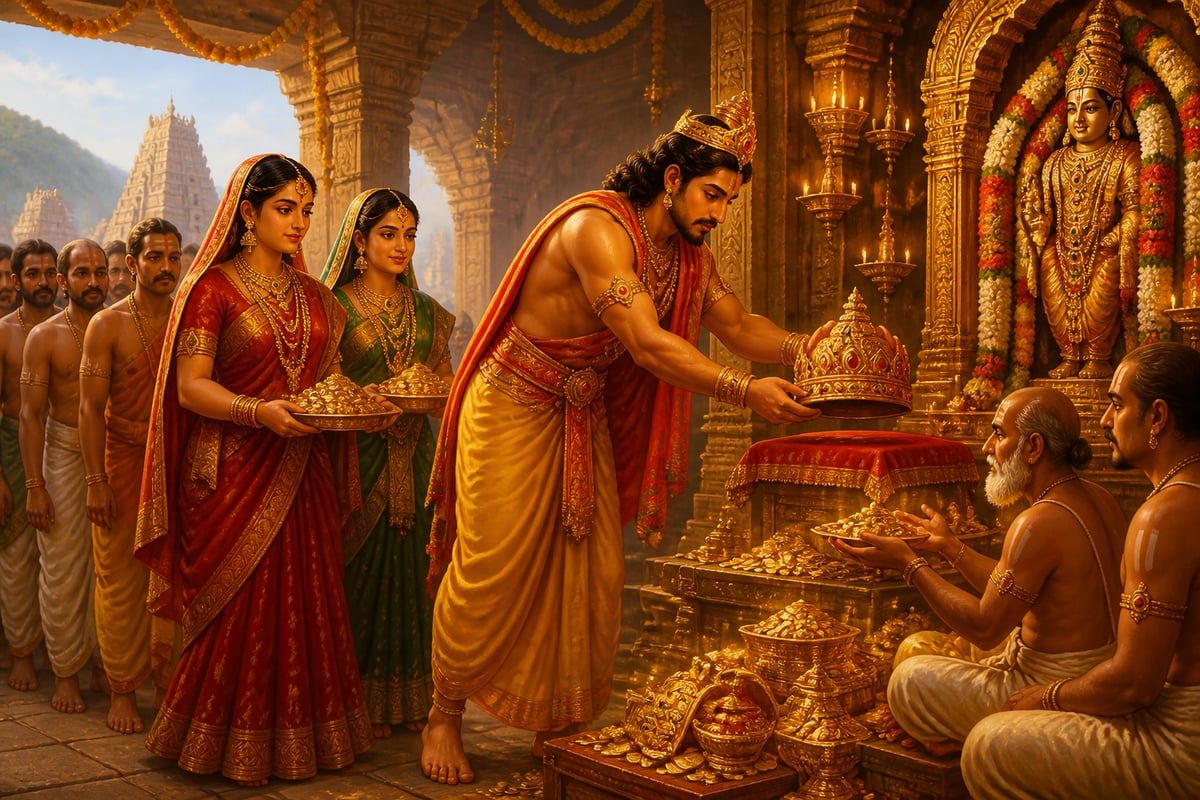
The emperor offering his crown to the deity

But hold the picture a moment longer. This man commanded armies of hundreds of thousands. Kings sent him tribute so he would not visit them in person. And here he stood in a queue of pilgrims, barefoot, placing a crown at the feet of a god and folding his hands like any farmer from the plains below.

He would do this seven times. And near the end, he would leave behind the strangest gift of all: statues of himself and his queens, standing forever at the temple entrance with palms joined. The conqueror of the South chose to be remembered, in the one place that would outlast everything, in the posture of asking rather than commanding. This lesson is about why that was the smartest thing he ever did.

Seven Climbs

Krishnadevaraya ruled from 1509 to 1529, the golden peak of the Vijayanagara empire. His armies took Raichur, humbled the Gajapati kings of Odisha, and made his capital, Hampi, one of the largest and richest cities on Earth. Traders from Portugal wrote home in disbelief about its markets, where gems were sold in heaps.

The temple's inscriptions record his seven visits to Tirumala across those twenty years, several of them straight from military campaigns. The gift list reads like an empire's balance sheet turned toward heaven:

Notice the design of the giving. Very little of it was decoration. A village endowment is not a trophy; it is a revenue stream with a job: it pays for a specific offering, every day, with no end date. The emperor was not just being generous. He was buying permanence, plugging his wealth into a system, the one Ramanuja had organized four centuries earlier, that could convert gold into something that runs daily forever.

The Poet Who Wore the Crown

Here the story loops back to the poets of this chapter's first lesson, because Krishnadevaraya was one of them.

The emperor was a serious scholar and poet, and his court's nine great poets are still famous in Telugu memory. On one southern campaign, tradition says, the god appeared to him in a dream and commanded him to compose a great poem, and to compose it not in Sanskrit but in Telugu. The dream's reasoning survives as one of the most quoted lines in the language:

దేశ భాషలందు తెలుగు లెస్స

dēśa bhāṣalandu telugu lessa

Among the languages of the land, Telugu is the finest.

Attributed to the god in Krishnadevaraya's dream, in the tradition of the Amuktamalyada

Krishnadevaraya writing poetry in his war tent

The poem he wrote, the Amuktamalyada, is counted among the greatest classics of Telugu literature. And its subject is worth a smile: it tells the story of Andal, the woman Alvar from lesson one of this chapter, who dreamed of marrying the lord of the hill. The emperor had absorbed the whole lesson of this chapter without being taught it. He knew the songs had built the hill, he knew the people's language was where fame lives, and so the conqueror sat down at night, after the war councils, and wrote poetry about a poet.

Standing in Bronze

Now come to the statues, because they are the heart of this lesson.

Bronze statues of Krishnadevaraya and his queens

Near the temple's entrance stand life-size metal figures of Krishnadevaraya and his two queens. Their hands are folded in anjali, the gesture of greeting and surrender. Five centuries of pilgrims have walked past them; lakhs walk past them every week today. The emperor commissioned them in his own lifetime. He decided, while holding more power than any man in the South, that this is how the future should see him: not on a horse, not with a sword, but standing in the queue with everyone else, asking.

Set that choice against what happened next, and it becomes almost unbearable in its wisdom. Krishnadevaraya died in 1529. Within four decades, in 1565, the empire lost the battle of Talikota, and Hampi, the wonder city, was sacked and abandoned. Today his capital is a beautiful ruin. His conquests are borders nobody remembers. The tribute is spent, the armies are dust, and the palaces are photographed by tourists.

But the gold on the Ananda Nilayam still catches the sun every morning. The festivals he endowed are still performed. His statues still greet every pilgrim. Of everything the emperor captured, nothing remains in service. Of everything he gave, almost everything does. What you capture, your successors lose. What you endow, the institution keeps running. He is the proof, standing in bronze, hands folded.

India's modern history repeated the pattern almost exactly. Jamsetji Tata built mills and trading firms, wealth on the scale of a small kingdom. In 1898 he pledged roughly half his personal fortune toward something that did not yet exist: an institute of science for India. He died in 1904, five years before the Indian Institute of Science opened in Bangalore. The mills of his era are footnotes now. The institute produced generations of scientists and still does. Like the emperor, he is remembered for what he gave, not what he owned, and like the emperor, he arranged it that way on purpose, while still at his peak.

The Donor's Question

Strip away the gold and the centuries, and Krishnadevaraya leaves every successful person one question: when the winning is done, what will your name be attached to?

The emperor's answer had three parts, and each is usable at any scale. He gave to something that would outlive him, an institution with systems, not a monument needing his protection. He gave while at his peak, from strength and gratitude, not as a deathbed correction. And he was not shy about the record: his gifts were carved in public stone, because a public record of giving invites the next donor to give. The temple walls were, among other things, the most effective fundraising display in history: every arriving king could read exactly what his rivals had given.

Which raises the question this chapter has been circling. Who started that public record? Who first decided that gifts to this temple would be carved into stone, name and date and amount, for anyone to read? The answer is not an emperor. It is a queen, five and a half centuries before Krishnadevaraya, and her inscription of the year 966 opens the best-documented history of any temple in India. She is the next lesson.

Case studies

Jamsetji Tata's Unseen Institute

In 1898, Jamsetji Tata was India's most successful industrialist: mills, trading houses, grand hotels on the way. That year he pledged roughly half his personal fortune, fourteen buildings and four landed properties in Bombay, toward something that did not exist and that he might never see: a research institute of science for India. Advisors questioned it; the colonial government dragged its feet for years. Tata kept the pledge anchored, recruited allies, and wrote to Swami Vivekananda seeking his support for the idea of research as national service. He died in 1904. The Indian Institute of Science opened in Bangalore in 1909, on land gifted by the Maharaja of Mysore, five years after its founder's death.

This is Gita 17.20 executed precisely: a gift given because it ought to be given, to a recipient that could never repay him, at the right place and time, and aimed like Krishnadevaraya's village endowments at a system that converts wealth into permanent daily output. Tata gave at his peak, from strength, to an institution designed to run without him, and he accepted that the harvest would come after his death. The emperor never saw most of what his endowments funded either; permanence is always a gift to strangers.

IISc became the seedbed of Indian science: it trained and housed the people who built India's space, atomic, and industrial research programs, and it is still ranked among Asia's great institutions more than a century later. The mills that made Tata's fortune are historical footnotes. The gift is the empire that survived.

Wealth spent on what you own stops working when you do. Wealth endowed into a well-designed institution keeps working for people who will never know your face. The donors remembered longest are the ones who bought permanence, not monuments.

The same choice faces anyone with a surplus: consumption, monuments, or endowment into systems that outlive you. The emperor and the industrialist, four centuries apart, chose the third and are remembered for it.

Tata's 1898 pledge was valued at about 30 lakh rupees, roughly half his personal wealth. IISc opened in 1909 and has run continuously for over a century, through two world wars and independence.

The Building or the Hundred Names

Prakash sold his logistics startup last year, and his old engineering college in Guntur has noticed. The development office offers him the classic deal: ten crore rupees, and the new academic block carries his name in steel letters. He walks the campus and does the arithmetic no one asked him to do. The same ten crore, endowed, would fund the full costs of about twenty students a year, forever: fees, hostel, laptops, a mentor stipend. First-generation students, like he was. But the scholarships come with no building, no steel letters, no photograph at an inauguration. His wife asks the question that settles most such decisions: 'Which one will you be prouder of at seventy?'

The Tirumala tradition does not demand anonymous giving; the temple carved every donor's name in stone, and the next lesson shows why that public ledger was itself a gift. The real question is not name versus no name but monument versus endowment: does the money buy an object that needs maintenance, or a system that produces value forever? Krishnadevaraya gave villages with jobs attached, revenue streams tied to daily services. The building is a kirita for Prakash; the scholarships are villages.

Prakash endows the scholarship fund and names it after his parents, and the college records the endowment publicly, its own inscription. Twenty years later the building he did not fund is due for renovation and renamed for a newer donor. The fund has put over four hundred engineers into the world, several of whom fund scholarships of their own, citing his. The record turned out to matter; the steel letters would not have.

Put your name on the system, not the structure. A public record of real giving compounds, because it recruits the next giver; a nameplate merely occupies a wall until someone pays more.

Every alumni office, temple trust, and charity offers both options. The emperor's test cuts through the brochure: ask what the money will be doing on an ordinary Tuesday, fifty years from now.

Living traditions

Krishnadevaraya remains the model of the donor-king in South Indian memory: Telugu and Kannada cultures both claim him, his court's wit lives on in Tenali Rama stories, and his giving pattern, endow the institution, record the gift, give at your peak, is visible in everything from TTD's endowment schemes to modern Indian philanthropy. The statues with folded hands have outlasted the empire, the dynasty, and the very idea of emperors.

  • Greeting the Donor Statues: Pilgrims moving through the temple complex pass the statue group of Krishnadevaraya and his queens, and many pause to fold their own hands back at the emperor. Guides retell his seven visits and gifts on the spot, keeping a five-hundred-year-old donor's story in daily oral circulation.
  • Endowed Sevas: Donors today endow specific services, a morning ritual, a festival day, the feeding of pilgrims, through the temple's endowment schemes, exactly as Krishnadevaraya endowed villages to fund daily offerings. The service then runs in perpetuity, with the endowment's records maintained by the temple administration.
  • Achyutaraya (Tiruvengalanatha) Temple, Hampi: In 1534, five years after Krishnadevaraya's death, his successor Achyutaraya consecrated a grand temple to Tiruvengalanatha, the lord of Venkata, in the imperial capital itself. The dynasty so loved the god of the hill that it built him a second home at the seat of power. The empire fell in 1565; the Hampi temple is a ruin, while the original on the hill never closed.

Reflection

  • The emperor chose to be depicted forever in the asking posture, not the commanding one. What posture would you choose for the one image of you that outlasts everything else you made?
  • Of everything you are currently striving for, how much is capture (position, possession, victory) and how much is endowment (things that will run for others when you step away)? What is the honest ratio?
  • The temple carved every donor's name in stone, yet the Gita calls the purest gift the one given without expectation of return. Is a publicly recorded gift less pure than an anonymous one?

More in The History: Carved in Stone

All lessons in The History: Carved in Stone · Tirupati Balaji ebook course