A Thousand Inscriptions
Samavai's endowment of 966 CE, and how a public stone ledger made Tirumala India's best-documented temple
The first recorded donor in Tirumala's history is not an emperor. She is a queen named Samavai, and in the year 966 she did two things: she gave, and she had the gift carved into stone for anyone to read. A thousand inscriptions followed her, turning the temple's walls into a public ledger a thousand years long. Her silver image is still worshipped every day. This lesson is about the quietest superpower in institution-building: writing it down.
The Queen Who Wrote in Stone
In the year 966 CE, on the hill of Tiruvenkatam, a stonecutter set his chisel against the temple wall and began to carve Tamil letters. The words he cut were not a prayer. They were a record.
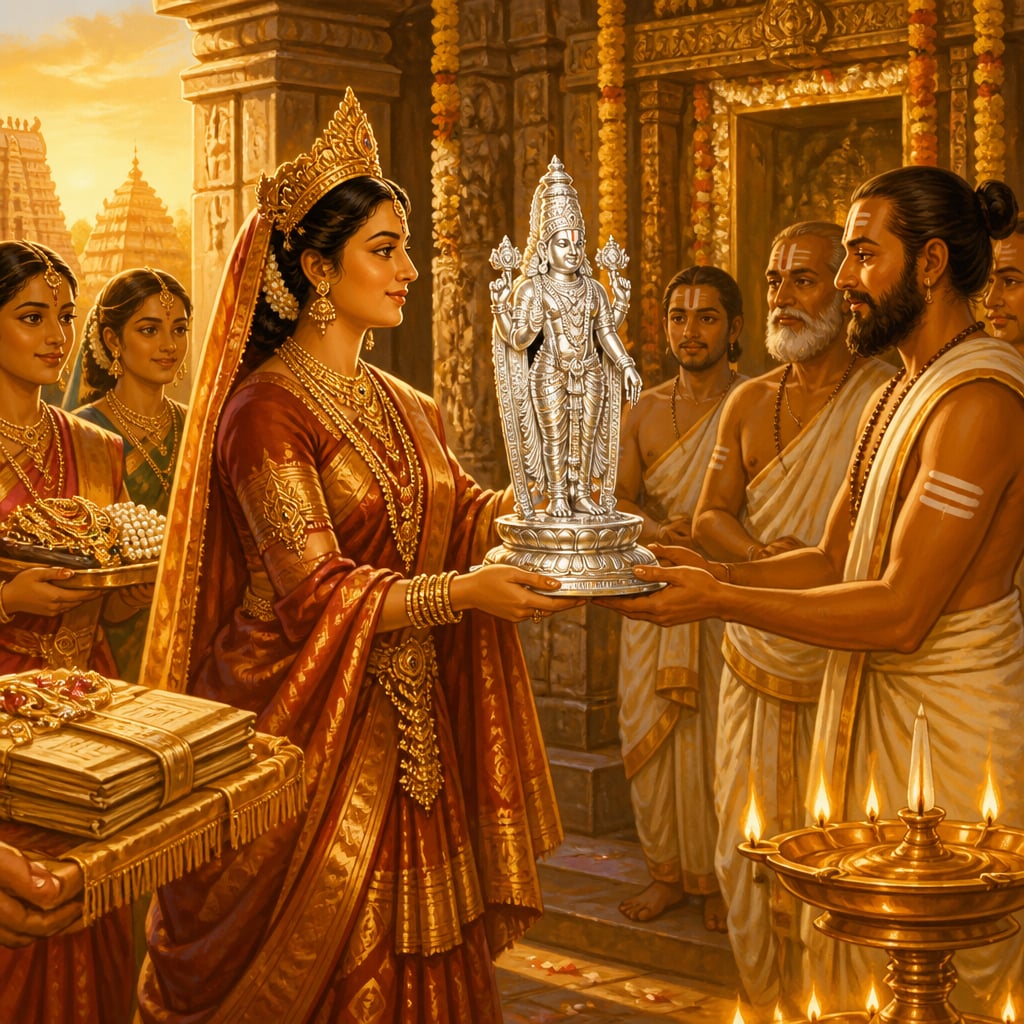
A Pallava queen named Samavai had made a gift, and she wanted it remembered exactly. The inscription lists what she gave: two plots of land, with instructions that their harvest income fund specific festivals and offerings at the shrine. It also records her other gift, the one you can still see today: a silver processional image of the lord, made so that the deity could leave the sanctum for festivals, since the ancient stone image never moves.
Read the scene the way a builder would. People had surely given to the hill before her; songs and pilgrims had been arriving for centuries. But a gift that is only remembered in someone's head dies with that head. A harvest meant for a festival can quietly become a harvest meant for someone's kitchen, and no one can prove otherwise. Samavai's chisel changed the rules. From her gift onward, this temple wrote things down, in public, in stone, where a workman, a priest, or a rival queen could stand and read exactly what was promised, by whom, and for what.
She could not have known what she was starting. Over the next seven centuries, more than a thousand inscriptions followed hers onto the temple's walls and copper plates. Together they make Tirumala arguably the best-documented sacred institution in India, a temple whose account book is a building. And the habit she started answers this chapter's question, how do you build something that outlives you, with its fourth and least glamorous answer: write it down.
What the Wall Remembers
Samavai's own record has held up for over a thousand years, and here is the astonishing part: so has her gift.
The silver image she endowed, known as Bhoga Srinivasa, is still in the temple, still in worship, every single day. Because the main stone deity never moves, this silver form receives many of the daily services on the deity's behalf: it is this image that is bathed, laid to rest at night, and honored in rituals the immovable lord cannot physically attend. During worship, tradition links it to the main image by a cord, so that the two are treated as one. A gift given by a woman in 966 has been on active duty for more than ten centuries, longer than most countries have existed.
And the inscriptions kept coming. The temple's walls carry them in Tamil, Telugu, Kannada, and Sanskrit, layer over layer, dynasty after dynasty: Pallava, Chola, Pandya, and the Vijayanagara emperors of the previous lesson, whose gifts were carved by the same custom Samavai began. When the temple's modern administration finally copied and published them in the twentieth century, the effort filled volume after volume: over a thousand records, spanning seven hundred years.
A Thousand Ledger Entries

What do a thousand inscriptions actually say? Mostly, they say small, precise, wonderfully boring things:
- Who gave: kings and queens, but also merchants, army officers, temple servants, village assemblies, and many ordinary women, each named
- What exactly was given: land, gold coins, lamps, cows for milk and butter, flower gardens, water channels
- What the gift must fund: a specific offering on a specific day, a lamp that must never go out, rice for pilgrims, a festival procession
- And the standing instruction that the arrangement run, as many deeds put it, for as long as the moon and the sun
Historians treasure this wall of small print. From it they can reconstruct the hill's economy century by century: what land was worth, what a festival cost, how water was managed, what workers were paid in. Very few institutions anywhere on Earth can show you their accounts from the 900s. This one can, because a queen decided records were part of the gift.
But the inscriptions were never meant for historians. They were meant for trust. Put yourself in the sandals of a merchant in the year 1100 deciding whether to endow a lamp. On the wall, he can read two centuries of promises and check that they are still being kept: Samavai's festivals still run, the lamps of earlier donors still burn. The record converts his hope into confidence. Every kept promise, publicly visible, lowered the risk for the next giver. That is why the giving compounded for a thousand years. Trust is built one kept, visible promise at a time, and records are how the promises stay visible after the people are gone.
The deeds even carried their own security system: a curse verse, found on thousands of Indian endowment inscriptions, promising misery to anyone who steals what was given. The tradition understood that a record needs teeth.
The Ledger Is the Trust

India's merchant communities built an entire trading civilization on this same insight. For centuries, Marwari and other trading families kept bahi-khata: red cloth-bound account books, written up daily, checked against cash every evening. The discipline was so central to their identity that once a year, on Diwali, the new ledgers are formally worshipped in the Lakshmi puja before a single entry is made. The account book, in this tradition, is not paperwork. It is a sacred object, because it is the physical form of your trustworthiness.
Those ledgers made something remarkable possible: a merchant in Calcutta could accept a paper credit note from a stranger in Bombay, because behind every such note stood families whose books balanced every night and whose reputations traveled with their records. Kept books meant strangers could trade. It is the temple wall's logic, carried into the bazaar.
The modern word for all this is transparency, and it still works exactly the way it worked on the hill. Companies that publish honest numbers borrow more cheaply. Charities that show their accounts raise more. The pattern never ages, because the problem never ages: humans cooperate at scale only when promises can be checked by people who were not in the room.
The Chapter's Answer
Step back, and the four lessons of this chapter now fit together as one blueprint for building something that outlives you:
| Lesson | Builder | The move |
|---|---|---|
| 1 | The Alvars | Build the fame first: quality work, in the people's language |
| 2 | Ramanuja | Build the process: named duties, clean oversight, succession by rule |
| 3 | Krishnadevaraya | Fund the system, not monuments, and give at your peak |
| 4 | Samavai | Write it all down, in public, so trust can compound |
Fame, process, funding, records. Take away any one of them and the institution wobbles; together they have run for a thousand years and counting.
And notice, finally, who anchors this chapter. Its earliest documented builder is a woman, whose name most pilgrims have never heard, whose silver image is worshipped every morning, and whose real monument is a habit: the habit of the written record, which every donor after her, emperor included, simply followed.
The stone ledger has one more trick to show us. In the next chapter, a poor young poet will climb this hill and begin composing songs, one every day, for the deity. The temple will do for his songs what it did for Samavai's gift: engrave them, this time on thousands of copper plates, and seal them in a stone vault inside the temple. They will sleep there, forgotten, for four hundred years, and then be found. His name is Annamacharya, and his story opens the chapter of the bhaktas.
Case studies
The Red Ledgers: Bahi-Khata and the Trade That Trust Built
For centuries, India's Marwari trading families ran far-flung businesses with a technology no more advanced than a red cloth-bound ledger: the bahi-khata. Entries were made daily and balanced against cash every evening; a family's books were its honor, and sons were trained on them like scripture. Once a year, on Diwali, the new ledgers are formally worshipped in the Lakshmi puja before a single entry is made. On this discipline rode the hundi system: paper credit notes that let a merchant in Calcutta advance money to a stranger from Bombay, because behind the paper stood families whose books balanced every night and whose reputation for honored obligations traveled the trade routes with them.
The bahi-khata is the temple wall carried into the bazaar. Samavai's inscription and a Marwari ledger solve the same problem: promises must remain checkable after the people who made them are gone or far away. Both traditions treated the record as sacred, one carving it beside the deity, the other literally worshipping the account book at Diwali, because both understood that the ledger is not paperwork about the trust; the ledger IS the trust.
On this invisible infrastructure of kept books, Indian merchant networks financed trade across the subcontinent and beyond for centuries, long before modern banks reached most of it. Communities famous for ledger discipline became famous for creditworthiness, and their hundis passed like currency among strangers.
Records are not bureaucracy; they are cooperation technology. Whoever keeps honest, checkable books can borrow trust from strangers, and whoever cannot must pay for everything in advance, forever.
Credit scores, audited accounts, and public company filings are bahi-khata at industrial scale. The principle is unchanged since 966: the visible record is what lets people who have never met you say yes.
The Diwali worship of new account books (chopda pujan or bahi-khata pujan) is still performed by millions of Indian business families every year: the only major civilization that put its ledgers inside the prayer.
The Startup That Showed Its Books
Devika runs a forty-person company in Vijayawada that buys chillies and turmeric from about 3,000 small farmers and supplies food brands. Her rival pays a rupee more per kilo in good seasons. Devika does something stranger: every month she publishes her numbers to her farmers, what she sold at, her costs, her margin, and what she paid out, on a printed sheet at every collection center. Her accountant calls it madness; competitors photograph the sheets. Then a price crash hits. The rival, squeezed and opaque, quietly drops its buying price and blames 'the market'. Devika's sheet shows her own margin shrinking alongside the farmers' price, with the arithmetic visible.
Devika has built a temple wall. The medieval merchant deciding whether to endow a lamp could read two centuries of kept promises in stone before committing; her farmers can read eighteen months of honest margins before deciding whom to trust in a crash. Like Samavai, she pays a real cost for the record, exposure, scrutiny, the loss of comfortable vagueness, and like the temple, she is buying something the extra rupee cannot: confidence that survives bad years, because it was never based on claims.
Through the crash season, her farmer retention barely moves while the rival's collapses; two farmer societies sign multi-year supply agreements with her because, as one society head puts it, they can see her books and only hear the rival's promises. The transparency that looked like a competitive handicap turns out to be the moat: any rival can match her price for a season, but matching eighteen months of published honesty requires eighteen months.
Openness is slow armor. It wins nothing in the first month and everything in the first crisis, because trust built on checkable records does not evaporate when conditions turn.
Open-books management, published salaries, public post-mortems after failures: every version trades short-term comfort for compounding trust. The temple wall suggests the trade has been profitable for about a thousand years.
Living traditions
Tirumala's inscriptions are a primary source for South Indian economic history, cited wherever scholars reconstruct medieval prices, land tenure, and temple economies. The deeper legacy is a working demonstration, a thousand years long, that public records compound trust: the logic now embedded in audits, credit systems, and open-data governance, running continuously on one hill since 966.
- The Published Ledger: The temple's modern administration continues Samavai's habit at industrial scale: donation receipts for every hundi offering and endowment scheme, published budgets, and records of endowed services maintained and auditable. A donor endowing a day's free meals today enters a documented system directly descended from the stone wall.
- Ledger Worship at Diwali: Business families across India begin their new account books on Diwali with the chopda pujan or bahi-khata pujan: the fresh ledgers are placed before Lakshmi, marked with auspicious symbols, and worshipped before the first entry. The account book opens the year as a sacred object.
- Sri Venkateswara Museum: The temple's museum displays stone inscriptions, copper plates, and centuries of temple objects, letting pilgrims stand face to face with the actual ledger entries this lesson describes, including records from the dynasties whose donors filled the walls.
Reflection
- The temple's first recorded donor is a woman most pilgrims have never heard of, whose gift has worked daily for a thousand years. What does it change in you to know that the deepest foundations are usually anonymous to the crowds standing on them?
- What is the most important arrangement in your life that exists only in spoken words and memory, and who pays the price if memory fails or the people change?
- The inscriptions bind the future: land given in 966 still funds festivals today. When one generation writes rules the next must keep, is that a gift to the future or a claim on its freedom?