Saraswati Sits on the Books
The Markandeya Purana, the Bangalore Lathe, and the MIT Maker Movement Reinventing a 1,500-Year-Old Tool Blessing
Why a Hindu, on a single morning every October, stops working, garlands the laptop, draws a chalk swastika on the lathe, and refuses to touch any tool until the next sunrise. The Markandeya Purana codified the dual Vijayadashami narrative around 600 CE: Devi destroying Mahishasura and Rama destroying Ravana on the same day, both as victories of knowledge over ego. Csikszentmihalyi 1990 and Seligman 2011 vindicated the underlying mechanism through flow research and the VIA Character Strengths framework. The same impulse now shows up at the MIT Media Lab as 'first make day' and at Japanese factories as Jizo ceremonies, with the original Ayudha Puja and the original Saraswati left out.
The Lathe That Will Not Run Today
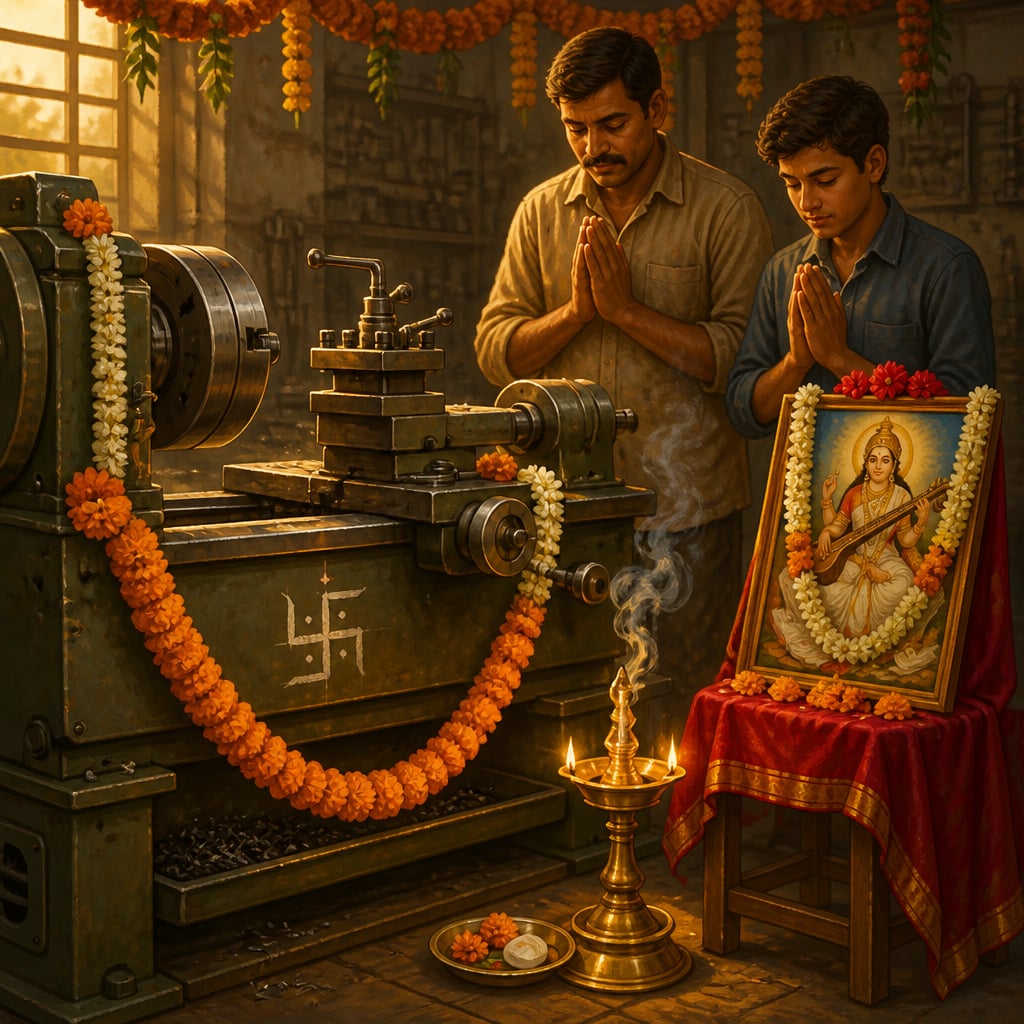
A small machine workshop in Peenya Industrial Area, Bangalore, on the morning of 12 October 2018. The owner, age fifty-four, in a clean white shirt and a fresh sandalwood tilak on his forehead, has not switched on a single machine in his factory. The four lathes, the milling machine, the grinder, and the small press are silent. The floor has been swept. The metal shavings of the previous month have been cleared. Each machine has been wiped down and garlanded with marigolds. A small banana leaf sits in front of each lathe with a coconut, a betel leaf, and a small steel cup of milk.
In the corner of the workshop, on a wooden stool draped in a red cloth, sits a small framed image of Saraswati holding a veena and resting her right hand on a stack of palm-leaf manuscripts. Beside her is a smaller image of Vishwakarma, the divine architect. The owner's youngest son, age sixteen, in a fresh shirt, is breaking a coconut in front of the largest lathe, the one his father bought twenty-two years ago. The coconut shatters cleanly. The boy's older sister, the workshop accountant, ties a red sacred thread around the lathe's main spindle and another around her father's wrist.
The day is Vijayadashami, the tenth day after the start of Sharad Navaratri. Across the country on the same morning, several hundred million people are doing the same thing at different scales. A school teacher in Kerala is putting her chalk and her register at the foot of a small Saraswati image and refusing to teach today. A truck driver in Punjab is garlanding the steering wheel of his Tata 1612. A doctor in Hyderabad is touching her stethoscope to a small Devi image at the home shrine. A software engineer in Pune is unable to bring himself to push code; he runs git status, smiles, and closes the laptop. None of them are performing a quaint regional custom. They are performing a single ritual the Markandeya Purana codified around 600 CE, the Ayudha Puja, the worship of the tools of one's craft.
What Ayudha Puja Actually Is
Ayudha Puja is the Sanskrit name for the worship of the tools, instruments, weapons, and machines of one's craft. The word breaks into ayudha (weapon, tool, instrument) and puja (formal worship). The ritual is performed once a year on Vijayadashami, the tenth day of Sharad Navaratri, falling in late September or October. The instructions are precise: clean the tool, garland it, mark it with sandalwood and kumkum, place a coconut and a betel leaf in front of it, do not use it for the day, and let it rest as if it were itself a deity.
The rule that the tool is not used for the day is the heart of the practice. The mechanic does not pick up a wrench. The teacher does not hold a chalk. The trader does not open a ledger. The driver does not start an engine. The musician does not pluck a string. The mathematician does not write a proof. For one twenty-four-hour window every year, the entire production economy of Bharat goes into a deliberate halt, with the tools acknowledged as the agents that make the work possible. The next morning, on the day called Vijayadashami itself or Dussehra in the North, the tool is touched ceremonially with a fresh garland, the work resumes, and the year's serious labour begins.
The ritual is one of the most class-equal practices in any civilisation. The Brahmin pandit places his palm-leaf manuscripts before Saraswati. The Kshatriya soldier garlands his sword. The Vaishya merchant garlands his account books. The Shudra craftsman garlands his hammer, his loom, his potter's wheel, his cobbler's awl. The same ritual, the same day, the same logic. The dignity of the tool is the dignity of the person who uses it. The Hindu tradition is making a structural claim through the ritual: every craft is honourable because every craft has its tools, and every tool is, on this day, a deity.
The Scripture Names the Two Victories
The Markandeya Purana, the Devi Mahatmya chapters specifically, and the Valmiki Ramayana together carry the dual narrative justification of Vijayadashami. The Markandeya Purana, datable to roughly 600 CE in its surviving recension, names the day as the moment when Durga destroyed the buffalo-demon Mahishasura after the nine nights of battle that gave the festival its name (nava-ratri, the nine nights). The same Purana and the wider tradition place on the same day the moment when Rama killed Ravana at Lanka after the ten-day siege. The two victories are not parallel coincidences. They are the same victory, told twice. Both are knowledge over ego, dharma over adharma, the tool wielded with reverence over the tool wielded with arrogance.

या देवी सर्वभूतेषु शक्तिरूपेण संस्थिता। नमस्तस्यै नमस्तस्यै नमस्तस्यै नमो नमः॥
yā devī sarva-bhūteṣu śakti-rūpeṇa saṃsthitā namas-tasyai namas-tasyai namas-tasyai namo namaḥ
The goddess who dwells in all beings as the form of power. To her, salutations. To her, salutations. To her, salutations again and again.
Devi Mahatmya 5.16 (Ya Devi hymn)
The verse is recited at every Ayudha Puja in households, schools, and workshops across the subcontinent. The Devi who dwells in all beings as the form of power dwells, by extension, in the tool that lets the worker do her work. The lathe is shakti. The chalk is shakti. The wrench is shakti. The festival's claim is metaphysical: the divine feminine is the operating principle of every productive act, and the tool is her local instantiation.
Saraswati and the Books
The second deity of the day is Saraswati, the goddess of knowledge, speech, music, and the arts. The Saraswati form of the Ayudha Puja, called Saraswati Puja in many regions and Saraswati Avahanam in the South, runs on a slightly different calendar in different traditions, with the strongest observance falling on the same Vijayadashami window in the South and on Vasant Panchami (in late January or early February) in Bengal and the North. On the chosen day, the books, the musical instruments, the writing tools, and the educational implements of the household are placed at the goddess's feet, the family does not study, and on the morning after, the books are touched to the forehead before the year's serious learning begins.
The ritual carries a specific procedural detail: any book or instrument placed at Saraswati's feet on the puja day is, by tradition, opened first the next morning at a random page, with the first verse, line, or note of that page read aloud as a small augury for the year. The ritual treats the resumption of study as itself a moment of reverence. The student does not return to the textbook as if to an inert object; she returns to it as if to a friend recently honoured.
Why the Body Responds
The practice does measurable work on the practitioner, not only on the tool. Mihaly Csikszentmihalyi at Claremont Graduate University, in his 1990 book Flow: The Psychology of Optimal Experience and the research programme that preceded it, established the foundational findings of modern flow research. The ten or so conditions that produce flow include clear goals, immediate feedback, a balance between challenge and skill, a sense of control, and one finding directly relevant to Ayudha Puja: craftspeople who report a deep relationship with their tools (whom Csikszentmihalyi describes in the book's chapters on autotelic personalities) report significantly higher rates of flow states during their work, longer durations of flow, and greater post-flow satisfaction.
Martin Seligman at the University of Pennsylvania, in his 2011 book Flourish and the parallel VIA Character Strengths framework developed with Christopher Peterson, formalised the cross-cultural finding that appreciation of beauty and excellence, the strength called transcendence in the VIA taxonomy, is one of the strongest single predictors of long-term life satisfaction across the twenty-four character strengths the framework names. Seligman's empirical conclusion is that the disposition to honour beauty and excellence in the work and tools of others, and in one's own work and tools, is a stronger predictor of well-being than wealth, status, or family structure.
The combination of the two findings is precise. The Hindu Ayudha Puja prescribes annual reverence for the tools of one's craft, with a specific procedural sequence (clean, garland, mark, rest), a specific timing (Vijayadashami), and a specific theological frame (the tool is shakti). Csikszentmihalyi's flow research documents the productivity-and-satisfaction effect of the underlying disposition. Seligman's VIA framework documents the well-being effect of the appreciation of excellence. The Ayudha Puja institutionalises both at civilisational scale, on the same day every year, in the household and the workshop and the classroom and the temple at the same time.
What the World Calls It Now
The modern industrial world has rediscovered the impulse to honour tools and has rebuilt the ritual under several different names, none of which cite the Ayudha Puja precedent.

The maker movement, anchored in Neil Gershenfeld's Center for Bits and Atoms at the MIT Media Lab since 2005, has developed structured first make ceremonies for new fabrication tools in the global fab-lab network. The protocols vary: some labs blow on the new laser cutter or 3D printer before its first run; others have the lab director draw a small chalk symbol on the machine; the MIT Media Lab itself has, on more than one occasion, held a small ceremonial first-cut event for major new equipment. The protocols are described in maker-movement literature as either spontaneous innovations or borrowings from craft traditions, with no citation to the Ayudha Puja's fifteen-hundred-year institutional precedent.
The Japanese tradition of Jizo ceremonies, performed annually at certain factories and craft workshops, blesses tools and instruments and offers small prayers for safe operation in the year ahead. The Jizo tradition is a Buddhist transmission with roots that almost certainly trace, through the Indo-Tibetan Buddhist corridor, back to the same dharmic source as Ayudha Puja, although the Japanese ritual literature does not name the connection.
The corporate tool-blessing practice, which appears at the launch of new factories, the commissioning of new ships, the inauguration of new aircraft, the first run of new server installations, and the commissioning of new scientific instruments, runs across the global industrial economy with no single citation but a clear functional descent from rituals like Ayudha Puja. The breaking of a champagne bottle on a ship's hull at launch, the Western parallel, is a fragment of the same impulse with the underlying dharma deleted.
None of the three modern industries cites the Markandeya Purana, the Devi Mahatmya, or the Ayudha Puja's institutional history. The structure travels. The lineage is left behind.
What to Call It Yourself
The renaming is small and exact. When the MIT Media Lab calls it first make day, you say Ayudha Puja. When the maker-movement essay calls it honouring the tools of fabrication, you point at the Markandeya Purana, the Devi Mahatmya 5.16, and the year 600 CE. When the corporate-launch press release calls it commissioning ceremony, you say Vishwakarma Puja or Ayudha Puja depending on the trade. When a colleague describes the satisfaction of cleaning her workspace on a Friday, you point at the annual ritual that does the same thing at civilisational scale.
The practice itself is portable to any household, classroom, workshop, or office. On the next Vijayadashami morning (the precise date varies year to year by the lunar calendar), do not work. Clean the tools you use most: the laptop, the kitchen knife, the desk, the loom, the lathe, the textbook, the stethoscope, the steering wheel. Garland them with any flower available, even one. Place a small token (a fruit, a nut, a sweet) in front of each. Do not touch the tools for the day. On the next morning, touch each tool to the forehead, and resume the year's work. The cost is the price of one day of foregone work and a few flowers. The merit, in the Devi Mahatmya's language, is the recognition that the shakti who dwells in all beings as the form of power dwells in your tools too.
Modern Echoes and the Receipts on the Other Side
The convergence is documented. Csikszentmihalyi 1990 names the flow-and-tools mechanism. Seligman 2011 and the VIA Character Strengths framework name the appreciation-of-excellence well-being mechanism. The Markandeya Purana codified the Vijayadashami dual narrative around 600 CE. The Devi Mahatmya 5.16 placed the goddess as the form of power in all beings, including the tool. Saraswati and Vishwakarma have been the household and craft deities of Indian work for at least fifteen hundred years.
The market has noticed and rebuilt. The maker movement at MIT runs first-make ceremonies. The Japanese Jizo tradition blesses tools annually. The corporate world commissions ships, planes, factories, and servers with launch ceremonies. None cite the Hindu corpus.
The Ayudha Puja runs free in roughly two hundred million households, workshops, schools, and offices on the same single morning every year, with the Markandeya Purana, the Devi Mahatmya, the 1990 Flow book, and the 2011 VIA framework all in the supporting literature.
Back in the Bangalore workshop, the lathe is silent. The marigolds are fresh on its spindle. The owner has touched the coconut shards to his forehead and is sitting on the floor with his children, eating the small steel cups of milk that were placed before each machine. Tomorrow morning at six, he will touch the lathe's main switch with a fresh sandalwood mark on his thumb, the spindle will turn, and the year's metal will begin to be cut. Csikszentmihalyi has not been read here. Seligman has not been read here. The Devi Mahatmya 5.16 has been recited by the boy and the older sister together. The flow state will arrive on its own, on schedule, the next morning.
Case studies
The Markandeya Purana and the Dual Vijayadashami: One Day, Two Victories
Around 600 CE, the Markandeya Purana, in its surviving recension, codified Vijayadashami as the day on which two simultaneous victories occurred: Durga's destruction of the buffalo-demon Mahishasura after the nine nights of battle that gave Sharad Navaratri its name, and Rama's destruction of Ravana at Lanka after the ten-day siege. The two narratives are not parallel coincidences. They are the same victory, told twice. Both are knowledge over ego, dharma over adharma, the well-honoured tool wielded with reverence over the arrogant tool wielded for self-aggrandisement. The Devi Mahatmya chapters of the same Purana provide the scriptural backbone for the festival's metaphysical claim: the goddess who dwells in all beings as the form of power (Devi Mahatmya 5.16) dwells, by extension, in the tool that gives the worker her power. The Markandeya Purana's codification of the dual narrative made Vijayadashami the most narrative-rich day in the Hindu calendar, and the Ayudha Puja the most institutionally portable festival in the corpus.
The Hindu tradition does not treat the two narratives as competing origin myths. It treats them as the same teaching from two angles. The Devi Mahatmya's Mahishasura-mardini story emphasises the destruction of ego (the buffalo-demon's arrogance and his demand to be worshipped) by knowledge in its feminine form. The Ramayana's Ravana-vadha emphasises the destruction of ego (the rakshasa-king's abduction of Sita and his refusal to return her) by dharma in its masculine kingly form. The Ayudha Puja takes both teachings into the household and the workshop: the tool, when honoured properly and used with reverence, is dharma; the same tool, when used arrogantly and without ritual recognition, is the seed of Mahishasura and Ravana's failure. The festival's claim is structural: every craft is the daily replay of the same victory the Purana narrates.
The Markandeya Purana's codification has held for fifteen hundred years. Vijayadashami is observed at full national scale across India today, with both narratives invoked simultaneously: the Mahishasura effigies are built and burnt in some regions, the Ravana effigies are built and burnt in others, and the Ayudha Puja runs in households, workshops, schools, and offices everywhere on the same morning. The Vijayanagara empire elevated the festival to state-ceremony scale at Hampi in the fifteenth and sixteenth centuries, and the Mahanavami-dibba platform at Hampi remains the most documented historical venue for an empire-scale Ayudha Puja review. The festival's institutional continuity from 600 CE to 2026 is the longest unbroken record of any tool-honouring ritual in any civilisation.
The Hindu tradition's choice to give Vijayadashami two simultaneous narrative justifications is not a contradiction. It is a teaching about the universality of the underlying victory. The same dharma that the goddess wields against Mahishasura is the dharma the king wields against Ravana, the dharma the schoolteacher wields with her chalk, the dharma the surgeon wields with her scalpel, and the dharma the engineer wields with her lathe. The Ayudha Puja institutionalises the recognition that all these are the same victory, on the same day, in the same household, every year. The maker movement's first-make ceremonies are reinventing this recognition without the institutional scale or the dual scriptural anchor that the Markandeya Purana built fifteen hundred years ago.
Markandeya Purana, c. 600 CE: codifies Vijayadashami as the day of the dual victory of Durga over Mahishasura and Rama over Ravana, the most narrative-rich day in the Hindu calendar. The Vijayanagara empire (14th-16th c CE) elevates the Ayudha Puja to state-ceremony scale at the Mahanavami-dibba platform at Hampi, documented by foreign visitors including Domingo Paes and Abdur Razzaq.
The MIT Media Lab's First-Make Day and the Japanese Jizo Ceremony: An Impulse Reinvented Twice
Since 2005, Neil Gershenfeld's Center for Bits and Atoms at the MIT Media Lab has anchored the global maker movement and the international fab-lab network. Within the maker-movement literature and the fab-lab community, structured 'first make' ceremonies have emerged spontaneously across labs worldwide: some labs blow on the new laser cutter or 3D printer before its first run; others have the lab director draw a small chalk symbol on the new machine; the MIT Media Lab itself has held small ceremonial first-cut events for major new equipment. In parallel, Japanese factories and craft workshops conduct annual Jizo ceremonies, blessing tools and instruments and offering small prayers for safe operation in the year ahead. The Jizo tradition is a Buddhist transmission with roots that almost certainly trace back, through the Indo-Tibetan Buddhist corridor, to the same dharmic source as Ayudha Puja. Neither the maker-movement literature nor the Japanese ritual literature names the Markandeya Purana or the Ayudha Puja's fifteen-hundred-year institutional precedent. The corporate-launch tradition of breaking a champagne bottle on a ship's hull, and the various commissioning ceremonies for new factories, planes, and server installations, run on the same impulse with the underlying dharma deleted.
The dharmic frame did not separate the impulse to honour tools from the lineage that supports it. The Ayudha Puja works because the Markandeya Purana named the dual victory, the Devi Mahatmya placed the goddess as the form of power in all beings (including the tool), the Vishwakarma tradition gave the workshop its specific patron deity, and a hundred generations of craftspeople kept the practice in continuous operation across every region and every craft. To extract the impulse (honour the tools), monetise it as a maker-movement protocol, and name it 'first make day' is permitted, but the lineage is what gave the impulse its civilisational scale. The maker movement's two decades of first-make ceremonies cover roughly ten thousand fab-labs worldwide. The Hindu Ayudha Puja covers roughly two hundred million households on a single day every year.
The maker movement, the Japanese Jizo tradition, and the corporate-launch ceremony continue. The structures are now standard inventory in fabrication-lab culture, Japanese industrial practice, and global corporate ritual. The underlying lineage is invisible to almost all of the participants. The asymmetry is one of the clearest illustrations in the modern industrial economy of how a deeply useful disposition can be reinvented multiple times in different cultures, each time without naming the institutional civilisational ritual that already encoded it at scale.
The right response to the asymmetry is not to dismiss the maker movement or the Jizo tradition. Both do real work. The maker-movement first-make ceremony genuinely changes how the lab treats the new machine. The Jizo ceremony genuinely strengthens the bond between the worker and her instrument. The right response is articulation. Run a first-make ceremony at your lab if you want the Western iconography. Observe Vijayadashami at your home, your workshop, or your office if you want the protocol. The first-make ceremony is improvised; the Ayudha Puja has fifteen hundred years of institutional refinement, the Markandeya Purana, the Devi Mahatmya, and the 1990 Flow research and 2011 VIA framework all in the supporting literature.
Neil Gershenfeld's Center for Bits and Atoms at MIT Media Lab: founded 2005, anchors the global maker movement and the fab-lab network of approximately 2,000+ labs worldwide. Japanese Jizo ceremonies: annual tool-blessing tradition at factories and craft workshops, Buddhist transmission with roots in the Indo-Tibetan corridor. Hindu Ayudha Puja: continuously observed since at least 600 CE, runs in roughly 200 million households on a single morning every year.
Csikszentmihalyi 1990 and Seligman 2011: Two Books That Vindicate the Lathe's Garland
In 1990, Mihaly Csikszentmihalyi published Flow: The Psychology of Optimal Experience, establishing the foundational findings of modern flow research. The book documented the ten or so conditions that produce flow, including clear goals, immediate feedback, balance between challenge and skill, and a deep relationship with the tools of one's craft. Csikszentmihalyi's chapters on autotelic personalities documented that craftspeople who report a deep relationship with their tools report significantly higher rates of flow, longer durations of flow, and greater post-flow satisfaction. In 2011, Martin Seligman published Flourish, articulating the VIA Character Strengths framework developed with Christopher Peterson. The framework's strength of appreciation of beauty and excellence is one of the strongest single predictors of long-term life satisfaction across the populations studied, exceeding the predictive value of wealth, status, or family structure. Neither book cites the Markandeya Purana, the Devi Mahatmya, the Vishwakarma Sukta of the Rig Veda, or any element of the Ayudha Puja corpus.
The Hindu Ayudha Puja prescribes annual reverence for the tools of one's craft, with a specific procedural sequence (clean, garland, mark, rest), a specific timing (Vijayadashami), and a specific theological frame (the tool is shakti, the goddess in the form of power). Csikszentmihalyi 1990 documents the productivity-and-satisfaction effect of the underlying disposition. Seligman 2011 documents the long-term well-being effect of the appreciation-of-excellence character strength. The dharmic frame names the combined effect as the merit of the daily reverence and the festival merit of Vijayadashami. The modern frame names it as flow and the VIA transcendence cluster. The grandmother who garlands her loom and the mechanic who garlands his lathe are running both interventions in the same morning, three times a year on average across Vijayadashami, Saraswati Puja, and Vishwakarma Jayanti.
Csikszentmihalyi 1990 has become the foundational citation in the modern flow literature and is referenced across organisational psychology, education research, sports science, and management theory. Seligman 2011 and the VIA framework are the empirical foundation for the modern positive-psychology field, with the framework now used in clinical, educational, and corporate contexts worldwide. Neither line of research has incorporated the Hindu Ayudha Puja corpus into its citation network. The maker movement, the Jizo tradition, and the corporate launch ceremony that built on the same disposition cite neither the dharmic source nor the modern empirical research with the Hindu source named alongside.
When the labs vindicate a household ritual, the right response is not surprise. It is recognition. The Bangalore workshop owner did not need Csikszentmihalyi 1990 or Seligman 2011 to know that garlanding the lathe on Vijayadashami morning produced something measurable in the year's work. He had the Markandeya Purana, the Devi Mahatmya 5.16, and his father and grandfather's example. The journals and the books catching up are welcome, and they make the case to a generation that trusts the citation more than it trusts the grandfather's example. The Ayudha Puja is, in this frame, the most-practised and best-vindicated tool-honouring ritual in the literature.
Csikszentmihalyi, Flow (1990): foundational text of modern flow research, documenting that craftspeople with deep tool-relationships report higher flow rates and durations. Seligman, Flourish (2011) and the VIA Character Strengths framework: appreciation of beauty and excellence is one of the strongest single predictors of long-term life satisfaction across populations studied. Markandeya Purana, c. 600 CE: codifies Vijayadashami and the Ayudha Puja as institutionalised reverence for the tools of every craft.
Historical context
From the Rig Vedic Vishwakarma Sukta (c. 1500 BCE) and the Markandeya Purana's codification of the dual Vijayadashami narrative (c. 600 CE), through the Vijayanagara empire's elevation of the festival to state-ceremony scale (15th-16th centuries CE), to the 1990 publication of Csikszentmihalyi's Flow, the 2005 founding of Neil Gershenfeld's Center for Bits and Atoms at the MIT Media Lab, and the 2011 publication of Seligman's Flourish.
The Ayudha Puja is one of the most institutionally continuous festivals in any civilisation, running unbroken from at least the Vijayanagara period (and almost certainly earlier) at full national scale to the present. The continuity across class context (the schoolteacher, the soldier, the merchant, the craftsman, the modern software engineer all observe the same day with the same procedural sequence), across region (Vijayadashami in the South, Dussehra in the North, Saraswati Puja in Bengal, Ayudha Puja in Tamil Nadu and Karnataka), across the diaspora (Indian-origin engineers in Silicon Valley, Indian-origin doctors in Toronto, Indian-origin teachers in London all observe the day), and across the modernisation of the tools themselves (the lathe replaced the loom; the laptop replaced the manuscript; the puja remained) is the proof that the protocol survives because the disposition it institutionalises is foundational. The tool deserves reverence; the worker who reverses her tool produces better work; the well-being of the household that observes the disposition is measurable.
Living traditions
The maker movement at the MIT Media Lab and the global fab-lab network has spent two decades developing first-make ceremonies for new fabrication tools, with no citation to the Ayudha Puja's fifteen-hundred-year institutional precedent. The Japanese Jizo tradition blesses tools and instruments annually at factories and workshops, with no acknowledgement of the dharmic source from which the impulse almost certainly travelled through the Indo-Tibetan Buddhist corridor. The corporate-launch tradition (champagne on a ship's hull, ribbon-cutting at a new factory, ceremonial first cut at a server installation) runs the same impulse globally with the underlying dharma deleted. Csikszentmihalyi's 1990 Flow and Seligman's 2011 Flourish vindicate the underlying mechanism without citing the Hindu corpus. Re-Sanskritize: when the MIT Media Lab calls it 'first make day', you say Ayudha Puja. When the maker-movement essay calls it 'honouring the tools of fabrication', you point at the Markandeya Purana, the Devi Mahatmya 5.16, and the year 600 CE. When the corporate launch press release calls it 'commissioning ceremony', you say Vishwakarma Puja or Ayudha Puja depending on the trade. On the next Vijayadashami morning, do not work. Clean the tools you use most: the laptop, the kitchen knife, the desk, the loom, the lathe, the textbook, the stethoscope, the steering wheel. Garland them with any flower available. Place a small token in front of each. Do not touch the tools for the day. On the next morning, touch each tool to the forehead, and resume the year's work. The cost is one day of foregone work and a few flowers. The merit, in the Devi Mahatmya's language, is the recognition that the shakti who dwells in all beings as the form of power dwells in your tools too.
- Mahanavami-dibba Platform, Hampi: The grand stone platform at Hampi from which the Vijayanagara emperors reviewed the empire's annual Mahanavami and Vijayadashami tool-blessing parade in the fifteenth and sixteenth centuries. The platform is approximately twelve metres tall and decorated with friezes of horses, elephants, foreign envoys, and craftspeople. Foreign visitors including the Portuguese chronicler Domingo Paes (1520-1522) and the Persian ambassador Abdur Razzaq (1442-1443) have left detailed accounts of the empire-scale Ayudha Puja review held here, which included the blessing of weapons, agricultural implements, craft tools, and the empire's military horses and elephants. The site is the most documented historical venue for a state-scale Ayudha Puja in any civilisation.
- Mysore Palace and the Mysore Dasara Procession Route: The Mysore Palace (officially the Amba Vilas Palace) is the venue of the Mysore Dasara state procession, one of the most institutionally continuous Vijayadashami events in modern India. The Wodeyar dynasty's Mysore Dasara traces its institutional descent from the Vijayanagara empire's tool-blessing review at Hampi, with the procession running from the palace to the Banni-mantapa pavilion on Vijayadashami afternoon. The day's ritual sequence at the palace includes the morning Saraswati and Ayudha Puja, the afternoon procession with the royal elephant carrying the Chamundeshwari image, and the evening torchlight parade. The palace itself is illuminated with approximately ninety-seven thousand bulbs every evening during the Dasara week.
- Saraswati Temple, Basar: The Sri Gnana Saraswati Temple at Basar is one of only three temples in India dedicated specifically to Saraswati (the others being at Pushkar and Kashmir). The temple is the most visited site for the Aksharabhyasam (the first-letter ceremony) for children in Telangana and Andhra Pradesh, with several hundred children initiated into formal learning every Vijayadashami and Vasant Panchami morning. The temple is built on the bank of the Godavari river and is associated by tradition with the sage Vyasa, who is said to have composed the Mahabharata at this site.
Reflection
- Of the tools you use most in your daily work (laptop, phone, kitchen knife, vehicle, primary instrument of your craft), which is the one you most take for granted, and what would change in your relationship to it if, on the next Vijayadashami morning, you cleaned it, garlanded it, and refused to use it for twenty-four hours?
- Why might the Markandeya Purana have given Vijayadashami two simultaneous narrative justifications (Durga's destruction of Mahishasura and Rama's destruction of Ravana on the same day) rather than one? What is the Purana saying about the underlying victory by giving it two faces?
- If Csikszentmihalyi 1990 and Seligman 2011 independently confirmed the productivity-and-well-being effects of the disposition the Ayudha Puja institutionalises, why has the modern academic literature on flow, positive psychology, and craftsperson identity not yet incorporated the Markandeya Purana, the Devi Mahatmya, or the Vishwakarma Sukta into its citation network? What would have to change, in academic norms or in the framing of the source material, for the older citations to enter the literature?