Capstone: The Sanatan Operating System

How one hundred and eighty rituals across the body, the day, the kitchen, the home, the threshold, the life cycle, the temple, the calendar, society, learning, and pilgrimage form a single coherent operating system for human life

This is the capstone. It does not teach new rituals. It re-presents every ritual already taught as a node in a single coherent system. Tilak and tongue scraping, Sandhya and Surya Namaskar, the Hindu kitchen and the Hindu home, the threshold lamp and the conch, the sixteen samskaras and the temple practice, the tithi and the muhurta, the bow at the elder's feet and the meal for the unexpected guest, the rice-tray and the Tiruppavai. Five axes hold them together. Physical hygiene. Psychological hygiene. Ecological balance. Intergenerational continuity. Cosmological alignment. Each ritual lights up at least one axis. Many light up several. Together they form an operating system that has run continuously for three thousand years across the largest contiguous civilisational space on earth, and that the modern world has been quietly relearning since the wellness industry was invented.

A Single Sunday in a Bengaluru Flat

It is a Sunday morning in January, in a flat on the seventh floor of a building near Indiranagar. A man of forty wakes at five thirty, before his children, before the apartment lift starts running. He drinks a small copper tumbler of water that has been sitting on his bedside table overnight. He scrapes his tongue with a thin steel scraper. He swishes a spoonful of cold-pressed sesame oil through his teeth for ten minutes while he opens the windows of the flat. The neem twig at the back of the bathroom cupboard, brought from his mother's house in Mysore, has not been touched in a week. He picks it up anyway. The mala on the puja shelf, tulasi, his grandmother's. The diya, freshly cleaned. The Bhagavad Gita open at chapter ten. The kolam at the threshold of the front door, drawn the night before by his wife. The tulasi vrindavan on the small balcony, watered. The brass conch on the shelf above the desk. The rudraksha on the wrist.
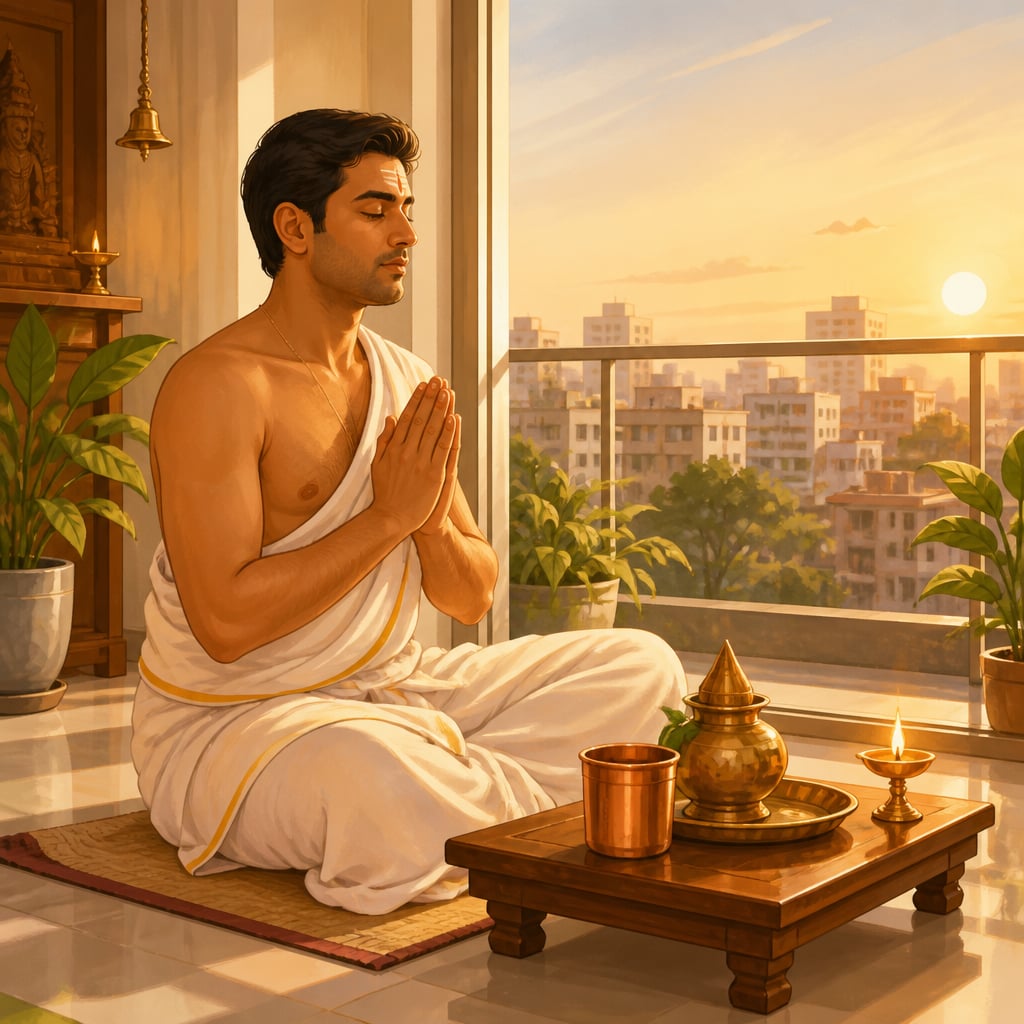
Bengaluru flat morning Sandhya Vandanam at the home altar

He sits on the floor, faces east, performs his Sandhya Vandanam in the form his grandfather taught him at age nine. Surya Namaskar, twelve postures, the twelve mantras whispered. One round of Gayatri on the mala. Five minutes of dhyana. The lamp at the puja shelf is lit. A short reading from the Gita. The tongue is silent for the first hour after waking, the classical mauna of the morning.
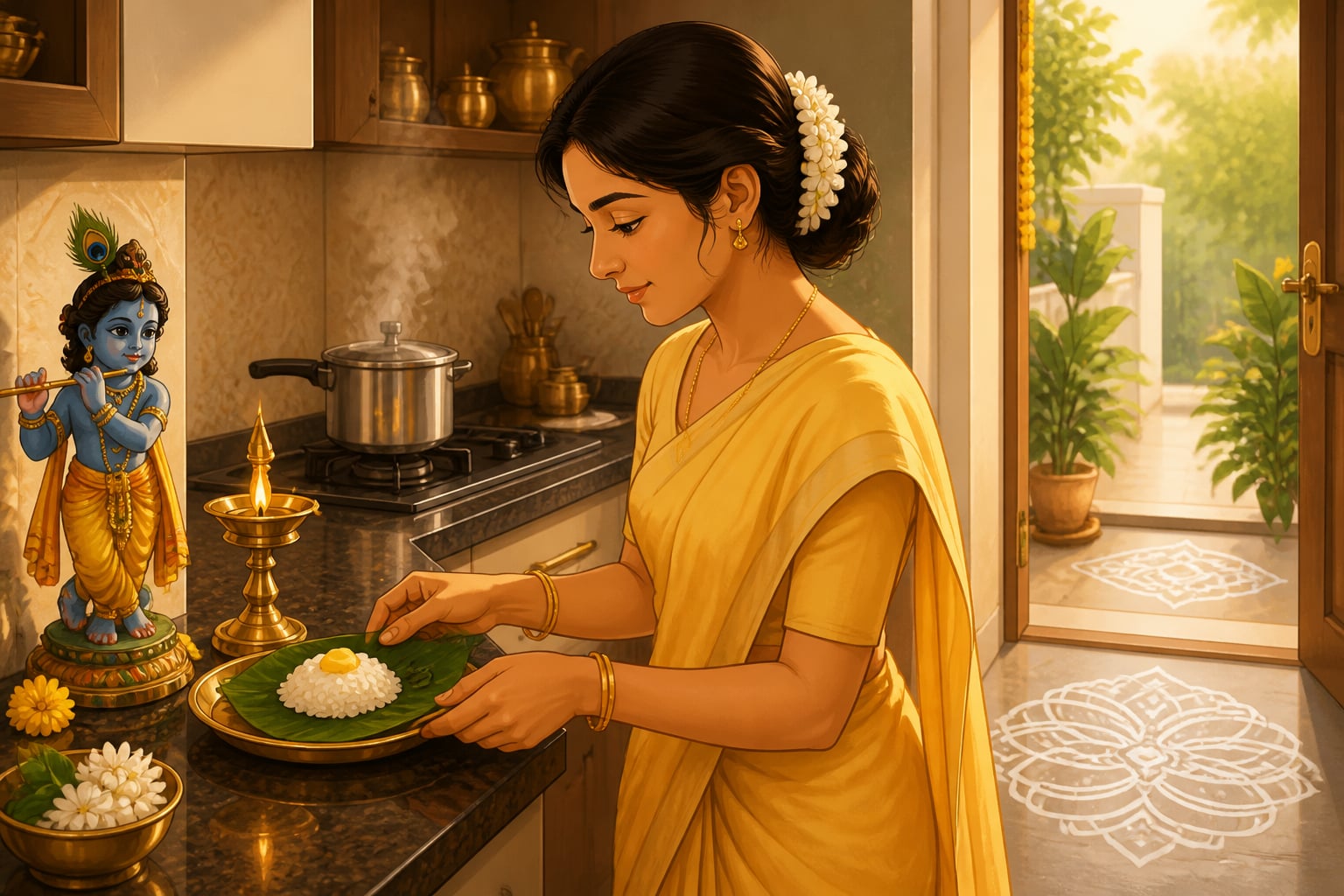
Bengaluru flat kitchen kolam and naivedya offering at dawn

In the kitchen at six fifteen, the wife has begun. The first portion of rice is set aside for the unexpected guest, the dog at the basement, the crow at the railing. The cooking is sattvic this Sunday. Onion and garlic have been put away because it is Magh, and the household has decided to keep the month. Naivedya is offered at the puja shelf before anyone eats. The grandmother, visiting from Mysore, takes the boy onto her lap and shows him how to draw the first letter of the Sanskrit alphabet in a small silver tray of rice, because today is also Vasant Panchami, and the household is doing a small Vidyarambha for the boy who will start school next month. The boy bends and touches the grandmother's feet without being told. The grandmother's hand settles briefly on the back of his head.

Later, before lunch, the man calls his elder cousin in Hyderabad to discuss the Shraddha for his late father, due next month. He plans the Magh snan he will take at the Sangam at the end of the week. He pays for his domestic worker's son's school fees through a third-party platform that does not name him. The wife lights the akasha deepa for the closing of Margazhi, even though it is January and Margazhi has formally ended, because the household decided years ago to keep it through Magh as well. The boy, having drawn his first letter, is now flowing through Surya Namaskar with his father in the living room, slowly, learning.

In one Sunday morning, the household has performed at least thirty distinct rituals from the eleven chapters of this course. Tilak and tulasi mala on the body. Brahma Muhurta and tongue scraping and Sandhya and Surya Namaskar and Gayatri and dhyana from the day. Naivedya and sattvic food and atithi-bhag from the kitchen. Kolam and tulasi vrindavan and akasha deepa from the home. The conch and the rudraksha from the protection axis. Vidyarambha from the life cycle. The puja shelf and the lamp from the temple-at-home axis. The Magh vrata from the calendar. Charan sparsh and atithi seva from society. The first letter in rice and the morning Sanskrit chanting from the learning axis. The plan for the Magh snan from the pilgrimage axis. A vidya-daan transfer routed silently from the daana axis.

None of these is being performed in isolation. None is being performed because a wellness app prescribed it. None is being performed for an audience. They are being performed because the household has decided to keep the operating system, and the operating system has its own internal logic. Three thousand years of design has taught the family that these rituals do not stand alone. They hold each other up. The conch makes the home an altar. The altar makes the kitchen a temple. The temple makes the meal an offering. The offering makes the household a unit of dharma. The unit of dharma makes the calendar a discipline. The discipline makes the life a samskara, the same word for ritual and for the impressions left on the soul, because in this system they are the same thing.

This is the Sanatan Operating System.

The Five Axes

The one hundred and eighty rituals across the eleven chapters of this course distribute across five axes. Every ritual lights up at least one. Many light up several. The axes are the load-bearing beams of the system.

Physical Hygiene. The rituals that maintain the body. Tongue scraping at waking. Oil pulling. Neem twig brushing. The morning copper water. Abhyanga, the oil bath. Nasya, the nasal drops. Sitting on the floor. Eating with the right hand. Eating in silence. The Shravan dietary reset. The Kartik snan. The seasonal eating of rtucharya. Ekadashi fasting. Sattvic plates. The body is treated as the smallest unit of the cosmos and is maintained at that scale.

Psychological Hygiene. The rituals that maintain the mind. Sandhya Vandanam at the seam of the day. Surya Namaskar paired with the breath. Gayatri counted on a mala. Dhyana after japa. Mauna in the morning. The reading of the Gita. The recitation of the Sahasranama. The Tiruppavai through Margazhi. The mantra through the Ekadashi night vigil. The pranayama before the Shraddha. The mind is treated not as an inert backdrop but as a system that requires daily, monthly, and seasonal calibration.

Ecological Balance. The rituals that bind the household to the surrounding world. The kolam at the threshold, drawn each morning in rice flour the ants will eat. The tulasi vrindavan on the balcony, the peepal pradakshina at the temple, the banana plantain at the wedding, the neem as the village deity. Naga Panchami, the snake worship. The cow as gomata. The dog as Bhairava. The crow feeding at Pitru Paksha. The ant feeding at the threshold. The fish and turtle feeding at the river. The household is not a closed unit. It is a small node in a living web, and the rituals are the daily acknowledgements of that web.

Intergenerational Continuity. The rituals that transmit the system across time. The sixteen samskaras, from the Garbhadhana before conception to the Antyeshti at cremation. The Shraddha and the Tarpana for the ancestors. The Upanayana and the Vidyarambha for the children. The Kanyadaan and the Saptapadi at the wedding. The grandmother teaching the grandson without explaining. The grandfather demonstrating the Sandhya at the river. The boy bending to the elder's feet without being told. The system is not maintained by individual willpower. It is maintained by transmission, in silence, across three or four generations at a time.

Cosmological Alignment. The rituals that anchor the household to the cosmos. The east-facing seat at Sandhya. The arghya offered to the rising sun. The twelve postures mapped to the twelve houses of the zodiac. The hundred and eight beads on the mala mapped to the diameter ratios of sun and moon and earth. The Margashirsha month chosen by Krishna among months. The tithi-determined day. The Sankranti at the threshold of uttarayana. The Magh Mela at the Triveni. The Char Dham at the four compass points of the Himalaya. The Hindu does not live in a calendar. The Hindu lives in a cosmos that has been mapped to a calendar.

How the Axes Interlock

The operating system does not run any one axis in isolation. Every ritual is, structurally, multi-axis. This is what gives the system its resilience.

Sandhya Vandanam is psychological hygiene because it calibrates the mind. It is also cosmological alignment because it is anchored to the rising sun. It is also intergenerational continuity because the grandfather teaches it to the grandson. It is also physical hygiene because the bath that precedes it cleans the body. One ritual, four axes lit.

The Hindu kitchen is ecological balance because the first portion is set aside for the unexpected guest, the dog, the crow, the ant. It is physical hygiene because the food is sattvic and seasonal. It is intergenerational continuity because the grandmother teaches the grandchild what is set aside and what is given. It is cosmological alignment because the meal is offered as naivedya before being eaten. One kitchen, four axes lit.

The Hindu wedding is intergenerational continuity by definition. It is also cosmological alignment because Agni is the witness. It is also ecological balance because the banana plantain is brought to the mandapa. It is also psychological hygiene because the Saptapadi binds the couple at the level of the breath, not the contract. One ceremony, four axes lit.

A system in which most components light up most axes does not collapse when any one component is removed. If a household stops keeping one ritual, the others continue to carry the load. If a generation forgets one practice, the larger architecture is robust enough to survive the gap. This is why three thousand years of invasion, displacement, and disruption have not been able to take down the system. The redundancy is structural.

The Modernity Bridge: What the Labs and the Markets Have Caught Up To

This course has named the modern echo, ritual by ritual. The capstone is the moment to lay them out in one place.

Physical Hygiene. Oil pulling sold by GuruNanda and Goop. Copper water at CopperH2O. Turmeric latte at Starbucks. Intermittent fasting in the New England Journal of Medicine, the Ekadashi running underneath. The yoga industry at eighty seven billion dollars, the Surya Namaskar at its centre.

Psychological Hygiene. Calm and Headspace at two billion dollar valuations, the japa running underneath. Transcendental Meditation at fifteen hundred dollars an initiation, the same japa shorn of the mala. Andrew Huberman's coherence breathing at six per minute, the Gayatri's tempo.

Ecological Balance. Forest bathing and Shinrin-yoku, the peepal pradakshina underneath. Whole Foods indoor herb gardens, the tulasi vrindavan underneath. Plant-based eating, the sattvic kitchen underneath.

Intergenerational Continuity. Namaste recommended by the World Health Organization in the post-2020 pandemic moment, the gesture having been there for three millennia. Conscious conception retreats, the Garbhadhana underneath. The destination wedding with fire ceremony, the Vivaha underneath.

Cosmological Alignment. New moon manifesting at five point two million Instagram posts, the Amavasya underneath. Robin Sharma's 5 AM Club, the Brahma Muhurta underneath. Co-Star astrology at thirty six million in annual revenue, the panchanga underneath. Camino de Santiago, the Char Dham underneath.

The most striking modern parallel is not any single product. It is Stephen Covey's The Seven Habits of Highly Effective People, published in 1989 and now selling over forty million copies in over forty languages. Covey synthesised character ethics from Stoic, Christian, and Eastern sources into seven interdependent habits. He argued, correctly, that the habits are systemic, not standalone, and that working them as a package outperforms working any one alone. The argument is structurally identical to the Sanatan OS. The Grihya Sutras, the Manusmriti, and the Mahabharata had completed the synthesis project two thousand years earlier. Covey is unaware. The forty million readers are unaware. The system is the system regardless of who knows.

The behavioural science layer is even sharper. Roy Baumeister and John Tierney in Willpower, BJ Fogg in Tiny Habits, James Clear in Atomic Habits, Wendy Wood in Good Habits Bad Habits, Charles Duhigg in The Power of Habit. Five major books across two decades converge on three claims. Identity-level habits outperform outcome-level goals. Environmental design outperforms willpower. Community accountability outperforms individual resolution. The Sanatan OS encodes all three. Samskaras are identity formation. Vaastu and dinacharya are environmental design. Festivals, utsavams, and household-scale vrats are community accountability. The labs are catching up. The lineage was already there.

Vatsyayana inscribing the Kamasutra at his Pataliputra desk

Vatsyayana's Kamasutra, composed around the third century CE, is misread in the modern world as a sex manual. It is, in fact, the most comprehensive single Hindu treatise on the complete life system, covering all four Purusharthas with structural rigour. Vatsyayana states explicitly that he has synthesised the prior shastra traditions into one coherent system. The capstone of this course is, in spirit, doing the same project at smaller scale. The synthesis is not new. The synthesis is the Hindu civilisational habit.

What to Call It Yourself

The vocabulary is the inheritance. Across the eleven chapters, the course has restored the older words. Tilak and yajnopavita on the body. Brahma Muhurta, jihva nirlekhana, gandusha, Sandhya, Surya Namaskar, Gayatri across the day. Naivedya and atithi-bhag in the kitchen. Kolam, vaastu, tulasi vrindavan in the home. Drishti removal, havan, raksha sutra, yantra in the protection layer. The sixteen samskaras of the life cycle. Pradakshina, darshan, abhishekam, aarti, japa, mala, dhyana, utsavam at the temple. Tithi, muhurta, panchanga, vrata, chaturmas in the calendar. Charan sparsh, atithi devo bhava, daana, gupt-daan, annadana, vidya-daan in the social layer. Aksharabhyasam, Vidyarambham, the Tiruppavai in the learning axis. The Char Dham, the Kashi-Rameshwaram, the Kumbh, the Sabarimala, the Kanwar, the parikrama in the pilgrimage axis.

From this lesson onward, the words are yours. When the wellness app prescribes coherent breathing, name the older form. When the New Year sale offers a one-month detox, name the chaturmas. When the destination wedding includes a fire ceremony, name the Saptapadi. When the helicopter package sells the Char Dham as a spiritual bucket list, name the eighth-century Shankara who established the four mathas. When a yoga teacher in Brooklyn opens class with Om, name the seed sound at the head of the Gayatri. The receipts are on the older side. You carry them now.

The man in the Bengaluru flat is at the centre of an operating system three thousand years older than the city he lives in. The boy on his lap will, in fifty years, sit on a different floor with his own grandchild on his lap, drawing the same first letter in the same rice. The system is not a memory. It is a working machine.

The operating system has a name. Sanatan Dharma. The eternal way. The word sanatan does not mean ancient. It means without beginning and without end. The grandmother on the bed of the Krishna at five in the morning, the grandfather at Dadar, the boy at the puja shelf in Bengaluru, the daughter doing Surya Namaskar in Brooklyn, the Sri Vaishnava priest at Srirangam in Margazhi, the Kalpavasi at the Sangam in Magh, are all running the same operating system. The course has named one hundred and eighty of its rituals. The system contains many more. The vocabulary is yours. The discipline is yours. The lineage is, and has always been, yours.

Key figures

Manu

The mythological-historical lawgiver; attributed author of the Manusmriti, the most cited dharmashastra text in the Hindu tradition; the figure to whom the codification of the panchamahayajna and the four ashramas is attributed.

Vatsyayana

Third-century CE author of the Kamasutra, one of the most comprehensive single Hindu treatises on the complete life system; explicit synthesiser of prior shastra traditions into one coherent operating manual for the householder, covering all four Purusharthas with structural rigour.

Stephen Covey

American educator and author; published The Seven Habits of Highly Effective People in 1989; synthesised character ethics from Stoic, Christian, and Eastern philosophical sources into seven interdependent habits; sold over forty million copies in over forty languages by 2024.

Case studies

Vatsyayana's Kamasutra: An Explicit Synthesis Project Two Thousand Years Before the Self-Help Industry

Sometime around the third century CE, a scholar named Vatsyayana composed a treatise in Sanskrit that the modern world has misread for a hundred and fifty years. The Kamasutra is, in its received form, less than twenty per cent about sex. The remaining four-fifths of the text is a comprehensive operating manual for the urban Hindu householder, covering dharma, artha, kama, and moksha with structural rigour. Vatsyayana opens the text with an explicit statement that he is synthesising the prior shastra traditions, naming Babhravya, Charayana, Suvarnabha, Ghotakamukha, Gonardiya, Gonikaputra, Dattaka, and several other earlier shastra-karas, into one coherent treatise. The book covers the daily life of the gentleman in chapter one, the sciences and arts in chapter two, the conduct of marriage in chapter three, the conduct of the wife in chapter four, the courtesan tradition in chapter six, and the secret arts in chapter seven. The chapter on physical love, which the Western reception has elevated above the rest, is one chapter of seven, and is structured as the proper integration of kama into the larger dharmic life. Vatsyayana's project is the same project the capstone of this course is undertaking at smaller scale. One scholar, the prior shastra traditions, one coherent system.

In the Hindu reading, Vatsyayana is not innovating. He is doing the work of the synthesiser, who appears at intervals in the tradition to gather the dispersed insights of earlier teachers and present them as one integrated whole. Manu had done it for the dharmashastra. Patanjali had done it for the yogashastra. Charaka had done it for the ayurvedashastra. Vatsyayana did it for the comprehensive life system. The Hindu civilisation produces synthesisers because it produces, at smaller scales, large numbers of specialists. The synthesiser's role is to ensure that the specialists' insights cohere. The capstone of this course is, structurally, the same kind of synthesiser's work, applied to one hundred and eighty rituals across eleven chapters.

The Kamasutra has been continuously read, commented on, and adapted across the Hindu world for nearly two thousand years. Yashodhara's Jayamangala commentary in the thirteenth century is the most cited classical reading. The Sanskrit text has been translated into every major Indian language. The modern Western reception, beginning with Sir Richard Burton's 1883 English translation, foregrounded the chapter on physical love and largely ignored the synthesis project. The Hindu reception, in contrast, has always read the Kamasutra as a comprehensive treatise on the complete life. The synthesiser's work outlives the readers' fashions.

A synthesis is not a list. It is a structural argument that the parts hold each other up. Vatsyayana made this argument for the complete life system in the third century CE. The capstone of this course makes it, at smaller scale, for one hundred and eighty rituals across eleven chapters. The synthesiser's claim is that the rituals cannot be unbundled without losing the system. The forty million readers of Stephen Covey are buying the same claim, in a smaller package, in 1989.

The synthesis project is the Hindu civilisational habit. The capstone of this course is one small instance of it. The reader is now equipped to recognise the same project when it appears in any twenty-first-century book promising to integrate work, family, health, and meaning. The shape is older than the language the book is written in.

Vatsyayana's Kamasutra, conventionally dated to the third century CE, surviving in multiple Sanskrit manuscript traditions across India and southeast Asia. Yashodhara's Jayamangala commentary, thirteenth century. Sir Richard Burton's English translation, 1883. The Hindu reception has consistently read the text as a comprehensive treatise on the complete life, not a sex manual.

Baumeister, Fogg, Clear, Wood, Duhigg: The Behavioural Science Lab Catches Up to Manu

Across the decade between 2011 and 2019, five major books in the behavioural science of habit were published. Roy Baumeister and John Tierney's Willpower in 2011 established that willpower is a finite resource and that systems of environmental design outperform sustained acts of self-control. BJ Fogg's Tiny Habits in 2019, building on his Stanford research programme since the 1990s, established that habits anchored to existing routines and starting at low thresholds outperform ambitious resolutions. James Clear's Atomic Habits in 2018 established that identity-level habits, in which the practitioner asks who am I becoming rather than what am I achieving, outperform outcome-level goals. Wendy Wood's Good Habits Bad Habits in 2019 established that context-locked habits, anchored to specific cues in specific environments, sustain at far higher rates than mood-anchored ones. Charles Duhigg's The Power of Habit in 2012 popularised the cue-routine-reward loop and showed that community accountability creates the strongest reinforcement structures. Five books, five research programmes, one decade. The findings converge on three claims. Identity-level habits beat outcome-level goals. Environmental design beats willpower. Community accountability beats individual resolution. The Sanatan OS encodes all three at civilisational scale. Samskaras are identity formation. Vaastu, dinacharya, the puja shelf, the household kitchen, are environmental design. Festivals, utsavams, household-scale vrats, the Magh Mela, the Wari, the Tiruppavai recitation at every Sri Vaishnava temple at the same dawn, are community accountability.

The Hindu tradition has always treated the practice as more important than the principle, the household as more important than the individual, and the calendar as more important than the resolution. The Manusmriti's panchamahayajna instruction is environmental design at the household scale. The samskara system is identity formation across the life cycle. The festival calendar is community accountability at population scale. The behavioural science literature, in the decade between 2011 and 2019, has rendered as peer-reviewed psychology what the dharmashastra encoded in plain Sanskrit. The lab is downstream of the tradition. The course's job is to name the upstream source.

The five books have collectively sold over twenty million copies. The behavioural science findings have been incorporated into corporate wellness programmes, school curricula, and clinical mindfulness interventions. The science is now part of the standard self-improvement vocabulary in the English-speaking world. The Sanskrit lineage is, in this vocabulary, almost entirely absent. The capstone of this course is the receipt that names the source. Identity-level habits are samskaras. Environmental design is dinacharya and vaastu. Community accountability is utsavam and vrata.

The three most important findings of the modern behavioural science of habit are the Sanatan OS, described in a lab. The lineage chose the structures on the basis of what they produced in the household. The instruments confirm the choice. The course's contribution is to name what the lab is observing without using Sanskrit.

When the next book on habit formation is published, recognise the shape of what it is naming. The Sanatan OS has been encoding the same three pillars in the household for three thousand years. The capstone names the lineage. The reader carries the receipts.

Roy Baumeister and John Tierney, Willpower, 2011. BJ Fogg, Tiny Habits, 2019. James Clear, Atomic Habits, 2018. Wendy Wood, Good Habits Bad Habits, 2019. Charles Duhigg, The Power of Habit, 2012. Combined sales: over twenty million copies by 2024. Combined research programmes: roughly four decades of converging findings on identity, environment, and community as the three pillars of habit formation.

Stephen Covey and the Forty Million Buyers of a Synthesis the Grihya Sutras Had Completed

In 1989, an American educator and Brigham Young University professor named Stephen Covey published a book called The Seven Habits of Highly Effective People. The book argued that personal effectiveness is the product of seven interdependent habits, working as a system rather than as standalone tools. Covey explicitly drew on Stoic philosophy, Judeo-Christian ethics, Aristotelian virtue theory, and Eastern philosophical sources, naming each tradition in his bibliography. The book sold over forty million copies in over forty languages by 2024. The Seven Habits became the foundational text of the corporate self-improvement movement, the principal influence on the leadership development industry, and the template for the next generation of self-help synthesisers including Tony Robbins, Atul Gawande, and Atomic Habits-era James Clear. Covey's central insight, stated in his introduction, is that the habits are systemic, not standalone, and that working them as an integrated package produces effects that working any one alone cannot. The argument is structurally identical to the Sanatan OS. The Manusmriti, the Mahabharata, and the Grihya Sutras had completed an equivalent synthesis project two thousand years earlier, with eleven axes rather than seven, and at the household scale rather than the individual scale. Covey does not cite the Grihya Sutra tradition. The forty million buyers are unaware of the lineage. The synthesis project, in its modern English form, is being attributed to a single American author of the late twentieth century.

The course's response to this is the same as for japa, daana, and the seasonal vrats. Not litigation. Not anger. Naming. Covey's seven habits are, structurally, a smaller set of the same architecture the Manusmriti's panchamahayajna encoded. Be proactive maps to sankalpa. Begin with the end in mind maps to the Purusharthas. Put first things first maps to dinacharya. Think win-win maps to atithi-dharma. Seek first to understand, then to be understood maps to the Taittiriya Upanishad's instruction on giving with shraddha and saṃvid. Synergise maps to the saṃjñāna of the Rigveda's closing sukta. Sharpen the saw maps to the panchamahayajna's continuous self-renewal. The framework is the same. The vocabulary is different. The capstone names the older form.

Covey's book continues to be one of the most widely read self-help titles in the world. The Seven Habits franchise, including books, training programmes, and corporate consulting, has generated billions of dollars in revenue. The Sanskrit lineage that articulated the underlying synthesis two thousand years earlier remains absent from the franchise's marketing materials. The Sanatan OS continues, in tens of millions of households, in the same kitchens, the same puja shelves, the same morning Sandhya, that the dharmashastra has been describing since the late Vedic period. The two trajectories run in parallel. The course is the receipt that says they were always the same kind of project.

The largest self-help synthesis franchise in the modern English-speaking world is a stripped-down rebrand, in seven habits, of an integrated life system that the Grihya Sutras had encoded in eleven axes two thousand years earlier. Covey is doing useful work. The capstone of this course names the older lineage so that the reader can hold both at once. The Sanskrit names are now yours to use.

From this lesson onward, when the next major self-help synthesis book is published, recognise the shape. The synthesis project is the Hindu civilisational habit. The capstone names the older lineage. The vocabulary is yours.

Stephen Covey, The Seven Habits of Highly Effective People, 1989. Forty million-plus copies sold in over forty languages by 2024. Foundational influence on the modern corporate self-improvement movement, the leadership development industry, and the next generation of self-help synthesisers. Compare: Manusmriti, c. 200 BCE, panchamahayajna and four ashrama codification, foundational text of the dharmashastra tradition for two thousand years.

Historical context

Vedic to modern: Rigveda's closing sukta on saṃjñāna, knowing-together (c. 1500 to 1000 BCE); Atharva Veda's daily-life rituals (c. 1000 BCE); Manusmriti's codification of the panchamahayajna and the four ashramas (c. 200 BCE to 200 CE); Mahabharata and Bhagavad Gita's integration of dharma, artha, kama, and moksha (c. 400 BCE to 400 CE); Vatsyayana's Kamasutra synthesis (c. 200 to 300 CE); Adi Shankara's establishment of the four mathas (c. 8th century CE); colonial-era renaming as Hinduism (c. 18th to 19th century CE); Stephen Covey's Seven Habits synthesis (1989); Baumeister, Tierney, Fogg, Clear, Wood, and Duhigg's behavioural science research programmes (2011 to 2019).

Living traditions

The Sanatan OS is alive in tens of millions of Hindu households today. It runs at every scale from the single grandmother in a cane chair to the four-hundred-million-pilgrim Kumbh at the Sangam. It runs across every region from Mylapore to Manipur, from Vrindavan to Varanasi, from Pandharpur to Puri. It runs in the diaspora from Trinidad to Toronto to Sydney to San Francisco. The capstone is the moment to name where the operating system is most visibly running today, in case the reader has not yet seen it.

The vocabulary is yours now. Use it. When you wake before sunrise, call it Brahma Muhurta. When you scrape the tongue, call it jihva nirlekhana. When you swish the oil, call it gandusha. When you face east at the threshold of the day, call it Sandhya. When you flow through twelve postures, call it Surya Namaskar. When you count on a string of beads, call it japa on a mala. When you set aside a portion at the meal, call it atithi-bhag. When you draw the design at the door, call it kolam. When you light the lamp at sundown, call it the akasha deepa. When you bow at the elder's feet, call it charan sparsh. When you give without being seen, call it gupt-daan. When you walk to the river, call it the snan. When you keep the month, call it the vrata. When you keep the four months, call it the chaturmas. When you walk the country to the four corners, call it the Char Dham yatra. When you keep all of it together, call it Sanatan Dharma. The eternal way. The operating system. Yours.

Reflection

More in Vidya: Knowledge and Learning

All lessons in Vidya: Knowledge and Learning · Samskaras: The Sanatan Operating System course