The First Letter Is Drawn in Rice

Why a Hindu child's first letter is drawn in a tray of raw rice on Vijayadashami, and how the modern back-to-school market preserves the occasion while losing every layer of meaning

The Hindu child's first written letter is not drawn on a notebook page. It is drawn with the child's index finger, guided by the guru's hand, in a flat tray of raw rice grains. The tray is placed before the household altar. Saraswati is invoked. Ganesha is invoked. The day is Vijayadashami, the closing of Navaratri, the day on which dharma defeated adharma in two parallel narratives (Rama killing Ravana, Devi killing Mahishasura). The child traces the syllable Om in the rice. The first reading text is written next on a palm leaf or a slate. The whole ceremony takes thirty minutes. The dharmic tradition has been running this protocol for at least twelve hundred years in continuous Kerala administrative records and probably much longer in oral and household practice. The modern back-to-school market in the United States, valued at fifty billion dollars annually, preserves the occasion (new stationery, new clothes, the first-day-of-school photograph) and removes every layer of meaning. Anne Diamond at UBC and Karin James at Indiana University have, in the last fifteen years, documented that hand-writing in a multisensory medium activates motor cortex and visual-spatial processing simultaneously and produces measurably deeper learning than keyboard input. The rice tray is not symbolic. It is optimal learning hardware.

A Living Room in Trivandrum, the Morning of Vijayadashami
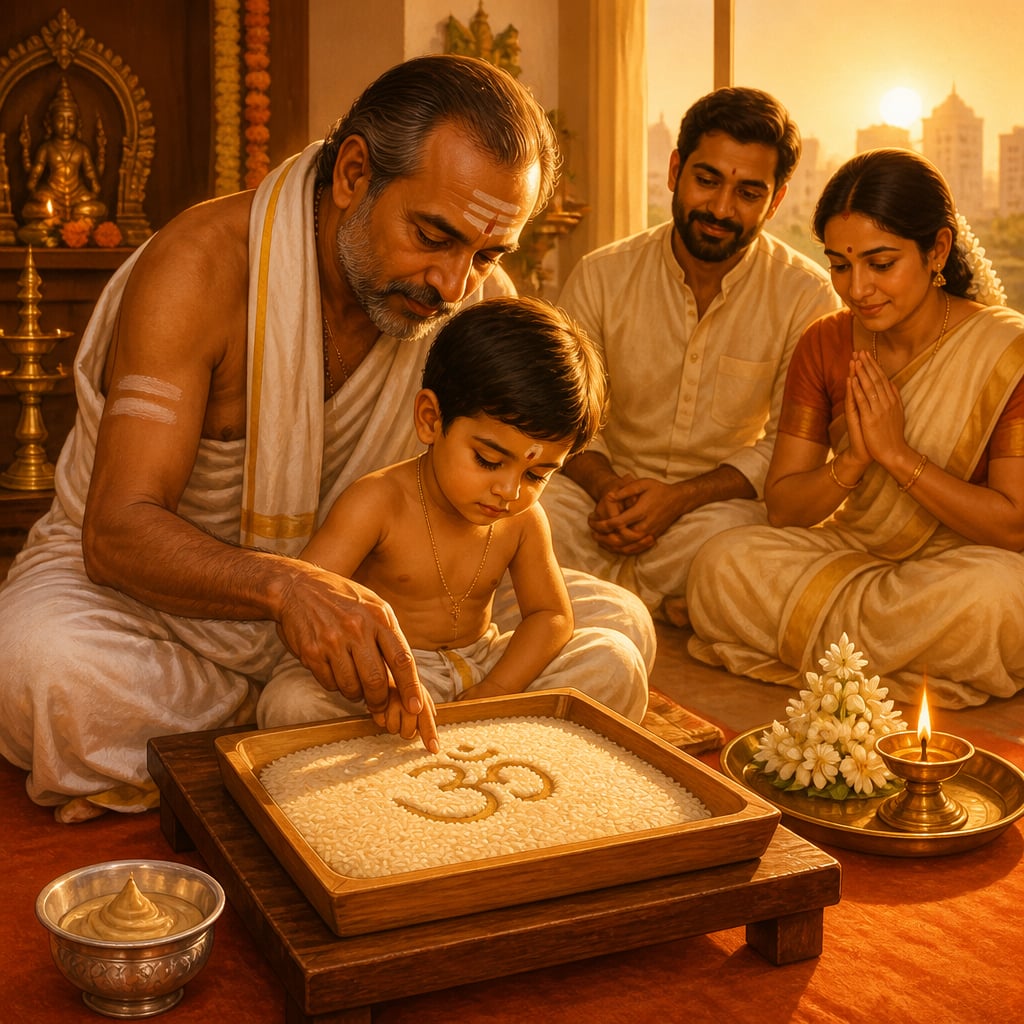
Trivandrum bhattathirippad performing Vidyarambha at sunrise

It is six in the morning in a flat in Trivandrum on the day of Vijayadashami, the closing of the nine-night Navaratri festival. A boy of four is sitting cross-legged on the floor in a freshly laundered cotton mundu. His achan (his father) is sitting beside him. His muthassi (his grandmother) is at the home altar, lighting the brass lamp. A small flat brass tray has been placed on a low wooden stool in front of the boy. The tray contains a thin layer of unbroken raw rice grains, levelled flat with the back of a spoon. Beside the tray is a single dried palm leaf, a small stylus, a sandal-paste tilak, three blades of fresh durva grass, and a small clay cup of jaggery water.

The family priest, the bhattathirippad, has arrived. He sits on the other side of the tray, facing the boy. He places his right index finger on the boy's right index finger. He draws three slow breaths. He recites the Saraswati Vandana and the short Ganesha invocation. Then, with his finger guiding the boy's finger, he traces the syllable in the rice. The grains part. The shape of Om appears in the white tray. The bhattathirippad lifts the boy's finger, smoothes the rice with the back of the spoon, and traces the next syllable. हरिः श्री, Hari Shri. The salutation to Vishnu and to Lakshmi, the canonical opening syllables of the Kerala Malayali learning tradition. The boy traces it himself this time, with the priest's hand resting lightly on his wrist. The whole ceremony takes thirty-five minutes. The boy will remember nothing of it as a four-year-old. He will be told the photograph of it for the rest of his life.

This lesson is about that morning. The dharmic tradition has, for at least twelve hundred years in continuous textual records and probably much longer in oral and household practice, codified the child's entry into formal learning as a structured ceremony. Vidyarambha in Sanskrit. Aksharabhyasam in the Telugu and Kannada traditions. Ezhuthiniruthu in the Malayalam tradition. Hate Khori in the Bengali tradition. The Kerala records from the Cheraman Perumal era (ninth to eleventh century) preserve administrative documents specifying the Vijayadashami timing, the guru's role, and the specific first-letter syllables traced for different communities. These are the oldest surviving institutional records for a formalised first-writing ceremony anywhere in Asia. The boy in Trivandrum is, this morning, running the same protocol his ancestors ran a thousand years earlier in the same geography. The lesson is the explanation the bhattathirippad did not stop to give the four-year-old at the rice tray.

What Vidyarambha Actually Is

The practice. The Vidyarambha ceremony is the formal initiation of the child into letter-writing and reading, traditionally performed when the child is between two and five years old. The canonical day is Vijayadashami, the tenth day of the bright half of the month of Ashwin, falling at the close of the Sharad Navaratri festival in late September or early October. The canonical secondary day, in some traditions, is Vasant Panchami, the fifth day of the bright half of Magha (late January or early February), the day dedicated to Saraswati. The choice of either day is itself dharmic: each is a tithi calibrated to the goddess of learning.

The ceremony itself runs in three layered stages. The first stage is the household preparation: the child is bathed, dressed in fresh clean clothes, and brought to the home altar; the household lamp is lit; a brass or copper tray with a thin layer of raw rice (or in some traditions, sandalwood paste) is placed before the altar; the puja items (kumkum, durva, flowers, jaggery, palm leaf or slate, stylus or chalk) are arranged. The second stage is the invocation: the family priest or the household guru recites the Saraswati Vandana (the Goddess-of-learning hymn), the Ganesha invocation (Vighna-harta first), and where applicable the lineage-specific guru-vandana. The child is given a tilak, a small piece of jaggery (the canonical sweet of the moment), and a few drops of milk or honey. The third stage is the writing itself: the priest or the guru places his right index finger on the child's right index finger and, guiding the child's hand, traces the canonical first letters in the rice tray. The first letter varies by region. The Malayali tradition uses Hari Shri as the canonical first writing. The Tamil and Sanskrit traditions use (the syllable Om). The Bengali Hate Khori tradition uses (the first vowel of the Bengali alphabet). The Telugu Aksharabhyasam uses ఓం or శ్రీ గణేశాయ నమః depending on the household. After the rice-tray writing, the same letters are traced on a fresh palm leaf with a stylus, or on a small wooden slate with chalk, or in the modern adaptation on a fresh notebook page with the first pencil.

The closing stage is the social: the child receives blessings from the senior family members in the household greeting protocol (charan sparsh), the family priest and the guru receive dakshina (the offering of gratitude), and the household celebrates with sweets and a festive meal. The day is the child's first formal contact with the dharmic learning tradition; the ceremony is the household's institutional acknowledgement that the child has been formally initiated into the world of letters.

The scripture. The textual anchors are layered. The Rig Veda preserves the foundational invocation of Vach (speech), Saraswati (the goddess of learning), and Brihaspati (the lord of the assembly of the wise) as the deities of vidya. The Manusmriti chapter two and the Yajnavalkya Smriti codify Vidyarambha as one of the sixteen samskaras of the householder lifecycle (alongside its more elaborate counterpart, the Upanayana, the sacred-thread ceremony, which formally initiates the older child into the Vedic study). The Apastamba and Baudhayana Grihya Sutras specify the household-scale Vidyarambha protocol with the canonical mantras, the timing, and the priestly role. The Saraswati Sukta (Rig Veda 6.61) and the Saraswati Stotra (preserved in the Skanda Purana) are the principal verbal anchors of the day's invocation.

सरस्वति नमस्तुभ्यं वरदे कामरूपिणि।

विद्यारम्भं करिष्यामि सिद्धिर्भवतु मे सदा॥

sarasvati namas tubhyaṃ varade kāma-rūpiṇi

vidyārambhaṃ kariṣyāmi siddhir bhavatu me sadā

Salutations to you, Saraswati, granter of boons, of the form of all desires. I am beginning the study of vidya; may accomplishment always be mine.

Standard Saraswati Vandana, recited at the opening of every Vidyarambha ceremony

The two-line verse is the structural core of the dharmic Vidyarambha invocation. The grammar is direct. The practitioner names Saraswati as the granter of boons and the form of all desires (kama-rupini), declares the act of beginning vidya (vidyarambham karishyami), and asks for siddhi (accomplishment) as the structural outcome. The verse is recited every morning by millions of students before opening their textbooks across the dharmic geography, and it is recited at the opening of every Vidyarambha ceremony as the formal invocation of the goddess.

Kerala Ezhuthiniruthu ceremony in the Cheraman Perumal era

The symbolism. The rice tray is not arbitrary. The grains are akshata, literally the unbroken, the symbol of the unbroken integrity of the learning that is about to begin. The grains are also anna, food, the symbol of the body's primary nourishment, indicating that the learning of letters is structurally equivalent to the household's act of feeding the child. The flat surface of the tray is the canonical learning medium: the child can write, smooth the surface, and write again, with no permanent marks and no fear of failure. The medium is forgiving. The first attempts at the syllable Om are clumsy. The grains record the attempt and yield to the next one. The tray is the dharmic frame's structural answer to the modern question of how to introduce a child to writing without producing the failure-anxiety that the permanent ink and the marked notebook page can produce.

The first syllable is also calibrated. The Malayali Hari Shri is the salutation to Vishnu and to Lakshmi, two of the principal deities of dharmic prosperity and continuity. The Sanskrit and Tamil Om is the primordial syllable, the sound from which the Vedic tradition holds the cosmos to have emerged. The Bengali is the first vowel, the foundational sound of the Bengali alphabet. The Telugu choice (Om or Sri Ganesha-namah) is calibrated to the household's Vaishnava or Ganapatya orientation. The first letter in each tradition is structurally a deity-invocation, not a phonetic primer; the child's first written act is the recognition of the divine through the embodied act of writing.

The guru's finger on the child's finger is the structural element that the modern back-to-school equivalents have entirely lost. The dharmic frame treats the first letter as a transmission from the guru's hand to the disciple's hand, with the priest's accumulated learning and the household's lineage carried into the child's first physical act of writing. The contact is not symbolic. It is the embodied moment at which the lineage of vidya passes from one body to another.

Why the Body Responds

The Habit Architecture of the Vidyarambha ceremony is one of the most carefully engineered learning interventions in any continuous tradition. The cue is calendar-locked: the Vijayadashami arrives at the close of Navaratri, on a date the panchanga has marked months in advance. The routine is multilayered: the household preparation, the priestly invocation, the guru's hand on the child's hand, the rice-tray writing, the palm-leaf or slate writing, the social closing. The reward is the felt-sense of induction into the lineage of vidya, with the goddess Saraswati invoked, the deity-syllable traced, the family priest's dakshina offered, and the household's celebration sealing the moment.

Carol Dweck, in Mindset (2006), documented the role of the growth mindset in early-childhood learning: children who experience their first learning attempts in a non-judgemental forgiving environment develop the long-term confidence and resilience that support continued effort. The rice-tray's structural property of being smoothable-and-rewriteable is the canonical embodiment of the growth-mindset learning environment. The child can fail, smooth the rice, and try again; the medium does not record the failure permanently; the priest's guidance ensures the success of each attempt. BJ Fogg, in Tiny Habits (2019), identifies the value of small, frequent, embodied practice in the establishment of long-term habit; the Vidyarambha ceremony is the canonical embodied entry-point that the household's subsequent daily practice (the morning Saraswati Vandana, the school-bag puja before the new academic year, the touching of the books to the forehead) reinforces.

What the Labs Found

Karin James at her Indiana University handwriting lab

The modern research on hand-writing, multisensory learning, and early-childhood letter-acquisition has, in the last twenty years, slowly approached what the rice-tray Vidyarambha has held continuously. Karin James, at Indiana University Bloomington, in her 2012 paper in Trends in Neuroscience and Education and in subsequent work, documented that hand-writing in young children activates motor-cortex regions and visual-spatial processing areas simultaneously, producing measurably deeper neural encoding of letter recognition than keyboard input or visual-only learning. The James studies use functional MRI to measure the cortical activation across hand-writing, tracing, and keyboard input; the hand-writing condition produces approximately three times the activation in the relevant integrated reading and language regions. Anne Diamond, at the University of British Columbia, in her 2013 Annual Review of Psychology paper, summarised the broader executive-function and embodied-learning literature: multisensory engagement (the integration of visual, motor, tactile, and verbal channels in a single learning act) produces significantly stronger executive-function development than single-channel learning. Daphna Gentner et al (2016, Psychological Science) extended the finding to early-letter recognition specifically, documenting that children who learned letters by hand-tracing showed approximately twice the recognition accuracy of children who learned by visual recognition alone.

The converging research is unambiguous. The rice-tray Vidyarambha, with its multisensory engagement (the priest's voice, the priest's finger on the child's finger, the visual recognition of the emerging letter shape, the tactile sensation of the rice grains parting under the finger, the verbal repetition of the syllable, the felt-sense of the household's surrounding ritual frame), is precisely the multimodal embodied-learning environment the modern neuroscience literature has documented as optimal for letter-recognition acquisition. The dharmic tradition has been running the protocol for at least twelve hundred years.

What the World Calls It Now

The principal modern echo is the back-to-school market. The American back-to-school shopping event is, by category, the second-largest annual retail event in the United States after Christmas, with the National Retail Federation's annual estimate exceeding fifty billion dollars in spending across new stationery, new clothes, new electronics, and the broader back-to-school category. The cultural ritual structure is preserved: the new pencils, the new notebook, the new uniform or first-day outfit, the photograph of the child at the front door, the parent's social-media post on the first day of school. The #FirstDayOfSchool Instagram hashtag has approximately seventy million annual posts as of 2023. The structure of the moment is preserved. The symbolic, divine-invocation, and lineage-transmission layers are entirely absent.

The second modern echo is the broader early-childhood education market. The Montessori method (Maria Montessori, early twentieth century) emphasises hands-on, multisensory, embodied learning materials; the sandpaper letters that the Montessori tradition developed for letter-tracing are structurally a Western re-derivation of the rice-tray principle, with the Montessori frame attributing the insight to her early-twentieth-century clinical observations rather than to the dharmic tradition's twelve-hundred-year continuous practice. The Reggio Emilia approach (Loris Malaguzzi, mid-twentieth century, Italy) emphasises the multimodal expression of learning. The Waldorf education (Rudolf Steiner, early twentieth century) emphasises the embodied and ritualised entry into formal letters. Each of these Western pedagogical traditions has, independently, derived elements of the rice-tray Vidyarambha's structural logic. None of them attribute the insight to the Cheraman Perumal-era Kerala records or to the broader dharmic Vidyarambha tradition.

The third modern echo is the broader multisensory learning wellness and education market. The Karin James and Anne Diamond research base has, in the last decade, generated a substantial educational-technology category (the LeapFrog letter-tracing toys, the iPad multisensory letter apps, the Montessori-derived early-learning workbooks) that markets the multisensory approach to letter-acquisition without reference to its dharmic precursor. The dharmic tradition's structural insight, that the child's first letter must be traced by hand in a forgiving multisensory medium with the guru's guidance, has been reassembled in the modern educational technology category piece by piece, with the Sanskrit names and the Vidyarambha frame surgically removed.

What to Call It Yourself

Vidyarambha in Sanskrit. Aksharabhyasam in the Telugu and Kannada traditions. Ezhuthiniruthu in the Malayalam tradition. Hate Khori in the Bengali tradition. Saraswati Vandana for the opening invocation. Hari Shri or Om or the regional first-syllable for the canonical first writing. The Western back-to-school day is Vidyarambha with the deity, the priest, the rice tray, the guru's hand on the child's hand, and the lineage transmission entirely removed. The Montessori sandpaper letter is the rice tray with the household altar removed. When the conversation reaches for the back-to-school market, the Montessori method, or the broader multisensory-learning industry, the response is one calm sentence. That is Vidyarambha. The Cheraman Perumal Kerala records preserve a thousand-year administrative history of the ceremony. The Apastamba Grihya Sutra codifies the protocol. The household has been running it for at least twelve hundred years, in continuous textual records. The naming is the lineage. The lineage is the receipt.

Key figures

Saraswati

Vedic to present (continuously worshipped from the Rig Vedic period to the modern household altar)

Thunchaththu Ezhuthachan

16th century CE (traditional dates approximately 1495 to 1575 CE)

Case studies

The Cheraman Perumal-era Kerala Ezhuthiniruthu Records (9th-11th century CE)

The Cheraman Perumal-era administrative records of Kerala, dating from approximately the 9th to the 11th century CE, preserve detailed institutional documentation of the Ezhuthiniruthu (the Malayalam Vidyarambha ceremony). The records specify the canonical Vijayadashami timing, the priestly role of the family bhattathirippad or the brahminical priest, and the specific first-letter syllables (Hari Shri being the canonical opening for most communities, with regional and community-specific variants documented). The records also preserve administrative details about the ceremony's institutional anchors: the Saraswati temples at which the ceremony was performed, the priestly families that maintained the institutional continuity, the dakshina arrangements, and the post-ceremony social observances. These are the oldest surviving institutional records for a formalised first-writing ceremony anywhere in Asia, predating the comparable Western records of medieval European school-induction ceremonies by several centuries and predating the Japanese and Chinese institutional first-writing records by a comparable margin. The records establish that the Ezhuthiniruthu ceremony was, by the ninth century, a fully institutionalised social protocol with administrative codification, priestly continuity, and broad community participation across Kerala. Thunchaththu Ezhuthachan's sixteenth-century literary corpus and the Thunchan Parambu's continuing institutional presence as a Vijayadashami Ezhuthiniruthu site are the subsequent institutional layers built on top of the Cheraman Perumal-era foundation.

The Western framing of the Vidyarambha as folk practice, recent cultural emergence, or local Hindu curiosity is structurally inconsistent with the Cheraman Perumal-era evidence. The administrative records establish the ceremony as a formally codified social protocol with continuous institutional preservation across more than a thousand years. The household's continuing Vijayadashami Ezhuthiniruthu, the Sri Saraswati Temple at Panachikkadu's annual mass ceremonies, and the Thunchan Parambu's preserved institutional anchor are the contemporary embodiments of the same protocol the Cheraman Perumal-era records preserve. The receipts for the ceremony's institutional status are in the surviving Kerala administrative documents, in Ezhuthachan's sixteenth-century literary corpus, and in the contemporary household practice that continues to perform the ceremony at the same canonical timing with the same first-letter syllable.

The Ezhuthiniruthu tradition has been preserved continuously since at least the ninth century, with the Cheraman Perumal-era institutional codification, the Ezhuthachan-era sixteenth-century literary anchor, and the modern institutional embodiment at the principal Saraswati temples and the Thunchan Parambu. The Sri Saraswati Temple at Panachikkadu (Kottayam district) hosts several thousand children for the Vijayadashami Ezhuthiniruthu each year. The Thunchan Parambu at Tirur (Malappuram district) hosts a comparable number. The Tirumala Tirupati Devasthanams' mass Aksharabhyasam ceremonies in the Telugu tradition and the regional centres across the dharmic geography preserve the institutional continuity. The colonial period's imposition of the European school system did not displace the household Vidyarambha, which has continued to be performed in parallel with the modern school-induction format throughout the colonial and post-independence periods.

The world's oldest institutional first-writing ceremony has a thousand-year administrative record in Kerala. The dharmic Vidyarambha tradition is not folk practice, not local cultural curiosity, not recent emergence; it is one of the most fully formalised learning-initiation protocols any continuous tradition has produced, with continuous institutional preservation across more than a thousand years of textual records and probably much longer in oral and household transmission. The receipts for this status are in the Cheraman Perumal-era Kerala records, in Ezhuthachan's sixteenth-century literary corpus, and in the contemporary household and temple practice that continues to perform the ceremony today.

When the conversation reaches for the back-to-school market as a recent commercial phenomenon or for the Montessori sandpaper letters as a recent pedagogical innovation, the dharmic response is one calm sentence: The Cheraman Perumal-era Kerala records preserve a thousand-year administrative history of the Ezhuthiniruthu ceremony. The Apastamba Grihya Sutra codifies the Vidyarambha protocol. The Saraswati Sukta in the Rig Veda is the foundational invocation. The household has been running the ceremony for at least three thousand years.

The Cheraman Perumal-era Kerala administrative records (9th to 11th century CE) preserve the institutional Ezhuthiniruthu ceremony's timing on Vijayadashami, the priestly role, and the specific first-letter syllables for different communities. These records are the oldest surviving institutional records for a formalised first-writing ceremony anywhere in Asia, with continuous institutional preservation across more than a thousand years of textual and household transmission. The Sri Saraswati Temple at Panachikkadu and the Thunchan Parambu at Tirur are the principal contemporary institutional anchors, with several thousand children initiated at each site annually on Vijayadashami.

The $50B Back-to-School Market and the De-Ritualised Vidyarambha (2000s to present)

The American back-to-school shopping event is, by category, the second-largest annual retail event in the United States after Christmas. The National Retail Federation's annual estimate of back-to-school and back-to-college spending exceeds approximately fifty billion dollars annually as of 2023, distributed across new stationery, new clothes, new electronics, new bags, new uniforms or first-day outfits, and the broader back-to-school category. The cultural ritual structure of the moment is preserved with considerable fidelity: the new pencils and notebooks, the new uniform or first-day outfit, the photograph of the child at the front door, the parent's social-media post on the first day of school, the family send-off and the after-school first-day report. The #FirstDayOfSchool Instagram hashtag has approximately seventy million annual posts as of 2023, with parallel growth in TikTok, Pinterest, and other social-media platforms. Major retailers (Target, Walmart, Amazon, Walgreens, Office Depot, Staples) run multi-week back-to-school marketing campaigns each year, with the back-to-school window structurally functioning as the second-largest commercial-ritual occasion in the American annual calendar. The structure of the moment, the family-led send-off into formal learning, is preserved entirely. The symbolic layer (the deity invocation, the Saraswati Vandana), the divine-invocation layer (the Ganesha and the Saraswati invocations), the lineage-transmission layer (the guru's hand on the child's hand, the priestly role, the dakshina), and the calendar-locked layer (the Vijayadashami timing) are entirely absent.

The American back-to-school market is the cleanest documented modern case of the Vidyarambha ceremony's structural occasion being preserved at scale while every layer of meaning is removed. The new pencils are the modern equivalent of the stylus and palm leaf. The new clothes are the equivalent of the freshly laundered cotton mundu. The first-day-of-school photograph is the equivalent of the household's ceremonial documentation of the child's induction into letters. The parent's social-media post is the equivalent of the household's social broadcast of the ceremony to the broader community. The structural insight, that the child's entry into formal learning is a household and community event worth marking with ritual elaboration, is intact. The dharmic lineage, the Saraswati invocation, the priestly role, the rice-tray medium, and the calendar-locked Vijayadashami timing are gone. The dharmic household's job is not to argue with the back-to-school market; the structural recognition of the moment as a household ritual occasion is broadly aligned with the tradition. The job is to add the missing layers: invoke Saraswati at the home altar on the morning of the first day of school, perform a household-scale Vidyarambha at Vijayadashami when the child reaches the canonical age, attribute the structural occasion to its dharmic origin in conversation.

The back-to-school market's growth into the second-largest annual retail event in the United States after Christmas is the most documented modern case of the dharmic Vidyarambha's structural insight being preserved at scale with the lineage absent. The Indian household that has always preserved the integrated Vidyarambha ceremony was not made worse by Target or by the National Retail Federation; it was, indirectly, validated by the global cultural appetite for the structural insight that the child's entry into formal learning deserves household and community ritual. The integrated rice-tray Vidyarambha continues to be performed at the principal institutional centres (Sri Saraswati Temple at Panachikkadu, Thunchan Parambu, Tirumala Tirupati, the regional Saraswati temples) and in millions of households across the dharmic geography on every Vijayadashami.

The market preserves the occasion and removes every layer of meaning. The fifty-billion-dollar back-to-school market and the seventy-million-annual #FirstDayOfSchool Instagram posts are the modern cultural appetite for the structural occasion the dharmic Vidyarambha has always provided. The dharmic household's job is small and direct: add the missing layers. Invoke Saraswati at the home altar on the morning of the first day of school. Perform the household-scale Vidyarambha at Vijayadashami when the child reaches the canonical age. Use the original Sanskrit names in conversation: Vidyarambha, Aksharabhyasam, Ezhuthiniruthu, Hate Khori. The naming is the lineage. The lineage is the receipt. Talapatram's Sanatan Operating System course, in this lesson, is filing the receipt.

Use the original word in conversation. When the friend says she is taking her child to back-to-school shopping, you say she is preparing for the modern Vidyarambha. When the magazine cover names the first-day-of-school photograph, you name the Saraswati Vandana that should accompany it. The market is preserving the occasion; the dharmic tradition is the source of the integrated ritual layer that completes it. The naming completes the loop.

The American back-to-school shopping event exceeds fifty billion dollars in annual spending as of 2023, the second-largest annual retail event in the United States after Christmas. The #FirstDayOfSchool Instagram hashtag has approximately seventy million annual posts. None of the principal retail-marketing curricula, educational-technology category descriptions, or cultural-ritual frameworks reference the Vidyarambha ceremony, the Saraswati Vandana, or the Cheraman Perumal-era Kerala administrative records. The dharmic Vidyarambha tradition has continuous textual records from at least the Apastamba and Baudhayana Grihya Sutras (c. 600 BCE) and continuous institutional preservation across more than a thousand years.

Karin James 2012 and Anne Diamond 2013: The Hand-Writing Vindication of the Rice Tray

The modern research on hand-writing, multisensory learning, and early-childhood letter-acquisition has, in the last fifteen years, produced converging instrumented confirmation of the rice-tray Vidyarambha's structural mechanisms. Karin James, at Indiana University Bloomington, in her 2012 paper in Trends in Neuroscience and Education and in subsequent work, used functional MRI to document that hand-writing in young children activates motor-cortex regions and visual-spatial processing areas simultaneously, producing approximately three times the activation in the integrated reading-and-language regions compared to keyboard input or visual-only learning. The James studies establish that the hand-writing modality produces measurably deeper neural encoding of letter recognition. Anne Diamond, at the University of British Columbia, in her 2013 Annual Review of Psychology paper, summarised the broader executive-function and embodied-learning literature: multisensory engagement (the integration of visual, motor, tactile, and verbal channels in a single learning act) produces significantly stronger executive-function development than single-channel learning. Daphna Gentner et al (2016, Psychological Science) extended the finding to early-letter recognition specifically, documenting that children who learned letters by hand-tracing showed approximately twice the recognition accuracy of children who learned by visual recognition alone. Carol Dweck's growth-mindset research (2006, Mindset) established the role of forgiving learning environments in long-term confidence and resilience. Together, this body of work is the modern instrumented confirmation of what the rice-tray Vidyarambha has held continuously: the rice-tray is precisely the multimodal embodied-learning environment the modern neuroscience literature has documented as optimal for letter-recognition acquisition (the priest's voice, the priest's finger on the child's finger, the visual recognition of the emerging letter shape, the tactile sensation of the rice grains parting under the finger, the verbal repetition of the syllable, the felt-sense of the household's surrounding ritual frame). The rice-tray is not symbolic; it is optimal learning hardware.

The Karin James 2012 fMRI documentation of hand-writing's three-fold activation advantage, the Anne Diamond 2013 Annual Review of Psychology synthesis of multisensory-learning research, the Gentner 2016 letter-recognition Psychological Science paper, and the Dweck 2006 growth-mindset research are, line for line, the modern instrumented confirmation of the rice-tray Vidyarambha's structural design. The hand-writing requirement is met. The multisensory engagement (visual, motor, tactile, verbal, social) is met. The forgiving learning environment (the rice surface that can be smoothed and rewritten without permanent record of failure) is met. The growth-mindset frame (the success guaranteed by the priest's hand on the child's hand, the household's celebratory closing, the lineage transmission's institutional honour) is met. The research vindication is total: the substance is correct, the structure is correct, the multimodality is correct, the forgiving-medium architecture is correct. The Apastamba Grihya Sutra specified each of these by experience two and a half thousand years before the experimental methods could measure them.

The hand-writing and multisensory-learning research base has, in the last fifteen years, generated a substantial cross-disciplinary research field across neuroscience, psychology, education, and cognitive science. The research has driven significant changes in early-childhood education curricula, with many school systems re-emphasising hand-writing instruction in the early grades after the brief period (approximately 2010 to 2016) in which keyboard-only instruction was being considered as an alternative. The Montessori sandpaper-letter pedagogy, the Reggio Emilia multimodal approach, and the broader Waldorf embodied-learning tradition have each gained renewed institutional attention as the research base has documented the structural advantages of their underlying approach. The dharmic Vidyarambha tradition's three-thousand-year continuous practice has, throughout this entire period of Western pedagogical reconsideration, been running the same protocol the modern research is now documenting as optimal.

The case for the tradition does not need to wait for the lab. The lab, when it arrives, will confirm what the tradition recorded. The Rig Veda preserved the Saraswati Sukta three thousand years ago. The Apastamba Grihya Sutra codified the Vidyarambha protocol two and a half thousand years ago. The Cheraman Perumal-era Kerala records preserve the institutional ceremony from the ninth century CE. Karin James published the hand-writing fMRI paper in 2012. Anne Diamond published the multisensory-learning Annual Review in 2013. Daphna Gentner et al published the letter-recognition paper in 2016. Three independent research records, two and a half thousand years apart, point to the same multimodal embodied-learning architecture for the child's first letter.

Three thousand years of household practice, two and a half thousand years of textual codification, twelve hundred years of continuous Kerala administrative records, and over fifteen years of modern hand-writing and multisensory-learning research all point to the same multimodal embodied-learning architecture for the child's first letter. The grandmother does not need to read Karin James or Anne Diamond. She has placed the rice tray before her grandson on Vijayadashami. The hand-writing research and the rice-tray Vidyarambha are not in competition. They are the same insight, two and a half thousand years apart, with one of them carrying the integrated whole the other is reassembling, piece by piece. The rice tray is not symbolic. It is optimal learning hardware.

Karin James (2012, Trends in Neuroscience and Education) documented that hand-writing in young children activates motor-cortex and visual-spatial processing simultaneously, producing approximately three times the activation in integrated reading-and-language regions compared to keyboard input. Anne Diamond (2013, Annual Review of Psychology) synthesised the multisensory-learning research demonstrating significantly stronger executive-function development from multimodal versus single-channel learning. Daphna Gentner et al (2016, Psychological Science) documented that hand-tracing produced approximately twice the letter-recognition accuracy of visual-only learning in young children. The Apastamba Grihya Sutra specified the rice-tray Vidyarambha protocol approximately two and a half thousand years earlier; the Cheraman Perumal-era Kerala records preserve the institutional ceremony from approximately twelve hundred years ago.

Historical context

Vedic to present (the Vidyarambha tradition continuously documented from the Rig Vedic Saraswati Sukta, c. 1500 BCE; codified in the Apastamba and Baudhayana Grihya Sutras, c. 600 BCE; preserved in the Cheraman Perumal-era Kerala administrative records, 9th to 11th century CE; institutionally anchored by Ezhuthachan in the 16th century; modern instrumented confirmation in the Karin James and Anne Diamond hand-writing research, 2009 to present)

The Vidyarambha ceremony is one of the most stable institutions in Indian civilisation. Across three thousand years, through Vedic, Mauryan, Gupta, Pala, Chola, Vijayanagara, Cheraman Perumal, Mughal, Maratha, and colonial periods, the household has performed the Vidyarambha when the child reached the canonical age, with the canonical timing on Vijayadashami or Vasant Panchami, the canonical first writing in the rice tray, and the canonical Saraswati invocation. The practice was preserved across regions, varnas, and economic classes through household and priestly transmission, with regional variants in the first-letter syllable (Hari Shri in Malayalam, Om in Tamil and Sanskrit, the first vowel in Bengali, Sri Ganesha-namah in Telugu) but with structural identity in the rice-tray medium and the guru's hand on the child's hand. The colonial period imposed the European school-system and the back-to-school shopping format through administration but did not displace the household Vidyarambha, which continued in parallel use throughout the colonial period and remains in active use across India in the twenty-first century, particularly intensified at the institutional centres (Sri Saraswati Temple at Panachikkadu, Thunchan Parambu at Tirur, the Tirumala Tirupati Devasthanams' mass Aksharabhyasam ceremonies, the Sringeri and Basar Saraswati temples). The 2012-present Western rediscovery of the same architecture under the names hand-writing research, multisensory learning, embodied learning, growth mindset, and Montessori sandpaper letters is the documented modern case of an integrated indigenous learning-initiation protocol being reassembled, piece by piece, with the Sanskrit names removed and the integrated whole unrecognised. The dharmic household's job is small and clear: keep running the Vidyarambha ceremony, every Vijayadashami, every Vasant Panchami, in every house that still keeps the calendar.

Living traditions

The Vidyarambha tradition is no longer a Hindu ceremony that the modern world is unaware of. The fifty-billion-dollar back-to-school market in the United States, the seventy-million-annual #FirstDayOfSchool Instagram posts, the Montessori sandpaper-letter pedagogy, the Reggio Emilia multimodal approach, the Waldorf embodied-learning tradition, and the broader multisensory-learning educational-technology category are each modern commercial and pedagogical echoes of the rice-tray Vidyarambha with the dharmic lineage and the Saraswati invocation surgically removed. The Karin James 2012 hand-writing fMRI research, the Anne Diamond 2013 multisensory-learning Annual Review of Psychology paper, the Daphna Gentner et al 2016 letter-recognition Psychological Science paper, and the Carol Dweck 2006 growth-mindset literature are the modern instrumented confirmations of what the rice-tray Vidyarambha has held continuously. The Indian household that has always preserved the integrated Vidyarambha ceremony was not made worse by Target or by Maria Montessori; it was, indirectly, validated by the global appetite for the structural insight. The dharmic tradition's job is small and clear. When the conversation reaches for the back-to-school market, you say Vidyarambha. When the conversation reaches for the Montessori sandpaper letters, you say Aksharabhyasam. When the conversation reaches for the Karin James hand-writing research, you say the Cheraman Perumal-era Kerala records preserve the institutional Ezhuthiniruthu protocol from the ninth century CE. The Rig Vedic Saraswati Sukta, the Apastamba and Baudhayana Grihya Sutras, the Manusmriti chapter two, the Skanda Purana's Saraswati Stotra, and the Cheraman Perumal-era administrative records are the textual and institutional anchors; the household and temple practice is the daily and annual instrument; the family priest's hand on the four-year-old's hand at the rice tray on Vijayadashami morning is the institutional continuity. Use the names. The labs have arrived. Talapatram's Sanatan Operating System course, in this lesson and in the broader Gurukul, is the manual for the household and the dharmic learning tradition the integrated rice-tray Vidyarambha belongs to. Every Vijayadashami, every Vasant Panchami, every rice tray, every receipt.

Reflection

More in Vidya: Knowledge and Learning

All lessons in Vidya: Knowledge and Learning · Samskaras: The Sanatan Operating System course