The Book Is Touched to the Forehead

Why a Hindu touches a book to the forehead, never steps on a book, and removes slippers near scripture: the dharmic protocol for the body of the written word

In the dharmic tradition, the book is not an object. The book is the body of the word, and the word is Saraswati, and Saraswati is the deity. The Hindu therefore touches the book to the forehead before opening it, never steps on a book accidentally placed on the floor (and immediately offers a small apologetic touch to the forehead if it happens), removes slippers and footwear near scripture, and never places a book on the bed or on a chair where someone will sit. Nalanda's seventh-century library regulations, preserved in the Chinese pilgrim Xuanzang's records, codify the institutional protocol for the body of the word. Marie Kondo's book-gratitude method, popularised in the 2019 Netflix series Tidying Up and reaching forty million households, is the same protocol with the dharmic frame surgically removed. The Mueller and Oppenheimer 2014 Psychological Science research and the Sparrow et al 2011 Google Effect research provide the modern instrumented confirmation that the reverential treatment of the body of the word produces measurably deeper encoding and retention than the casual treatment of information. The grandmother who picks up the dropped book and touches it to her forehead is running the protocol that the lab has, in the last decade, slowly approached.

A Library in Chennai, the Year the Boy Was Twelve

The boy is twelve and is reading on the floor of his grandmother's small library room in T Nagar, Chennai. The room has three almirahs of books: the Tamil and Sanskrit volumes on the top shelves, the English and reference volumes on the lower shelves, an old wooden lectern in the corner with a half-finished palm-leaf manuscript on it that the boy's late great-grandfather had been transcribing in the 1960s. The boy has been reading a Penguin paperback of the Mahabharata and has, without thinking, placed the book on the floor beside him to reach for a glass of water. The grandmother walks in. She sees the book on the floor. She does not say anything for a long time.
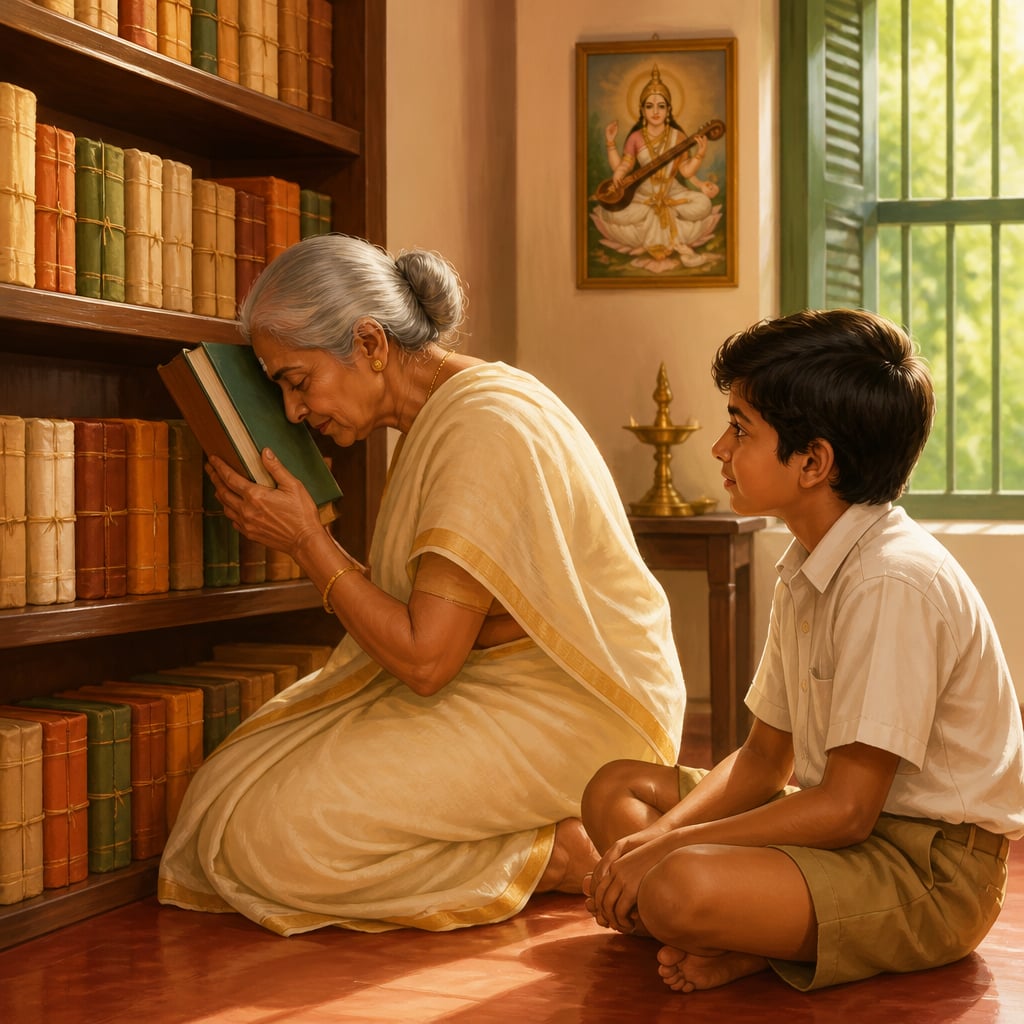
Chennai grandmother touching a fallen book to her forehead

Then she says, in Tamil, "Adai kizhe vaikaade." Do not place that on the ground. The boy, embarrassed, picks up the book and, before saying anything in his defence, automatically touches it to his forehead. The grandmother nods once. She says, "Athu Mahabharatam. Saraswathi adhuvula irukka." That is the Mahabharata. Saraswati is in it. She does not say Saraswati is in books; she says Saraswati is in this one. The boy understands the difference. He places the book on the lectern, not on the floor, takes the glass of water, and resumes his reading from a chair, with the book on the lectern, not on his lap.

This lesson is about that scene. The dharmic tradition does not treat the book as an object. The book is the body of the word, and the word is Saraswati, and Saraswati is the deity. The Hindu therefore touches the book to the forehead before opening it, never places a book on the floor (and if a book accidentally falls or is placed on the floor, the offender immediately touches the book to the forehead in apology before placing it back at its proper height), removes footwear near scripture, never places a book on a bed or chair where someone will sit, and treats the household library with the gravity the dharmic theology requires. The protocol is universal across the dharmic tradition, preserved continuously across more than two thousand years of household and institutional practice, and is the structural insight that the modern world has spent the last decade rediscovering through Marie Kondo's book-gratitude method, the modern minimalism movement, and the experimental psychology of attentional reverence.

The Practice: The Body of the Word

The protocol. The dharmic protocol for the book includes the following structural features, preserved continuously across regional and sectarian lines.

The forehead-touch on opening. Before opening any book of substance (the scriptural texts, the textbook before a study session, the journal before writing in it), the Hindu touches the book to the forehead in a brief gesture of acknowledgement. The gesture is structurally identical to the touching of an elder's feet (the charan sparsh of the previous lesson in this chapter sequence): a tangible acknowledgement of the relationship's structure and of the substance that the book carries.

The forehead-touch on accidental contact. If a book accidentally falls to the floor, or is accidentally stepped over, or is accidentally placed where it will be sat upon, the offender immediately picks up the book, touches it to the forehead, and offers a brief silent or whispered apology. The gesture is automatic and culturally near-universal across the dharmic tradition; the boy in the Chennai library room performs the gesture without thinking, because the grandmother's generation taught the boy's generation through the embodied example of the gesture itself.

The protocol of placement. Books are never placed on the floor; books are placed on shelves, on lecterns, on the household altar's lower step, or on a clean cloth on a clean surface. Books are not placed on beds (because the bed is associated with the sleeping body and its associated impurities), not placed on chairs where someone will sit (because the act of sitting on a book is a structural transgression), and not placed near footwear or in places where footwear is stored. The household library is, by structural definition, kept at a height above the floor and away from the household's footwear-and-bath spaces.

The protocol of footwear. Footwear is removed in the household library, in the temple library, in the Vedic gurukul's manuscript room, and in the household altar's vicinity where the household scripture is kept. The protocol mirrors the removal of footwear before entering the temple sanctum: the body of the word is, like the murti, a structural anchor that requires the bodily acknowledgement of removal-of-footwear in proximity.

The protocol of food. Food is not consumed near the principal household scriptures (the Bhagavad Gita, the Ramayana, the Mahabharata, the household sampradaya's principal texts). Snacks and meals are taken in the household's eating spaces, not in the library. The food-and-scripture separation mirrors the broader dharmic protocol of separating the household's eating spaces from the household's worship spaces.

The protocol of writing. When writing in a journal or a notebook, the Hindu typically begins the journal with a brief invocation: the Om Sri Ganeshaya Namaha for the Ganapati bhakta, the Om Sri Saraswati Namaha for the Sri Vidya householder, the Om Sri Krishnaya Namaha for the Vaishnava, or the household's chosen invocation. The first page of the journal is reserved for this invocation; the writing itself begins on the second page. The protocol is preserved across the dharmic tradition's writing practices and is the structural ancestor of the modern bullet-journal's monthly-intention page.

The Saraswati Puja occasion. Once a year on Vasant Panchami (the fifth day of the bright fortnight of the lunar month of Magha, typically late January or early February on the Gregorian calendar, treated in the lesson on Saraswati Puja in this chapter sequence), the household performs the formal Saraswati puja in which all the household's books, instruments, and tools of learning are placed before the goddess, anointed with kumkum and sandalwood paste, and worshipped explicitly. The day's ritual is the institutional confirmation of the year-round protocol: the books that have been treated with daily reverence are, on Vasant Panchami, treated with explicit annual worship.

Nalanda: The World's Oldest Documented Library Protocol

Nalanda mahavihara library monk copying a palm-leaf manuscript

The Nalanda mahavihara in modern Bihar (operational from approximately the fifth century CE to 1193 CE) was, at its peak, the world's largest institution of higher learning, with approximately ten thousand resident students, two thousand teachers, and the Dharmaganja, the three-building library complex that housed approximately nine million manuscripts on every discipline of dharmic learning. The Dharmaganja consisted of the Ratnasagara (the Ocean of Jewels, nine stories tall), the Ratnodadhi (the Sea of Jewels), and the Ratnaranjaka (the Jewel-Adorned), and was, by the Chinese pilgrim Xuanzang's seventh-century account, the most institutionally sophisticated library complex documented anywhere in the pre-modern world.

The Nalanda library protocol, preserved in Xuanzang's seventh-century records (the Si Yu Ki, the Records of the Western Regions) and the parallel records of Yijing (a few decades later), included the following institutional features: footwear was prohibited within the Dharmaganja's three buildings; food was prohibited near the manuscripts; daily practice of copying worn texts was institutionalised across the resident students, with the senior monks and the senior students alike participating in the manuscript-preservation discipline; the books were stored on raised shelves with the appropriate orientation (the principal scriptures on the uppermost shelves, the technical and reference texts at the more accessible heights); the manuscripts were touched only after the reader's hands had been ritually cleaned; and the principal scriptures were brought out for reading only after the reader had performed the brief invocational namaskara to the appropriate deity (Saraswati for the general scholarly disciplines, Manjushri for the Buddhist discourse, the deity-specific invocations for the sectarian texts). The Nalanda protocol was the institutional embodiment of the dharmic book-protocol at the highest scholarly scale.

The Vikramashila mahavihara (Pala-period, 8th-12th centuries CE) and the Odantapuri mahavihara preserved parallel protocols. The Sringeri, Kanchi, and Tirupati Vedic centres, and the various sampradayic acharya-kulas across the medieval and modern periods, have continuously preserved the institutional protocol for the body of the word. The household-level protocol is the compressed form of the institutional protocol; the institutional protocol is the formalised form of the household-level reverence.

The Scripture Behind the Saraswati-as-Word Doctrine

The Rig Veda's Vagdevi Sukta (10.125, the Speech-Goddess Hymn) is the foundational classical articulation of the Saraswati-as-word doctrine. The hymn, attributed to Vak Ambhrini (the woman seer Vak, daughter of Ambhrina), is among the earliest documented self-articulations of the divine speech: "aham rashtri samgamani vasunam" (I am the queen, the assembler of treasures), with the speech-goddess identifying herself as the foundational reality through which the gods themselves are made manifest. The hymn is one of the only Rig Vedic hymns attributed to a woman seer and is one of the most theologically dense single hymns in the Vedic corpus.

The Brihadaranyaka Upanishad's opening dialogue between Yajnavalkya and his wife Maitreyi includes the foundational teaching that the shabda (the word, the sound-form) is the substrate through which the brahman (the supreme reality) becomes available to consciousness; the teaching is the philosophical foundation of the dharmic theology of the word. The Mandukya Upanishad elaborates the doctrine through its analysis of the syllable Om as the foundational sound-form. The Vakyapadiya of Bhartrihari (5th-6th c CE) is the foundational classical text of the dharmic philosophy of language, articulating the doctrine of shabda-brahman (the word as the supreme reality) across approximately two thousand verses.

सरस्वति महाभागे विद्ये कमललोचने।

विद्यारूपे विशालाक्षि विद्यां देहि नमोऽस्तु ते॥

sarasvati mahā-bhāge vidye kamala-locane

vidyā-rūpe viśālākṣi vidyāṃ dehi namo 'stu te

O Saraswati, greatly fortunate, knowledge itself, lotus-eyed,

Form of knowledge, broad-eyed one, grant me knowledge, salutation to you.

Saraswati Vandana, traditionally recited at the opening of every formal study session

The verse is among the most universally recited Sanskrit shlokas in continuous practice in the dharmic tradition. The verse identifies Saraswati not as the patron-deity of learning but as vidya-rupa, the very form of knowledge itself; the request for vidyam dehi (grant me knowledge) is therefore a request to the form of knowledge for the knowledge that is the goddess's own substance. The shloka is recited at the opening of every formal study session in the gurukul tradition, at the opening of every Saraswati Puja, and at the household's opening of any new book or notebook of consequence.

Why the Body Responds: The Habit Architecture of Book-Reverence

The Habit Architecture of the dharmic book-protocol is unusually well-engineered for the modern question of attention and information retention. The cue is the book itself, in its proper placement (on the shelf, on the lectern, on the clean cloth on the clean surface) and in its proper context (in the library, in the gurukul, in the household scripture-space). The routine is the brief forehead-touch on opening, the structured handling, the absence of food and footwear in the book's vicinity, the deliberate slowness with which the book is approached compared to the speed with which a magazine or a newspaper might be flipped through. The reward is the attentional sanctity that the routine produces: the felt-sense that the moment of reading is structurally distinct from the household's other moments, the embodied recognition that the substance the book carries deserves the reader's full attention.

The behavioural science is exact. The dharmic book-protocol is what the modern attention research literature calls a sacralisation cue, an environmental and behavioural signal that elevates the user's attentional state above the baseline. Mihaly Csikszentmihalyi's Flow research (1990) established that environmental and ritual cues are among the most reliable predictors of the deep-attention state he named flow; the dharmic library and book-protocol institutionalise the flow-cuing environment continuously across the household. Cal Newport's Deep Work (2016) synthesised the contemporary attention-research literature with practical recommendations that mirror the dharmic protocol's structural features: the dedicated workspace, the ritual opening, the elevation of the work-substance above the casual-consumption baseline, the institutional separation of the deep-work environment from the household's other environments. Newport does not name the dharmic source; the dharmic protocol is the institutional ancestor.

What the Labs Found

Mueller and Oppenheimer's Princeton handwriting study

Pam Mueller and Daniel Oppenheimer (2014), The Pen Is Mightier Than the Keyboard: Advantages of Longhand Over Laptop Note Taking, in Psychological Science, established through controlled experimental comparison that handwritten notes (which require slower, more deliberate, more reverent engagement with the source material) produce approximately forty percent better conceptual retention than typed notes. The mechanism is the deliberateness itself: the slower physical act of handwriting forces the writer to encode the material at a deeper conceptual level rather than merely transcribing it verbatim. The handwritten-notes protocol is the modern instrumented confirmation of the dharmic palm-leaf and bhuja-patra (birch-bark) manuscript-preservation tradition: the act of copying the worn manuscript by hand, institutionalised at Nalanda and across the dharmic learning tradition, was simultaneously the act of preserving the manuscript and the act of deepening the copyist's encoding of the material.

Betsy Sparrow, Jenny Liu, and Daniel Wegner (2011), Google Effects on Memory: Cognitive Consequences of Having Information at Our Fingertips, in Science, established that the casual, immediately-accessible treatment of information (the Google-search format that the modern reader applies to most everyday information needs) produces measurably reduced encoding depth, reduced subsequent recall, and reduced conceptual integration, compared to the deliberate, harder-to-access treatment of information. The Sparrow et al research is the modern instrumented confirmation that the reverential treatment of information produces structurally better cognitive outcomes than the casual treatment; the dharmic book-protocol is the institutional embodiment of the reverential treatment.

Maryanne Wolf's Reader, Come Home (2018) synthesised the cognitive-neuroscience research on reading attention with the specific finding that the deep-reading mode (sustained, contextually-embedded, reverentially-attended reading of long-form text) produces neural-architectural patterns that the scan-reading mode (the modern web-and-app skim-reading) does not produce. The book is, in Wolf's framework, a different cognitive instrument from the screen, and the body of the word the book carries is a different substance from the web's text-fragments. The dharmic protocol's structural insight, that the book is the body of the word and deserves the bodily reverence, is the institutional ancestor of Wolf's neuroscientific framework.

Mihaly Csikszentmihalyi's Flow (1990) and Cal Newport's Deep Work (2016) together establish the broader attention-research literature's confirmation that environmental and ritual cues are the structural prerequisites of deep cognitive engagement. The dharmic book-protocol's structural features (the dedicated library space, the brief forehead-touch on opening, the absence of food and footwear, the institutional separation from the casual household environment) are the institutional embodiment of the flow-cuing and deep-work environment that Csikszentmihalyi and Newport describe.

What the World Calls It Now

The principal modern Western echo is the Marie Kondo book-gratitude method, which prescribes holding each book and thanking it before letting it go. The KonMari method, articulated in Kondo's 2010 The Life-Changing Magic of Tidying Up and popularised globally through the 2019 Netflix series Tidying Up With Marie Kondo (which reached approximately forty million households in its first season alone), repackages the dharmic book-respect tradition (the touching to the forehead, the formal release, the recognition that the book is not a casual object) as a minimalism practice. The Netflix series taught approximately forty million households to bow to their books with explicit gratitude before deciding whether to keep or release them; the Nalanda mahavihara taught the same protocol institutionally fourteen hundred years earlier. Kondo does not claim a Hindu lineage; she cites a generic Japanese animism (the Shinto kami-in-objects framework). The structural insight, that the book deserves a bodily acknowledgement before it is opened, kept, or released, is the dharmic protocol's; the lineage is unacknowledged.

The modern bullet journal method (Ryder Carroll's The Bullet Journal Method, 2018) and the broader journaling-as-ritual wellness movement (the Five Minute Journal, Headspace's journaling integrations, the various morning-pages and evening-reflection journaling apps) is the institutional rediscovery of the dharmic protocol of beginning the journal with a structured invocation, treating the journal as a substance worthy of attention, and reserving specific pages for specific functions. The bullet-journal industry is estimated at approximately five hundred million dollars globally as of 2023, with the various journaling apps and physical journal markets contributing additional billions.

The modern deep work and digital minimalism movements (Cal Newport's foundational works, the various productivity-coaching offerings priced from one hundred to two thousand dollars per programme) is the institutional rediscovery of the structural separation between the deep-attention environment and the casual-consumption environment. The dharmic library and book-protocol institutionalised this separation continuously across the household for two thousand years; the deep-work movement is reassembling the protocol in the modern white-collar professional's home office.

The modern slow reading movement, the annotation revival in education (the resurgence of teaching students to write notes by hand, the institutional return to handwritten essays in the wake of the Mueller and Oppenheimer 2014 research), and the broader post-screen literacy discussion (Maryanne Wolf's work, Nicholas Carr's The Shallows, the various neuroscience-of-reading works) are each downstream of the same structural insight that the dharmic protocol has institutionalised: the book is a different cognitive instrument from the screen, the reverential treatment produces measurably better encoding, and the institutional separation of the deep-reading environment from the casual environment is the structural prerequisite of mastery.

What to Call It Yourself

Pustaka in Sanskrit (the book). Granthavali (the collection of books, the library). Saraswati for the deity of the word. Vidya for the substance the book carries. The English word book is too thin; text is closer in the academic sense; manuscript preserves the historical sense but loses the contemporary application. The dharmic terms carry the substance the English does not.

When the friend describes a Marie Kondo book-purging session, the response is one calm sentence. "That is the dharmic book-protocol with the lineage removed. Nalanda's seventh-century library regulations specified the protocol fourteen hundred years before Marie Kondo. The forehead-touch the Hindu performs on accidentally dropping a book is the same gesture Kondo prescribes, with the explicit naming of Saraswati as the substance the book carries."

When the colleague describes a deep-work or digital-minimalism programme, the response names the source. "That is the dharmic library-protocol applied to the modern home office. The dharmic household has institutionalised the deep-work environment continuously across two thousand years through the protocol of the body of the word."

The boy in the Chennai library room does not know any of this. The boy knows only that the grandmother saw the book on the floor, that the boy automatically touched the book to his forehead before defending himself, and that the gesture was older than the boy's defence and older than the grandmother's correction. Twenty years later, when the boy has become a journalist and is interviewed for a wellness magazine about his daily practice, the boy will say one word about his library. Saraswati. The wellness magazine will translate it as the muse. The boy will say nothing. The translation cannot carry the substance. The substance is the body of the word. The body has been at the threshold of the grandmother's library since long before the wellness magazine had a category.

Key figures

Xuanzang (Hsuan-tsang)

602 - 664 CE

Bhartrihari

5th-6th century CE

Pam Mueller and Daniel Oppenheimer

Mueller, born c. 1985; Oppenheimer, born 1972; principal published work 2014-present

Case studies

The Nalanda Dharmaganja Library Protocol (7th c CE, Xuanzang's Records)

The Nalanda mahavihara, established in approximately the fifth century CE under Gupta-period patronage in modern Bihar, was at its peak the world's largest institution of higher learning, with approximately ten thousand resident students, two thousand teachers, and the Dharmaganja: the three-building library complex consisting of the Ratnasagara (the Ocean of Jewels, nine stories tall), the Ratnodadhi (the Sea of Jewels), and the Ratnaranjaka (the Jewel-Adorned). The Dharmaganja housed approximately nine million manuscripts on every discipline of dharmic learning. The Chinese Buddhist pilgrim Xuanzang, who travelled across India from 629 to 645 CE and resided at Nalanda for approximately fifteen years, preserved the most detailed external documentary account of the Nalanda institutional protocol in his Si Yu Ki (the Records of the Western Regions, completed 646 CE). The Nalanda library protocol included the following institutional features: footwear was prohibited within the Dharmaganja's three buildings; food was prohibited near the manuscripts; daily practice of copying worn texts was institutionalised across the resident students, with the senior monks and the senior students alike participating in the manuscript-preservation discipline; the books were stored on raised shelves with the appropriate orientation (the principal scriptures on the uppermost shelves, the technical and reference texts at the more accessible heights); the manuscripts were touched only after the reader's hands had been ritually cleaned; and the principal scriptures were brought out for reading only after the reader had performed the brief invocational namaskara to the appropriate deity (Saraswati for the general scholarly disciplines, Manjushri for the Buddhist discourse, the deity-specific invocations for the sectarian texts). The Nalanda Dharmaganja protocol was the institutional embodiment of the dharmic book-protocol at the highest scholarly scale and across the longest documented institutional duration.

The Nalanda Dharmaganja is the institutional flagship of the dharmic book-protocol at the highest scholarly scale. The protocol's structural features are not arbitrary cultural conventions; they are the embodied recognition of the dharmic theology of the word. The footwear-prohibition mirrors the temple-sanctum protocol: the body of the word, like the murti, is a structural anchor that requires the bodily acknowledgement of removal-of-footwear in proximity. The food-prohibition mirrors the broader dharmic protocol of separating the household's eating spaces from the household's worship spaces. The daily-manuscript-copying discipline simultaneously preserves the manuscript and deepens the copyist's encoding (the structural feature that Mueller and Oppenheimer's 2014 research has confirmed at the modern laboratory scale). The institutional protocol was preserved continuously for approximately seven hundred years until the 1193 CE destruction by Bakhtiyar Khilji, with the household-level and the sectarian acharya-kula protocols continuing unbroken into the present.

The Nalanda mahavihara operated for approximately seven hundred years (c. 5th c CE to 1193 CE) until the institutional destruction by the Ghurid forces of Bakhtiyar Khilji during the medieval invasions of northern India. The Dharmaganja library was set on fire and burned, by Persian historian Minhaj-i-Siraj's account (Tabaqat-i-Nasiri), for approximately three months. The institutional library tradition of Nalanda was broken, though the household and gurukul-level protocols continued unbroken across the medieval and modern periods. The Sringeri, Kanchi, and Tirupati Vedic centres, the various sectarian acharya-kulas, and the household-level practice across India and the diaspora have continuously preserved the structural reverence for the body of the word that the Nalanda protocol embodied at institutional scale. The 2014 archaeological revival of the Nalanda site (the Nalanda University reopening initiative under the Government of India and the partnership of multiple Asian governments) is the institutional attempt to reconstruct the Dharmaganja's continuity in the modern period.

The world's most institutionally developed pre-modern library complex ran on a structural protocol that the modern world is rediscovering paper by paper through the Marie Kondo book-gratitude movement, the deep-work and digital-minimalism literature, and the cognitive-neuroscience research on attention and encoding. The Nalanda Dharmaganja's seven-hundred-year operation produced the foundational scholarly works of the post-Vedic period and trained the lineages that shaped the entire subsequent dharmic learning tradition. The receipts for the institutional protocol are in Xuanzang's seventh-century records; the receipts for the structural insight are in the Mueller-and-Oppenheimer 2014 paper, the Sparrow-et-al 2011 paper, and the Maryanne Wolf 2018 synthesis.

Every modern claim that the structured reverence for books is a recent minimalism trend or a Japanese-animism cultural import can be answered with one citation. The Nalanda Dharmaganja's seventh-century library protocol institutionalised the same structural reverence (footwear-prohibition, food-prohibition, hand-cleaning, daily-manuscript-copying, structured handling) at the highest scholarly scale fourteen hundred years earlier. The Marie Kondo book-gratitude method, the deep-work movement, and the slow-reading revival are the modern echoes; Nalanda is the institutional source.

The Nalanda Dharmaganja, by Xuanzang's seventh-century account and the parallel records of Yijing, housed approximately nine million manuscripts at its peak operational period. The Ratnasagara was nine stories tall. The institution operated continuously for approximately seven hundred years (c. 5th c CE to 1193 CE) until the destruction by Bakhtiyar Khilji, with the library fire reportedly burning for three months. The Nalanda institutional protocol predates the modern Marie Kondo book-gratitude method by approximately fourteen hundred years.

Marie Kondo's Book-Gratitude Method and the 40 Million Households of Tidying Up (2010-Present)

In 2010, the Japanese organising consultant Marie Kondo published The Life-Changing Magic of Tidying Up in Japan, which articulated the KonMari method of household decluttering. The method's distinctive feature, popularised through the book's subsequent global translations and through the 2019 Netflix series Tidying Up With Marie Kondo, is the prescription that the user must hold each item being considered for release, thank the item explicitly for its service, and only then decide whether to keep it or to release it. The book-treatment within the KonMari method is among the most explicit applications of the method's bowing-and-thanking structure: the user is instructed to hold each book, acknowledge what the book has given the user, and offer a brief explicit gratitude before deciding the book's fate. The Netflix series, which premiered on January 1, 2019, reached approximately forty million households in its first season alone (the largest first-season Netflix viewership for an unscripted series at the time of release) and triggered a global wave of household decluttering practices that the post-2019 lifestyle media has documented across multiple cultural contexts. Kondo cites a generic Japanese animism (the Shinto kami-in-objects framework) as the philosophical justification for the bowing-and-thanking practice; she does not claim a Hindu lineage. The structural insight, that the book deserves a bodily acknowledgement before it is opened, kept, or released, is identical to the dharmic book-protocol's forehead-touch and structured-reverence features. The Nalanda Dharmaganja's seventh-century library protocol institutionalised the same structural reverence approximately fourteen hundred years earlier; the broader dharmic household and gurukul protocols have institutionalised the same reverence continuously for over two thousand years.

The Marie Kondo book-gratitude method is a clean documented case of the dharmic book-protocol reaching mainstream Western audiences with the dharmic lineage surgically removed. The structural insight is intact: the book deserves a bodily acknowledgement before it is opened, kept, or released. The lineage is gone: no Vagdevi Sukta, no Saraswati Vandana, no Bhartrihari shabda-brahman doctrine, no Nalanda Dharmaganja precedent, no forehead-touch as the canonical gesture. Kondo's substitution of the generic-animism justification for the dharmic theology is structurally adequate for the surface practice but loses the philosophical depth: the dharmic protocol's reverence is grounded in the metaphysics of the word as the supreme reality, not in a generic kami-in-objects framework. The dharmic householder's job is not to argue with Marie Kondo; the method's surface advice is broadly aligned with the tradition. The job is to use the original word and the original gesture. Saraswati, not 'thank you, book'. Forehead-touch, not bow. The naming is the lineage.

The Marie Kondo book-gratitude method has helped a generation of Western households experience a structural format for object-relating that the post-Industrial-Revolution Western culture had largely abandoned in favour of the casual-consumption-and-disposal default. The Indian household that has always preserved the dharmic book-protocol was not made worse by Marie Kondo; it was, indirectly, validated by the global appetite for the structural insight. The KonMari method's commercial success (the book has sold over twelve million copies globally; the Netflix series reached approximately forty million households; the broader KonMari brand including the certified consultants and the household-organisation industry is estimated at several hundred million dollars) is the documented evidence of the global market's recognition that the structural insight is correct, with the dharmic lineage left unacknowledged.

The market and the global media reward the rebrander, not the source. The dharmic householder's job is not to sue Marie Kondo. The job is to use the original word and the original gesture. Saraswati, not generic-animism kami. Forehead-touch, not bow. When the friend describes a Marie Kondo book-purging session, the response is one calm sentence: 'That is the dharmic book-protocol with the lineage removed. Nalanda's seventh-century library regulations specified the protocol fourteen hundred years before Marie Kondo. The forehead-touch the Hindu performs on accidentally dropping a book is the same gesture Kondo prescribes, with the explicit naming of Saraswati as the substance the book carries.' Talapatram's Sanatan Operating System course, in this lesson, is filing the receipt.

Use the original word and the original gesture in conversation. When the friend says she is doing a Marie Kondo book-purge, you say she is performing the dharmic book-protocol's release-side. When the magazine cover names the bowing-to-objects practice, you name Nalanda. When the lifestyle podcast describes the book-gratitude method, you note that the household altar's daily protocol has been delivering the structural reverence freely for two thousand years. The naming completes the loop.

The Life-Changing Magic of Tidying Up has sold over twelve million copies globally since its 2010 publication. The 2019 Netflix series Tidying Up With Marie Kondo reached approximately forty million households in its first season alone. The Nalanda Dharmaganja library protocol, preserved in Xuanzang's 646 CE Si Yu Ki, specified the underlying structural reverence for books approximately fourteen hundred years earlier. The Nalanda precedent is mentioned in zero of the principal English-language KonMari curricula, household-organisation books, and lifestyle-media coverage of the book-gratitude method.

Mueller-Oppenheimer 2014 and Sparrow et al 2011: The Cognitive Vindication of Reverential Treatment

In 2011, Betsy Sparrow, Jenny Liu, and Daniel Wegner published 'Google Effects on Memory: Cognitive Consequences of Having Information at Our Fingertips' in Science, establishing that the casual immediately-accessible treatment of information (the Google-search format that the modern reader applies to most everyday information needs) produces measurably reduced encoding depth, reduced subsequent recall, and reduced conceptual integration, compared to the deliberate harder-to-access treatment of information. The research demonstrated through controlled experimental comparison that participants who believed information would remain accessible (the Google-effect condition) showed significantly reduced memory for the information itself, while participants who believed the information would be erased after the session showed substantially better recall. In 2014, Pam Mueller and Daniel Oppenheimer published 'The Pen Is Mightier Than the Keyboard: Advantages of Longhand Over Laptop Note Taking' in Psychological Science, establishing through controlled experimental comparison across three studies with multiple participant cohorts that handwritten notes produce approximately forty percent better conceptual retention than typed notes. The mechanism is the deliberateness of the encoding: the slower physical act of handwriting forces the writer to engage with the source material at a deeper conceptual level rather than merely transcribing it verbatim. Maryanne Wolf's 2018 Reader Come Home synthesised the broader cognitive-neuroscience research on reading attention with the specific finding that the deep-reading mode (sustained, contextually-embedded, reverentially-attended reading of long-form text) produces neural-architectural patterns that the scan-reading mode (the modern web-and-app skim-reading) does not produce. Mihaly Csikszentmihalyi's foundational 1990 Flow research and Cal Newport's 2016 Deep Work synthesis establish the broader attention-research literature's confirmation that environmental and ritual cues are the structural prerequisites of deep cognitive engagement. Together, this body of research is the modern instrumented confirmation of what the dharmic book-protocol has institutionalised continuously for over two thousand years: that the reverential treatment of information produces structurally better cognitive outcomes than the casual treatment, and that the institutional separation of the deep-reading environment from the casual environment is the structural prerequisite of mastery.

The dharmic book-protocol institutionalises every structural feature that the cognitive-neuroscience research has, in the last fifteen years, identified as the prerequisite of deep encoding and durable retention. The forehead-touch on opening is the structural opening-cue that Csikszentmihalyi's flow research identifies as the prerequisite of deep-attention engagement. The structured placement (on the shelf, on the lectern, never on the floor) is the environmental separation that Newport's Deep Work synthesis identifies as the prerequisite of the deep-work environment. The footwear-prohibition and the food-prohibition mirror the temple-sanctum protocol and institutionalise the bodily acknowledgement that elevates the attentional state above the baseline. The daily manuscript-copying discipline of the Nalanda Dharmaganja embodies the deliberate-handwriting feature that Mueller and Oppenheimer's 2014 research identifies as producing forty-percent better encoding. The Sparrow et al 2011 Google-effect research's finding that easily-accessible information is encoded shallowly is the modern vindication of the dharmic protocol's structural feature that the book is approached deliberately rather than scanned casually. The Wolf 2018 deep-reading research is the modern neural-architectural vindication of the institutional separation of the book-mode from the screen-mode that the dharmic library protocol has institutionalised continuously.

The cognitive-neuroscience and attention-research literature has, in the last fifteen years, broadly confirmed the structural insights the dharmic book-protocol has institutionalised continuously for over two thousand years. The Sparrow et al 2011 paper, the Mueller-Oppenheimer 2014 paper, the Wolf 2018 synthesis, the Csikszentmihalyi 1990 foundational work, the Newport 2016 synthesis, and the broader post-screen literacy literature have together established the modern instrumented framework for the reverential treatment of information and the structural separation of the deep-reading environment from the casual environment. The contemporary institutional response (the annotation revival in education, the resurgence of handwritten essays in the post-2014 academic context, the bullet-journal industry's growth, the deep-work and digital-minimalism programmes priced from one hundred to two thousand dollars) is the institutional reassembly of what the dharmic library and book-protocol has always run.

The case for the tradition does not need to wait for the lab. The lab, when it arrives, will confirm what the tradition recorded. The Vagdevi Sukta of the Rig Veda specified the divine status of the word in approximately the second millennium BCE. Bhartrihari's Vakyapadiya articulated the shabda-brahman doctrine in the fifth or sixth century CE. Nalanda's Dharmaganja institutionalised the protocol at the highest scholarly scale across the seven hundred years from the fifth to the twelfth centuries CE. Sparrow, Liu, and Wegner published the Google Effect paper in 2011. Mueller and Oppenheimer published the longhand-versus-typed-notes paper in 2014. Maryanne Wolf published Reader Come Home in 2018. Three independent records, two thousand years apart, point to the same structural feature of human cognition: the reverential treatment of information, the deliberate physical engagement with the substance the book carries, and the institutional separation of the deep-reading environment from the casual environment together produce measurably better cognitive outcomes than the alternative. The cognitive-neuroscience literature is doing serious good work. The dharmic book-protocol is the structural source.

Two thousand years of dharmic book-protocol practice, fourteen hundred years of Nalanda institutional embodiment, and approximately fifteen years of modern cognitive-neuroscience research all point to the same architecture. The grandmother in the Chennai library room does not need to read Pam Mueller. The grandmother has touched the book to her forehead at the threshold of every reading session and has institutionalised the reverential treatment that the deliberate-encoding research now measures. The cognitive-neuroscience literature and the dharmic book-protocol are not in competition. They are the same insight, two thousand years apart, with one of them carrying the integrated architecture the other is reassembling, paper by paper. The substance is the body of the word. The body is the receipt.

Sparrow, Liu, and Wegner published 'Google Effects on Memory' in Science in 2011. Mueller and Oppenheimer published 'The Pen Is Mightier Than the Keyboard' in Psychological Science in 2014, establishing the approximately forty-percent retention advantage of handwritten notes. Maryanne Wolf published Reader Come Home in 2018. The Nalanda Dharmaganja's library protocol predates the modern research by approximately fourteen hundred years; the Vagdevi Sukta and the broader dharmic philosophy of language predate the modern research by over two thousand years. The Nalanda precedent and the dharmic book-protocol are mentioned in zero of the principal English-language cognitive-neuroscience and attention-research curricula on encoding, retention, and the deep-reading mode.

Historical context

Vedic foundations of the speech-as-divine doctrine (c. 1500-1000 BCE) through the Upanishadic and Vyakarana elaborations (c. 800 BCE - 500 CE), the institutional embodiment in the Nalanda and Vikramashila mahaviharas (5th-12th c CE), the medieval manuscript-preservation traditions, the colonial-period disruption, the post-independence revival, and the modern attentional-reverence research (1990-present)

The integrated book-protocol is one of the most stable and most universally practiced institutions in dharmic civilisation. Across two thousand years, through the Vedic, Mauryan, Gupta, Pala, Chola, Vijayanagara, Maratha, and modern periods, the household and institutional protocols for the body of the word have been preserved continuously. The Vagdevi Sukta of the Rig Veda, the Saraswati Vandana, the shabda-brahman doctrine of Bhartrihari's Vakyapadiya, and the broader dharmic philosophy of language provide the textual and theological anchors. The Nalanda mahavihara's seven-hundred-year institutional embodiment (5th-12th c CE) is the most fully developed historical case, with the Dharmaganja library complex housing approximately nine million manuscripts and the institutional protocol preserved in Xuanzang's seventh-century records. The medieval and early-modern household and gurukul book-protocols, the manuscript-preservation traditions of the Kashmir, Vijayanagara, and Tanjavur scriptoria, and the post-independence Saraswati Puja and Vasant Panchami observances have continued the institutional reverence into the present. The 2010-present Western rediscovery of the underlying structure under the names Marie Kondo book-gratitude, deep work, digital minimalism, slow reading, annotation revival, and the broader post-screen literacy discussion is the most documented modern case of an integrated indigenous book-and-attention architecture being reassembled, paper by paper, with the Sanskrit names removed and the integrated whole unrecognised. The dharmic householder's job is small and clear: keep touching the book to the forehead before opening it, keep removing the footwear in the library, keep the food away from the scripture, keep the institutional reverence for the body of the word that the grandmother's generation taught the present generation through the embodied example of the gesture itself.

Living traditions

The integrated dharmic book-protocol is no longer a Hindu tradition that the modern world is unaware of. The Marie Kondo book-gratitude method, popularised through the 2010 The Life-Changing Magic of Tidying Up and the 2019 Netflix series Tidying Up With Marie Kondo (reaching approximately forty million households in the first season alone), is the principal modern institutional rediscovery of the structural reverence for books, with the dharmic lineage left unacknowledged. The deep-work and digital-minimalism literature (Cal Newport's foundational works, the various productivity-coaching offerings priced from one hundred to two thousand dollars per programme), the slow-reading movement and the annotation revival, the bullet-journal industry (approximately five hundred million dollars globally), and the broader post-screen literacy discussion (Maryanne Wolf's work, Nicholas Carr's The Shallows, the various neuroscience-of-reading works) are each downstream of the same structural insight that the dharmic book-protocol has institutionalised continuously. The Mueller-Oppenheimer 2014 forty-percent retention advantage research, the Sparrow-Liu-Wegner 2011 Google Effect research, and the broader cognitive-neuroscience literature on attention and encoding is the modern instrumented confirmation. The dharmic tradition's job is small and clear. When the conversation reaches for the Marie Kondo book-purge, you say the dharmic book-protocol's release-side. When the conversation reaches for deep work and digital minimalism, you say the dharmic library-protocol applied to the modern home office. When the conversation reaches for the slow-reading and annotation revival, you say the daily-manuscript-copying discipline of the Nalanda Dharmaganja. The Vagdevi Sukta of the Rig Veda, Bhartrihari's Vakyapadiya, and Xuanzang's Si Yu Ki are the textual anchors; the Nalanda Dharmaganja's seven-hundred-year operation is the institutional precedent; the Saraswati Mahal Library's five-hundred-year continuity is the modern institutional inheritor; the household altar and the household library are the daily living embodiment. Use the names. The labs have arrived. Nalanda's Dharmaganja library protocol predates the Marie Kondo book-gratitude method by approximately fourteen hundred years. The Vagdevi Sukta predates the cognitive-neuroscience research on attention by over three thousand years. Talapatram's Sanatan Operating System course, in this lesson and in the broader Gurukul, is the manual for the integrated book-protocol the dharmic tradition has always run. Every forehead-touch, every Vasant Panchami, every household library, every receipt.

Reflection

More in Vidya: Knowledge and Learning

All lessons in Vidya: Knowledge and Learning · Samskaras: The Sanatan Operating System course