Upaaya: The Plan to Fell Bhishma
Pandavas seek Bhishma's secret
On the night after Day Nine, the Pandavas do the unthinkable: they cross the battlefield to ask their enemy how to defeat him. In Bhishma's tent, a conversation unfolds that reveals the depth of the grandfather's tragedy and the nature of his release. He speaks a name, Shikhandi, and tells a story of revenge spanning lifetimes. The secret is cruel but effective. Tomorrow will be Bhishma's last day of command.
The Desperate Decision
The council had disbanded. The plans had failed. Nine days of war had brought nothing but mounting casualties and approaching defeat.
That night, Krishna made the proposal that no one else could have voiced: "We must go to Bhishma."
Yudhishthira stared at him. "Go to Bhishma? In the middle of war? What would we say, please stop killing us?"
"No." Krishna's voice was soft but certain. "We ask him how we can stop him."
The tent fell silent. The idea was absurd, unprecedented, possibly mad. You don't ask your enemy for help defeating him. You don't visit the man slaughtering your army to request advice.
Yet this was exactly what Krishna proposed.
"Bhishma loves you," Krishna said. "His body fights for Duryodhana, but his heart belongs to dharma. He has been waiting for someone to ask this question. He will answer."
Crossing the Battlefield
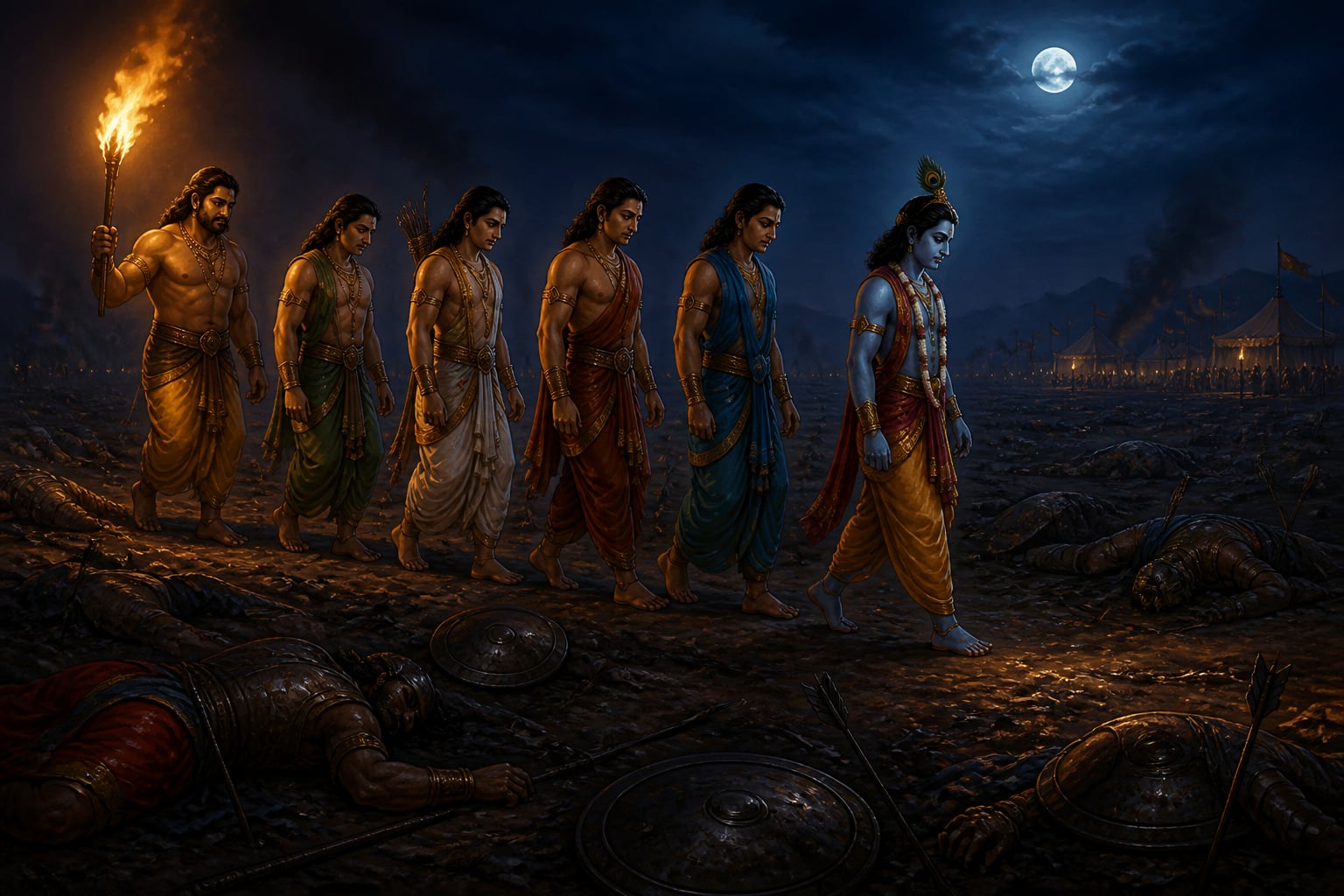
That night, under cover of darkness, the five Pandavas and Krishna crossed the killing fields of Kurukshetra.
The battlefield was never truly silent. Even at night, the groans of the wounded rose from the darkness. The smell of death hung in the air, blood, smoke, and the early decay of those who had fallen in the day's fighting and could not yet be cremated.
The brothers walked in single file, stepping carefully around bodies that had been their soldiers that morning. Arjuna recognized some of the fallen faces, men he had led, trained, encouraged. Now they lay still, their wars ended.
This is what we've come to, he thought. Walking through our own dead to beg our grandfather's killer for mercy.
But it was not mercy they sought. It was strategy. It was the secret that could end Bhishma's terrible effectiveness and perhaps, perhaps, save what remained of their cause.
The Enemy's Tent
Bhishma's tent stood at the center of the Kaurava camp. Guards surrounded it, but Krishna had anticipated this.
"Let them pass," Krishna said, loud enough for the guards to hear but not so loud as to alert the entire camp. "Bhishma expects them."
He was guessing. Or perhaps he knew something beyond human sight. The guards hesitated, then stepped aside.
Inside the tent, Bhishma sat on a simple cot, his weapons beside him. He looked up as the brothers entered, and something crossed his face, not surprise, not anger, but something closer to relief.
"I wondered when you would come," he said. "Sit. We have much to discuss and little time."

The Question
Yudhishthira approached first, bowing low. "Pitamaha, we come not as enemies tonight, but as your grandsons."
"I know why you've come." Bhishma's voice was tired, not physically, but spiritually. "Nine days I have killed your soldiers. Nine days you have tried to stop me and failed. Now you want to know how to succeed."
"Yes."
The word hung in the air. No pretense. No justification. Just the simple admission of desperation.
Bhishma closed his eyes for a moment. When he opened them, they glistened.
"I have waited for this question my entire life. Not this war, this lifetime. Since the day I made my vow, I have been waiting for someone to find a way to release me from it."
He looked at each brother in turn: Yudhishthira the righteous, Bhima the strong, Arjuna the skilled, Nakula and Sahadeva the quiet. His grandchildren. His family. His enemies.
"I will tell you how to kill me," Bhishma said. "But first, you must understand why."
The Story of Amba
Bhishma began to speak of events that had occurred before any of the Pandavas were born, events that had set in motion the fate now unfolding.
"When I was young, though already old by normal reckoning, my father Shantanu wished to marry a woman named Satyavati. Her father would only consent if Satyavati's children became heirs to the throne. This meant I had to step aside."
The brothers knew this story. Bhishma's vow, to never marry, never have children, to serve the throne without ever sitting upon it, was legendary.
"I accepted that vow," Bhishma continued. "And to prove my commitment, I raided the svayamvara of Kashi, carrying off three princesses, Amba, Ambika, and Ambalika, as brides for my half-brother Vichitravirya."
Ambika and Ambalika accepted their fate. They married Vichitravirya and eventually, through Vyasa's intervention, became grandmothers to both the Pandavas and Kauravas.
"But Amba refused." Bhishma's voice grew heavy. "She had already given her heart to King Shalva. She demanded I let her go to him."
"And did you?" Arjuna asked.
"I did. But Shalva rejected her, she had been carried off by another man, touched by another's hands. Her honor was compromised in his eyes. She had nowhere to go."
Amba's Fury
Bhishma described what followed: Amba's return, her demand that he marry her since he had ruined her life, his refusal on the grounds of his vow.
"She told me then that she would destroy me. That if it took a hundred lifetimes, she would find a way to end my existence. I... I laughed. I was young in a different way then. I did not understand what true hatred could accomplish."
Amba had approached every warrior who might challenge Bhishma. None would fight him, his reputation was too fearsome, his skills too legendary. Even Parashurama, the great sage-warrior who had taught Bhishma, fought for her but could not defeat his former student.
Finally, Amba turned to extreme austerities, praying to Lord Shiva himself.
"Shiva granted her a boon: she would be reborn as the cause of my death. Not my killer directly, but the instrument through which my death would come."

Amba walked into a fire, ending her life with absolute certainty of rebirth and revenge.
Shikhandi
"Amba was reborn as Shikhandi," Bhishma said.
The brothers exchanged glances. Shikhandi was in their camp, a warrior of Drupada's kingdom, fighting for the Pandava cause. They knew Shikhandi's unusual history.
"Born as a woman in Drupada's house, named Shikhandini, she, he, acquired male gender through a yaksha's boon. Now he fights as a man. But he carries Amba's soul, Amba's rage, Amba's mission."
Bhishma paused, his ancient face showing the weight of lifetimes.
"I cannot raise my bow against Shikhandi. To me, he is still Amba, still the woman whose life I destroyed. When I see him, I see her face as it looked when she cursed me. My arms will not obey. My arrows will not fly."
The Cruel Strategy
Krishna spoke for the first time since entering the tent. "So if Shikhandi stands before you..."
"I will not fight," Bhishma confirmed. "Anyone behind Shikhandi can strike me freely. I will not defend myself."
The implications were clear, and terrible. They would use Shikhandi as a living shield. Arjuna could stand behind him and shoot arrows into the undefending grandfather.
It was not heroic. It was not glorious. It was using one person's trauma to exploit another's guilt. It was the opposite of dharmic single combat.
But it would work.
"Why do you tell us this?" Yudhishthira asked, his voice barely above a whisper. "You know we will use it against you."
Bhishma's answer was simple: "Because I want to die."
The Grandfather's Confession
For the first time, Bhishma spoke without the weight of duty, without the mask of the invincible warrior. He spoke as a man who had lived too long.
"I have served the throne of Hastinapura for five generations. I watched your great-great-grandfather grow old. I watched your grandfathers born and die. I taught your fathers, watched them perish in various tragedies. Now I fight their children."
"I have kept my vow perfectly. And my vow has made me a monster."
"I protected Duryodhana because I swore to protect the throne. I watched him commit atrocity after atrocity, and I did nothing, because my vow bound me to the institution, not to justice. I stood silent when Draupadi was humiliated. I counseled peace but fought for war. I have been righteous in letter and corrupt in spirit."
Tears ran down the old warrior's cheeks.
"Tomorrow, end it. Place Shikhandi before me and let Arjuna's arrows find their mark. It will not be murder, it will be mercy. You will be releasing me from a prison I built with my own choices."
The Farewell
Arjuna could not speak. The man who had taught him archery, who had held him as a child, was asking to be killed, and worse, was explaining exactly how to do it.
Bhima had no such hesitation. "We will do what must be done. The war requires it."
Yudhishthira stood, bowing deeply. "We grieve already, Pitamaha. Tomorrow we will grieve more. But we thank you for this... gift."
"It is not a gift," Bhishma said. "It is a debt. I owe Amba a death. I owe you victory. Tomorrow, both debts will be paid."
As the brothers turned to leave, Bhishma called out one last time:
"Arjuna, aim true. Do not let me suffer. If you must kill me, let it be swift. Let the arrows make a bed on which I can lie until the sun turns north. I wish to die on an auspicious day."
Arjuna nodded, unable to speak.
The Pandavas left the tent, walked back across the battlefield of the dead, and returned to their camp to prepare for the tenth day.
Tomorrow, they would kill their grandfather.
The Weight of Knowledge
Back in the Pandava camp, no one slept.
Yudhishthira sat in meditation, trying to find peace with what they were about to do. The strategy was sound, the outcome was necessary, but the method, using Shikhandi, exploiting Bhishma's guilt, abandoning the principles of fair combat, sat heavy on his conscience.
Arjuna cleaned his weapons mechanically. Gandiva, his divine bow, would tomorrow pierce the body of the man who had first placed a bow in his hands. Every technique he would use, Bhishma had taught him. He would kill his teacher with the teacher's own lessons.
Bhima alone seemed at peace. "The old man wants to die. We need him dead. Where is the problem?"
"The problem," Krishna said quietly, "is not in the action. The problem is in how we will remember it afterward."
Shikhandi's Role
Shikhandi had to be told.
Krishna found him in his tent, sharpening weapons for the next day.
"Tomorrow, you will face Bhishma," Krishna said.
"I face him every day. He ignores me, shoots around me, refuses to engage."
"Tomorrow will be different. Tomorrow, Arjuna will stand behind you. When Bhishma lowers his bow, Arjuna will shoot. We need you to be the shield that allows the arrow to strike."
Shikhandi was quiet for a long moment.
"I was born for this," he finally said. "In my previous life as Amba, I spent years seeking revenge. I immolated myself to be reborn for this purpose. I do not fear facing him."
"But I want to be clear: when Bhishma falls, it will be because of me. Not just Arjuna's arrows. The revenge is mine. The victory is mine."
Krishna nodded. "The victory will be all of ours. But yes, the revenge belongs to Amba. To Shikhandi. You have waited lifetimes for this day."
Tomorrow, all the threads would converge: Amba's ancient rage, Bhishma's ancient guilt, Shikhandi's present purpose, and Arjuna's terrible duty. On the tenth day of Kurukshetra, the invincible grandfather would fall.
Living traditions
The night visit to Bhishma's tent has become a metaphor for unconventional negotiation strategies in Indian business culture. 'Going to the enemy's tent' suggests approaching problems through unexpected channels, finding common ground with apparent adversaries. The concept is taught in management courses as an example of creative problem-solving when conventional approaches fail.
- Bhishmashtami Observances: Annual commemoration of Bhishma's death day, observed with fasting, prayers, and reading of his final teachings from the Shanti and Anushasan Parvas
- Amba/Shikhandi Veneration: Worship of deities associated with gender transformation and the power of feminine rage to achieve justice
- Bhishma's Tent Site (Traditional): Traditional location identified as where Bhishma's tent stood during the war, and where the famous night conversation occurred.
- Vyasa's Ashram Site: Traditional location of Vyasa's ashram, where the sage observed and recorded the events of the war, including the night visit narrative.
Reflection
- The Pandavas asked their enemy how to defeat him. Have you ever sought help from an unexpected source, perhaps someone who seemed opposed to your goals? What made that possible, and what did you learn?
- Bhishma said his vows had made him a 'monster', noble in letter but corrupt in spirit. Have you experienced (or witnessed) commitments that started good but became harmful? How do we know when to maintain vows and when to release them?
- Amba's revenge took multiple lifetimes to complete. The Mahabharata suggests that karma operates across lives. What does it mean to think about justice on such vast timescales? Does it change how you view your own actions?