Mrityu: Dying by the Thousands
Virata's sons fall in battle
Behind every war's grand narrative are countless individual tragedies, sons who will never return, fathers who died for causes not their own, kingdoms that lost their futures on a foreign field. This lesson pauses the military chronicle to honor the dead: Virata's sons who paid for their father's alliance, allied kings who fell far from home, and the millions of unnamed soldiers whose deaths are counted only in numbers.
The Mathematics of Grief
The Mahabharata speaks of eighteen akshauhinis, nearly four million warriors, gathered at Kurukshetra. By the war's end, only a handful would remain alive. The epic counts casualties in lakhs (hundreds of thousands), speaks of rivers of blood, describes the battlefield as a cremation ground stretching to the horizon.
But numbers cannot capture grief.
Behind every number was a man. Behind every man was a family. Behind every family was a village that would never be the same. The Mahabharata's tragedy lies not in its scale but in its intimacy, in the moments when the epic pauses to show us individual deaths, individual grief, individual loss.
"I do not weep for the Pandavas or the Kauravas," Gandhari would say at war's end. "I weep for the widows. I weep for the mothers. I weep for the children who will never know their fathers."
The House of Virata
No family illustrated the war's cost to allies better than the house of Virata.
King Virata had sheltered the Pandavas during their thirteenth year of exile, the year of hiding when discovery meant additional banishment. He had risked everything to protect them, asking nothing in return. When war came, he marched to Kurukshetra with his entire kingdom's strength.
He brought his sons:
- Uttara - the eldest, proud and brave
- Shweta - skilled with the sword
- Shankha - a promising archer
- Suratha - the youngest, eager to prove himself
None of them would survive the first ten days.
Uttara's Fall (Day One)
Uttara had faced fear before. During the Pandavas' year of hiding, he had trembled when confronted with the Kaurava army, only Arjuna (disguised as Brihannala) had saved him. That experience should have taught him caution.
But young men forget fear when glory beckons.
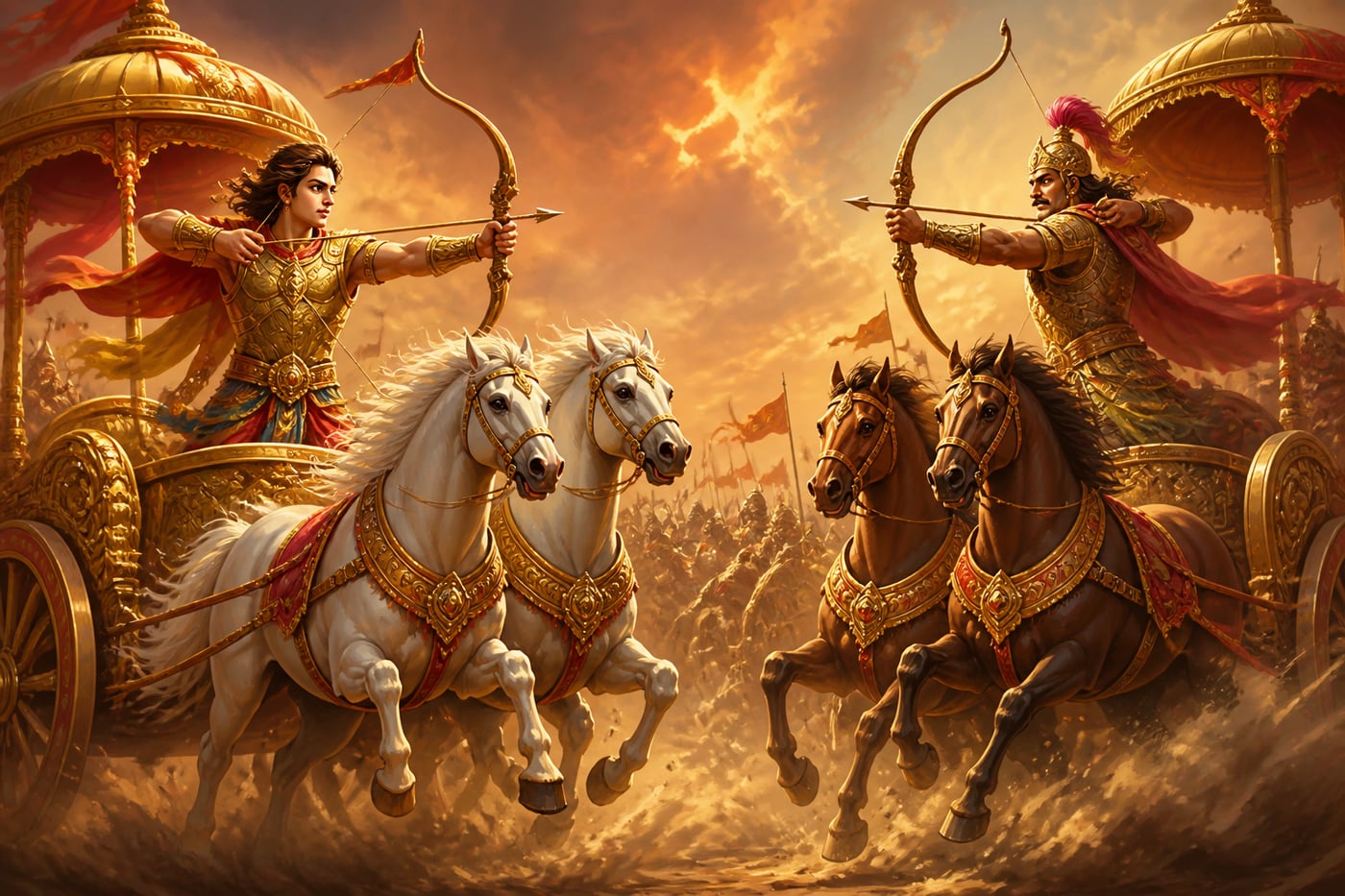
On the war's first day, Uttara saw Shalya, king of Madra, and charged. He saw a chance to prove he was no longer the frightened boy who had needed rescuing. He saw his name written in history.
What he did not see was Shalya's experience, Shalya's strength, Shalya's absolute superiority in combat.
"Uttara attacked like a young lion," Sanjaya reported. "Shalya struck him down like a hunter killing a kitten."
Uttara's body was carried back to the Pandava camp at sunset. Yudhishthira wept. This boy had laughed with them, eaten at their table, offered them sanctuary when no one else would. Now he lay cold, killed fighting for their cause.
The debt could never be repaid.
Shweta's Stand (Day One)
Word of Uttara's death spread through the Pandava forces. Grief turned to rage. Shweta, Virata's second son, demanded the right to avenge his brother.
Yudhishthira tried to restrain him: "Wait. We need you alive. Tomorrow you can, "
"Tomorrow means nothing if my brother's death goes unavenged today," Shweta replied. "Let me go."
He went.
Shweta fought like a demon, or like a man with nothing left to lose. He carved through Kaurava warriors, seeking Shalya, seeking the man who had killed Uttara. His rampage was magnificent, terrifying, and ultimately futile.
Bhishma himself moved to stop Shweta's advance. The grandfather did not want to kill this boy, he had no quarrel with Virata's sons, but Shweta was too dangerous to ignore, too effective to let continue.
Their duel was brief.
Shweta's arrows, though well-aimed, could not penetrate Bhishma's divine armor. Bhishma's return shots found every gap in Shweta's defense. Within minutes, Virata had lost a second son.
"Two princes of Matsya lay dead before the sun set on the first day," the chronicles record. "King Virata stood in his tent, unable to speak. The alliance that should have brought glory had brought only graves."
The Cascade of Grief
Virata's remaining sons, Shankha and Suratha, fell in the days that followed. The records are less detailed about their deaths; perhaps the chroniclers grew tired of documenting similar tragedies, perhaps the deaths blurred together in the chaos of battle.
What we know:
| Son | Day of Death | Killer | Circumstances |
|---|---|---|---|
| Uttara | Day 1 | Shalya | Charged rashly, outmatched |
| Shweta | Day 1 | Bhishma | Avenging Uttara, fell to the grandfather |
| Shankha | Day 2-5 | Unknown | Lost in the chaos of formation battles |
| Suratha | Day 2-5 | Unknown | Died protecting fallen brother |
King Virata himself would survive the war, but barely. A king without heirs is a kingdom without future. The house that had protected the Pandavas was left hollow.
This was the price of alliance. This was what friendship with the righteous cost.
Allied Kings Who Fell
Virata was not alone. Kings from across Bharatavarsha had chosen sides, and their choices became death sentences.
For the Pandavas:
- Drupada, king of Panchala, father-in-law to the Pandavas, would fall to Drona (later in the war)
- Dhrishtaketu of Chedi died on Day Nine, facing Drona's unstoppable assault
- Kuntibhoja, Kunti's foster father, led his troops until arrows found him
- Nila of Mahishmati, Jayatsena of Magadha, names that fill the casualty lists
For the Kauravas:
- Bhagadatta, the elephant warrior from Pragjyotisha, ancient and formidable, would fall to Arjuna
- Bhurishravas, the wise Kuru elder, died in controversial circumstances
- Countless princes of kingdoms whose names survive only in death rolls
Each of these kings had subjects who depended on them, children who called them father, wives who waited for their return. Each brought warriors who believed in their king's cause. When the kings fell, kingdoms lost their futures.
The Anonymous Millions

For every prince whose death is named, ten thousand soldiers died unnamed.
They came from villages across Bharatavarsha. They were farmers pressed into service, craftsmen who had never held weapons before, young men who saw the army as escape from poverty. They marched to Kurukshetra with kings they barely knew, fought for causes they didn't understand, and died in heaps that had to be burned in mass pyres because individual cremation was impossible.
The Mahabharata gives them no names. It counts them in numbers, "ten thousand fell," "a hundred thousand perished", as if death in such quantities could be reduced to arithmetic.
But consider:
- Every number was someone's son
- Every casualty meant a family shattered
- Every death left a widow, an orphan, or both
- Every village that sent men to war received fewer back
"What sin did these soldiers commit?" the sage Vyasa asked. "They were born in kingdoms that chose sides. They marched where their kings led. They died because their lords quarreled. Is this dharma?"
The question hangs unanswered.
The War's True Cost
Modern analysis of the Mahabharata's casualty figures reveals the epic's awareness of war's devastating impact:
Physical casualties (as per traditional counts):
- 18 akshauhinis (~4 million) entered the war
- Only 12 people survived on the winning side
- The Kauravas were annihilated entirely except for Yuyutsu
Economic destruction:
- Kingdoms bankrupted by war expenses
- Agricultural labor conscripted into armies
- Trade routes disrupted for years afterward
Social devastation:
- A generation of young men killed
- Thousands of widows, tens of thousands of orphans
- The warrior class (kshatriyas) effectively destroyed
Psychological trauma:
- Survivors haunted by what they had done
- Yudhishthira's guilt prevented him from ruling effectively
- Gandhari's curse ensured the Yadava dynasty's destruction
The war's "victory" was pyrrhic in the extreme. The Pandavas won a kingdom of ashes, ruled by ghosts, surrounded by grief.
The Mothers of Kurukshetra
The epic's most devastating perspective on the war's cost comes from the mothers.
Kunti watched her five sons march to battle every dawn, not knowing if evening would bring their bodies. She had already lost one son, Karna, to the enemy side, a secret she would carry until after his death.
Gandhari heard reports of her hundred sons dying one by one. Blind like her husband by choice, she could only listen as Sanjaya's descriptions grew darker each day.
Draupadi lost all five of her sons, the Upapandavas, in a single night of treachery after the war proper ended. Her joy at Kaurava defeat turned to ash.
Subhadra would lose her son Abhimanyu in circumstances so dishonorable that even Kaurava warriors were ashamed.
The mothers paid a price no victory could redeem.

Honoring the Dead
The Mahabharata does not glorify war. Despite its battle descriptions, despite its cataloging of heroic deeds, the epic is fundamentally anti-war. Every victory is shadowed by loss. Every triumph is measured against its cost.
The dead of Kurukshetra are honored in several ways:
Through memory: The epic preserves their names, ensuring they are not forgotten. Even minor warriors receive mention; even anonymous soldiers are counted.
Through ritual: The post-war sections describe elaborate shraddha (death) ceremonies for all fallen warriors, not just kings and princes.
Through grief: The epic allows its characters to mourn fully. Gandhari's lamentations, Yudhishthira's guilt, Ashwatthama's rage, all are given space.
Through wisdom: The deaths lead to teaching. The Shanti Parva and Anushasan Parva contain Bhishma's final instructions, wisdom extracted from the mouth of a dying warrior, as if the only way to redeem so much death was to ensure it produced enlightenment.
The Question That Remains
As we count the dead of Bhishma's ten days, a question emerges that the epic never fully answers:
Was it worth it?
The Pandavas fought for dharma, for justice, for the principle that wrongs must be righted. They achieved their goal, Duryodhana fell, the kingdom was restored, the righteous ruled.
But the righteous ruled a graveyard. The dharma they established was built on bones. The justice they achieved cost millions of lives, most of whom had no stake in the outcome.
"I would give back all of Hastinapura," Yudhishthira said after the war, "to have my brothers' sons alive. I would return to the forest forever to undo a single day of this war."
He could not.
No one can undo the dead.
The lesson of Kurukshetra's casualties is not that war is sometimes necessary, though the epic suggests it sometimes is. The lesson is that war's cost falls hardest on those who had least choice in it: the soldiers who marched where their kings led, the sons who followed their fathers' alliances, the kingdoms that paid in blood for friendship.
Remember them. In all the glory of Arjuna's archery and Bhishma's prowess, in all the philosophical depths of the Gita and the strategic brilliance of the vyuhas, remember the unnamed dead.
They paid the price. We inherit their lesson.
Living traditions
The Mahabharata's treatment of war casualties has influenced modern Indian military ethics and memorial culture. India's National War Memorial includes space for honoring 'unknown soldiers,' echoing the epic's awareness that most who die in war are unnamed. Anti-war movements in India often cite the Mahabharata's depiction of war's cost, not as glorification but as warning. The phrase 'Kurukshetra of grief' is used to describe any situation where supposed victory brings only devastation.
- Pitru Paksha Observances: A 15-day period for honoring ancestors, during which many Hindu families visit Kurukshetra to perform shraddha ceremonies
- War Memorial Traditions: Indian military tradition of honoring all fallen, including enemy combatants, draws explicitly on Mahabharata precedents
- Sannidhit Sarovar: Sacred tank where according to tradition, all the tirthas (holy places) of India gathered during the war. Associated with performing shraddha for warriors who died at Kurukshetra.
- Bhishma Kund: Traditional site where Bhishma lay on his arrow bed. Pilgrims perform death rituals here, connecting to the epic's most famous battlefield death.
- Nabhi Kamal (Navel Lotus Temple): Vishnu temple considered the 'navel' of the world, where performing shraddha is believed to release the souls of all ancestors. Associated with the cosmic significance of Kurukshetra's deaths.
Reflection
- Virata lost his entire male lineage fighting for the Pandavas' cause. Have you ever supported someone's fight and paid a higher price than expected? How did that experience shape your understanding of alliance and commitment?
- The epic counts casualties in numbers, 'ten thousand fell,' 'a hundred thousand perished.' When we reduce deaths to statistics, what do we lose? How can we honor the individual within the aggregate?
- Yudhishthira won the war but later said he would give it all back to undo a single day of fighting. What does it mean to win something you no longer want?