Bala: The Grandfather's Fury

Bhishma dominates days six to nine

Days six through nine see Bhishma unleash his full, terrible power. The Pandava forces shrink daily under his arrows, despair spreading through their camp like poison. Arjuna cannot bring himself to truly fight his grandfather; Krishna nearly breaks his vow in frustration. As hope fades, one sacrifice illuminates the darkness, and a desperate plan takes shape: the Pandavas will visit their enemy at night, asking how to kill him.

The Grandfather Unleashed

By the sixth day, Bhishma had stopped holding back.

Whatever restraint had tempered his fighting in the war's opening days now disappeared. Perhaps Duryodhana's constant complaints, "Why do you spare them? Kill the Pandavas!", had worn down his patience. Perhaps he hoped that overwhelming devastation might force a surrender, ending the war with fewer total deaths. Or perhaps the warrior within him, suppressed for so long by political considerations, finally demanded full expression.

The results were catastrophic.
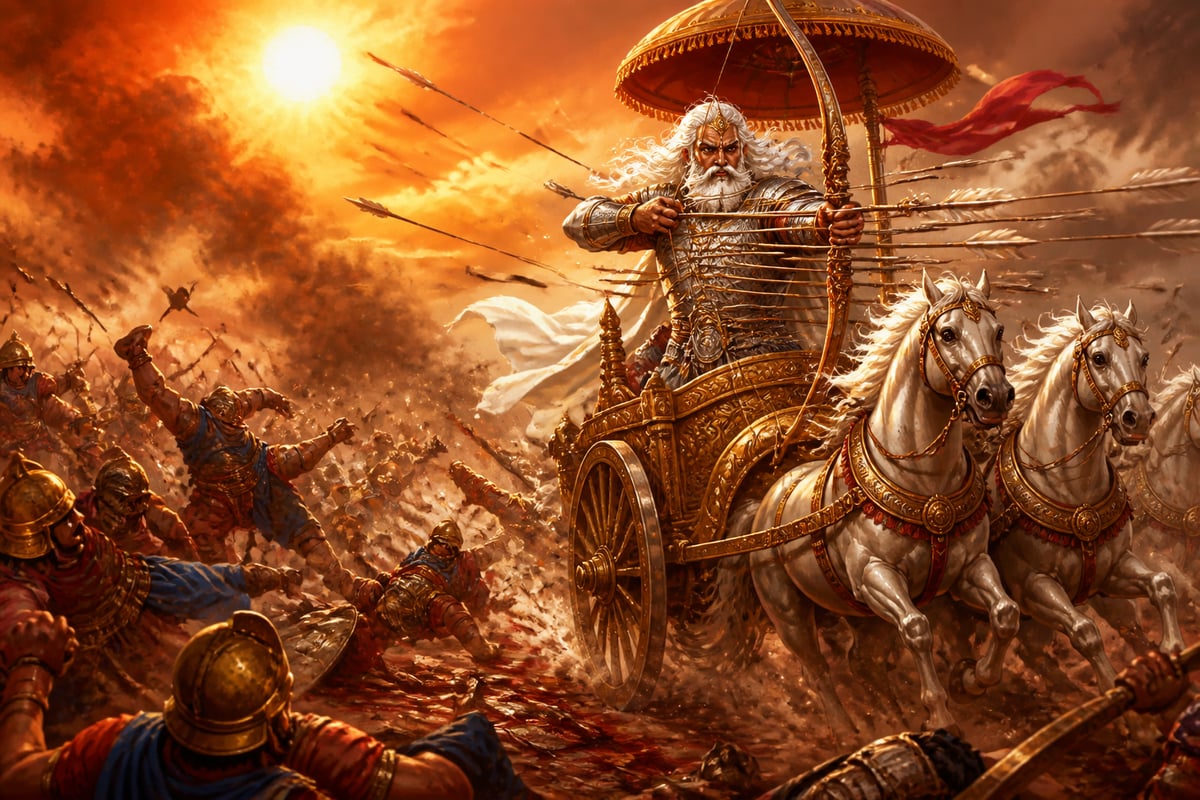
Bhishma at the height of his battlefield fury

"Bhishma moved through the Pandava army like a fire through dry grass," Sanjaya reported. "Wherever his chariot turned, men died. His bow sang without rest, and each note was a death."

The Mathematics of Destruction

Bhishma had promised to kill 10,000 Pandava warriors daily. Now he exceeded that number:

Day Estimated Pandava Casualties Major Events
Day 6 15,000+ Bhishma's devastating sweep
Day 7 18,000+ Arjuna driven back repeatedly
Day 8 12,000+ Iravan's sacrifice
Day 9 20,000+ Krishna nearly breaks his vow

These numbers, mythologically inflated but narratively significant, painted a picture of systematic annihilation. The Pandava force, already outnumbered, was being ground to nothing.

At this rate, victory would become meaningless. There would be no army left to claim it.

Day Six: The Killing Field

The sixth day's battle began with Drona forming the Pandava-destroying formation: the Makara Vyuha (Crocodile Formation), with Bhishma at its deadly jaws.

Arjuna responded with Krauncha Vyuha (Heron Formation), placing himself at the beak. Crane versus Crocodile, both predatory, both designed to tear the other apart.

But formations meant nothing against Bhishma's fury. Within hours, the Krauncha's beak had been blunted, its wings scattered. Arjuna found himself constantly driven back, able only to defend while the grandfather slaughtered his soldiers around him.

Bhima fared better, his mace work creating a zone of safety where Pandava forces could rally. But even Bhima could not be everywhere. For every hundred he protected, a thousand fell elsewhere to Bhishma's arrows.

By evening, the Pandava commanders gathered in grim silence. Yudhishthira's face was ashen.

"We have fought six days. We have lost perhaps a quarter of our force. The Kauravas have lost far less. If Bhishma continues at this pace, we will have nothing left by Day Fifteen."

No one had an answer.

Day Seven: The Student and the Teacher

The seventh day brought another brutal lesson: Arjuna could not defeat Bhishma.

This was not a matter of skill. In pure archery, Arjuna was Bhishma's equal, perhaps even his superior. But combat requires more than skill. It requires will: the complete commitment to destroying your opponent.

Arjuna lacked that will.

Every time he drew his bow against Bhishma, memories flooded his mind:

How do you kill your grandfather? How do you end a life that has protected yours?

Krishna saw this struggle and said nothing, yet. The time for intervention was approaching.

That night, Arjuna sat alone, staring at his bow Gandiva. The weapon that had never failed him now seemed a terrible weight. What good was the greatest bow in the world if he could not bring himself to use it?

Day Eight: Iravan's Sacrifice

The eighth day brought a death that illuminated the war's terrible cost.

Iravan was Arjuna's son by Ulupi, the Naga princess. Raised in the underwater kingdom, he had come to Kurukshetra to fight for his father's cause, a young warrior eager to prove himself worthy of his legendary parent.

Iravan facing overwhelming odds against the Kaurava illusionists

On Day Eight, facing overwhelming odds against an army of illusionists (mayavi warriors) deployed by the Kauravas, Iravan fought with brilliant desperation. But bravery could not overcome numbers. Surrounded and outnumbered, he was cut down.

Arjuna learned of his son's death at sunset.

The greatest archer in the world stood in his tent, trembling. He had sent his child to die. The war he was fighting, the war he could not bring himself to fight fully against Bhishma, had killed his son.

"Pitah," Krishna said gently, "grief is natural. But Iravan died a hero. His sacrifice was not in vain."

"Was it not?" Arjuna's voice cracked. "We are losing, Krishna. My son died for a cause that is failing. And I cannot even avenge him because I cannot bring myself to kill the one man who matters."

That night, a plan began to form. If Arjuna could not find the will to kill Bhishma, perhaps Bhishma himself would provide it.

Day Nine: Krishna's Fury

The ninth day broke Arjuna's paralysis, but not in the way anyone expected.

Krishna had watched for nine days. He had guided his chariot through impossible situations, had counseled patience, had trusted that Arjuna would eventually find his warrior's heart. But watching the Pandava army crumble while Arjuna hesitated had worn his patience thin.

When Bhishma launched his most devastating assault yet, a sharavarsha (arrow-storm) that seemed to blot out the sun, Krishna finally snapped.

The Lord of the Universe broke his vow.

Krishna leaps from the chariot with the blazing Sudarshana Chakra raised, advancing on Bhishma in fury.

Leaping from the chariot, Krishna grabbed his Sudarshana Chakra, the divine discus that had slain countless demons, and strode toward Bhishma. His face, usually serene, blazed with divine wrath.

"Enough!" Krishna roared. "If my warrior will not fight, I will end this war myself!"

The battlefield froze. Warriors on both sides stopped fighting, staring at the impossible sight: the charioteer who had sworn not to lift weapons now advancing with death incarnate spinning above his hand.

Bhishma saw Krishna coming and smiled, a genuine smile of joy.

"Come, Keshava!" the grandfather called out. "Come and release me! To die by your hand would be the greatest blessing. I have waited so long for this moment!"

But Arjuna moved faster.

Throwing himself from his chariot, Arjuna caught Krishna's arm, dragging him back.

"Stop, Madhava! You gave your word! I will not let your honor be stained because of my weakness. I swear to you, I will fight. I will kill Bhishma. Just... give me the way."

Krishna paused. The Sudarshana Chakra slowed its spin. The divine fury in his eyes gradually subsided, replaced by something that might have been satisfaction.

The crisis had served its purpose. Arjuna was finally ready.

The Night Visit Decided

That evening, the Pandava council made their most desperate decision yet.

"Bhishma cannot be defeated in fair combat," Yudhishthira stated the obvious. "We have tried everything, formations, diversions, multiple attacks. Nothing works. Either we find another way, or we lose this war."

"There is another way," Krishna said. "But it requires something none of you may be willing to do."

He explained: Bhishma had a secret. Every warrior has a weakness, a situation in which they cannot or will not fight. Bhishma's was known to few, but Bhishma himself knew it.

They would have to ask their enemy how to kill their enemy.

"It violates no rule of war," Krishna continued. "Bhishma is bound to Duryodhana by vow, but his heart belongs to dharma, to you. He will tell you the truth if you ask. The question is whether you can bring yourselves to ask."

Silence fell over the tent.

Could they really go to Bhishma? Could they ask the grandfather who had raised them how to end his life? What kind of men would they become by doing so?

Yudhishthira spoke first: "If this is the only way, we must do it. The lives of thousands depend on ending Bhishma's command. Our discomfort is a small price."

The decision was made. That night, the Pandavas would cross the battlefield to the enemy camp, enter Bhishma's tent, and ask the question that would change everything.

The Weight of the Ninth Day

As darkness fell on the ninth day, the war had reached its crisis point.

The Pandava forces had lost nearly forty percent of their strength. Morale was shattered. Soldiers whispered that Bhishma was truly invincible, that the gods themselves could not stop him.

But something had shifted.

Krishna's near-intervention had shocked Arjuna out of his paralysis. The visit to Bhishma, yet to come, would provide the tactical key. And Bhishma himself, watching Krishna's charge toward him, had revealed something crucial:

He wanted to die.

The grandfather was not fighting to win. He was fighting to fulfill his vow while hoping someone would find a way to end his impossible position. He would tell the Pandavas how to kill him because, in his deepest heart, he was asking them to release him.

Nine days of war. Nine days of killing. And the grandfather who had protected the Kuru dynasty for generations was ready to let his own grandchildren bring him down.

The night ahead would reveal the secret. Day Ten would test whether they could use it.

Living traditions

The Sudarshana Chakra has become a symbol of divine intervention in popular culture, invoked when situations seem impossible without higher help. 'Krishna's discus moment' is used colloquially to describe intervention when patience is exhausted. Iravan's story has gained new relevance through the LGBTQ+ community's embrace of his festival, transforming an ancient tragedy into a celebration of acceptance and chosen family.

Reflection

More in Bhishma Parva

All lessons in Bhishma Parva · The Mahabharata course