Sangrama: The Tide of Battle

Days two to five, heroes clash

As the war settles into its grim rhythm, days two through five reveal the strategic depths of ancient warfare. Armies reshape themselves into Garudas and Kraunchas, eagles and cranes of death. Great warriors seek each other through the chaos. And a terrible pattern emerges: Bhishma cannot be stopped, the Pandavas cannot break through, and the dead continue to multiply.

The Rhythm of War

By the second morning, Kurukshetra had changed. The pristine field that had once hosted sacrifices and meditation now stank of death. Scavenger birds circled overhead. The ground, once firm, had turned to mud mixed with blood.

Yet when the conches sounded at dawn, men marched out again.

This is the strangest truth of war: it becomes routine. The horror that shocked on the first day becomes merely the context by the fifth. Warriors who had vomited at their first kill now ate breakfast beside the bodies of yesterday's enemies.

"What disturbs most about war," Krishna observed, "is not the violence itself, but how quickly the soul adapts to it."

Day Two: The Battle of Formations

The second day saw the war's first major tactical engagement. Bhishma arranged the Kaurava forces in Garuda Vyuha, the Eagle Formation.

This was not mere decoration. The vyuhas (military formations) of the Mahabharata represented sophisticated tactical thinking:

Formation Shape Purpose
Garuda Vyuha Eagle with spread wings Aggressive encirclement
Krauncha Vyuha Crane/Heron Penetrating attack
Padma Vyuha Lotus/Circular Defensive trap
Chakra Vyuha Discus/Wheel Rotating offensive
Makara Vyuha Crocodile Amphibious flexibility
Sarpa Vyuha Serpent Flanking movements

Arjuna responded with Krauncha Vyuha, the Crane Formation, its sharp beak designed to pierce the eagle's heart. The two armies collided like mythical beasts made of men and metal.

The Garuda's wings swept forward to envelop. The Krauncha's beak struck for the center.
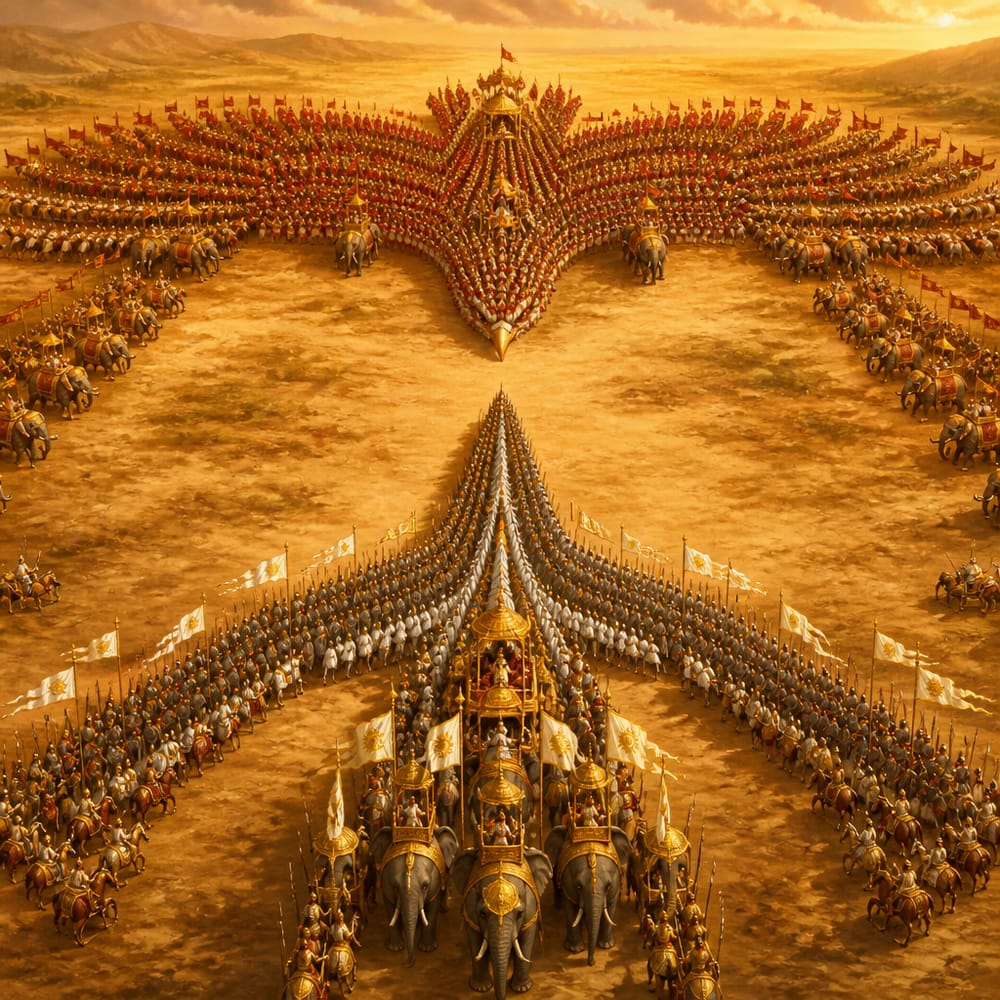
A high view of Kurukshetra shows the Kaurava eagle formation closing on the Pandava crane formation.

By midday, both formations had shattered into the chaos of general engagement, but not before thousands had died in the precise geometry of tactical warfare.

Duels of the Second Day

Drona vs. Dhrishtadyumna: The most psychologically charged duel of the war. Dhrishtadyumna had been born from fire specifically to kill Drona, his entire existence was defined by this future act. Now student faced destined killer across the battlefield. Neither could finish the other. Dhrishtadyumna's arrows were deflected; Drona's strikes fell short. It was as if fate itself held them apart, waiting for the appointed hour.

Arjuna vs. Bhishma: Again they faced each other. Again neither truly committed to killing. Their arrows flew, crossed, negated each other, a strange dance of warriors who loved each other but stood on opposite sides of dharma.

Bhima's Rampage: While the great archers dueled with precision, Bhima fought with raw fury. He abandoned his chariot and waded into the Kaurava infantry on foot, his mace crushing everything in reach. By day's end, he had personally killed over a hundred elephants, the most effective elephant-killer the war would see.

Day Three: The Tide Turns

The third day belonged to Bhishma entirely.

Something changed in the grandfather. Perhaps the restraint of the first two days had exhausted his patience. Perhaps he decided to test whether devastating the Pandava forces might end the war quickly, sparing greater bloodshed. Whatever the reason, Day Three saw Bhishma at his most terrifying.

His arrows created what survivors described as a wall of death:

"The grandsire's shafts flew so thick that they formed a curtain no one could penetrate. Warriors died before they saw what killed them. Chariot after chariot fell. The Pandava army broke and fled."

For the first time, the Pandavas experienced genuine rout. Yudhishthira watched his forces scatter, and despair touched his heart. How could they defeat a man who fought like a natural disaster?

Only Arjuna's intervention prevented complete catastrophe. Driving into the teeth of Bhishma's arrow-storm, he created enough of a screen for the army to reform. But by sunset, the Pandava losses were catastrophic.

The Council of Desperation

The Pandava brothers in grim night council with Krishna

That night, the Pandava council was somber.

"We cannot continue like this," Yudhishthira said. "Each day, Bhishma kills thousands. Our forces shrink while the Kauravas' numerical advantage grows. At this rate, we will be destroyed within a fortnight."

Arjuna sat in troubled silence. He had faced Bhishma three times now, and each time something held him back. The grandfather who had taught him archery, who had held him as a child, who had protected the family through generations, how could he truly commit to killing such a man?

Krishna watched this internal struggle with knowing eyes. The moment for the Gita's teaching to be tested was approaching. Arjuna had accepted his duty intellectually. Could he accept it emotionally?

"There is a way," Krishna said carefully. "But it requires knowledge that only Bhishma himself can provide."

He was already thinking ahead to the night visit that would change everything.

Day Four: Bhima's Glory

Bhima rampaging through the Kaurava princes with his mace

The fourth day saw Bhima emerge as the Pandavas' most effective warrior.

While Arjuna remained paralyzed against Bhishma, Bhima had no such hesitation against the Kaurava princes. These were the men who had laughed while Draupadi was humiliated. These were the brothers of the man who had tried to poison him, burn him, steal everything he loved.

Bhima remembered. And Bhima struck.

On Day Four, he engaged fourteen of the hundred Kaurava brothers. Eight of them died by his mace before sunset. The others fled, terror replacing their earlier confidence.

Duryodhana watched his brothers fall and rage consumed him. He charged toward Bhima personally, only to be intercepted by his own commanders. "Not yet," they counseled. "The time for single combat between you will come. Today is not that day."

But Duryodhana had seen something that frightened him: Bhima's strength had not diminished after thirteen years of exile. If anything, it had grown. The second Pandava was not merely fighting, he was hunting.

Day Five: The War Finds Its Pattern

By the fifth day, certain patterns had become clear:

Morning: Both armies arranged their formations, commanders positioned their best warriors at key points.

Midday: Formations dissolved into general melee. Great warriors sought each other out for single combat while infantry crashed together in anonymous slaughter.

Afternoon: Fatigue set in. The fighting became more desperate, more vicious. Men who had shown restraint at dawn killed without thought by afternoon.

Evening: Conches sounded cease-fire. The armies separated. The wounded were collected. The dead were counted.

Night: Councils met. Strategies were revised. The weeping of widows could be heard from villages beyond the battlefield.

The fifth day's major encounter was Satyaki vs. Drona, a fierce duel that established Satyaki as one of the Pandavas' premier warriors. Trained by Arjuna himself, Satyaki matched Drona stroke for stroke, neither gaining advantage.

The Vyuha Masters

Both sides employed vyuha-vidya, the science of military formations, with increasing sophistication. Understanding these formations helps illuminate the tactical genius involved:

Offensive Formations:

Defensive Formations:

The ability to shift formations mid-battle, transforming from offensive Makara to defensive Sarvatobhadra in minutes, required extraordinary coordination and training. The Kaurava advantage lay in numbers; the Pandava advantage lay in the flexibility their smaller force allowed.

The Psychological War

Beyond the physical combat, a psychological war was being waged.

Bhishma's devastating effectiveness was demoralizing Pandava forces. Soldiers began to believe the grandfather was truly invincible, that fighting him was merely a slower form of suicide.

The Pandava brothers' survival despite repeated encounters with death gave their troops hope. If the five brothers could face Bhishma and live, perhaps victory was possible.

Krishna's presence was worth more than any army division. When soldiers saw the divine charioteer calmly guiding Arjuna's chariot through impossible situations, they believed they fought on the side of dharma itself.

Duryodhana's complaints to Bhishma, "Why do you spare them? Why don't you kill the Pandavas?", began to spread through the Kaurava camp. Some wondered whether their own commander truly wanted to win.

The Balance Sheet

After five days, the war's mathematics looked grim for both sides:

Metric Kauravas Pandavas
Starting akshauhinis 11 7
Estimated losses (Days 1-5) ~15% ~25%
Major warriors lost Few Several allied kings
Morale Confident but questioning Desperate but determined

The Kauravas were winning by attrition. Bhishma's daily harvest of 10,000 warriors was slowly grinding the Pandava force to nothing. If nothing changed, the war would end within two weeks, and not in the Pandavas' favor.

The Turning Point Approaches

As the fifth day ended, the situation demanded desperate measures.

Yudhishthira knew they could not continue trading casualties with a larger force. They needed to remove Bhishma, but how? The grandfather was unbeatable in fair combat. The brothers could not bring themselves to truly attack him. The rules of dharma yuddha prevented dishonorable tactics.

Something had to change.

That night, after the councils disbanded and the wounded groaned in their tents, a plan began to form. It would require swallowing pride. It would require asking their enemy for help. It would require a truth that no one wanted to face.

Bhishma himself would have to tell them how to kill Bhishma.

But that conversation, and the terrible revelation it would bring, was still days away. First, days six through nine would show the grandfather at the height of his terrible power. The Pandavas would have to endure the storm before they could find its center.

Living traditions

The concept of vyuha has entered modern Indian business vocabulary. Companies speak of 'competitive vyuhas' and 'market formations.' The Indian military continues to study Mahabharata tactics in strategic courses. Management consultants reference the war's lessons on attrition, formation, and the importance of morale. The ancient battle continues to inform modern thinking about strategy and conflict.

Reflection

More in Bhishma Parva

All lessons in Bhishma Parva ยท The Mahabharata course