Ratha: Charioteers of Destiny

Krishna drives Arjuna's chariot

In the ancient art of chariot warfare, the sarathi was far more than a driver, he was strategist, guardian, and the warrior's second mind. When Krishna chose to serve as Arjuna's charioteer, the Lord of the Universe became a servant. This lesson explores the sacred bond between warrior and charioteer, and why this relationship made the Bhagavad Gita possible.

The Art of the Charioteer

In the warfare of the Mahabharata age, no warrior fought alone. The great maharathas, those capable of fighting ten thousand ordinary soldiers simultaneously, stood upon their chariots with arrows nocked and swords drawn. But behind every legendary archer stood another figure, equally essential: the sarathi, the charioteer.

The sarathi held the reins of destiny.

A chariot required four horses, perfectly trained to move as one. The warrior stood at the back, focused entirely on combat, shooting arrows, deflecting missiles, scanning the battlefield for threats. He could not also manage the horses. He could not choose his positioning. He could not watch what happened behind him.

The sarathi did all of this.

"A warrior's skill means nothing if his charioteer is incompetent," the texts declared. "The best archer in the world becomes helpless if his sarathi cannot position him correctly."

More Than a Driver

The charioteer's responsibilities extended far beyond handling horses:

Role Description
Navigator Chose routes through the chaos of battle, avoiding obstacles and enemy formations
Strategist Advised on when to advance, retreat, or hold position
Guardian Protected the warrior from attacks he couldn't see
Communicator Conveyed signals to allied forces and interpreted enemy movements
Motivator Kept the warrior's spirits high during the long hours of combat
Witness Observed everything, providing perspective the fighting warrior lacked

The sarathi needed to understand warfare as deeply as any kshatriya. He needed courage equal to any fighter, for he stood in the same chariot, faced the same arrows, yet wielded no weapons of his own. His survival depended entirely on his warrior's skill and the speed of his own reflexes.

The relationship between warrior and charioteer was one of absolute trust.

Krishna's Choice
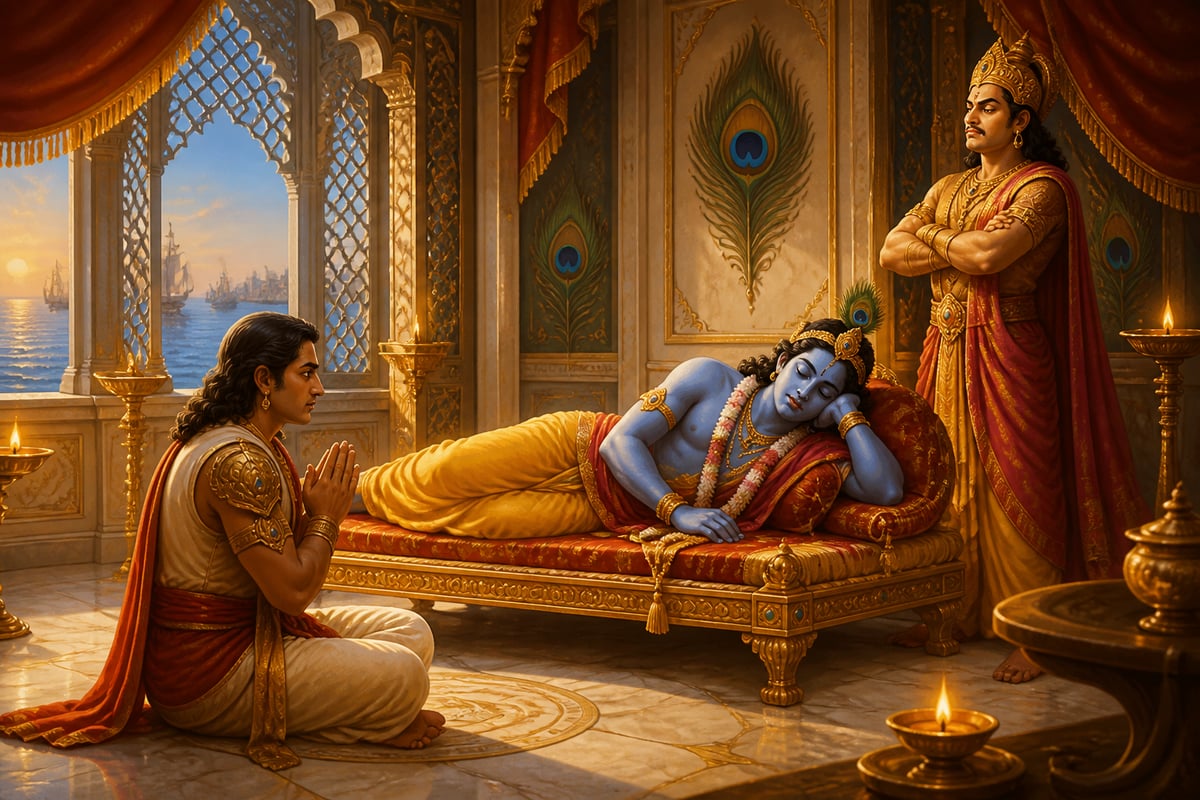
Arjuna and Duryodhana waiting beside the sleeping Krishna at Dwaraka

When both Arjuna and Duryodhana arrived at Dwaraka seeking Krishna's support for the coming war, they found him asleep. Duryodhana, arriving first, seated himself at Krishna's head, the position of superiority. Arjuna, arriving moments later, stood humbly at Krishna's feet.

When Krishna awoke, his eyes fell first on Arjuna.

"Both of you seek my help," Krishna said. "I will divide what I have. On one side, my entire Narayani Sena, the vast army of the Yadavas, fully armed and trained. On the other side, myself alone. But I will not fight. I will not lift a weapon. I will only serve."

He offered Arjuna the first choice.

Duryodhana's heart leaped. Let the fool choose Krishna, he thought. What good is one man who won't even fight? I'll take the army.

Arjuna bowed low. "I choose you, Madhava. Only you."

"But why?" Duryodhana laughed when he heard. "He won't fight! He's just one man!"

Arjuna's answer was simple: "With Krishna beside me, I cannot lose. Without him, I cannot win, regardless of how many soldiers stand behind me."

Duryodhana thought he was getting an army. He was getting numbers.

Arjuna knew he was getting something far greater: guidance from the divine itself.

The God Who Chose to Serve

Consider what Krishna's choice meant.

He was Vishnu incarnate, the Preserver of the Universe, the Lord of all creation. He had lifted mountains, defeated demons, established dharma across countless ages. The gods themselves sought his counsel.

And he chose to hold the reins of a chariot.

He chose to serve.

Krishna sits calmly at the reins of a white-horse chariot while Arjuna stands behind him, ready for battle.

This is the radical heart of Krishna's message: true greatness lies not in domination but in service. The highest being in the cosmos took the lower position. The master became the servant. The guru became the guide who stands behind, not in front.

When Krishna mounted Arjuna's chariot and took the reins of the four white horses, he demonstrated a principle that would echo through his later teachings: action without ego, service without expectation of recognition, doing what is needed without concern for status.

The Chariot as Metaphor

Later commentators would see in the chariot a symbol of human existence itself:

Element Spiritual Meaning
Chariot The physical body
Horses The senses, pulling toward desires
Reins The mind, which must control the senses
Charioteer The intellect (buddhi) or the inner guide
Warrior The individual soul (atman)
Road The path of life

In this reading, Krishna as sarathi represents the divine intelligence that guides the soul through the battlefield of existence. The warrior (soul) must fight, must engage with life, but needs the steady guidance of higher wisdom to navigate correctly.

Without a good charioteer, the horses run wild. Without the guidance of buddhi, or of divine grace, the senses drag us toward destruction.

Other Charioteers of Kurukshetra

Krishna was not the only significant sarathi on the battlefield:

Shalya whispering demoralizing words to Karna in battle

Shalya, king of Madra and uncle to the Pandavas, had been tricked into fighting for Duryodhana. But his greatest role came later, as Karna's charioteer, a position Duryodhana forced upon him specifically because Shalya was a maharatha himself and could match Krishna's skill. Yet Shalya despised Karna and spent their time together undermining his confidence rather than supporting him.

The contrast could not be starker: where Krishna uplifted Arjuna, Shalya poisoned Karna's mind.

Bhishma's charioteer was a skilled professional, but Bhishma often drove himself, a reflection of his self-reliance and perhaps his unwillingness to fully trust anyone with his fate.

Drona and Ashwatthama had their own trusted sarathis, though their names are less remembered. The skill of these anonymous charioteers kept legendary warriors alive through impossible battles.

The Bond Tested

The depth of the warrior-charioteer relationship was tested at the very beginning of the war.

When Arjuna asked Krishna to drive their chariot between the two armies, Krishna complied without question. He brought the chariot to the exact center of the battlefield, where Arjuna could see everyone, his teachers Drona and Kripa, his grandfather Bhishma, his cousins arrayed for slaughter.

What Arjuna saw broke him.

His bow Gandiva slipped from his fingers. His skin burned with fever. His mind reeled with grief and confusion. He collapsed onto the chariot floor, unable to fight.

"I will not fight," Arjuna declared. "Better to beg for alms than to kill these elders. Better to be killed than to become a killer of family."

In that moment of crisis, the charioteer became something more: he became the guru.

Krishna did not judge Arjuna's collapse. He did not mock his greatest warrior's weakness. Instead, he spoke, first with gentle questioning, then with profound teaching. Over the next hours (or perhaps moments, time works differently when the divine speaks), Krishna delivered the Bhagavad Gita: the Song of God, the distilled essence of dharmic wisdom.

This teaching was possible only because of the intimacy of the chariot.

The Gita's Setting

The Bhagavad Gita, studied in detail in Chapter 19 of this course, emerged from a specific context that the sarathi-warrior relationship made possible:

The chariot became a mobile ashram, a place of teaching on the edge of violence, a sanctuary of wisdom in the midst of war.

The Reins of War

Once Arjuna rose from his despair, the war began in earnest. And Krishna proved himself the greatest sarathi who ever lived.

Day after day, he maneuvered their chariot through the chaos of battle:

He never once lifted a weapon himself. He had promised not to fight, and he kept that promise. But his contribution was immeasurable.

"Krishna's chariot-driving alone is worth a thousand akshauhinis," one warrior observed. "He knows where every arrow will land before it is shot."

The Protection That Wasn't Seen

What the warriors did not see, but what the epic reveals, was Krishna's divine protection of Arjuna.

Though appearing merely as a sarathi, Krishna was simultaneously:

He was charioteer, protector, advisor, and friend, all without breaking his vow not to fight.

This is the nature of divine grace: it works through what appears ordinary, transforming simple acts of service into channels of infinite power.

The Lesson of Service

Krishna's choice to become a sarathi contains teachings that transcend the battlefield:

Service is not degradation. The highest being served the needs of the moment without concern for status. Krishna was equally divine holding reins as he was holding the Sudarshana Chakra.

Guidance requires proximity. Krishna could not have taught Arjuna from a distance. The chariot brought them close enough for transformation.

Support empowers action. Arjuna fought; Krishna enabled. The glory was Arjuna's; the possibility was Krishna's gift.

The servant sees what the actor cannot. Arjuna, focused on fighting, could not track the entire battlefield. Krishna, focused on supporting, saw everything.

As the first day of battle approached and conches prepared to sound, Krishna held the reins steady, waiting for Arjuna's command.

The warrior was ready.

The charioteer had made him so.

Living traditions

The charioteer metaphor pervades modern Indian discourse. Political leaders are often called 'sarathis' of their parties. Management literature discusses 'charioteer leadership', guiding without dominating. The image of Krishna driving Arjuna's chariot appears on countless vehicles as a blessing for safe travel. Auto-rickshaw drivers sometimes place small Gita scenes on their dashboards, modern charioteers invoking the divine charioteer.

Reflection

More in Bhishma Parva

All lessons in Bhishma Parva · The Mahabharata course