Relevance: Bhishma Parva in 2026
Duty, dilemma, and devotion in modern life
How the teachings of Bhishma Parva, duty against conscience, moral dilemmas, and dignified suffering, apply to modern life, from workplace ethics to personal relationships to leadership under pressure.
Relevance: Bhishma Parva in 2026
The Modern Hook
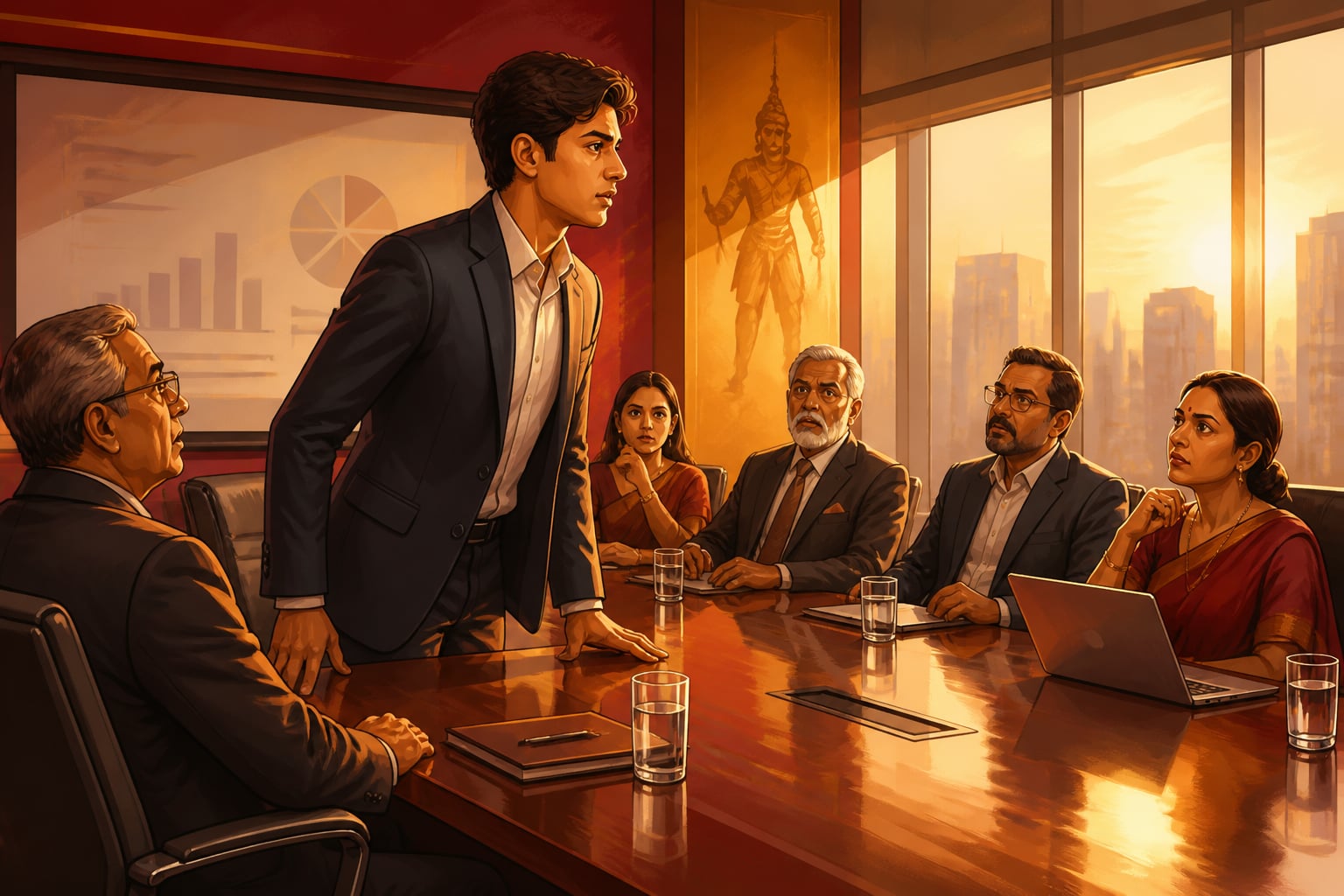
You're in a meeting. Your company is about to launch a product you know has problems, not dangerous, but not what customers expect. Your boss wants your support. Your paycheck depends on this job. Your mortgage depends on that paycheck. Your family depends on you.
Do you speak up and risk everything? Or do you stay silent and become complicit?
This is Bhishma's dilemma, dressed in business casual.

The Modern Challenge
We live in an era of impossible choices. The OpenAI board crisis of November 2023 showed executives torn between loyalty, mission, and financial obligations, all valid claims, all in conflict. Tech workers at major companies face daily decisions about features they consider harmful. Healthcare professionals navigate systems that prioritize metrics over patients. Teachers implement curricula they believe hurt students.
The modern world has made Arjuna's paralysis on the chariot an everyday experience. We are constantly asked to act in situations where every option seems to compromise something we value. And unlike ancient warriors, we can't call for divine intervention.
We're told to "follow our conscience," but what happens when conscience conflicts with commitment? When the promise we made last year now requires us to do something we believe is wrong? When loyalty to our organization means betraying our values?
Bhishma faced exactly this. He sat on the wrong side of a war he knew was unjust, bound by a vow made decades before. The greatest warrior of his age spent his final battle protecting a cause he condemned. His dilemma wasn't ancient, it was eternal.
The Ancient Insight
The Bhishma Parva doesn't offer easy answers. That's what makes it profound.
Bhishma chose his vow over his conscience, and the epic doesn't pretend this was the right choice. He himself called it his shame: "I let the letter of my word defeat its spirit." Yet Krishna didn't condemn him. The Pandavas wept when he fell. He was wrong, but he was also noble.
Arjuna needed divine counseling just to pick up his bow. Even after Krishna's wisdom, he fought with tears in his eyes. Shikhandi carried vengeance across two lifetimes, only to find emptiness when revenge was complete. Duryodhana went to his death still convinced he was right.
The Bhishma Parva teaches that moral perfection is a fantasy. You will face situations where you can't win, only choose which way to lose. The question isn't how to avoid such situations, you can't, but how to navigate them with wisdom, courage, and grace.
The Bridge: Modern Applications
Personal Decision-Making: When facing impossible choices, the Mahabharata suggests asking: "What can I live with?" Bhishma couldn't live with breaking his vow, even though keeping it caused harm. Arjuna couldn't live with abandoning his brothers, even though fighting meant killing teachers. These weren't calculations of outcomes, they were assessments of identity. Sometimes the question isn't "What's right?" but "Who am I, and what would destroy the person I'm trying to be?"
Workplace Ethics: The epic shows that institutional loyalty has limits. Bhishma's tragedy was staying too long, becoming complicit in wrongs he didn't commit but didn't prevent. For modern professionals, this raises a hard question: At what point does loyalty become enabling? The Kauravas' advisors, Bhishma, Drona, Kripa, were all good men serving a bad cause. Their individual integrity couldn't redeem their collective action.
Leadership Under Pressure: Krishna's role as charioteer offers a model: the best leaders don't remove their team's difficult choices, they help them think through consequences. Krishna never told Arjuna "Just follow orders." He explained the stakes, acknowledged the pain, and then let Arjuna decide. Good leaders don't pretend hard choices are easy.
Relationships and Family: The war pitted grandfathers against grandsons, teachers against students, brothers against brothers. Modern families face their own versions, political divides, inheritance disputes, caregiving disagreements. The epic doesn't suggest these conflicts can always be resolved. Sometimes family members end up on opposite sides. The question becomes: How do you fight without becoming what you're fighting against?
Addressing Skepticism
"This is just fatalism": Critics might argue the Mahabharata encourages resignation, "whatever happens was meant to be." But the epic shows characters actively struggling, not passively accepting. Arjuna questioned. Bhishma agonized. The teaching isn't "don't think", it's "think deeply, then act, even knowing you might be wrong."
"Ancient warfare doesn't apply": True, most of us won't fire arrows at our relatives. But the psychological structures are identical. Cognitive dissonance when our roles conflict. Moral injury when we do what we know is harmful. The paralysis of analysis when every option seems wrong. These aren't ancient problems, they're human problems with ancient names.
"There's no practical advice": The Mahabharata isn't a self-help book. It won't give you five steps to ethical clarity. What it offers is more valuable: company in confusion. The knowledge that the greatest heroes faced the same impossible choices, and that proceeding without certainty is itself a form of courage.
Call to Practice
The Bhishma Parva invites us to:
Acknowledge impossible choices instead of pretending they're simple. When all options involve harm, say so, to yourself at minimum, to others when appropriate.
Examine your vows and commitments. What have you promised that might now conflict with your values? Like Bhishma, are you honoring the letter while violating the spirit?
Find your own Bana Ganga. Arjuna created water for the grandfather he had wounded. What healing can you offer even in the midst of necessary conflict?
The war at Kurukshetra ended thousands of years ago. The war within us, between duty and desire, loyalty and truth, vow and virtue, continues every day. Bhishma Parva doesn't tell us how to win. It shows us how to fight with our eyes open.