Pratham Divas: The First Day

Blood flows on day one

The conches fall silent. The first arrow flies. And suddenly, the years of diplomacy, the months of preparation, the lifetimes of rivalry, all collapse into a single truth: men are dying. On Day One of Kurukshetra, the war reveals its terrible nature as grandfathers fight grandsons, teachers fight students, and the sacred ground drinks its first blood.

The Moment of No Return

For a heartbeat after the conches fell silent, no one moved.

Four million warriors stood frozen across the plain of Kurukshetra, each man suddenly aware of what was about to happen. Some had spent years preparing for this moment. Some had trained since childhood for exactly this. But training is not the same as reality, and no amount of preparation can truly ready a man for the moment he must kill someone he knows.
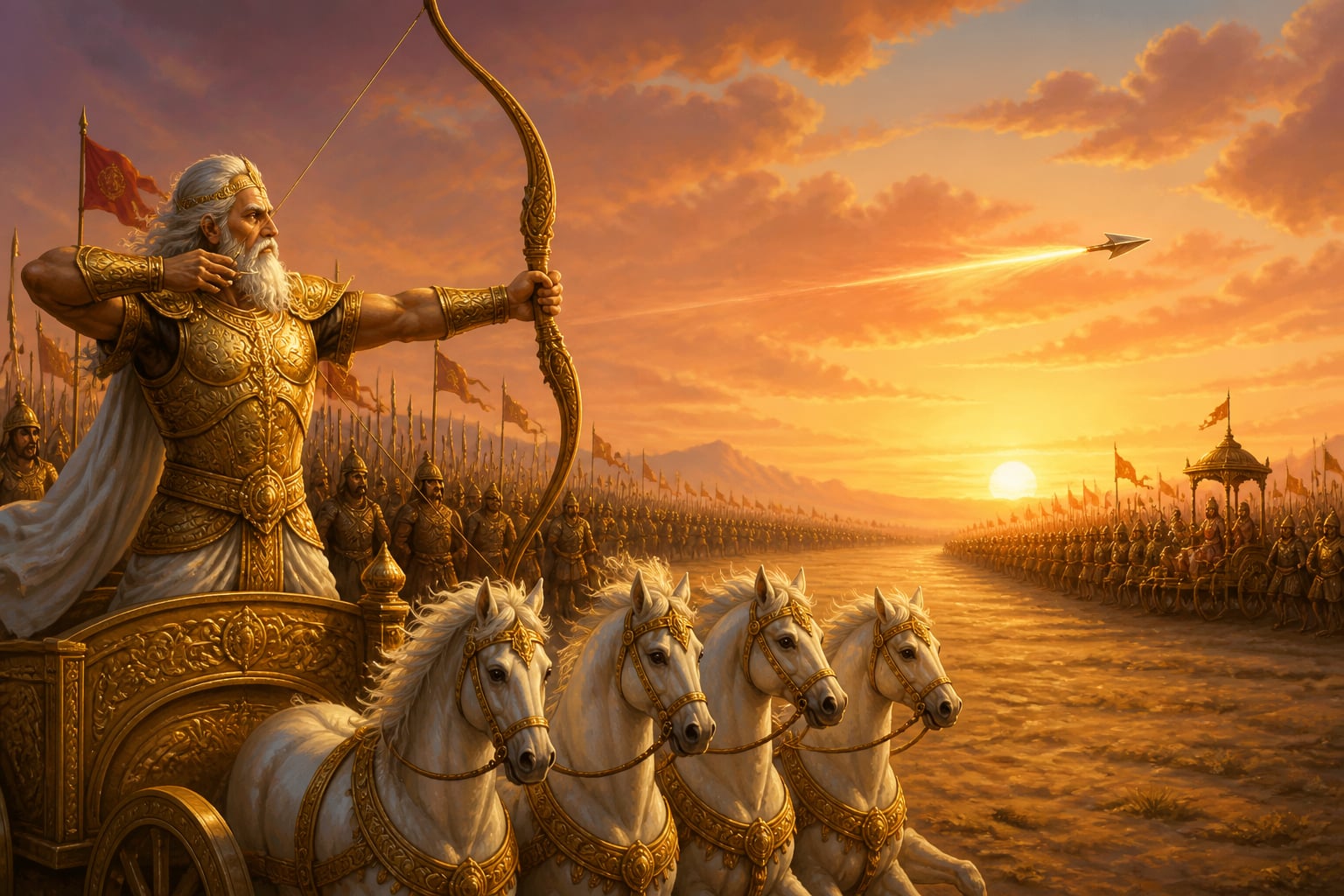
Bhishma loosing the first arrow of the war at dawn

Then Bhishma raised his bow.

The grandsire of both armies, the invincible warrior who had never known defeat, drew his first arrow of the war. It flew like a streak of light across the dawn sky, and somewhere in the Pandava ranks, a soldier fell.

First blood.

The war had begun.

Chaos Unleashed

What followed was not the orderly engagement of tactical plans. It was chaos, controlled chaos, perhaps, but chaos nonetheless.

Elephants charged forward, their massive bodies shaking the earth. Chariots wheeled and clashed, wheels sometimes locking together, forcing warriors into desperate close combat. Infantry surged toward each other in waves, spears and swords flashing. Cavalry swept around the flanks, looking for gaps in the enemy formation.

And above it all, the arrows flew.
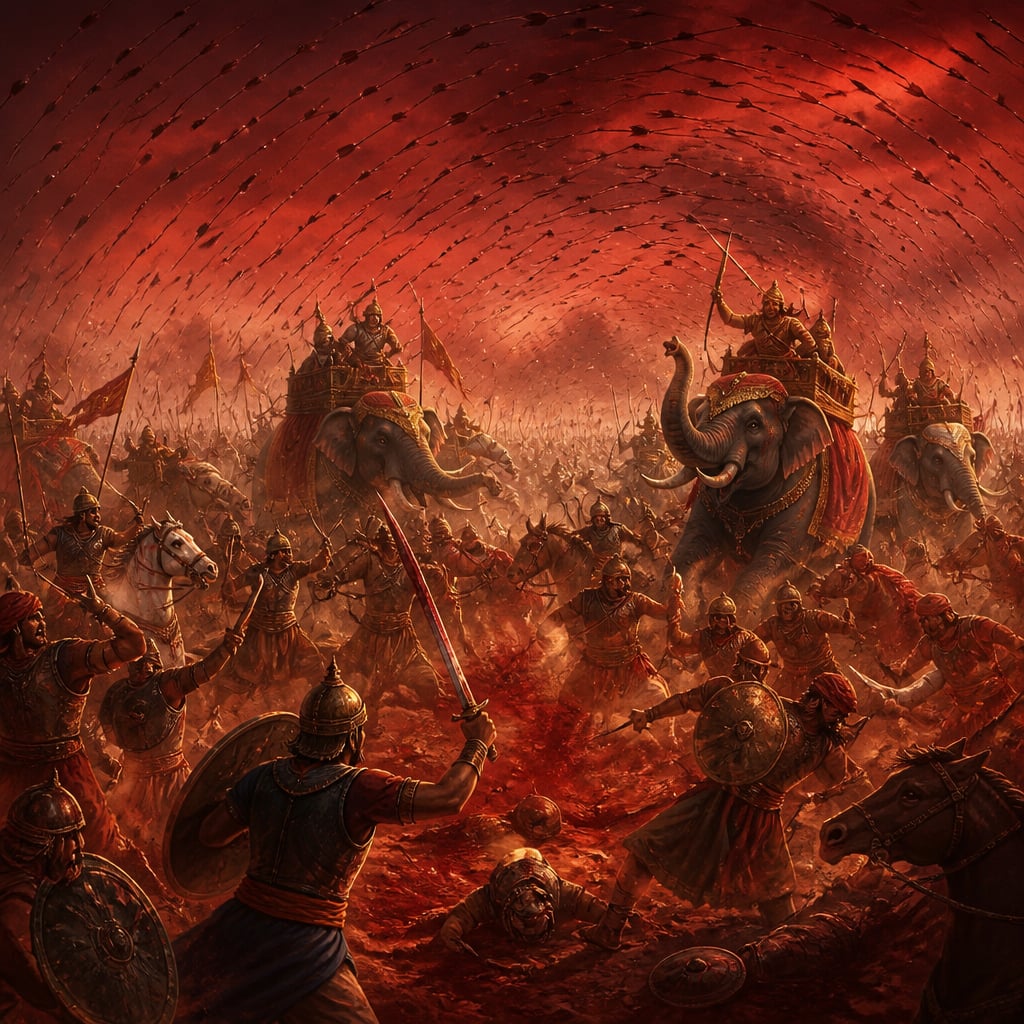
A dark cloud of countless arrows arcs across the Kurukshetra sky above the clashing armies below.

Thousands upon thousands of arrows, darkening the sky like monsoon clouds. The greatest archers could loose twelve shafts before the first one landed. Lesser warriors shot as fast as they could draw, knowing that in battle, quantity often mattered as much as accuracy.

"The sky disappeared," Sanjaya reported to the blind Dhritarashtra. "The sun could not be seen through the density of arrows. Men died before they knew they were struck."

The Rules of War

Before battle began, both sides had agreed to certain rules of dharma yuddha, righteous warfare:

Rule Principle
No fighting after sunset Battle ends at dusk, resumes at dawn
Equal combatants Infantry fights infantry; chariots fight chariots
No attacking the unarmed Warriors who lose weapons may retreat
No striking from behind Face your enemy directly
No attacking non-combatants Doctors, priests, and others are protected
Surrender is honored Those who yield are taken prisoner, not killed
No attacks during single combat When two warriors engage, others stand aside

These rules represented the aspiration of kshatriya dharma, that even war could be conducted with honor, that violence could be bounded by ethics, that men could kill without becoming monsters.

On the first day, the rules held.

They would not hold forever.

Bhishma's Fury

Bhishma fought like a god descended to earth.

The grandsire had not wanted this war. He had counseled against it, warned Duryodhana of its futility, predicted the very devastation now unfolding. But once battle began, his warrior nature emerged with terrifying force.

His bow seemed alive in his hands. Arrow after arrow found its mark, chariots shattered, horses fell, warriors died without even seeing the shaft that killed them. When the Pandava forces pressed close, Bhishma's arrows formed a wall of death that none could penetrate.

"I will kill 10,000 warriors each day," Bhishma had promised Duryodhana. "But I will not kill the five Pandava brothers."

It was a strange bargain: total commitment to the Kaurava cause, combined with a private vow to spare the enemy commanders. Bhishma fought for Hastinapura's throne while secretly hoping Hastinapura would lose.

This was the tortured loyalty of a man trapped by his own nobility.

The First Fallen

As the day progressed, the dead began to accumulate.

Most were anonymous, soldiers from distant kingdoms who had come to fight for one side or another, men whose names would never be recorded, whose families would never know exactly how they fell. They died in their thousands, trampled by elephants, pierced by arrows, cut down by swords in the press of infantry combat.

But some deaths carried weight beyond a single life.

Uttara, son of King Virata, had ridden confidently into battle that morning. He was young, brave, recently married to the Pandava princess Uttarā's namesake, no, he was married to Abhimanyu, Arjuna's son. The confusion of names reflects the confusion of war: Uttara the prince, Uttarā the princess, a kingdom that had sheltered the Pandavas now sending its sons to die for them.

Uttara charged toward Shalya, king of Madra, seeking glory. He found death instead. Shalya's spear ended the young prince's life before the first day was half done.

Shweta, a Pandava ally and skilled warrior, fell to Bhishma himself. His death sent ripples of grief through the Pandava forces, if Bhishma could kill Shweta so easily, who among them was safe?

The Psychology of First Blood

The first day of any war is unlike those that follow. The shock has not yet worn off. The sight of death, real death, not imagined, transforms warriors in unpredictable ways.

Some men froze. The sword in their hand became impossibly heavy. Their training vanished, replaced by the animal instinct to flee.

Some men went mad. Battle rage consumed them, and they fought with a ferocity that terrified even their allies. They killed and killed, unable to stop, unable to see anything but the next enemy.

Some men found a cold clarity. The chaos around them seemed to slow down. They moved through battle as if walking through a dream, striking with precision, conserving energy, surviving.

Arjuna was among the latter. Whatever hesitation he had felt before the war had been answered by Krishna's teaching. Now he fought with focused purpose, not rage, not despair, but the steady application of skill toward an accepted duty.

He had been told the soul cannot be killed. Now he tested that teaching with every arrow.

Duels Amid the Chaos

Within the larger battle, individual duels emerged, single combats between warriors of renown, watched by thousands even as the broader carnage continued.

Bhishma vs. Arjuna: Grandfather faced grandson across the battlefield. Their arrows crossed in mid-air, deflecting each other's shots. Neither pressed to kill, Bhishma because of his private vow, Arjuna because some part of him still could not fully commit to killing the man who had raised him.

Bhima vs. Duryodhana's brothers: Bhima's rage, nursed for thirteen years, found its first outlets. He did not seek Duryodhana himself, that would come later. Instead, he cut through the younger Kaurava princes like a reaper through wheat, each death a payment on a very old debt.

Sixteen-year-old Abhimanyu's brilliant battlefield debut

Abhimanyu's debut: Arjuna's young son fought his first battle with a brilliance that astonished both armies. At sixteen, he displayed skills that veterans had spent decades acquiring. Bhishma himself paused to watch the boy, seeing in him the echo of Arjuna at that age, and perhaps wondering if this was the one who would eventually bring him down.

Evening Falls

As the sun touched the western horizon, conches sounded again, this time calling the warriors to cease.

The rules held. Fighting stopped. Men who moments before had been trying to kill each other now withdrew to their respective camps, sometimes helping wounded enemies to safety, bound by the strange honor of dharma yuddha.

The field they left behind was transformed. Kurukshetra's sacred earth was soaked with blood. Bodies lay everywhere, men, horses, elephants, the mathematics of war made viscerally real. The evening breeze carried the smell of death, and the sounds that replaced battle were perhaps worse: the groaning of the wounded, the weeping of those who had lost friends, the silence of those too shocked to speak.

The Night Between

In the Pandava camp, the mood was mixed. They had survived the first day. Bhishma had not broken their forces. Arjuna had fought effectively. But they had also lost warriors they could not afford to lose, and the grandfather's daily harvest had begun.

Yudhishthira sat in troubled silence. The war he had tried so hard to avoid was now reality. Every death, on both sides, weighed on his conscience. He was king of the Pandavas, which meant the responsibility for this war was his.

"How many died today?" he asked.

No one could answer with precision. Thousands, certainly. Perhaps tens of thousands. The accounting of war is always approximate.

In the Kaurava camp, Duryodhana was satisfied. Bhishma had performed as promised. The Pandava forces had been bloodied. Surely a few more days like this, and the war would be decided.

He did not yet understand that his grandfather was fighting not to win but to survive, surviving until something changed, until the war resolved itself, until he could find an honorable death that freed him from his impossible position.

The Precedent Set

The first day established patterns that would repeat throughout the war:

But the first day also revealed something unexpected: despite Bhishma's prowess, despite the Kauravas' numerical advantage, the Pandavas had held. They had not broken. They had not fled.

Krishna observed this with quiet satisfaction. The war would be long and costly, but the Pandavas could endure. Their cause was just, their warriors skilled, their resolve firm.

Seventeen more days remained. Seventeen more dawns when the conches would sound and men would march out to kill and die on the field of dharma.

As darkness fell on Kurukshetra, the first day ended. The war had truly begun. And nothing would ever be the same.

Living traditions

The first day of Kurukshetra has become a metaphor in Indian corporate culture for 'market launch' moments, when months of preparation meet reality. Business schools use the phrase 'pratham divas' to describe initial market entry. Military academies study the opening of Kurukshetra for lessons about how plans survive contact with the enemy. The phrase 'after the first arrow' appears in Hindi business literature to mean the point of no return.

Reflection

More in Bhishma Parva

All lessons in Bhishma Parva · The Mahabharata course