Kurukshetra: The Field of Dharma

Two armies face at Kurukshetra

On the sacred plain of Kurukshetra, eighteen armies gather for the most catastrophic war in human memory. As conches sound and warriors take their positions, the weight of destiny settles upon a field where dharma itself will be tested, and where nearly four million men will die in eighteen days.

The Sacred Field

They called it Kurukshetra, the field of the Kurus, but its older name was Dharmakshetra, the field of dharma. For countless generations, sages had performed sacrifices here. The soil was sanctified by the austerities of King Kuru himself, who had plowed this land with a golden plowshare, watering it with his own sweat until Lord Indra appeared and granted it a boon: whoever died on this field fighting righteously would attain heaven.

Now that ancient promise would be tested on a scale unimaginable to those holy men of old.
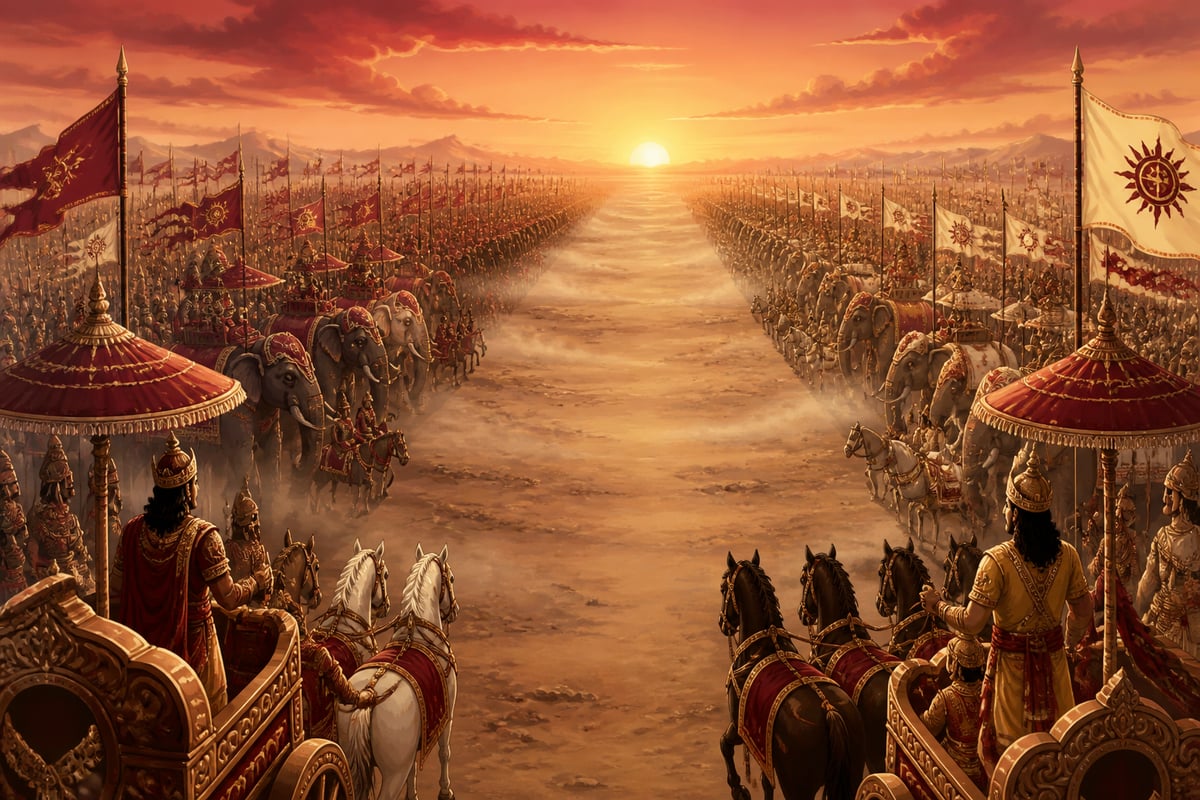
Two armies facing across the plain of Kurukshetra at dawn

As the first light of dawn crept across the plain, two armies faced each other across a distance of less than a yojana. The morning mist rose from the earth like the breath of the land itself, as if Bhumi Devi was sighing at what her children were about to do to one another.

"Here, on this very ground, my ancestors performed a thousand sacrifices," Duryodhana had declared when choosing the battlefield. "Here, we shall sacrifice the Pandavas."

He did not know, or did not care, that sacrifices can be refused by the gods, and that the sacrificer sometimes becomes the offering.

The Armies Array

The numbers were staggering. Eleven akshauhinis on the Kaurava side. Seven akshauhinis for the Pandavas. Each akshauhini contained:

Unit Count per Akshauhini
War elephants 21,870
Chariots 21,870
Cavalry 65,610
Infantry 109,350
Total warriors 218,700

Multiply by eighteen. Nearly four million warriors stood ready to kill or die on that autumn morning. The earth trembled under the weight of their armies. The sky darkened with their banners. The air itself seemed to thicken with the collective breath of men facing their mortality.

Bhishma, the grandsire of both armies, took his position at the head of the Kaurava forces. His white hair and beard gleamed like silver fire, and his eyes, those ancient eyes that had seen five generations of Kuru princes, held a sorrow deeper than the ocean.

He would lead an army against the grandsons he loved. He would fight to kill children he had bounced on his knee.

This was not his choice. He had warned Duryodhana a hundred times. He had counseled peace, begged for compromise, predicted this very catastrophe. But his vow, that terrible vow made lifetimes ago to serve the throne of Hastinapura regardless of who sat upon it, bound him like chains forged by the gods themselves.

The Weight of Vows

Across the field, the Pandava army arranged itself in response. Dhrishtadyumna, son of Drupada, served as their commander, a man born from sacrificial fire for the sole purpose of killing Drona. Destiny had shaped him into a weapon; now he would fulfill his purpose.

But the true weight of the Pandava cause rested on five brothers who had spent thirteen years in exile for a kingdom they never wanted to fight for:

And everywhere, on both sides, warriors looked across the field and saw faces they knew. Cousins. Teachers. Friends. The men they were about to kill had attended their weddings, celebrated their children's births, shared meals at their tables.

"This is the tragedy of Kurukshetra," the sage Vyasa would later write. "Not that strangers killed strangers, but that brothers killed brothers, and called it dharma."

The Commanders and Their Chains

Every great warrior on the Kaurava side fought not for conviction but for obligation:

Bhishma fought because of his vow to the throne, not to Duryodhana, but to the seat of power itself. He had told Duryodhana plainly: "I will not kill the Pandavas. I will fight for you, but I will not destroy them." What kind of commander enters battle having already limited his own effectiveness?

Drona fought because Hastinapura had given him everything, position, wealth, the chance to teach the greatest warriors of the age. His loyalty was to the institution, not to the cause. When he looked at Arjuna across the battlefield, he saw his finest student, the warrior he had shaped with his own hands. How do you kill your masterpiece?

Karna alone fought from the heart. His loyalty to Duryodhana was absolute, the one man who had seen his worth when everyone else saw only a charioteer's son. But Karna carried secrets that burned like poison: he knew now that he was Kunti's firstborn, that the Pandavas were his brothers. He would fight them anyway, because a promise made in ignorance is still a promise.

Kripa and Ashwatthama fought because their patriarch did. Shalya fought because he had been tricked into a promise. Shakuni fought because he had engineered this entire war and wanted to see his revenge completed.

Not one of them believed Duryodhana was right. They fought anyway.

The Pandava Dilemma

The Pandava side had its own chains, though of a different kind.

Yudhishthira did not want this war. Even now, standing at the threshold of carnage, part of him wished he could simply walk away, return to the forest, live in peace, let Duryodhana have the kingdom that had brought nothing but suffering.

But Krishna had been clear: "This is not about a kingdom. This is about whether adharma can triumph over dharma. If you walk away, you tell the world that cheaters prosper, that the honest are fools, that power belongs to whoever is willing to be most ruthless."

The Pandavas fought not for Indraprastha or Hastinapura. They fought for a principle, that there must be consequences for evil, that justice cannot simply be abandoned when it becomes inconvenient.

But principles don't bleed. Men do.

The Morning of Doom

As the sun rose higher, burning away the last of the mist, the rituals began. Both armies performed their morning prayers. Priests chanted mantras for victory, the same mantras, to the same gods, asking for opposite outcomes.

Conches sounded across the field:

The Pandava warriors raising their great conches

From the Kaurava side, Bhishma's conch answered, and then a hundred others, until the sound became a wall of noise that seemed to crack the sky itself.

Horses stamped. Elephants trumpeted. Warriors roared their battle cries. The accumulated tension of thirteen years, of lifetimes of rivalry, of cosmic forces beyond human understanding, all of it pressed down upon Kurukshetra like the weight of heaven itself.

The Pause Before the Storm

And then, in the moment before chaos, there was silence.

Arjuna asked Krishna to drive their chariot between the two armies. He wanted to see the men he was about to fight. He wanted to look into the faces of those who would die by his arrows.

What he saw broke him.

Teachers who had shaped him. Uncles who had blessed him. Cousins he had played with as a child. The grandfather who had taught him to hold his first bow. They stood arrayed against him, weapons ready, waiting for him to kill them or be killed.

"I see my own kinsmen, Krishna," Arjuna whispered, his voice cracking. "Arrayed for battle, eager to fight. My limbs give way. My mouth dries. My bow slips from my hand."

The greatest archer the world had ever known, the man who could shoot the eye of a fish by looking at its reflection, could not bring himself to raise his weapon.

This was not cowardice. This was the soul recognizing the horror of what was about to happen.

Arjuna slumps on his chariot between the armies as Gandiva slips from his hand and Krishna holds the reins.

In that moment of crisis, Krishna spoke to Arjuna, words of such profound wisdom that they would echo through the ages as the Bhagavad Gita, the Song of God. He spoke of duty and dharma, of the eternal soul and the temporary body, of action without attachment and surrender to the divine.

When Krishna finished, Arjuna raised his bow.

The war began.

The Parva of Bhishma

The Bhishma Parva covers the first ten days of the great war, the days when Bhishma commanded the Kaurava forces. These were the bloodiest days, the days when the rules of dharmic warfare still held (however tenuously), the days before the conflict descended into the moral chaos that would follow.

In this parva, we witness:

Kurukshetra had begun its harvest. For eighteen days, it would drink blood like water.

And the field of dharma would test whether dharma could survive the war fought in its name.

Living traditions

Kurukshetra has become a metaphor in Indian discourse for any decisive confrontation between right and wrong. Politicians invoke it when describing ideological battles; business leaders reference it when discussing market competition. The phrase 'Kurukshetra of democracy' appears in Indian electoral coverage. The site itself hosts Kurukshetra University (established 1956), which houses the Sanskrit Department and Gita Research Institute, ensuring academic study of the epic continues alongside religious pilgrimage.

Reflection

More in Bhishma Parva

All lessons in Bhishma Parva · The Mahabharata course