Śīghra-Paridhi: The Epicycle of Conjunction
The correction that explained retrograde motion, and quietly hid the Sun at the centre
Why do planets sometimes stop and slide backward against the stars? The second correction, the śīghra, answers it, and hidden inside its numbers is one of the most astonishing facts in Indian astronomy: the true relative sizes of the planets' orbits around the Sun, buried in a system that placed the Earth at the centre.
The Night Mars Went Backward
Picture an astronomer of the classical age at his rooftop station, tracking Mars against the stars, night after night, with a marked cord and a steady eye. For weeks the red planet has crept eastward through the constellations, as it should. Then something unsettling happens. Mars slows. It stops. And then, for weeks, it moves the wrong way, sliding westward, backward, against the fixed stars, before halting once more and resuming its forward march, having traced a slow loop in the sky.
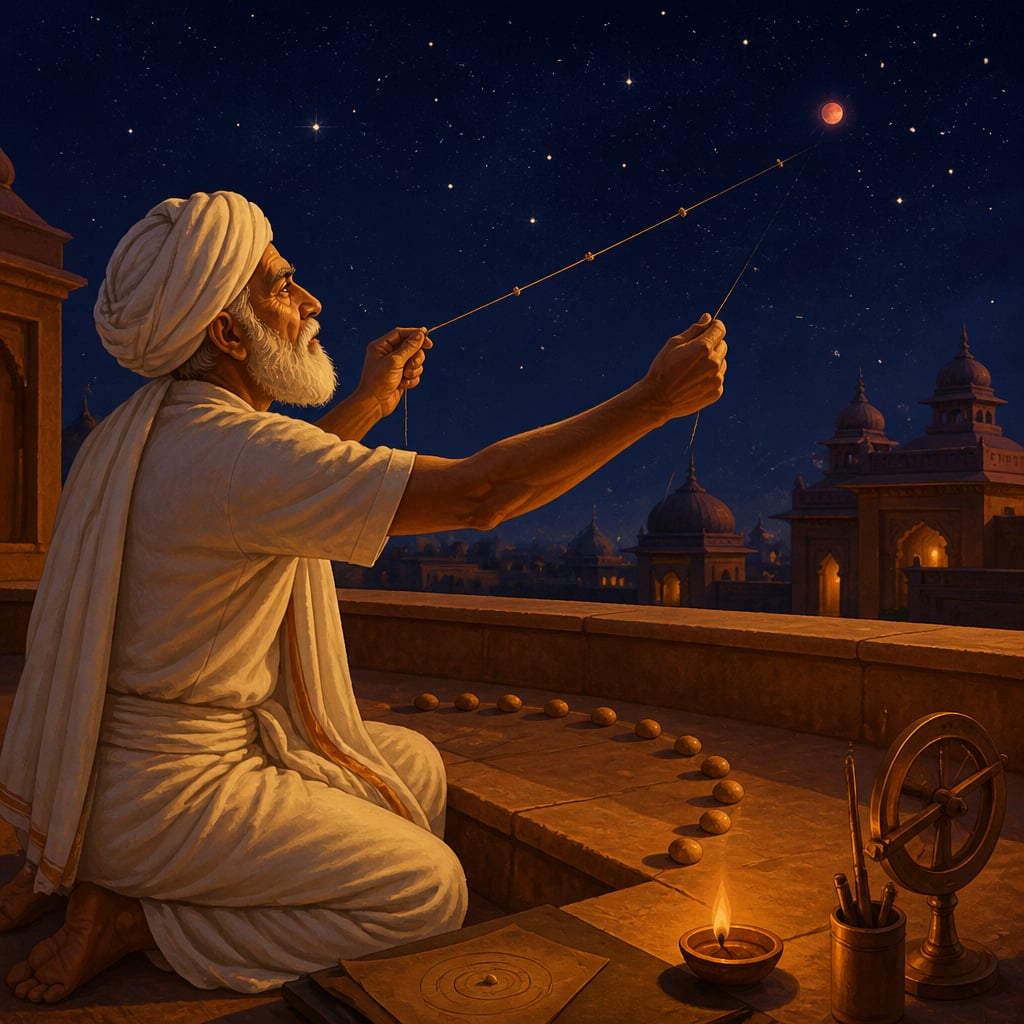
To an unschooled eye this is an omen, a planet breaking its own law. To the astronomer it is a problem to be solved. No planet truly reverses; whatever is happening, it must be accounted for by calculation, not by dread. The device that tamed this eerie backward motion is the subject of this lesson: the second great correction, the śīghra, and its little circle, the śīghra-paridhi, the epicycle of conjunction. And inside that device, as we will see, the Indian astronomers were unknowingly carrying a picture of the Sun at the centre of everything.
Not the Planet, but Our Viewpoint
The first correction, the manda, dealt with a planet's own uneven speed. The śīghra deals with something entirely different: the fact that we watch the planets from a moving platform, the Earth, and that all of the planets are bound in their motion to the Sun.
When a faster body on an inner track passes a slower body on an outer track, the outer one seems, for a while, to drift backward, just as a slower train appears to slide back when your faster train overtakes it. That apparent backward drift is the retrograde, or vakra, motion. It is not the planet reversing; it is the changing line of sight between two moving bodies. The śīghra epicycle is the device that captures exactly this changing geometry between the Earth, the Sun, and the planet, and it produces the backward loop precisely when the alignment calls for it.