Graha: What 'Planet' Means in Indian Astronomy
The seven seizers, the nine grahas, and a category drawn by motion, not matter
Understand what a graha really is. Not the modern 'planet' but a 'seizer', any body that moves against the fixed stars. This is why the list counts the Sun and Moon, leaves out the Earth, and adds two invisible points, Rāhu and Ketu.
The Boy Who Dated His Own Book
In the city of Kusumapura, on the Ganga near modern Patna, a young man set down a line of verse that quietly stamped his book with a date. His name was Āryabhaṭa. In that verse he mentions, almost in passing, that when three quarters of the great age and sixty times sixty years more had gone by, he himself was twenty-three years old. That works out to 499 CE, the year usually given for the book, though the verse dates his age, not the writing itself. It is a rare thing: an author telling us his age inside a book of astronomy.
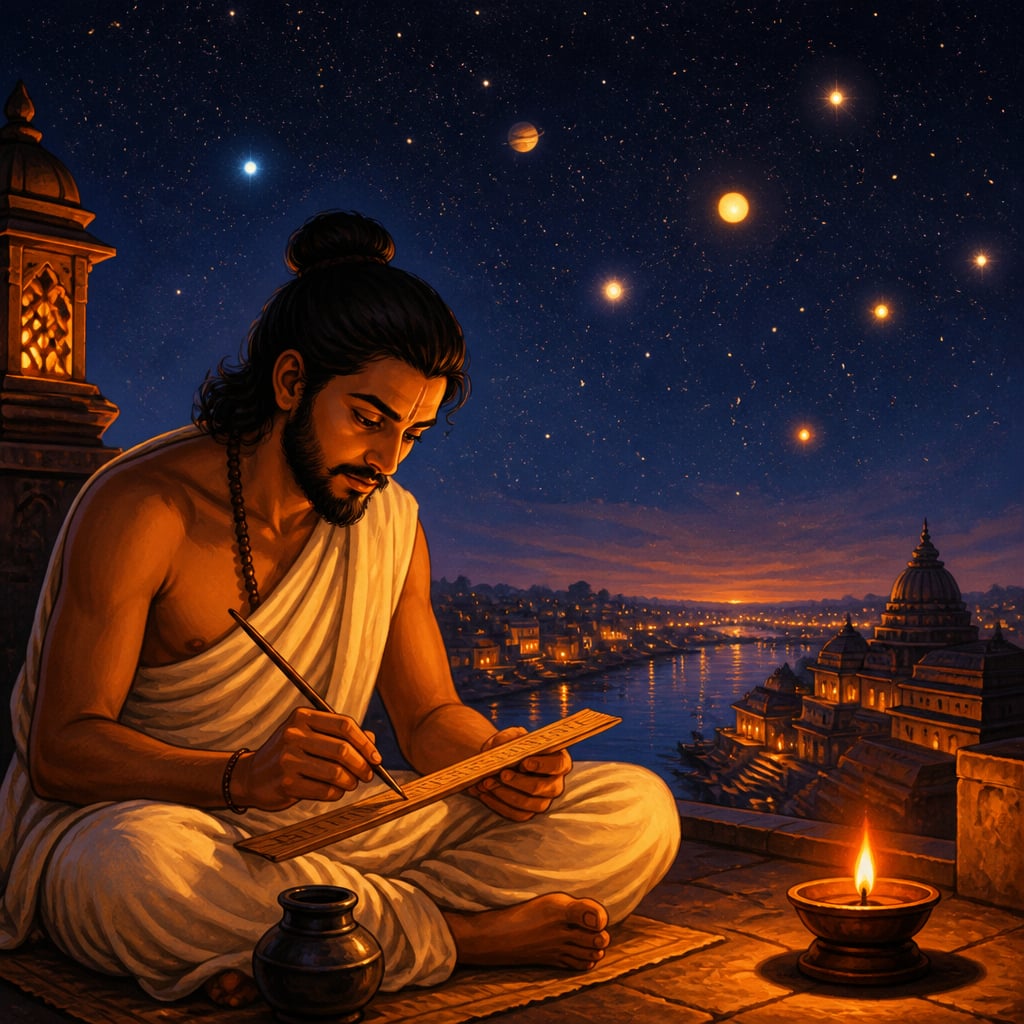
Around him lay the tools of his trade. Narrow strips of dried palm leaf, a reed pen, a pot of ink made from soot. Above him turned the thing he had given his life to measuring: a sky holding thousands of fixed stars and only a small handful of lights that refused to stay put. Before he could compute where those wandering lights would go, he had to settle a more basic question, the question this whole chapter turns on. Which bodies count as a graha, and in what order do they sit?
His answer would put the Sun and the Moon on the list. It would leave the Earth off it. And it would include two bodies that no one has ever seen.
What a Graha Actually Is
Start with the word, because the word is the whole idea. Graha does not mean "planet." It comes from the root grah, "to grasp, to seize, to take hold." A graha is a seizer. The name most likely began with Rāhu, who seizes the Sun and Moon at an eclipse, and spread to all the moving bodies that haul themselves across the fixed backdrop of stars.
That test draws the line in a completely different place from the English word "planet." To the Indian astronomer, what mattered was not what a body was made of, nor whether it circled the Sun. What mattered was one thing only: does it move against the stars? By that test the Sun moves, so the Sun is a graha. The Moon moves, so the Moon is a graha. The Earth under your feet does not appear to move against anything, so the Earth is not a graha at all. It is the still floor from which the seizing is watched.