Madhyama-Gati: Mean Motion and Orbital Periods
How a whole number of revolutions turned wandering lights into calculable clocks
Learn how Indian astronomers tamed the planets with a single idea: mean motion. By counting the exact number of revolutions each graha makes in a vast age of 4,320,000 years, Āryabhaṭa turned each wanderer into a steady clock whose position could be computed for any date.
The Apprentice and the Impossible Question
Imagine a young apprentice in the calculating school at Ujjain, a made-up figure but doing a wholly real job. His teacher has set him a task that sounds impossible. A patron's grandson will be born some years from now, and the family wishes to know where Jupiter will stand among the stars on that future day. The apprentice cannot watch Jupiter for the years in between. He has only a strip of palm leaf, a board dusted for figures, and a handful of numbers copied from his teacher's manual.
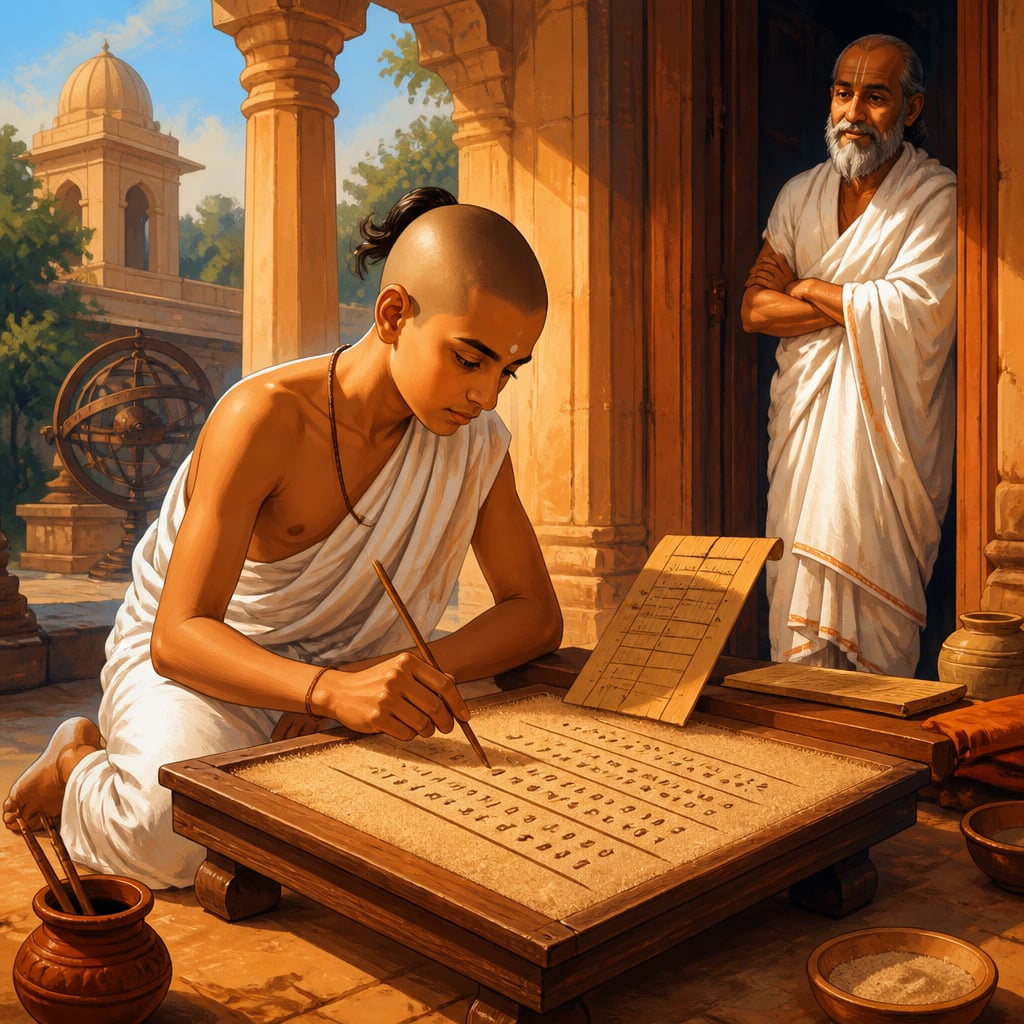
He is not troubled, because he knows the trick. He will not track Jupiter at all. He will instead reach for a single number so large it looks absurd for so small a task: the count of how many times Jupiter circles the entire sky in an age of 4,320,000 years. From that one number, and a little arithmetic, he can place the planet on any day he likes, past or future, without ever looking up. This lesson is about that number and the beautiful idea behind it.
The Idea of a Mean Motion
A real planet is a frustrating thing to predict. Watch Mars carefully and it does not keep a steady pace. It hurries, it dawdles, and now and then it even stops and slides backward against the stars. If you tried to build a clock out of its true, moment-to-moment speed, you would go mad.
So the Indian astronomers did something clever. They split the problem into two layers. Underneath the planet's messy, changing speed, they said, lies a perfectly steady average speed, as if the planet rode a smooth, uniform clock. They called this steady underlying rate the madhyama-gati, the mean motion. The planet's real, observed place, the spaṣṭa or true position, is then found by starting from the smooth mean and applying corrections, which is the work of the next several lessons.