Āryabhaṭa-Darśana: Āryabhaṭa's Rotating Earth
The claim that the sky only seems to turn, argued with a boat on a river
Around 499 CE, Āryabhaṭa made one of the boldest claims in the history of science: that the Earth spins on its own axis, and the nightly wheeling of the stars is only the reflection of our own turning. Learn his argument, the famous boat analogy, why the tradition largely rejected it, and how it was finally proved.
The Boat on the Ganga
Go out on the Ganga in a boat, moving smoothly downstream. Look at the bank. The trees, the ghats, the fixed things of the shore appear to glide past you, upstream, in the opposite direction. You know perfectly well the bank is not moving. It is you who move; the shore only seems to.
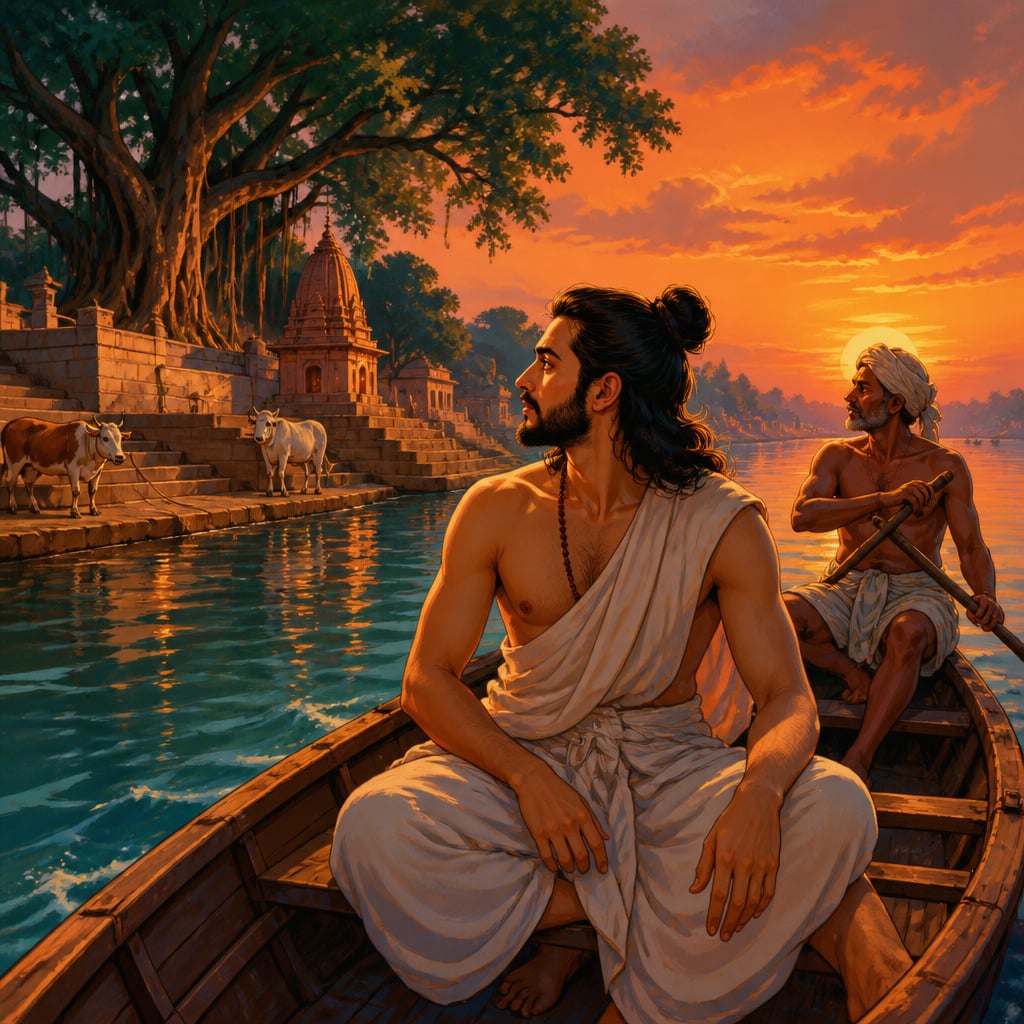
More than fifteen hundred years ago, a young astronomer at Kusumapura took that everyday experience and did something breathtaking with it. He turned it on the whole sky. Every night the stars wheel from east to west overhead, the most obvious motion in all of nature, so obvious that almost no one thought to question it. Āryabhaṭa questioned it. What if, he asked, the stars are the still bank, and it is the Earth beneath our feet that is turning? What if the grandest motion in the heavens is an illusion, the same illusion as the drifting shore, produced because we ride a spinning world?
This lesson is about that claim, one of the boldest and most rigorously argued ideas in the early history of science, and about the honest fact that Āryabhaṭa's own tradition, for the most part, told him he was wrong.
The Argument in One Verse
Āryabhaṭa compressed his reasoning into a single, luminous comparison.
अनुलोमगतिर्नौस्थः पश्यत्यचलं विलोमगं यद्वत्। अचलानि भानि तद्वत्समपश्चिमगानि लङ्कायाम्॥
anulomagatir nausthaḥ paśyaty acalaṃ vilomagaṃ yadvat acalāni bhāni tadvat samapaścimagāni laṅkāyām
Just as a man in a boat moving forward sees the unmoving things on the bank as moving backward, so a person at the equator sees the fixed stars as moving exactly westward.
Āryabhaṭīya, Golapāda 9
Everything is here. The observer is at Laṅkā, the tradition's name for the point on the equator taken as the reference; there the stars sweep due west. Āryabhaṭa says: they only seem to. The stars are acala, unmoving. The westward sweep is the boat-and-bank illusion, cast across the entire sky by the eastward rotation of the Earth. It is a complete argument from relative motion, and it is correct.