Talapatram

Thirteen Days, Thirteen Tasks

What each day means, and what it does.

The day-by-day decode of the rites everyone has sat through and no one explains: in the text’s model the daily pindas build the departed’s new body piece by piece, while in plain sight the same structure hands the mourner a task, a timeline, and a household full of people. Day thirteen gives acute mourning a formal end, because open-ended grief is the kind that breaks people.

The House on the First Evening
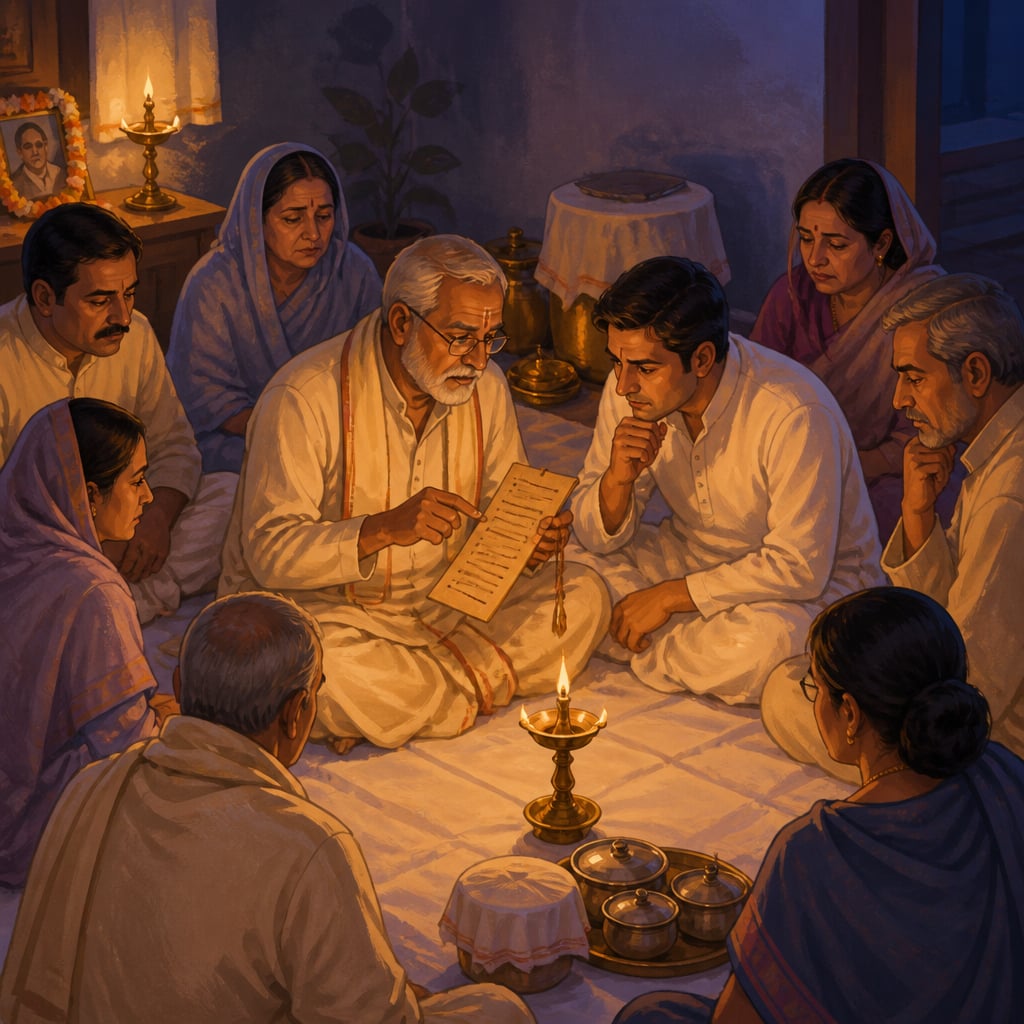
The priest reads the thirteen days' tasks to the house

Picture the house on the evening after a cremation. The lamps are low. Mattresses are on the floor, because the family will sleep there, not on beds, for days. The kitchen fire in many homes stays cold; food arrives from neighbours and relatives instead. A single flame burns in a corner for the one who has gone. The household has visibly shifted into another mode of living, as if the whole house had changed gears.

If you have ever sat in that house, you know its strange texture: sorrow, yes, but also schedule. Somebody always knows what happens tomorrow. There is a list, kept by an elder or a priest, and the list is old. This lesson reads the list.

The thirteen days after death are the most precisely choreographed stretch in all of Hindu ritual life. The Garuda Purana is the text of these days; its recitation in the mourning house is where most Indians have heard its name. Yet almost no one who sits through the fortnight is ever told what the structure means, on either of its two levels. It has two.

The Build: Ten Days, Ten Offerings

Here is the text's own account, the first level, told with the conviction the tradition brings to it.

The traveler of Chapter 3 has departed, but in the text's model the subtle body that must walk the year-long road does not exist yet at full strength. It must be built, and the building material is the family's offerings. Each day for ten days, the family offers a pinda, the rice-ball we met on the road. Each day's offering, the text says, constructs another part of the traveler's new frame: day by day, limb by limb, until by the tenth day the body for the journey stands complete. The sequence of these ten offerings is called the dashagatra: literally, the ten limbs.

This is why the days cannot be skipped or hurried, in the tradition's accounting: an interrupted build leaves the traveler unprovisioned for the road. The Purana states its own purpose in exactly these terms:

एवं ते कथितस्तार्क्ष्य जीवितस्य विनिर्णयः । मानुषाणां हितार्थाय प्रेतत्वविनिवृत्तये ॥

evaṃ te kathitas tārkṣya jīvitasya vinirṇayaḥ mānuṣāṇāṃ hitārthāya pretatva-vinivṛttaye

Thus, O Garuda, I have taught the full account of life's course: for the benefit of humankind, and for release from the state of the preta.

Garuda Purana, Preta Khanda 12.1

Mark the stated mission: pretatva-vinivritti, release from the in-between state. The entire ritual fortnight is engineering toward one goal: that the departed should not remain a wanderer, but be built, provisioned, and moved onward. The rites are for the dead. The tradition says so plainly, and means it.

The Same Days, Seen From the Kitchen

Now stand in the same house and watch the same days on their second level, the one visible to any observer, and decoded by almost none.

Rice cooked at dawn for the day's offering

The mourner has a task, every single day. Cook the rice. Shape the pinda. Carry it to the water. Offer it by name. The bereaved person, whose mind can hold nothing, is handed one small physical act each morning, and the act is for the person they lost. Grief is converted, daily, from a state into a job. The family is not mourning idly; it is working, and the work is love with a deadline.

The household is never empty. The rules of ashaucha, the mourning-period observances that set the family apart, drop every social obligation: no festivals, no visits paid, no work outside for the core mourners in the traditional pattern. The world is told, formally, to expect nothing from this family. And the same rules summon the community inward: relatives arrive and stay, neighbours send every meal. Step back and name that design in modern words: institutionalized bereavement leave, with catering, centuries before any labour law imagined the concept. And the observances mark the mourners, as the shaved head marked the karta, so that everyone they meet knows to be gentle.

The thirteenth day: the garlanded door and the relit kitchen

And the mourning has an end date. On the thirteenth day comes the shanti ceremony: the house is cleansed, the kitchen fire is relit, a feast is cooked, and the family formally re-enters the world, dressed in fresh clothes, often marking the heir's succession. Acute mourning is thereby given something modern loss almost never receives: a formal conclusion, fixed in advance, witnessed by everyone. Grief does not end on day thirteen, and the tradition knows it; the monthly rites of the road continue for a year. What ends is the acute phase, the floor-sleeping, world-stopped phase, and it ends by design rather than by exhaustion. Grief professionals converge on the same finding from the bedside direction: it is not intense grief that breaks people, but open-ended grief, mourning with no shape and no schedule. The fortnight's architecture answers precisely that: a task for every day, a build with a completion, and a door, marked in advance, through which the family walks back into life together.

Hold both levels at once, because the lesson is their coexistence. The tradition says the pindas build the traveler's body, and says it with full conviction. The same ten days, observably, rebuild the family, task by task, meal by meal, toward a marked door. The text never chose between serving the dead and serving the living. It wrote one choreography that carries both, and it is not obvious that any modern institution has designed anything better for a household in shock.

One day in the sequence remains unexplained: the day the departed formally stops being a preta at all, and takes a seat among the ancestors. That day, the quiet hinge of the whole system, and the crow that everyone waits for, is the next lesson.

Case studies

One Day at a Time

Alcoholics Anonymous, founded in 1935, faced the same species of problem as the mourning house: people in a state where willpower and long-horizon planning have collapsed. Its solution was structural: never ask for forever, ask for one day; give every day its meeting; give every member a sponsor who has walked the road; mark progress in fixed, celebrated milestones of thirty days, ninety days, a year, each with its physical token.

AA rebuilt the fortnight's architecture for a different collapse: the impossible total task broken into daily units a shattered executive function can perform, community structurally guaranteed rather than hoped for, and thresholds marked in public ceremony. The mourning house and the church basement run on the same discovery: structure is what carries people through what resolve cannot.

The model spread to a claimed membership in the millions across most countries of the world, and its structural core, daily units, guaranteed community, marked milestones, became the template for recovery programmes of every kind.

When the mind cannot hold the whole road, give it today's task and a room full of people. The oldest mourning manuals and the newest recovery science agree on the prescription.

AA reports over 120,000 groups worldwide; its 24-hour unit of commitment has been retained by essentially every recovery programme modeled on it since 1935.

208 Seconds Over the Hudson

In January 2009, US Airways Flight 1549 struck a flock of geese after takeoff from New York and lost both engines at low altitude. Captain Chesley Sullenberger and First Officer Jeffrey Skiles had about 208 seconds. What filled those seconds was not improvisation but structure: the engine-loss checklist begun instantly, roles split without discussion, the trained water-landing procedure flown as rehearsed. The aircraft ditched intact on the Hudson river; all 155 aboard survived.

The cockpit in those seconds was the mourning house at compressed scale: human minds in overwhelming shock, carried not by composure summoned on the spot but by a script written long before, in calm, by people who knew shock was coming. The fortnight's designers and aviation's designers reached the identical conclusion: prescribe everything, so that the worst hour requires no decisions, only execution.

The ditching became aviation's textbook case for procedure and crew coordination under total surprise; investigation confirmed the crew's adherence to trained structure as central to the outcome.

Composure in catastrophe is not a personality trait. It is the visible surface of a script prepared in advance, which is exactly what the tradition hands a family on the first evening.

Flight 1549 lost both engines at roughly 2,800 feet and was in the water about three and a half minutes after takeoff; all 155 occupants survived.

Living traditions

The thirteen-day structure remains widely observed across India and its diaspora, compressed where city life demands but rarely abandoned: even families who keep almost no other ritual calendar still keep the terahvin, the thirteenth-day gathering. Employers across India informally recognise the fortnight in ways no statute requires, and the instinct that a bereaved household should not cook its own meals survives intact in apartment complexes and villages alike: neighbours still send food, unasked, exactly as the ashaucha design intends.

Reflection

  • Recall the mourning house you have sat in, or the hardest fortnight your own family has passed through. What carried people: their strength, or the structure around them? Who built that structure?
  • Which hardship in your life ran open-ended, with no marked door, and what did the lack of an end date do to you? Where could you fix a shanti date now?
  • The ashaucha rules formally suspend the world's claims on a grieving family. When loss last touched your circle, did the world around them actually pause its expectations, or did it demand normal performance within the week?

More in Why Do We Do All Those Rituals?

All lessons in Why Do We Do All Those Rituals? · Garuda Purana ebook course