Talapatram

The Day a Ghost Becomes an Ancestor

Sapindikarana: death has a completion.

Sapindikarana, the rite where the departed formally stops being a preta and joins the pitrs, seated with the grandfathers, with the crow of kakasparsha decoded. The most consoling idea in the text: death has a completion, and the family performs it.

Waiting for the Crow
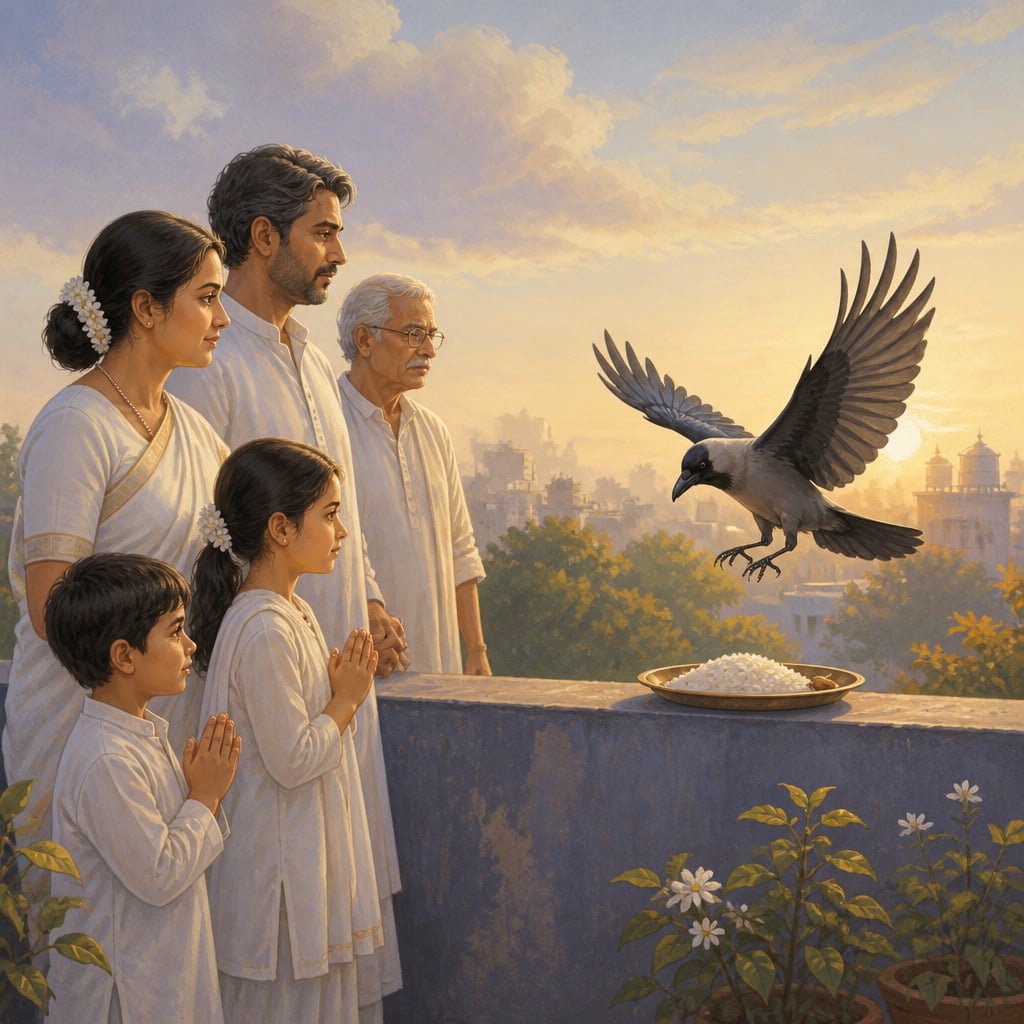
The family waits for the crow on the terrace

A family stands on a terrace in the morning light. On a leaf before them: rice, shaped by their own hands. Nobody speaks much. Everyone is watching the sky.

They are waiting for a crow.

If you have attended the rites after a Hindu death, you have probably stood in this scene, because it plays out across every region of India: the offering set out, the family watching, and the visible relief when a crow finally alights and touches the food. If the crows refuse, the family grows uneasy; elders murmur about what the departed might still want; promises are sometimes spoken aloud to the sky. Then a crow descends, the food is touched, and something in the family visibly settles.

Almost nobody standing on that terrace can tell you why the crow. This lesson can. The crow, called in the rite kakasparsha, the crow's touch, is the tradition's appointed messenger between the world of the living and the world of the pitrs, the ancestors. The crow's acceptance signals the ancestors' acceptance: the offering has reached, the departed is being received. The family's relief is not superstition misfiring. It is the correct reading of a signal the rite deliberately built: a visible yes from an invisible world.

But the crow is only the messenger of a much larger event, the one this lesson decodes: the day the departed stops being a ghost at all.

The Rite of Joining

Recall where Chapter 3 left the traveler: on the road, a preta, the one gone forth, in-between, still needing the living's monthly provisions. The fortnight's rites built the traveler a body. The monthly pindas sustain the road. But the road must end somewhere, and the tradition never leaves a journey without a destination.

The destination is a rite the text treats as the hinge of the whole system: sapindikarana, the making-into-a-sapinda, performed traditionally at the year's end, and in widespread practice now on the twelfth day.

The choreography is astonishingly precise. Four pindas are prepared. One is for the departed. Three are for the ancestors already seated: father, grandfather, great-grandfather of the departed, the three generations of the pitr line. And then comes the rite's center. The officiant divides the departed's pinda into three parts, and merges the parts into the three ancestral pindas, kneading them together until no separate ball remains.

Read the gesture. The rice is the person. As long as the departed's pinda stood alone, the departed stood alone: a preta, in-between, needing. The merging is the joining: the departed is folded into the line of the fathers, formally, physically, before witnesses. From that moment the person is no longer a preta and never will be again. They are a pitr: an ancestor, seated with the grandfathers, entitled to the standing honours of the line rather than the anxious provisions of the road.

And here is the fact worth pausing on. In this tradition, the departed cannot complete this passage alone. Only the living can perform the joining. The most consoling idea in the entire text sits exactly here: death is not something that merely happens to a family. It is something a family finishes, by its own hands, with rice and intention, on an appointed day.

Ghosts Are Unfinished Business

The decode deepens if you ask what a preta actually is, in the tradition's grammar. The preta is not a spooky presence; it is an incomplete process: a person whose passage stalled, whose joining was never performed. The tradition's ghost stories, read carefully, are almost all stories of interrupted rites, unclaimed bodies, unperformed offerings: unfinished business, in the most literal sense.

Which means the tradition locates the remedy for haunting not in fear but in completion. Perform the joining, and there is nothing left to haunt; the departed has an address, a seat, a role. The Bhagavad Gita, in its opening chapter, states the stakes of the system from the other side, in Arjuna's anguished words about what happens when a family's rites collapse:

सङ्करो नरकायैव कुलघ्नानां कुलस्य च । पतन्ति पितरो ह्येषां लुप्तपिण्डोदकक्रियाः ॥

saṅkaro narakāyaiva kula-ghnānāṃ kulasya ca patanti pitaro hy eṣāṃ lupta-piṇḍodaka-kriyāḥ

Such confusion drags the family and its destroyers down; for their ancestors fall, deprived of the offerings of rice and water.

Bhagavad Gita 1.42

Whatever else that verse carries, hear its assumption: the seated ancestors are sustained by the living line's offerings. The relationship between generations, in this tradition, is load-bearing in both directions, standing, and permanent, which is the next lesson's whole subject.

The Seat, Not the Absence

The seat at the table that death cannot revoke

Step back and weigh what this rite gives a grieving family, because nothing in the modern repertoire of consolation quite matches it.

Modern loss offers the bereaved a person-shaped absence, and a lifetime of learning to live around it. The tradition offers something structurally different: a transformation with a date. The person you lost does not remain a wound in the fabric; on a marked day, by your own hands, they become an ancestor: a seated, honoured, permanent member of the family in a new mode. Grief is not asked to pretend the person is gone from the family, because they are not gone from the family. The relationship continues; only its form has changed, from presence to seat.

Wax faces of the ancestors in a Roman atrium

Rome, at the other end of the ancient world, built its own version of the seat: the imagines, wax masks of the family's ancestors, kept in the atrium's shrine. Living relatives wore them at funerals, so that the whole line of the dead visibly walked in procession behind each newly departed member. A Roman entered adulthood under the gaze of the seated generations. And modern India built a quieter version in its proudest institution. ISRO's Moon craft carry the founders' names into the sky: Chandrayaan's lander is called Vikram for Vikram Sarabhai, and every mission walks, visibly, in a named procession behind its dead. The instinct is identical across all three: a civilization keeps its departed seated and working, present at the table, not vanished from it.

The crow touches the rice. The pindas are merged. The ghost is now a grandfather. What remains is the standing relationship itself: the feeding of the chain that runs through you, backward to the seated line and forward to the unborn. And with it comes a story: how one of the twentieth century's most influential theories of grief had to be reversed before the West could see what shraddha had assumed all along. That is the next lesson.

Case studies

The Wax Faces in the Atrium

A Roman noble family kept, in the shrine of its atrium, the imagines: wax masks of every distinguished ancestor, labelled with their offices and deeds. At each family funeral, living relatives put on the masks and walked in procession, so that the newly departed was visibly escorted by the entire line of the family's dead, and the watching city saw the generations walking together. Polybius, the Greek historian, wrote that no sight more powerfully formed a young Roman's ambition.

Rome built in wax what the sapindikarana builds in rice: the formal seating of the departed among the line, and the insistence that the line is present, watching, and walking with the living. Both civilizations refused the modern settlement in which the dead simply vanish; both gave them a seat, a face, and a standing role in forming the young.

The imagines tradition endured for centuries as the backbone of Roman family identity and public memory; historians treat it as central to how Rome transmitted standards of conduct across generations without written codes.

A family that keeps its ancestors visible gives its young something no rulebook provides: the felt gaze of the seated generations, before whom one does not wish to be small.

Polybius, writing in the second century BCE, described the funeral procession of masks as the single most effective institution Rome possessed for inspiring its youth to virtue.

Vikram Rides to the Moon

When India's space agency built its lunar landers, it named them Vikram, for Vikram Sarabhai, the programme's founder, dead since 1971. The rockets rise from the Vikram Sarabhai Space Centre; the 2023 landing near the lunar south pole, a first in human history, was announced with Sarabhai's name on the craft. Homi Bhabha, Satish Dhawan, and A.P.J. Abdul Kalam are likewise named into centres, satellites, and missions across the programme.

ISRO practices sapindikarana at institutional scale: its founders are not portraits in a lobby but seated, working members of every mission, their names carried physically into the sky. The departed lead from the pitr bench, and each success walks in a named procession behind them, exactly as the rite's grammar intends.

Chandrayaan-3's Vikram lander touched down near the lunar south pole in August 2023, making India the first nation to reach that region, with the founder's name doing the landing fifty-two years after his death.

Institutions, like families, are strongest when their dead remain seated and working. A founder named into the mission is a standard the living must rise to meet.

Chandrayaan-3's lander Vikram touched down on 23 August 2023; the date is now marked in India as National Space Day.

Living traditions

Kakasparsha remains among the most universally recognised moments of Hindu rites: films and novels invoke the waiting crow as shorthand every Indian audience reads instantly, and families across regions still speak of what the departed must have wanted when the crows delay. The deeper practice, keeping ancestors seated, thrives in forms old and new: the daily rice for crows, the garlanded photographs in the home shrine, and the ordinary habit of naming children for grandparents, which quietly performs the lesson's whole teaching in a single birth certificate.

  • Brahma Kapal: The high-Himalayan rock platform beside Badrinath temple where families perform pinda-daan for their ancestors, held by tradition to grant the departed a completed passage. Pilgrims combine the Badrinath darshan with rites for their line, joining the two errands, honouring the divine and seating the family's dead, in one of the tradition's most beautiful pairings of place.

Reflection

  • Where in your family do the departed hold actual seats, names given forward, recipes kept, photographs at ceremonies, and where have they been allowed to fade into mere absence?
  • What in your life is currently a preta: an ending that stalled incomplete, a departure never formally finished? What would its sapindikarana look like, and what has stopped you from performing it?
  • The Roman youth walked behind the masks of his line; the ISRO engineer launches under the founder's name. Whose seated gaze do you work under, and does it change what you permit yourself?

More in Why Do We Do All Those Rituals?

All lessons in Why Do We Do All Those Rituals? · Garuda Purana ebook course