Talapatram

The Deaths That Break the Pattern

The hard cases, and the tradition’s completeness.

What the text prescribes for the hard cases: children, ascetics who are buried and not burned, the unclaimed, the accidental. The point is the tradition’s completeness: it built an answer for every death, so no one goes unaccompanied.

The Man Who Claims the Unclaimed
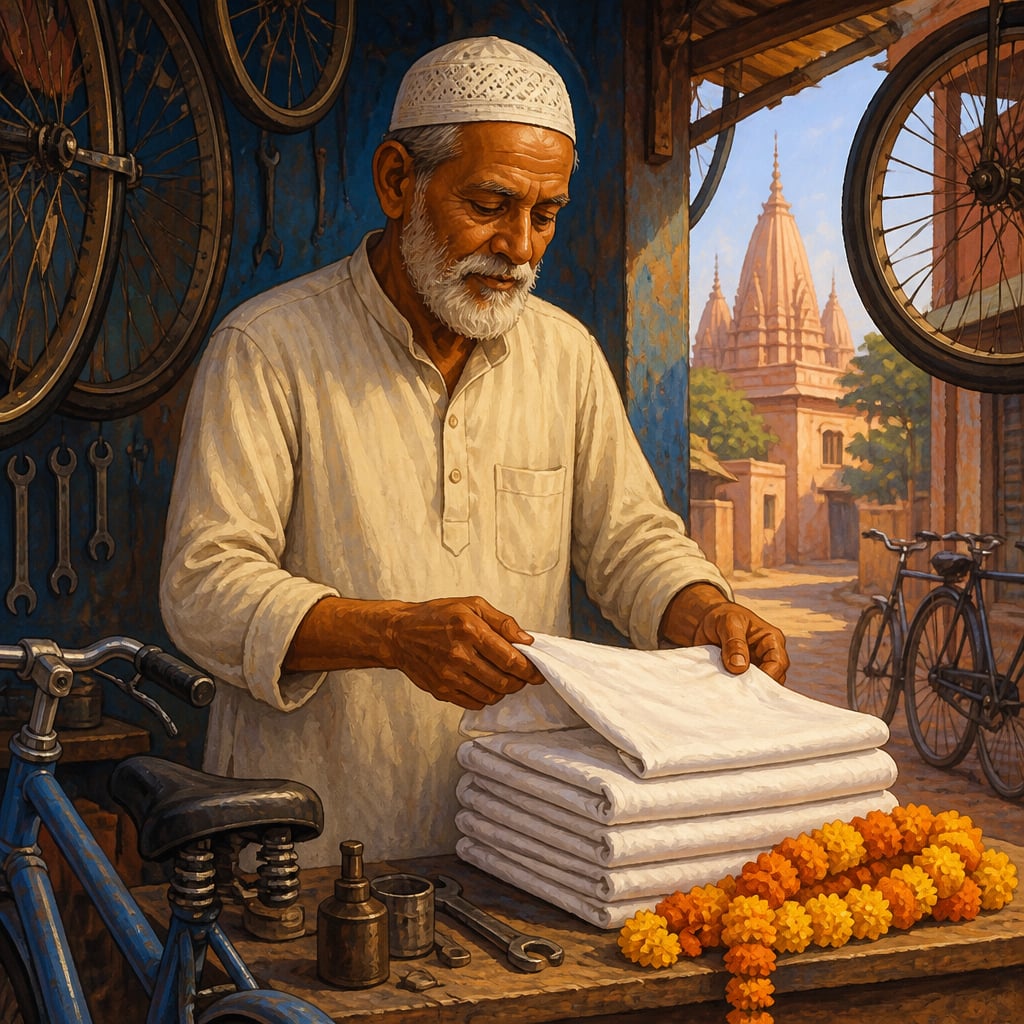
Shareef keeps cloth and marigolds ready for the unclaimed

In the lanes of Ayodhya, for over three decades, a bicycle mechanic named Mohammed Shareef kept a practice that made him famous far beyond his town. Whenever an unclaimed body was found, at the railway station, by the river, on the roadside, Shareef claimed it.

If the dead man was Muslim, Shareef arranged the janaza and burial. If the dead man was Hindu, Shareef arranged the cremation, with the rites, at the ghat. He learned the requirements of a tradition not his own, because the dead who fell to his care did not choose their faiths or their abandonment. The counts reported when India awarded him the Padma Shri in 2020 ran to many thousands of the unclaimed across the decades. Each received last rites in the manner of the dead person's own tradition.

Asked why, Shareef gave the answer this entire lesson decodes. His own son died far from home in 1992, and the body was never returned to him. He vowed that no one else's dead, within his reach, would ever go unaccompanied.

Hold his vow, because it is the exact vow this text made, fifteen centuries earlier, in prescription form. Every rite this chapter has decoded assumes the standard case: a full life, a body, a family, a line. But the tradition's designers knew what every era knows: deaths come that fit no template. And a system of care is measured, finally, not by its standard case but by its hardest ones.

The Cases That Break the Grammar

Walk through the hard cases as the tradition meets them, and watch a single principle repeat.

The child. A child who dies very young is, in most regional traditions, buried, not cremated, and mourned with drastically shortened observances. Read the design, not callousness but precision: the fire of antyeshti is the last sacrifice of a ritually formed life, closing an arc the samskaras opened. A small child's arc had barely opened: few rites performed, no karmic household career to conclude, nothing the fire's grammar applies to. The tradition holds such a soul light, barely burdened, needing no year-long road, and the earth receives the small body as a seed is received, gently. The shortened mourning is not a smaller love. It is the tradition saying, with full conviction: this one travels light, and quickly, and needs less carrying.

The renunciate. A sannyasi is also never cremated: buried seated in meditation posture, or given to a river, in the practice called jal samadhi. The decode is one of the most elegant in the whole system. At initiation, a sannyasi performs their own funeral: the old name renounced, the sacred thread surrendered, the rites of departure done for the person they used to be. The tradition means it literally: the sannyasi has already died once. What remains owes the fire nothing, because antyeshti cannot be performed twice. The seated burial marks a second difference: this body is not a vessel to be returned but a seat of practice, and it is planted, upright, mid-meditation, the posture held forever.

The far-away and the lost. For the one who dies with no body recoverable, drowned, lost in war, gone in a distant land, the tradition prescribes rites over an effigy: a form of darbha grass standing in for the body, the full sequence performed. Nothing about absence cancels the family's ability to complete the passage; the rite refuses to let geography interrupt love's last work.

The unclaimed. And for the dead with no one at all, the tradition's answer is not a rule but a merit: performing the rites for a stranger's body is counted among the highest acts of dharma, precisely because nothing obliges it and nothing repays it. This is the clause Shareef enacted for thirty years without ever reading it.

No traveler goes unaccompanied: lamps gather midstream

Across every case, the principle holds: the system bends its grammar rather than abandon a single traveler. The text's verse states the loneliness the whole apparatus answers:

सर्वेषां पश्यतामेव मृतः सर्वं परित्यजेत् । एकः प्रजायते जन्तुरेक एव प्रलीयते ॥

sarveṣāṃ paśyatām eva mṛtaḥ sarvaṃ parityajet ekaḥ prajāyate jantur eka eva pralīyate

Even as all stand watching, the departed leaves everything behind. Alone a being is born, and alone it passes away.

Garuda Purana, Preta Khanda 12.23

Alone born, alone departing: the verse is the tradition's clear-eyed statement of the human condition. And the entire ritual architecture of this chapter is the tradition's answer to its own verse: the journey may be made alone, but no one will be left alone in the making. A body will be carried. A rite will be performed. A name will be spoken. If not by family, then by whoever's dharma reaches the case: a neighbour, a stranger, a bicycle mechanic with a vow.

The Edge Is the Measure

Modern service design has a name for what this lesson keeps finding: the edge case, the user the standard flow fails. And the modern world's most admired institutions are admired for exactly the tradition's instinct. Medecins Sans Frontieres built an entire organisation on the cases everyone skips: care delivered where systems have collapsed, to patients no ministry counts, on the stated principle that need, not nationality or viability, is the only admission criterion. The instinct is identical to the text's: a system that quietly drops its hardest cases is not a system with exceptions. It is a system with a lie in its founding sentence.

The Garuda Purana's funeral apparatus, read whole, contains no such lie. Child and sage, householder and stranger, the drowned and the unclaimed: every death has an answer, every traveler an escort, every case a rite. The book that popular fear calls morbid turns out, at its edges, to be something else entirely: the most complete manual of accompaniment a civilization ever wrote.

And with that, the chapter closes, and the course pivots on its hinge. The road has been walked, the court visited, the rites decoded; death has given this text everything it has to give. What remains is the question the whole journey has been sharpening: if this is the road, how should I walk the part I am on now? The Garuda Purana's answer fills the next chapter, and it surprises everyone who meets it: the so-called book of death carries some of the shrewdest advice on money, friendship, speech, and daily life in all of Sanskrit. The counsel nobody expects is next.

Case studies

Thirty Years of Other People's Dead

After his son Mohammed Raees travelled to Sultanpur in 1992 and was murdered, his body never recovered by the family, Ayodhya bicycle mechanic Mohammed Shareef made a vow: no unclaimed body in his town would go without last rites. For over three decades he claimed the dead nobody claimed, from railway platforms, riversides, and hospital morgues, learning the Hindu rites for Hindu dead and performing the Muslim rites for Muslim dead, funding the work from his repair shop's meagre earnings.

Shareef performed the tradition's highest-merit clause, rites for the anatha preta, the unprotected departed, at industrial scale and across the religious boundary, embodying the system's deepest principle: the duty of accompaniment defaults to whoever's reach the case falls within. His wound became the vow; the vow became the town's safety net.

India conferred the Padma Shri on him in 2020, and his story travelled worldwide as an emblem of Ayodhya beyond its disputes. He continued the work into his eighties, and his family has pledged to carry it on.

Completeness of care is not built by institutions first; it is built by individuals who refuse to let a case within their reach fall through. The system's last safety net is always a person.

Reports at the time of his 2020 Padma Shri credited Mohammed Shareef with last rites for well over 25,000 unclaimed dead across three decades, performed according to each dead person's own faith.

Medecins Sans Frontieres: Care for the Cases Everyone Skips

Founded in 1971 by French doctors and journalists after Biafra, Medecins Sans Frontieres built its charter on a single inversion: where every existing system rationed care by nationality, viability, or politics, MSF would admit patients by need alone. Its teams work precisely where the standard flows have collapsed, war zones, epidemics, refugee camps, famine belts, treating the patients no ministry counts and no border admits.

MSF is the edge-case principle built into an institution's founding sentence: the measure of medicine is the patient the system fails, exactly as the measure of the funeral tradition is the death that breaks the pattern. Both refuse the quiet lie of systems that perform excellently for standard cases while their hardest cases disappear from the ledger.

MSF operates in over 70 countries with tens of thousands of field staff, received the Nobel Peace Prize in 1999, and its need-alone admission principle has reshaped humanitarian norms far beyond its own missions.

An institution that names its edge cases in its charter, rather than its footnotes, becomes the conscience of its entire field. The hardest case, deliberately owned, is the strongest foundation there is.

MSF was awarded the 1999 Nobel Peace Prize; it reports running medical projects in more than 70 countries with a majority of staff hired locally.

Living traditions

The tradition's completeness clause lives on wherever Indians organise care for abandoned deaths: the volunteer burial societies, the hospital workers who whisper the name of Rama or the kalima over unclaimed bodies according to what is known of them, the crowdfunded cremations for migrant workers far from home. And the sannyasi rules remain fully operative: when a great renunciate dies, the seated interment and the samadhi shrine follow the prescriptions this lesson decoded, watched now by television audiences of millions.

Reflection

  • The verse says alone born, alone departing, and the tradition answers with accompaniment at every edge. Who in your current circle is approaching a departure, of any kind, unaccompanied, and what is your reach in their case?
  • Audit a system you belong to, workplace, family, community, by its hardest case: who does its standard flow silently fail, and what would the explicit prescription for that case look like?
  • Shareef built thirty years of service at the exact site of his own wound. What deprivation of yours has been waiting to become a vow, and what has kept it a grievance instead?

More in Why Do We Do All Those Rituals?

All lessons in Why Do We Do All Those Rituals? · Garuda Purana ebook course