Talapatram

Fire, the Last Samskara

The body returned to the elements it was borrowed from.

Antyeshti as the sixteenth and final rite of a life: the body, borrowed from the five elements, formally returned to them, with the son’s shaved head and the broken pot decoded. In the first days of shock the ritual prescribes everything, so nobody grieving has to make a single decision.

The Ceremonies That Held You Before You Had a Name
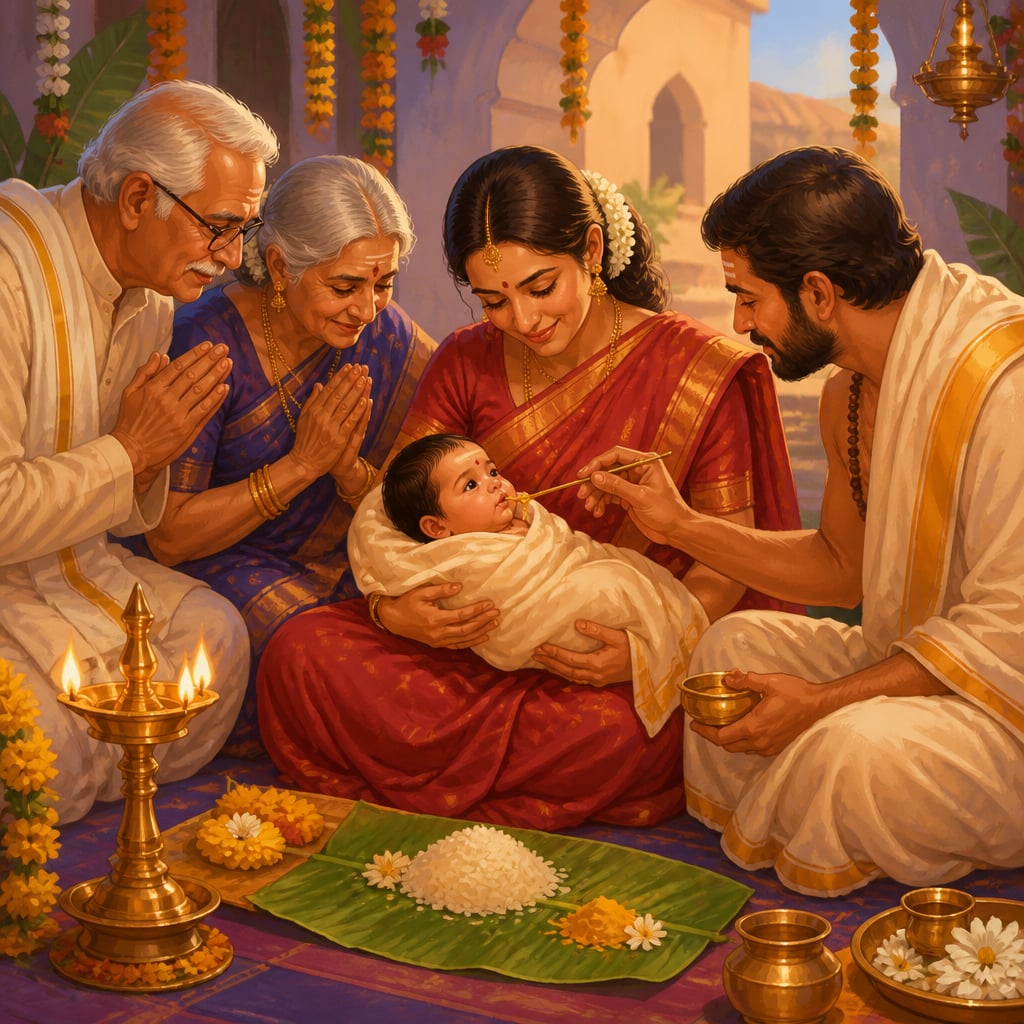
The naming rite that held you before you could speak

Before you could speak, the tradition had already held ceremonies for you. One welcomed you into the world. One gave you your name. One marked your first solid food, another your first haircut, another the beginning of your education. If you married, a fire witnessed it.

These are the samskaras: the rites of passage that punctuate a Hindu life, sixteen in the classical count. The word means refinement, the way a jeweller's work refines raw gold. Each rite takes a natural event, a birth, a meal, a marriage, and lifts it into significance: this moment matters, the family gathers to say. You are being shaped.

And then there is the sixteenth. The tradition calls it antyeshti: the last sacrifice. It is the one samskara nobody attends for you. It is also, this chapter will argue, one of the most intelligently designed ceremonies in the tradition, and almost nobody who performs it is ever told what it means. This chapter walks back from Yama's court into the house of the mourners, to decode the rites everyone has seen and no one explains.

A Loan, Formally Repaid
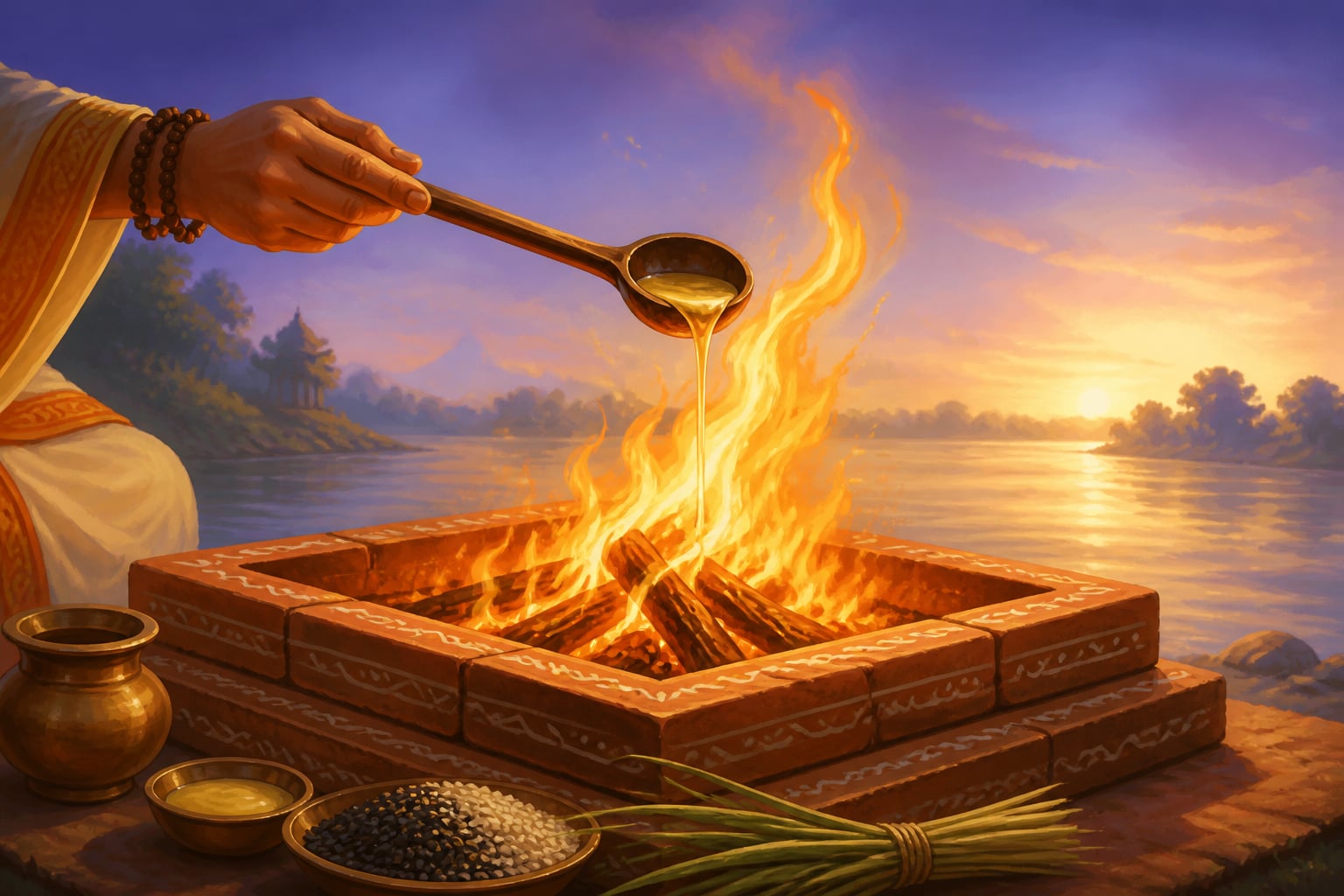
Ghee poured to Agni, carrier of offerings

Start with the fire, because everything else follows from what the tradition believes the fire is doing.

In the tradition's physics, the body is not the person. It is an instrument, assembled on loan from the five great elements: earth in the bone, water in the blood, fire in the body's heat, air in the breath, space in its hollows. The person, the traveler of Chapter 3, borrowed this instrument for a lifetime. At death, the loan falls due.

Antyeshti is the formal repayment. The fire is not destroying the body; in the rite's own grammar, the fire is returning it: each element released back to its source, earth to earth, water to water, breath to wind. And notice the name once more: the last sacrifice. A Hindu life is measured out in offerings made into fire, the daily lamp, the wedding's circling flames, the yajnas of the householder's years. The tradition's final statement about the body is that it, too, was an offering all along. The last act of a life of oblations is to become one.

The text's blunt verse states what remains once the instrument is returned:

एकोऽपि भुङ्क्ते सुकृतमेक एव च दुष्कृतम् । मृतः शरीरमुत्सृज्य काष्ठलोष्ठसमः क्षितौ ॥

eko'pi bhuṅkte sukṛtam eka eva ca duṣkṛtam mṛtaḥ śarīram utsṛjya kāṣṭha-loṣṭha-samaḥ kṣitau

Alone one experiences one's good deeds, and alone one's ill. The departed casts off the body, and it lies like wood or a clod upon the earth.

Garuda Purana, Preta Khanda 12.24

Wood and clay: the verse deliberately reduces the abandoned instrument to its raw materials. The person, and the person's record, have already left with the winds. What the fire receives is the packaging, and the rite treats it with the respect owed to something that carried a soul, and no more fear than that.

The Shaved Head and the Broken Pot

The shaved-headed mourner carries the leaking pot

Now the two symbols everyone has seen at a Hindu funeral, and almost no one can explain.

The shaved head. The chief mourner, traditionally the eldest son, arrives at the ghat with his head newly shaved. Hair, in the samskara system, is adornment: the first haircut was itself a rite of beautification. Removing it is the reverse rite. The mourner sets aside, visibly and at once, everything decorative about ordinary life. And the shaved head does a second job the tradition understood perfectly: it marks him. For weeks afterwards, everyone in the market, the office, the street can see at a glance that this man is carrying a loss. Nobody needs to be told to speak gently. The community reads the signal and adjusts around him without a word.

The broken pot. Near the end of the rite, the chief mourner circles the pyre carrying a clay pot of water on his shoulder. At each circuit, a hole is pierced; water streams out as he walks. On the final circuit he drops the pot behind him, and it shatters. He does not look back. The decode is almost unbearably direct. The clay pot is the body, earth shaped into a vessel for water, the tradition's oldest metaphor for life held in form. The draining water is the lifetime, poured out circuit by circuit. The shattering is the end, final and unambiguous. And the instruction not to look back is addressed to the living: the vessel is finished; what it held has gone on; your road now runs forward.

The Kindness Hidden in the Choreography

Step back from the symbols and look at the rite's structure, because its quietest intelligence is there.

Grief researchers describe the first days after a death as a state of shock in which executive function simply fails. The bereaved cannot plan, cannot prioritise, can barely decide what to eat. And it is precisely into those days that modern life drops its cruelest demand: a family, at its least capable hour, must suddenly make dozens of unfamiliar decisions.

Now watch what the rite does. From the moment of death, the tradition prescribes everything. Who leads: named. What happens first, second, third: fixed. What is worn, what is cooked, who may touch what, which direction the body faces, what is said and in what order: all decided, centuries ago, by the choreography. The grieving family makes not one decision. They are handed, instead, a sequence of tasks, each small, each physical, each shared. The tradition says the rite serves the departed, releasing the elements and sending the traveler on, and it means it with full conviction. But the same choreography, in plain sight, catches the living at the exact hour their own capacity fails. Nothing about that design is an accident, and the next lesson will watch it unfold across thirteen days.

The last samskara, then, is the first thing to know about this chapter: the rites are not superstition layered over loss. They are the tradition's completed thought about what a body is, a borrowed vessel, honourably returned, and what a family needs, a script, at the hour it cannot write one. The remaining days have their own architecture, and it is even more precise.

Case studies

Cradle to Cradle: Design That Returns Its Materials

In 2002 the chemist Michael Braungart and the architect William McDonough published Cradle to Cradle, an indictment of the industrial world's one-way logic: take materials, make products, dump them as waste. Their alternative, now a certification used across industries, designs every product from the start as a loan from the material world: every component either biodegrades back to soil or cycles back into manufacture, endlessly, with nothing discarded.

Cradle-to-cradle is antyeshti's physics applied to objects: nothing is owned, everything is borrowed from the elements, and good design means a formal, complete return. The rite performed at the ghat and the certification stamped on a product encode the same contract with the material world: what is taken in form must be given back as source.

Thousands of products across furniture, textiles, and construction now carry Cradle to Cradle certification, and its core principle, design for return, reshaped the circular-economy movement adopted by the European Union and major manufacturers.

A civilization's maturity shows in how it handles endings: of products or of bodies. Both traditions here agree that the ending should be a return, designed with as much care as the beginning.

The Cradle to Cradle Certified programme, launched in 2005, has certified thousands of products across more than 30 industry categories worldwide.

The India Pride Project: Sending the Gods Home

For decades, bronze deities stolen from Indian temples surfaced in auction houses and museum collections abroad, laundered through dealers like the notorious Subhash Kapoor. From the 2010s, S. Vijay Kumar, a Singapore-based shipping executive, and the volunteer network he co-founded, the India Pride Project, began matching museum catalogues against old temple archives and police records, evidence that forced institutions and governments to return idol after idol, including the celebrated Nataraja returned by Australia in 2014.

The project's driving conviction is this lesson's conviction: some things are held in trust, not owned, and holding them carries the duty of proper return. A murti belongs to its sanctum as the body's elements belong to the elements; the volunteers' patient documentation is a kind of rite, completing returns that were violently interrupted.

Hundreds of artefacts have been returned to India since the effort began, from Australia, the United States, and Europe, and several have been ceremonially reinstalled in the temples they were taken from, some after a century away.

Restitution is a species of last rite: the borrowed thing carried home, the interrupted circle closed. Completion, the tradition insists, is something the living must perform; it does not happen by itself.

India recovered more than 300 antiquities from abroad between 2014 and 2024, against barely a dozen in the preceding decades, with India Pride Project research contributing to many of the highest-profile returns.

Living traditions

Antyeshti remains among the most universally kept rites in Hindu life, performed in adapted forms from village ghats to electric crematoria in London and New Jersey, where families still shave the karta's head, still circle with the pot, still refuse to look back. Diaspora communities have rebuilt the choreography around municipal regulations, and the essential design survives every adaptation: the elements returned, the mourner marked, and the family handed a script for the week it cannot plan.

  • Manikarnika Ghat: The most renowned cremation ground in the Hindu world, where the fire is said never to have gone out, tended across generations by the Dom community. Kashi's tradition holds that antyeshti here, in the city of Shiva, carries the traveler with particular grace. To stand at a respectful distance is to watch this lesson's entire physics performed: the borrowed vessel returned, element by element, beside a river that has received the returns of centuries.

Reflection

  • The tradition brackets a life with sixteen rites, and modern life has quietly dropped most of them. Which threshold of your own life passed unmarked, and what did the absence of ceremony cost you?
  • If the body is a borrowed instrument rather than a possession, what changes tomorrow morning in how you treat yours?
  • The rite hands a collapsed family a complete script. When your own capacity last failed, in grief, illness, or crisis, what carried you: decisions you made, or structures that decided for you?

More in Why Do We Do All Those Rituals?

All lessons in Why Do We Do All Those Rituals? · Garuda Purana ebook course