The Questions Nobody Asks Aloud
Garuda asks Vishnu what every human hides.
The frame of the whole purana: Garuda asks Vishnu the questions every human carries but never says aloud, and the reader is handed Garuda's seat. Death remains the last conversational taboo; this text is a script for the unaskable.
The Flight That Ended in Tears
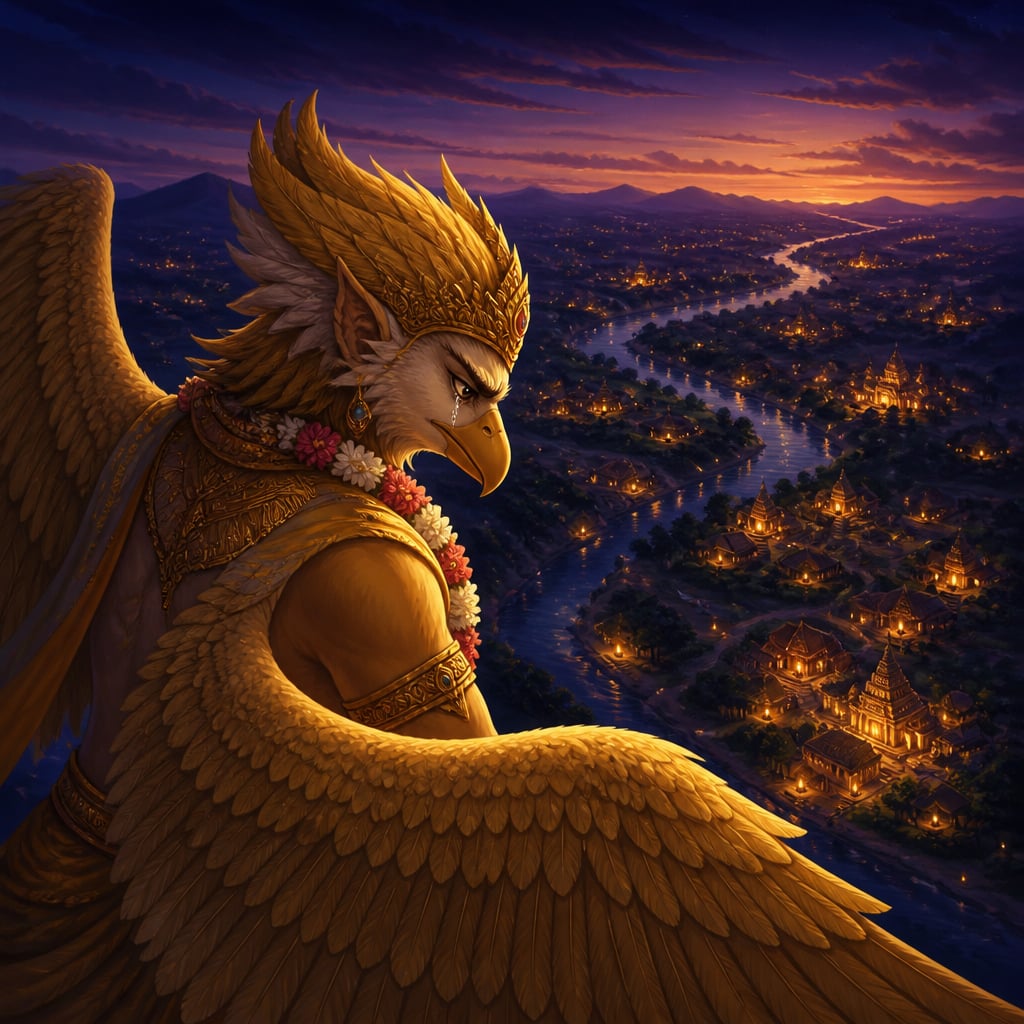
The last lesson ended with a freed Garuda setting out to see the worlds, chanting the name of Hari as he flew. The Purana tells us what that tour did to him.
He crossed the heavens and saw their pleasures. He crossed the lower realms and saw their fears. And then he flew low over the earth, over the land of Bharata, and looked closely at human beings. The text lists what he saw with an unblinking eye. People sunk in attachment and envy. The blind and the deaf, the lame and the sick, the wasted by disease. People proud of things as unreal as a flower in the sky. And over all of them, moving among them like a season, death.
The strangest thing, Garuda noticed, was how the people lived in the face of it. They saw death daily and behaved as if it were a mystery that had nothing to do with them.
He returned to Vaikuntha, Vishnu's radiant realm. The text paints the splendor he walked past. Shining beings on rows of aerial cars. Lakshmi on a swinging seat, singing the praises of her Lord. The great courtiers in attendance. Garuda walked through all of it with his hair thrilling and tears falling from his eyes, and bowed low before Vishnu. The grief of the worlds had come home with him.
The Question He Carried
Vishnu asked his companion, gently, how much of the universe he had managed to wander. And Garuda, who in the last lesson stole immortality from heaven without flinching, now asks something that costs him far more:
तेषां दोषस्य वैचित्र्या मृत्योर्गोचरतामपि । दृष्ट्वा प्रष्टुमनाः प्राप्तः को मृत्युश्चित्रता कथम् ॥
teṣāṃ doṣasya vaicitryā mṛtyor-gocaratām api dṛṣṭvā praṣṭumanāḥ prāptaḥ ko mṛtyuś-citratā katham
Having seen the strangeness of their ways, lived in the very sight of death, I have come to you with a mind to ask: what is death? Why is it such a mystery?
Garuda Purana 1.64
Read the question again and notice whom it is for. Garuda is immortal. He was granted freedom from death as a boon, before he ever drank or refused the nectar. Death cannot touch him. He is asking for us. He watched human beings live strangely in death's sight, and he carried their unasked question to the one teacher who could answer it.
The Teacher's First Word
And here is the moment this whole course is built on. The Lord does not wince at the question. He does not change the subject, or soften it, or praise Garuda for anything else first. His opening word is praise for the asking itself:
साधु पृष्टं त्वया लोके सदया जीवकारणम् । वैनतेय शृणुष्व त्वमेकाग्रकृतमानसः ॥
sādhu pṛṣṭaṃ tvayā loke sadayā jīva-kāraṇam vainateya śṛṇuṣva tvam ekāgra-kṛta-mānasaḥ
Well asked, O son of Vinata. Out of compassion for living beings you have asked about the mystery of life itself. Listen, then, with a one-pointed mind.
Garuda Purana, Preta Khanda 32.6
Sadhu prishtam: well asked. The tradition's picture of the perfect teacher begins with those two words. The hardest question in existence has just been put to God, and God's first act is to honor the asker. He even names why the question is noble: it was asked out of compassion, for everyone.
Everything this course covers flows out of that exchange. What is death is never just one question. Pull its thread and the others follow, the ones you have asked yourself at some 2 a.m. of your own. Whether anything you do finally matters. Why the rituals exist. What a good life actually is. Why this one life feels so urgent if the soul is eternal. And whether the wheel of birth and death has an exit. Those are the chapters of this course, because they are the questions of this text.
The Last Taboo
Now set the scene beside our own world. We have made almost everything speakable. Money, therapy, marriages, politics, the body: subjects our grandparents kept behind closed doors are podcast topics now. One subject did not make the crossing. Stand at a funeral and watch fluent, confident adults struggle for a sentence. "I don't know what to say" is the most honest thing most of us have ever said about death.

The civilization that produced this Purana handled the unaskable differently: it built forms for asking. Assemblies held formal debate, shastrartha, where the hardest questions were argued under rules, with witnesses, and losing to the truth was honorable. Sages riddled each other about death and the self in public contests. And this text staged the greatest asking of all: the mightiest being in creation, in tears, putting the forbidden question to God directly, and being praised for it. Questioning was not rebellion against the sacred. It was a form of the sacred.
That is the seat you occupy for the rest of this course. Garuda asked so that the question would exist in the open, with an answer attached. You are not eavesdropping on a funeral text. You are sitting in the questioner's place, and the teacher has already said the words: well asked. Listen with a one-pointed mind.
Modern Echoes
The cost of the unasked question has a modern accounting. The American columnist Ellen Goodman helped found The Conversation Project in 2012, after her mother's long decline. Through all those years, she realized, they had talked about everything except what her mother wanted at the end. The project builds simple starter kits for exactly one conversation: the one families keep postponing. Its surveys found the gap this lesson is about: the overwhelming majority of people say the conversation matters, and only about a third have ever had it. Almost everyone is carrying Garuda's question. Almost no one asks it aloud.
Back in Vaikuntha, the tears have been honored and the teaching is about to begin. But before we follow the answers, one more surprise about this book remains. The next lesson opens the rest of its shelves, and what sits on them is the last thing anyone expects to find in "the death book."
Case studies
Ellen Goodman and the Postponed Conversation
The American journalist Ellen Goodman spent years managing her mother's long decline, making one medical decision after another without knowing what her mother would have wanted, because in a lifetime of talking they had never talked about that. In 2012 she helped found The Conversation Project, which builds plain-language starter kits for families to discuss end-of-life wishes at the kitchen table, long before a crisis makes the conversation impossible.
The project is Garuda's move, institutionalized: take the question everyone carries and no one asks, and create a form in which asking it becomes normal, even welcomed. The Purana staged the asking in Vaikuntha and had God say "well asked"; the project stages it at the dinner table and has the family say it. The wager is identical: the question spoken aloud is lighter than the question carried alone.
The Conversation Project's materials have spread through hospitals, faith communities, and homes across the United States and beyond, and its surveys keep finding the same gap: most people say the conversation is important; only about a third have actually had it.
The unasked question does not go away; it just waits for the worst possible moment. Every tradition and every family needs a form in which the unaskable can be asked early.
The Conversation Project, co-founded by Ellen Goodman in 2012, reports that roughly nine in ten people consider end-of-life conversations important, while only about a third have had one.
Shastrartha: A Civilization's Arena for Hard Questions
Classical India built formal institutions for public questioning. In royal courts and scholarly assemblies, shastrartha debates were held under explicit rules: a question stated fairly, arguments heard by witnesses, umpires empowered to declare a result, and the defeated party expected to honorably accept the stronger argument, sometimes even adopting the winner's school. The Upanishads remember the assemblies of kings where sages contested the deepest riddles of death and the self in public, with great stakes on the table.
Garuda's question to Vishnu is the same cultural instinct at cosmic scale: hard questions belong in the open, put to the most qualified answerer, under forms that honor both asker and answer. A tradition that ritualized debate about death and the self could never treat those subjects as unspeakable; the taboo around the Garuda Purana is a late folk growth, not the tradition's own posture.
The debate culture kept India's philosophical schools sharp for centuries: positions had to survive public cross-examination, and the greatest reputations, of philosophers and courts alike, were built in the arena of questions.
Cultures stay honest about their hardest subjects by building arenas where questioning them is honorable. Remove the arena and the questions do not disappear; they go underground and turn into taboos.
The Brihadaranyaka Upanishad preserves an entire sequence of public debates at the court of King Janaka, where the prize for the winning argument was a thousand cows.
Living traditions
The question-and-answer form of this Purana is alive wherever katha and pravachan traditions gather: a teacher, an assembly, and questions given honor. The instinct that built shastrartha arenas and framed a scripture as one long asking survives in every satsang where someone finally says aloud what they have been carrying.
- Naimisharanya, Uttar Pradesh: The forest where, tradition holds, the Puranas were recited by Suta to the assembled sages: the outer frame through which the Garuda Purana's dialogue reaches us. Pilgrims still visit Chakratirtha and the ancient temples there. It is the tradition's monument to a listening assembly: a whole sacred geography built around people gathering to hear the great questions answered.
Reflection
- Garuda asked about death though it could not touch him, purely because he had seen others suffer. When did you last ask a question on someone else's behalf? What stopped you the times you did not?
- Vishnu's first words were "well asked." Think of a time you brought someone a hard question. How was it received, and what did that reception teach you about asking again?
- The people Garuda watched lived in the daily sight of death and treated it as a mystery with nothing to do with them. Where in your own life are you doing exactly that, and what would change if you stopped?