The Eagle Who Carried a God
Garuda earns his seat by crossing every world.
Garuda's own epic: Vinata's slavery, the serpents, the theft of amrita, and the bargain that made him Vishnu's vahana. Our narrator earned his seat by crossing every world; this is the course's emotional entry, and the story carries itself.
The Wager of the Two Sisters
In the elder days told by the Mahabharata, the sage Kashyapa had two wives who were sisters. Kadru asked him for a thousand sons, and they were born as the serpents. Vinata asked for only two sons, but greater than all of Kadru's thousand. Both wishes were granted, and the two mothers waited.
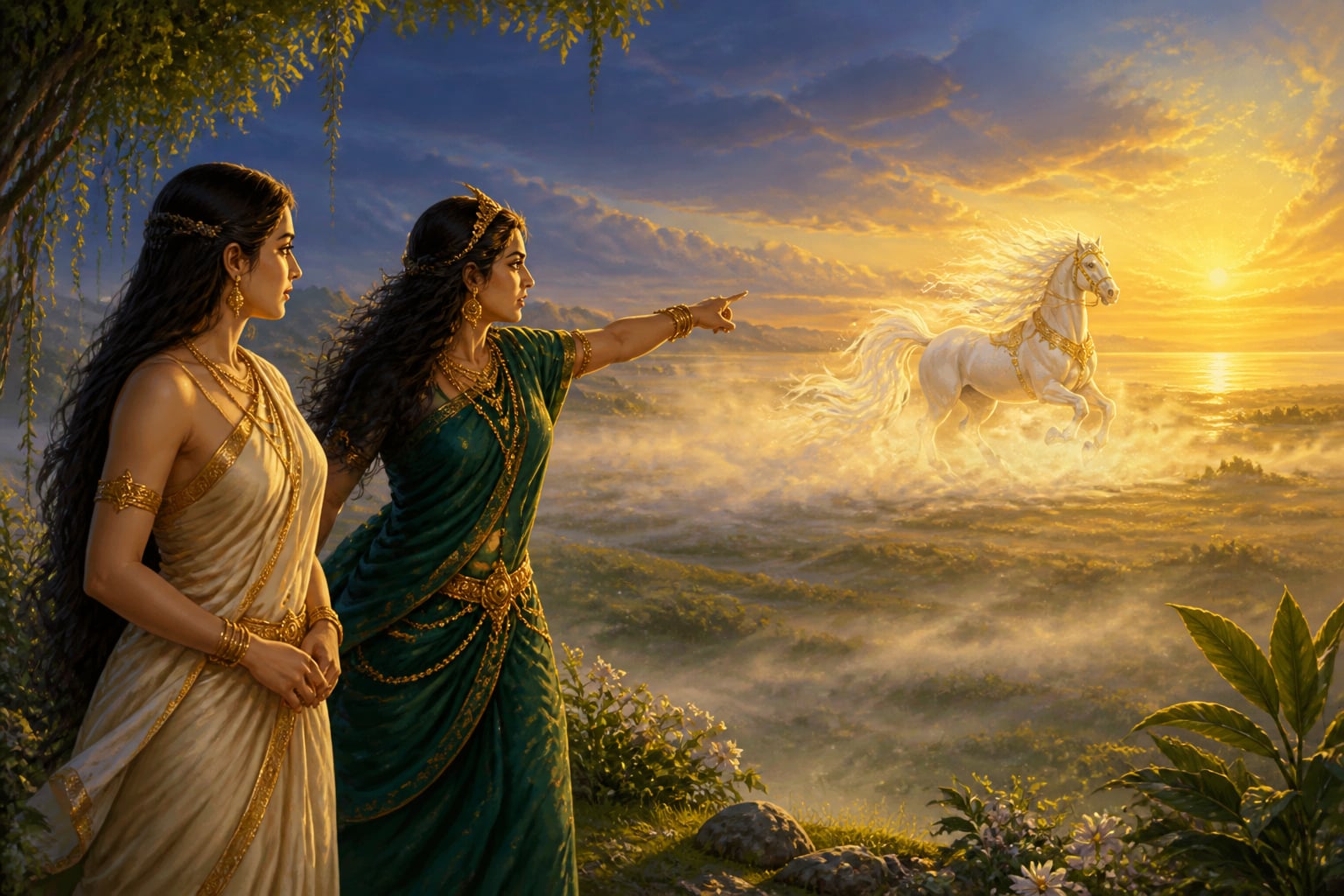
One morning the sisters argued about Uchchaihshravas, the shining white horse that had risen from the churning of the ocean. Vinata said the horse was white from nose to tail. Kadru said its tail was black. The argument hardened into a wager, and the stake was terrible: whoever was wrong would become the other's slave.
Kadru knew she was wrong. So that night she ordered her serpent sons to hang from the horse's tail like strands of black hair. At dawn, against the white flank of the great horse, the tail glistened black with living coils. Vinata, honest and cheated, bowed her head. From that day she served her sister.
The Egg That Waited
Vinata's two sons came as two eggs, and they were slow. After long years of waiting, she cracked the first egg open herself. The being inside was radiant but unfinished, formed only to the waist. This was Aruna, who would rise to become the charioteer of the sun. Before he left, he told his mother that her impatience had a price. She would remain a slave until her second son, allowed to come in his own time, set her free.
So the second egg waited, and Vinata served. And when at last it broke open on its own, the being that emerged blazed like a second sun. The gods themselves, dazzled, begged him to soften his light. This was Garuda, king of birds. He was born mighty, and he was born into servitude: his first inheritance was his mother's chains. He carried the serpents on his back wherever they demanded, until one day he asked the question that turns the whole story: what is the price of my mother's freedom?
The serpents named the one thing in the universe no one could get. Amrita, the nectar of immortality, kept in heaven under the guard of the gods.
The Thief Who Would Not Drink

Garuda went and got it. The gods massed at the gates of heaven, and he scattered them. The nectar itself was ringed by fire, by a whirring wheel of blades, and by guardian serpents. He made himself small, slipped through, and rose into the sky with the vessel in his claws.
Then comes the detail on which his whole character rests. He was carrying immortality itself. He was exhausted, wounded, and thirsty from battle. And he did not drink one drop. The nectar was a ransom, not a prize, and it was not his.
Vishnu had been watching, and it was exactly this that moved him. He offered Garuda any boon. Garuda asked for two things: to be immortal without drinking the nectar, and to be placed above Vishnu himself. Vishnu granted both, setting Garuda's image on his own banner, flying above him forever. Then he asked for something in return: be my mount, and carry me. The strongest being in the worlds agreed to serve. Not because he was tamed. Because service freely chosen is what strength is for.
On the way, Indra's thunderbolt struck him, the mightiest weapon of the gods. It could not wound him. But Garuda, out of respect for the weapon and the sage from whose bones it was made, let a single feather fall. Indra, astonished, offered friendship, and Garuda set the terms: I will deliver the vessel as I promised. Take it back before the serpents ever drink.
The Grass and the Split Tongues

Garuda set the vessel of nectar down on a bed of sharp kusha grass before the serpents. First, he said, my mother goes free. The serpents released Vinata. Then, he suggested, so great a drink surely deserves a purifying bath before it is tasted. The serpents slithered off to bathe, and in that moment Indra swept down and carried the vessel back to heaven.
The serpents returned to find only the grass the nectar had rested on. They licked it desperately, and the sharp blades split their tongues, which is why, the tradition smiles, snakes have forked tongues to this day. The promise had been kept to the letter. The mother was free. Not a drop was drunk, and not a war was fought to the last body. Garuda had freed her with wit, restraint, and exactness.
What This Makes of Our Narrator
Now you know who is asking the questions in this Purana, and why his name is on its cover. Garuda is the being who crossed every world on a single errand of love for his mother. He is the being who held the most tempting substance in existence and delivered it untasted. He is strength that chose service, and power that freed rather than punished. When such a being bows in Vaikuntha and asks about life, death, and dharma, he has earned the answers.
And the first thing he did with his freedom tells you everything about where this course goes next:
एकदा वैनतेयस्य लोकानां लोकस्पृहा । बभूव सोऽथ बभ्राम तेषु नाम हरेर्गृणन् ॥
ekadā vainateyasya lokānāṃ loka-spṛhā babhūva so'tha babhrāma teṣu nāma harer gṛṇan
Once, a longing arose in Garuda to see the worlds. So he set out, wandering through them all, chanting the name of Hari.
Garuda Purana 1.9
The freed son did not go to enjoy his strength. He went to look at the worlds, and what he saw there turned him into the asker of the great questions. That is the next lesson.
Modern Echoes
The shape of this story is not locked in the past. In 2018, twelve boys and their football coach were trapped deep inside the flooded Tham Luang cave in Thailand. The divers who found them alive after nine days were Rick Stanton and John Volanthen. They had spent decades mastering a skill with no market value: moving through drowned passages in zero visibility. Thousands of rescuers and about ninety specialist divers then carried the boys out, one by one, through water and darkness. The world's rarest strength, crossing between worlds to carry the helpless: every tradition that watched knew the shape of what it was seeing.
The story began with a cheated mother in chains. It ends with the strongest being in the worlds discovering what strength is for. Hold that, because the eagle's next flight begins the questions this whole course exists to answer.
Case studies
Aeneas Carrying His Father Out of Troy
In Virgil's Aeneid, composed in Rome in the decade before 19 BCE, the warrior Aeneas escapes the burning city of Troy carrying his aged father Anchises on his shoulders and leading his small son by the hand. Around him the city falls; he can save only what he can carry. He chooses to carry his father. The image became one of the most copied scenes in Western art: strength bent under a parent, walking out of ruin.
Aeneas is the West's closest cousin to Garuda: overwhelming strength defined by filial love, greatness measured by what it carries rather than what it conquers. Garuda crosses every world for Vinata; Aeneas walks through fire with Anchises on his back. Both traditions chose the same image for the same truth, that the strong are known by their burdens.
Aeneas's rescue of his father becomes the founding act of the lineage that, in the poem's telling, leads to Rome itself. The empire's national epic begins not with a victory but with a son carrying a parent.
Two civilizations, asked to picture ideal strength, both drew a child carrying a parent to freedom. Power in service of family is not a small virtue; it is the founding kind.
The Aeneid was composed between roughly 29 and 19 BCE and has been continuously read for over two thousand years.
The Divers of Tham Luang
In June 2018, twelve boys and their football coach were trapped by floodwater deep inside the Tham Luang cave in northern Thailand. After nine days, two British cave divers, Rick Stanton and John Volanthen, found them alive on a ledge four kilometres inside the mountain. The rescue that followed drew thousands of workers and about ninety specialist divers, who carried the boys out one at a time through hours of flooded passages in near-zero visibility.
Garuda is the being who crosses between worlds to carry the helpless, and Tham Luang is that exact shape in living memory: rare strength, built over decades in an obscure discipline, spent entirely on carrying others across a boundary they could never cross themselves. The divers took immense risk and claimed nothing, the modern version of delivering the nectar untasted.
All twelve boys and their coach were brought out alive after eighteen days underground, in a rescue most experts had privately believed impossible.
The world still recognizes Garuda when it sees him. Mastery plus selflessness plus a crossing between worlds moves the whole planet in a way raw strength never does.
The Tham Luang rescue of July 2018 involved an estimated ten thousand participants, including about ninety specialist divers from around the world.
Living traditions
Garuda remains one of the most alive figures of the tradition: temple processions across South India carry deities on Garuda vahanas, and his image stands guard on flagposts and gopurams. The being who crossed every world for his mother is still, everywhere, shown mid-service: wings spread, hands folded, carrying.
- Tirumala, Andhra Pradesh: Garuda Seva: On Garuda Seva night during the annual Brahmotsavam, the processional deity of Lord Venkateswara rides a great golden Garuda vahana through the temple streets, and it draws among the largest single-night crowds of any temple event in India. The eagle of this lesson is not a museum figure: lakhs of people still gather to see Vishnu carried exactly as this story says he chose to be.
Reflection
- Garuda was born the strongest being in the worlds, and his first great act was an errand for his mother. Who or what is your strength actually for, and would an honest observer see that in how you spent this week?
- Garuda carried amrita while thirsty and delivered it untasted. What is the thing you carry that tempts you most, and what would delivering it untouched look like?
- Kadru won the wager by cheating and gained a slave; Vinata lost honestly and gained a son whose love freed her. Looking back at your own life, what has an honest loss eventually given you that a dishonest win could not have?