Talapatram

The Book Kept Outside the House

Why households fear a book most have never read.

The fear named honestly: why households do not keep the Garuda Purana, why it is read only at funerals, and what it actually is, a full Mahapurana. Modern culture also quarantines death behind hospitals and euphemisms; we kept the taboo and lost the book.

The Book That Leaves With the Priest
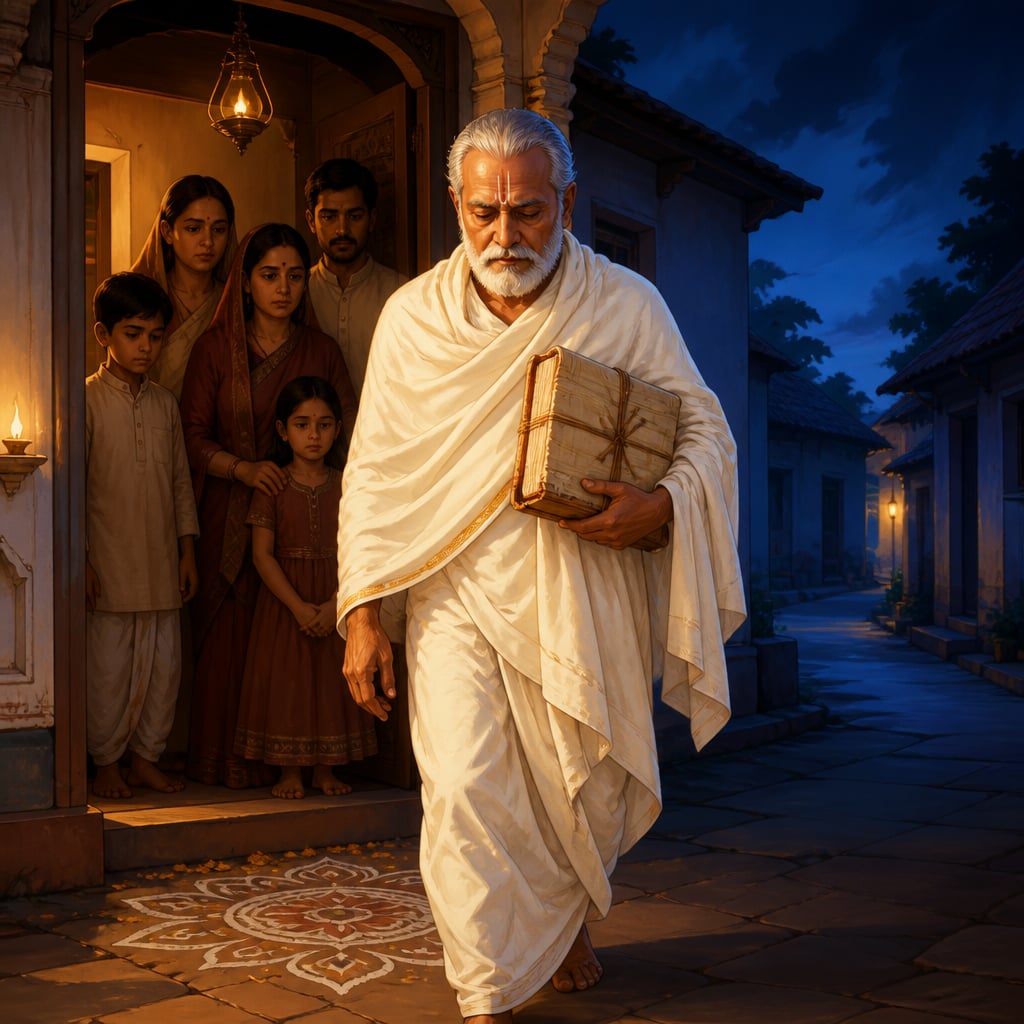
The priest carries the wrapped book away at dusk

For twelve days the house has not felt like its own. White sheets are spread on the floor of the front room. A brass lamp burns beside a photograph with a garland of marigolds on the frame. Relatives come and go with quiet voices and tiffin carriers. And once a day, at a fixed hour, a purohit (a family priest) opens a cloth-wrapped book and recites from it in Sanskrit. The family sits and listens to words almost none of them can follow.

The book is the Garuda Purana. On the thirteenth day the rites will end, and the priest will wrap the book again and take it away with him. No one will ask to keep it. In many families the belief is said openly: this book must not stay in the house. It is read when someone dies, and only then. Ask why, and the answers fade out. It is about death. It is not for ordinary days.

Here is the strange part. Almost no one who fears this book has read it. Its reputation guards it so well that its contents are among the least known of any major Hindu text. And those contents do not begin with death at all. They begin with an eagle who has a question.

What the Book Actually Is

The Garuda Purana is one of the eighteen Mahapuranas, the major Puranas of the Hindu tradition. It belongs to the Vishnu tradition: the teacher who speaks through it, from the first chapter to the last, is Vishnu himself. And its form is simple. Garuda, the king of birds and Vishnu's own carrier, asks. Vishnu answers. The whole Purana is one long conversation between a student and a teacher who happens to be God.

What did Garuda ask about? Almost everything. The text that reaches us has chapters on worship and daily conduct, on gemstones and how to test them, on medicine, on grammar, on statecraft, on yoga, on the duties of a householder. Death and what follows it is one section, the Preta Khanda (the section on the departed). It is a famous section, and an important one. But calling the Garuda Purana a death book is like calling a house a doorway because you only ever stood at its entrance.

Even the funeral recitation is not what most people think. What a purohit reads over those thirteen days is usually the Garuda Purana Saroddhara, "the extracted essence," a short digest of the death section prepared centuries ago by a scholar named Naunidhirama. He made it so that grieving families could hear the teaching in a handful of sittings. The vast Purana behind it stays unopened. So does the question of what else it holds.

And the fear of keeping it at home? No verse of the text asks for that. The text says the opposite about itself: its closing chapter promises blessing to the one who hears it, a promise the tradition calls a phala-shruti (a statement of the fruit of listening). The fear is a custom that grew up around the book's funeral duty, the way people grow uneasy about anything they only ever meet on the worst day of their lives. The book was never the danger. The association was.

The Eagle at the Door of Vaikuntha

Garuda alights at the doorway of Vaikuntha

The Purana's own opening scene is worth meeting early, because nothing dissolves the book's reputation faster.

The text tells it like this. Garuda, the golden-feathered king of birds, once set out to see the worlds, chanting the name of Hari as he flew. He crossed the earth. He crossed the heavens. He saw the realms below. And the more he saw, the heavier his heart became, because everywhere he looked, beings were suffering: sickness here, loss there, fear everywhere. He returned to Vaikuntha, Vishnu's own realm, with tears in his eyes, and bowed.

Vishnu asked his old companion how much of the universe he had managed to see. Garuda's answer is one of the quietest, most surprising verses in the Purana:

मया विलोकिता सर्वा जगत्स्थावरजङ्गमम् । भूर्लोकात् सत्यपर्यन्ता पुरा याम्या विना प्रभो ॥

mayā vilokitā sarvā jagat-sthāvara-jaṅgamam bhūrlokāt satya-paryantā purā yāmyā vinā prabho

By your grace, Lord, I have seen every world and every being in it, the moving and the unmoving, from the earth up to the highest heaven. Only the realm of Yama I have never seen.

Garuda Purana 1.24

Sit with that for a moment. The one being in the universe who can go anywhere has crossed every world and carried God on his back. Yet one region he has never entered, one subject he has never faced. Death is the gap in his knowledge too. The difference between Garuda and the rest of us is only this: he noticed the gap, flew straight to the best teacher in existence, and asked.

That is the seat this course offers you. Garuda asks the questions every human carries and never says aloud, and you sit where he sat. Over seven chapters, his questions will be yours:

The Fear We Kept, the Book We Lost

Notice, finally, that the modern world has not outgrown the old unease. It has simply reorganized it. A few generations ago, most people died at home, in the middle of the family. Today death happens mostly in hospitals, behind a curtain, managed by professionals. We do not say "died"; we say "passed away," "is no more," "left us." We hand the whole subject to doctors and priests and change the topic. The taboo survived. What we lost was the book: the one text the tradition kept precisely for this subject. It was read aloud in the very week a family needed answers, so that grief and understanding could arrive together.

Modern Echoes

In Kerala, a doctor named M. R. Rajagopal has spent four decades doing, in a modern form, what this text did for centuries: making death speakable. The movement he helped build cares for the dying and the seriously ill; Pallium India, which he founded in 2003, is its best-known face. It trains ordinary neighbours to sit with patients and their families, and to talk plainly about what is coming. Where that happens, families are not more afraid. They are less alone. Speaking about death does not invite it; silence just leaves people to face it by themselves. The Garuda Purana made the same wager a very long time ago.

On the thirteenth evening, the priest will still wrap the book in its cloth and carry it away. Custom is custom, and this course does not ask your family to change it. It only asks the question the mourning house never allows: what is actually inside?

From the next lesson on, we open it. And we begin where the Purana itself begins, with the eagle. Before Garuda asked his questions, he lived a story wild enough to explain why only he could ask them.

Case studies

Montaigne in His Tower

In 1571, a French nobleman named Michel de Montaigne withdrew to a tower on his family estate near Bordeaux, lined it with books, and began to write. Death had been circling him: his closest friend had died of plague, his father was gone, and he himself had nearly been killed in a riding accident. Instead of turning away from the subject everyone around him avoided, he faced it in writing, page after page, in a plain, honest voice no one had quite used before. One of his early essays took its title from an old philosophers' saying: that to philosophize is to learn to die.

Montaigne's move is the Garuda Purana's move: do not leave the feared subject unexamined, bring it into the room and question it in the plainest language you have. Garuda flies to Vishnu and asks about the one realm he has avoided; Montaigne sits in his tower and interrogates the fear itself. Both act on the same conviction, that the unexamined subject has power over you and the examined one does not.

The essays he wrote in that tower became a new form of literature, and their pages on death are among the most consoling ever written: he found that thinking about death steadily made him freer, not gloomier, and readers have reported the same for four and a half centuries.

Facing the feared subject directly is the cure for the fear, not the cause of it. The book you will not open owns you; the book you open becomes yours.

Montaigne's Essais, first published in 1580, have remained continuously in print for over 440 years.

The Doctor Who Made Death Speakable

As a young anesthesiologist in Kerala, M. R. Rajagopal kept meeting patients in severe pain whose families and doctors would not speak honestly about dying. The silence did not protect anyone; it left patients alone with their fear and families unprepared. He began building a different practice: honest conversation, pain relief, and neighbours trained to sit with the seriously ill. In 2003 he founded Pallium India in Thiruvananthapuram, and the community model he championed spread through Kerala and beyond.

The Garuda Purana was recited in the mourning house so that the hardest week of a family's life came with teaching instead of silence. Rajagopal's movement rebuilds that function in modern form: it brings the subject of death back into the room, spoken plainly, with the family present. The tradition's wager and the physician's wager are the same, that speaking about death lightens it.

Kerala became the reference point for palliative care in India, with trained volunteers embedded in ordinary neighbourhoods, and Rajagopal's work drew national and international recognition for showing that openness about dying improves how people live.

Silence around death does not protect the living; it isolates them. Communities that can speak about the end care better for everyone approaching it.

Pallium India, founded in 2003 in Thiruvananthapuram, has trained doctors, nurses, and community volunteers in palliative care from across India.

Living traditions

The thirteen-day recitation remains one of the most widely practised text-traditions in Hindu life: the Saroddhara is still printed in inexpensive editions and recited in homes across India and the diaspora. This course's wager is the text's own: that the book deserves to be met before the thirteenth day, while there is still time to live by what it says.

  • Vishnupad Temple, Gaya: The great centre of pind daan, the offerings for ancestors that the Garuda Purana's teaching frames. Families travel here from across India to complete rites for their departed, often with the Purana's words in the priest's mouth. Standing at the ghats of Gaya, the book of this course stops being an abstraction: its teaching is enacted here every single day. (The rites themselves are decoded in Chapter 4; the annual practice belongs to Pitru Paksha, covered in the Hindu Festivals course.)

Reflection

  • Garuda had seen every world except one, and that is the one he asked about. What is the question you have carried longest without ever saying it aloud?
  • The Garuda Purana is feared by people who have never read it. Is there something in your own life you have judged entirely by reputation, a book, a practice, a person? What would first-hand contact change?
  • Modern life keeps death out of sight: hospitals, euphemisms, changed subjects. Has that silence ever helped you when you actually faced a loss? What did you need in that week that no one offered?

More in What Is This Book, Really?

All lessons in What Is This Book, Really? · Garuda Purana ebook course