The Book of Everything
Gems, medicine, statecraft, grammar. And one section on death.
The reveal that reframes the course: this so-called death book contains gemology, medicine, statecraft, grammar and yoga, and death is one section among many. We live our lives split into separate domains; the text refuses the partition.
The Physician Takes the Floor
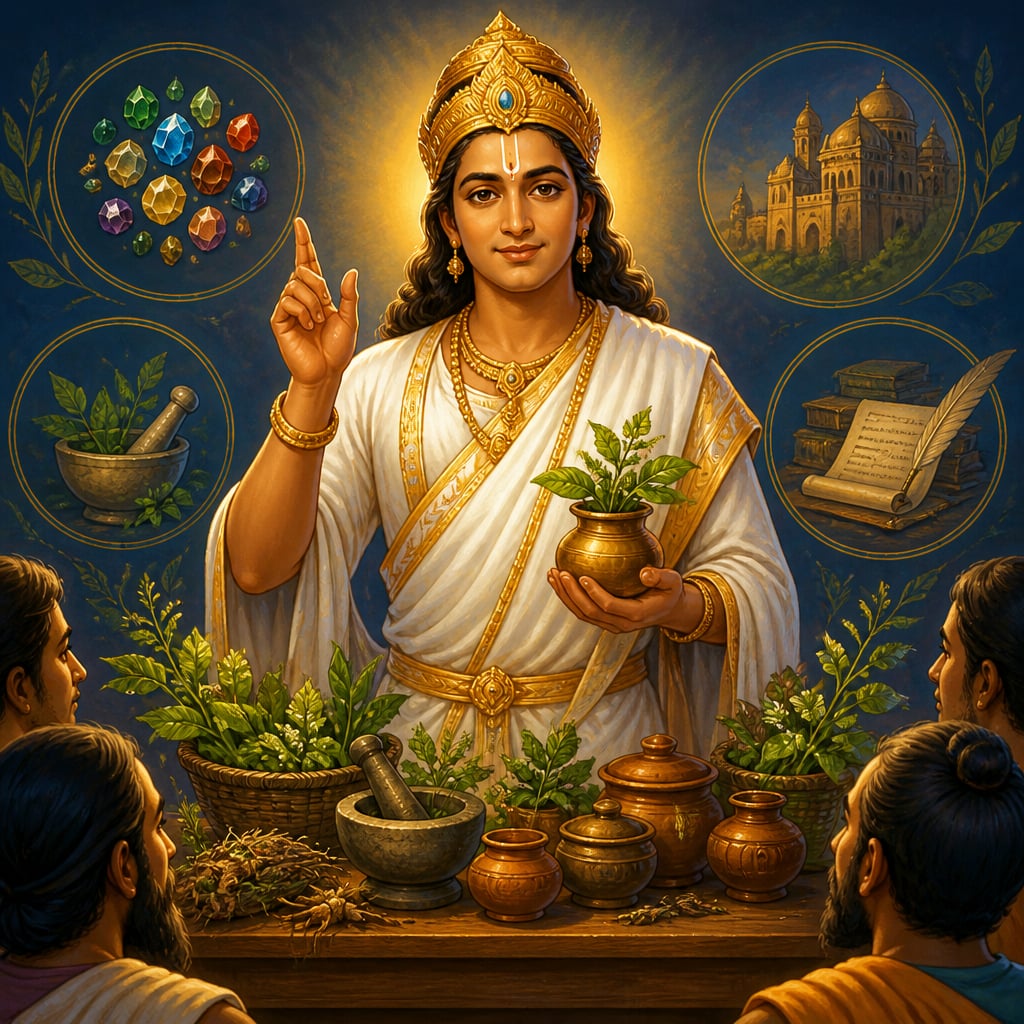
Somewhere past the middle of the Garuda Purana, the voice changes. A new teacher steps forward in the text: Dhanvantari, the physician of the gods. He is the radiant figure who rose from the churning of the cosmic ocean holding a pot of amrita in his hands. The same churning that produced the white horse of Lesson 2's wager produced the divine doctor. And here he is, deep inside "the death book," teaching medicine: fevers and their causes, diseases and their signs, the care of the living body.
Stop on that image for a moment. In the book families will not keep at home, there is a medical textbook. The physician who holds the nectar of immortality lectures inside the text everyone associates with dying. Whoever assembled this Purana clearly did not think it was a book about death.
So before the course walks into its great questions, one last piece of the myth has to fall. Let us open the rest of the shelves.
Shelf by Shelf
Walk through the text that actually reaches us, and you will find, alongside worship and conduct:
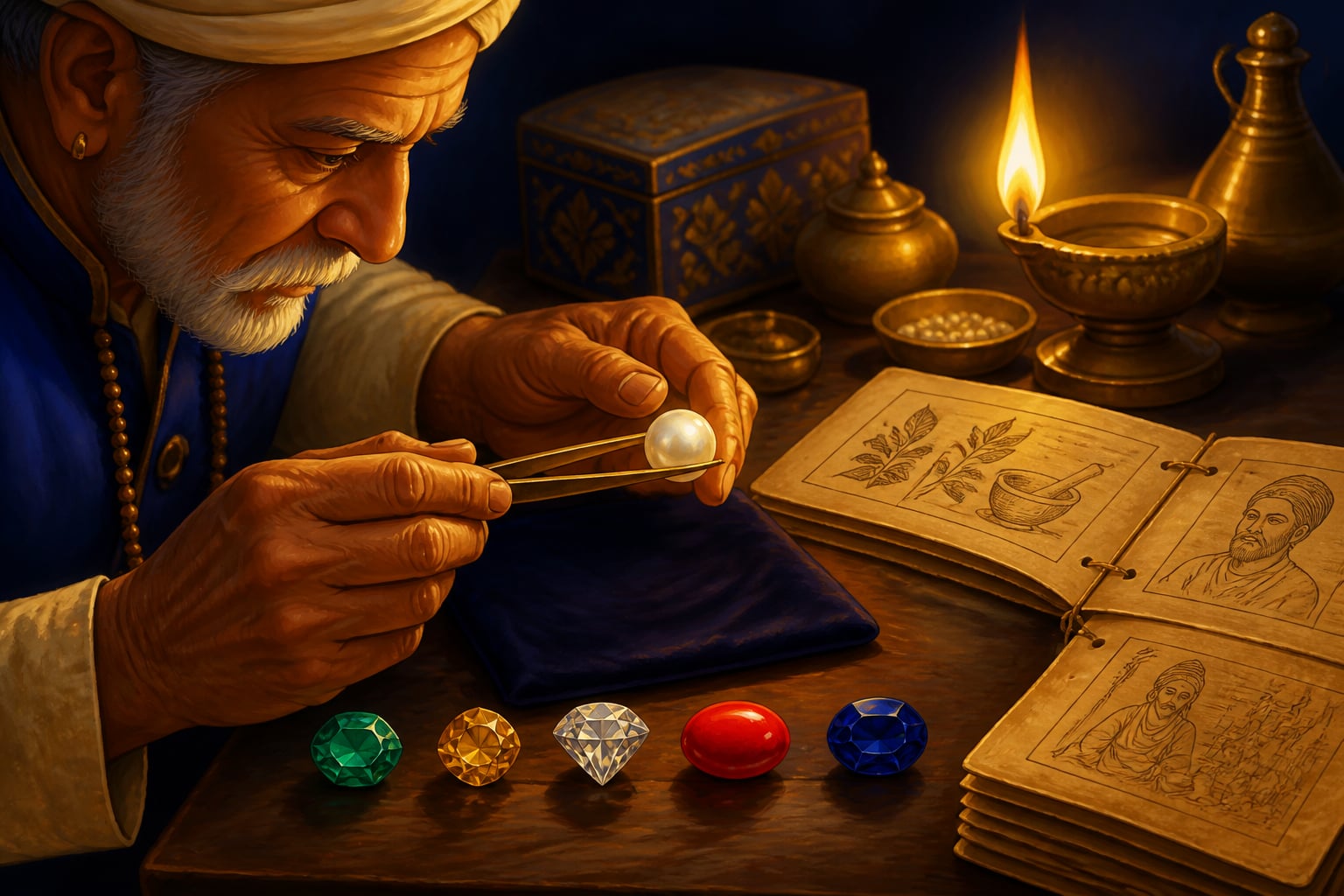
- Gemstones. Whole chapters of ratna-pariksha, the testing of gems: how to judge a pearl, what makes a diamond flawed, which stones carry which virtues. The Garuda Purana is one of classical India's sources on gemology, cited by jewellers' traditions for centuries.
- Medicine. The Dhanvantari chapters: the signs and causes of disease, remedies, the maintenance of the body.
- Grammar and language. Condensed teachings on Sanskrit grammar, in the same binding as the funeral verses.
- Statecraft and worldly counsel. Niti verses on money, friendship, kings, and judgment, so practical and so quotable that some of them circulate today in popular collections credited to Chanakya.
- Yoga, cosmology, and sacred geography. The disciplines of the self, the shape of the worlds, and the tirthas where the tradition touches the map.
And running under all of it, one voice. Open the text almost anywhere and this is what it actually sounds like:
धर्मो जयति नाधर्मः सत्यं जयति नानृतम् । क्षमा जयति न क्रोधो विष्णुर्जयति नासुराः ॥
dharmo jayati nādharmaḥ satyaṃ jayati nānṛtam kṣamā jayati na krodho viṣṇur jayati nāsurāḥ
Dharma is victorious, not adharma. Truth conquers, not falsehood. Forgiveness succeeds, not anger. Vishnu prevails, not the asuras.
Garuda Purana, Preta Khanda 47.46
That verse sits in the middle of the death section itself. This is what the feared book says when you open it at random: dharma wins, truth wins, forgiveness wins. It is one of the most hopeful sentences in the tradition, filed inside the text everyone is afraid of.
Why One Book Holds Everything
The range is not padding, and it is not an accident of old libraries. It is a statement about what a life is.

The Purana treats a human life as one fabric. How you heal a fever. How you test a pearl before paying for it. How you speak, handle money, worship, and die. To this text, these are not separate departments. They are one subject, conduct, running through every hour of a life. A merchant who tests gems honestly is practising dharma. A physician diagnosing a fever carefully is practising dharma. There is no wall in this book between the sacred and the useful, because the tradition never built one.
That is why death sits so calmly among the other chapters. When dying is part of the same fabric as trading, healing, and speaking, it does not need a separate, quarantined book. It is a chapter in the manual of living, exactly as ordinary and exactly as important as the others. The quarantine came later, from us, when we stopped reading the whole and met only the funeral extract.
The Partition We Live In
Now look at how we arrange the same material. Modern life runs in silos. One app for work, one for health, one for money, one for meditation. A work self who would never speak the way the family self does. Professional ethics in one drawer, personal ethics in another, and religion, for those who keep it, in a third drawer opened on festival days. We do not just organize our tools this way; we slowly become this way, a different person in every room.
The Purana's assumption is the opposite and quietly radical: one person, one conduct, one fabric. The same you tests the pearl, treats the fever, keeps the promise, and one day leaves the body. A text built on that assumption naturally holds gemology and grammar and death in one binding. A culture built on the opposite assumption naturally finds such a book strange, and files it under its scariest chapter.
Modern Echoes
The unpartitioned mind keeps proving its power. Leonardo da Vinci's surviving notebooks, some seven thousand pages, put anatomy studies beside flying machines beside notes on painting light. One page flows into the next with no respect for subject boundaries. The breadth was not a distraction from his genius but the engine of it. India's own M. Visvesvaraya built dams as an engineer, ran Mysore state as its Diwan, and wrote Planned Economy for India in 1934. The country still marks his birthday, 15 September, as Engineer's Day. One fabric, lived: the same conduct carried through engineering, administration, and economics.
Back inside the Purana, Dhanvantari is still mid-lecture, teaching the care of the living body in the book the world calls a death manual. You now know what this text actually is: a manual for the whole of a life, with death given its honest chapter among the others.
The myth this chapter set out to retire is retired. The book has been opened, the narrator has earned his seat, the question has been asked and welcomed, and the shelves are full. Now the course can do what the Purana does: answer. Chapter 2 begins with the first great question, and it is the one that decides all the others: does anything you do matter when no one is watching?
Case studies
Leonardo's Notebooks: One Mind, No Walls
Leonardo da Vinci filled notebook after notebook across his life in Renaissance Italy, and roughly seven thousand pages survive. On them, dissected shoulders share space with flying machines, studies of swirling water sit beside notes on how light falls on a face, and grocery lists interrupt engineering. He recognized no boundary between art, anatomy, engineering, and observation: it was all one investigation of how the world works.
Leonardo's notebooks are what the Garuda Purana's structure looks like when a single human does it: knowledge as one fabric, with no wall between the useful and the profound. The Purana binds gemology to liberation; Leonardo bound water studies to the Mona Lisa's smile. Both stand on the same conviction, that reality is one subject and the partitions are ours.
The cross-pollination was the genius: his anatomy made his painting true, his water studies fed his engineering, his art trained the observation his science ran on. The notebooks are now among the most valued documents on earth.
Breadth is not the enemy of depth; partition is. Minds and texts that refuse the wall between domains see connections the specialized cannot.
About 7,000 pages of Leonardo's notebooks survive, an estimated quarter of what he wrote.
Visvesvaraya: Engineer, Statesman, Economist
M. Visvesvaraya built his name as an engineer of dams and irrigation systems, including the Krishna Raja Sagara dam across the Kaveri. Mysore state then made him its Diwan, its chief administrator, where he founded industries, a university, and a bank. In 1934, decades before independent India's five-year plans, he published Planned Economy for India. Engineering, governance, and economics were, to him, one continuous discipline: the careful design of systems that serve people.
Visvesvaraya is the one-fabric principle as a modern Indian life. The same exactness he brought to a dam's sluice gates he brought to a state's budget and a nation's economic plan; his famous personal discipline ran through all of it. The Garuda Purana's claim, that testing a gem, healing a body, and governing conduct are one subject, reads like his biography's table of contents.
He was awarded the Bharat Ratna in 1955, and India marks his birthday, 15 September, as Engineer's Day, remembering a man whose competence refused to stay in one department.
A person of one conduct can carry excellence across any number of fields. It is the character that transfers, not the specialization.
Visvesvaraya published Planned Economy for India in 1934 and received the Bharat Ratna in 1955; Engineer's Day is observed on his birthday, 15 September.
Living traditions
The encyclopedic Purana tradition survives wherever knowledge refuses partition: in the classical training that still pairs grammar with philosophy, in Ayurveda taught alongside scripture, and in every household edition of the Garuda Purana whose owner discovers, past the famous chapters, a book about pearls, medicine, and how to live.
- Gita Press, Gorakhpur: The century-old publishing house whose inexpensive editions have kept the Puranas, including the Garuda Purana, in ordinary Indian homes and hands. Its campus, with the ornate Leela Chitra Mandir gallery, can be visited. If this lesson's argument is that the book deserves readers and not just funeral listeners, Gita Press is where the tradition has quietly been making that possible for a hundred years.
Reflection
- The Purana assumes one person, one conduct, one fabric. Honestly mapped, how many different selves do you currently run, at work, at home, online, and which one would you want present at the end?
- A scripture thought it worth teaching how to test a pearl. What small practical competence, if you took it as seriously as the text does, would most change your daily conduct?
- The verse at this lesson's centre says dharma, truth, and forgiveness win. Do you actually believe that, and how does your answer change how you act when losing seems likely?