Talapatram

Vaitarani

The river is crossed on what you gave.

The dreaded river, and the detail the funeral reputation buries: it is crossed on the strength of what one gave in life. Your net worth stays behind and your giving crosses with you; generosity as the bridge is the most repeated practical teaching in the Preta Khanda.

The Merchant Who Opened the Granaries
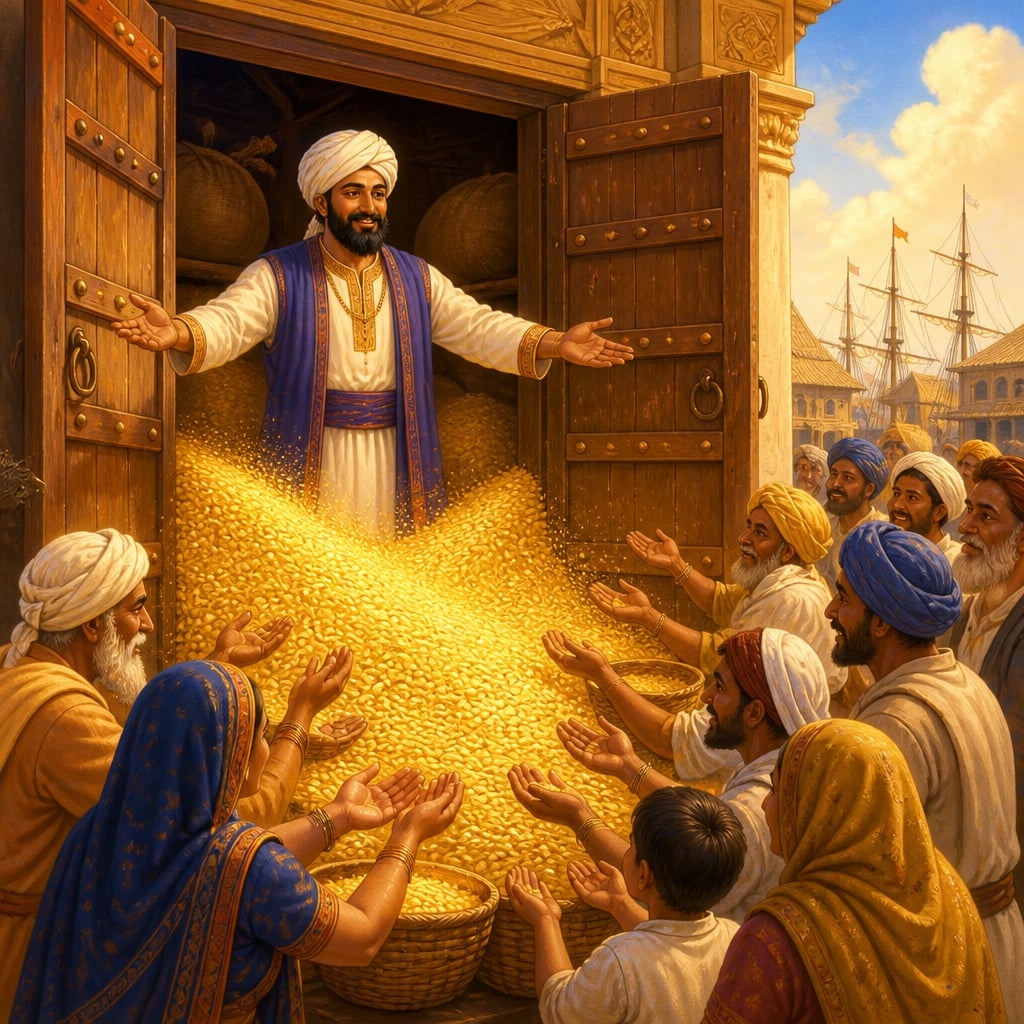
Jagadu opens his granaries to the famine-struck

In the middle of the thirteenth century, a merchant named Jagadu ran a trading empire from the port town of Bhadreshwar in Kutch, in today's Gujarat. Ships, warehouses, caravans: he was among the wealthiest men of his region. And, unusually for his time, the chronicles say he built for everyone, including a mosque for the town's Muslim traders alongside temples and wells.

Then, around 1256, the rains failed. And failed again. The famine that followed, remembered in Gujarat for centuries, stretched into a third year. Grain became more valuable than gold, and every merchant who held stores faced the same arithmetic: sell at famine prices and multiply a fortune, or open the doors and spend one.

Jagadu opened the doors. The Jain chronicle that records his life, the Jagaducharita, says he had built granaries across the region in the good years. Through the famine he gave grain in enormous quantities: to his own kingdom, and, remarkably, in consignments to the rulers of neighbouring kingdoms, feeding subjects who were not his responsibility by any map. He also ran soup kitchens for those with nothing to trade at all.

Seven centuries later, the fortune is gone, the ships are gone, the port itself has faded. What crossed the centuries was the grain. Jagadu is remembered for exactly one thing: what he gave away. Hold that inversion, wealth vanished, giving permanent, because the Garuda Purana built its most notorious image on it.

The River at the Border
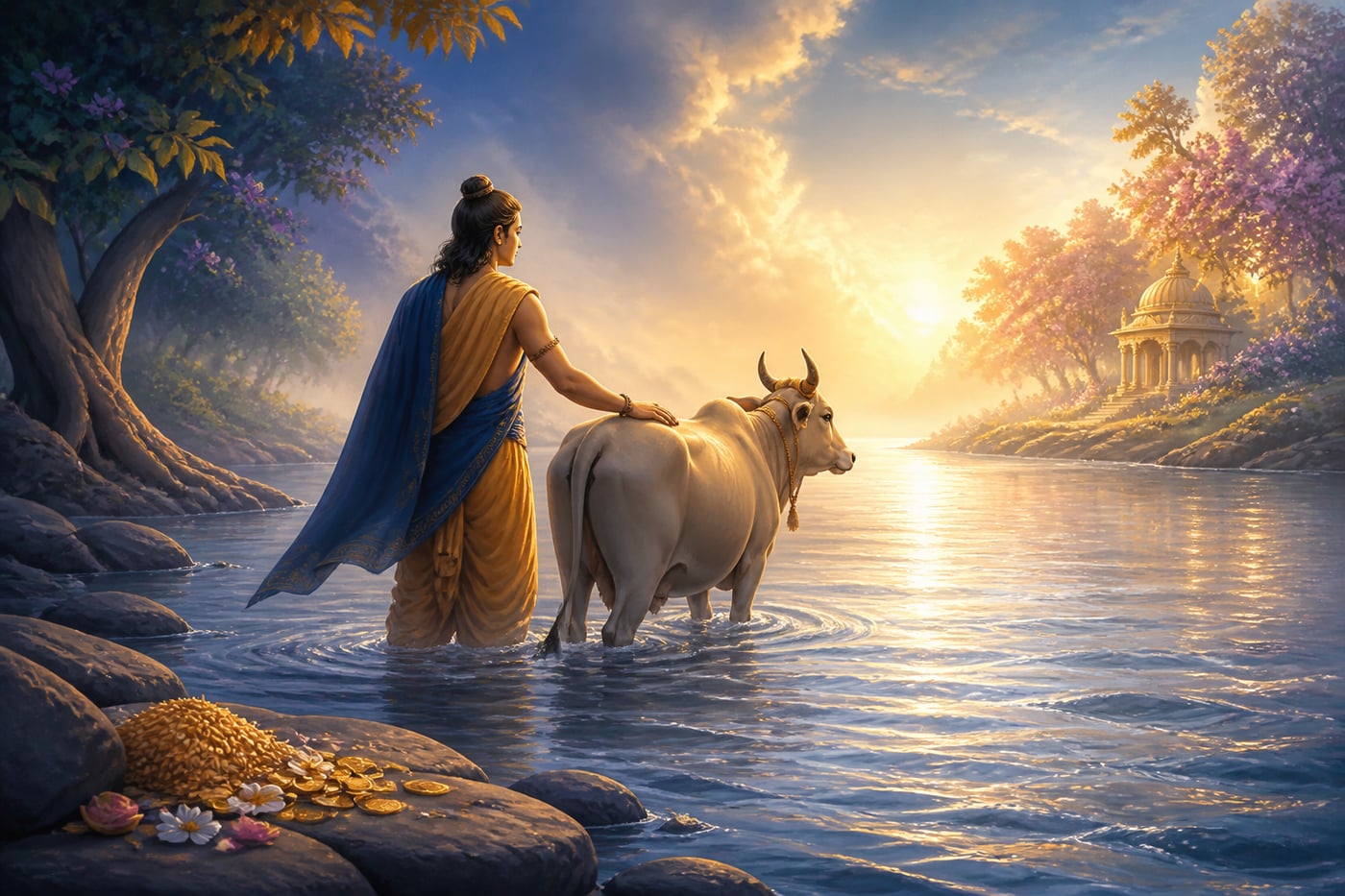
The river crossed gently on the strength of giving

Of everything in this text, nothing has frightened more people than the river. Vaitarani: the torrent at the boundary of Yama's realm, which the road of the last lesson must eventually meet. The text describes it in deliberately dreadful colours, wide, foul, impossible to swim, and popular retellings have lingered on those colours for centuries. If you have ever heard the Garuda Purana called a book of horrors, the river is usually exhibit one.

But walk past the description to the mechanism, the part the fearful retellings always omit. The text is precise about who crosses easily and why. The traveler who crosses, crosses because of dana: what they gave, freely, while alive. The tradition's rite makes the mechanism concrete in the gift of a cow, go-dana, made during life or through the final rites. In the model, the gift itself becomes the crossing: the cow given in the world of the living waits at the river as the ferry. More broadly, every gift, food, water, shelter, knowledge, given without strings while one had the power to give, accumulates on the far shore as purchase for the crossing. The one who never gave meets the river as described: alone, with full pockets and no boat.

Read the design plainly and the river turns out to be a customs post. It sits at the border and enforces the border's one law, which the chapter has been building lesson by lesson: nothing owned crosses. Wealth stops at the house; the body stops at the fire; family stops at the ghat. The river adds the final, precise clause: given wealth is the only wealth that converts. What you kept is confiscated at the border in full. What you gave was wired ahead.

The Only Transferable Currency

The text repeats this teaching so often it amounts to a refrain. The Preta Khanda returns again and again to dana: gifts of food, of water, of lamps, of grain, of the cow at the crossing. It treats giving as the single most consequential category of act a householder performs. And it grounds the urgency in a verse of plain-spoken finality:

शुभं वा यदि वा पापं भुङ्क्ते सर्वत्र मानवः । यदनस्तमिते सूर्ये न दत्तं धनमर्थिनाम् ॥

śubhaṃ vā yadi vā pāpaṃ bhuṅkte sarvatra mānavaḥ yad anastamite sūrye na dattaṃ dhanam arthinām

As surely as the sun rises and sets, everywhere one reaps the fruit of good and of ill, and of the wealth not given to those in need while the sun still shone.

Garuda Purana, Preta Khanda 12.27

Notice what the verse counts as a deed. Not only the harm done: also the giving withheld. The wealth not given while the sun still shone is listed with the day's actions, not its omissions, and it ripens like any other act. In this text's accounting, hoarding is not neutral. It is a verb.

This is why calling the Garuda Purana a death manual misses it so completely. The river is a teaching about liquidity, addressed to the living. Every possession you hold is currency of the near shore only; the exchange window is open now, today, while the sun is up; and the exchange rate, giving converted to crossing, is the most generous ever offered. The text is not asking you to fear the river. It is telling you, with the urgency of a friend who has seen the border, to change your money while you can.

The Man Who Finished the Transfer

The giver walks away with nothing left to carry

Our own era produced a man who took this logic to its mathematical conclusion. Chuck Feeney, an Irish-American entrepreneur, co-founded the Duty Free Shoppers empire and became a billionaire. Then, in 1984, he did something almost without precedent: he secretly transferred essentially his entire fortune into a foundation. He spent the next four decades giving it away while alive to steer it: about eight billion dollars, into universities, public health, and peace processes, much of it anonymously. He kept no house and famously wore a ten-dollar watch. He called the approach Giving While Living, and his stated reasoning was pure Vaitarani logic delivered in an accountant's accent: giving after death is giving what you could not keep anyway; giving while alive is the only giving that is fully yours. Feeney died in 2023 having hit his target: the foundation spent itself to zero while he watched.

A thirteenth-century Jain merchant and a twentieth-century duty-free billionaire, neither of whom ever read the other's book, arrived at the same ledger: what you keep, you lose at the border; what you give, you keep forever. The text puts a river and a cow where Feeney put a foundation, and the underlying transaction is identical.

And with the river behind them, the road runs out of obstacles. Ahead, at last, is the destination the whole year's journey has pointed toward: the city, the palace of pictures we glimpsed in Chapter 2, and the judge himself. His court is nothing like his reputation, and meeting him properly is the next lesson.

Case studies

Jagadu Empties the Granaries

When the rains failed across western India around 1256 and famine stretched into its third year, the Kutch merchant Jagadu held what everyone needed: grain, stockpiled in granaries he had built across the region during the good years. Famine pricing would have multiplied his fortune. Instead, the Jagaducharita records, he distributed grain on a staggering scale, consignments to his own ruler and to neighbouring kingdoms including their rivals, and ran free kitchens for those who could offer nothing back.

Jagadu performed the verse's instruction at civilizational scale: wealth given to the arthi, those in need, while the sun still shone, at the exact moment withholding would have been most profitable and most lethal. The text says such giving crosses the river with the giver. History adds its own version: it crossed seven centuries.

The famine passed; the fortune, the ships, and the port of Bhadreshwar eventually faded from the map. The giving did not. Jagadu remains a household name of Gujarati memory, invoked to this day as the standard for what wealth is for.

A fortune spent on the crossing outlasts a fortune kept, in the text's ledger and in history's. The granary opened at the right moment is the only granary still standing.

The Jagaducharita credits Jagadu with distributing hundreds of thousands of measures of grain across the famine years 1256 to 1258, including consignments to the rulers of Sindh, Delhi, and beyond.

Giving While Living

In 1984, at the height of his success, Chuck Feeney secretly signed over his entire stake in the Duty Free Shoppers empire to a foundation, an act discovered by the press only years later. His stated goal was unprecedented: give the whole fortune away while alive, anonymously where possible, and close the fund at zero. Over four decades the foundation moved about eight billion dollars into universities, public health systems, and peace processes across several countries, while Feeney flew economy and wore a ten-dollar watch.

Feeney's core argument, that posthumous giving merely releases what death was confiscating anyway, is the river's rule restated: only what is given while the sun shines is truly given, because only then does the giver pay from what was genuinely theirs to keep. His anonymity honoured the tradition's highest grade of dana: the gift without name, expecting nothing.

The Atlantic Philanthropies completed its spend-down and closed in 2020; Feeney died in 2023, by every account content. His example directly inspired public pledges by later billionaires, though few have matched the zero.

The rarest financial achievement of the modern age was not a fortune made but a fortune completely converted, on time, at the only exchange window that exists.

The Atlantic Philanthropies gave away approximately 8 billion dollars between 1984 and 2020, closing with Feeney's stated goal achieved: dying broke, on schedule.

Living traditions

The instinct that giving must accompany a death remains nearly universal in Hindu practice: anna-dana, the feeding of others in the departed's name, continues in homes, temples, and gurudwara-style community kitchens across every region. Many families mark death anniversaries not with monuments but with meals served, the tradition's oldest conviction in action: what is given in someone's name travels to them, and what is merely kept in their memory does not.

  • Vaitarani river ghats, Jajpur: The earthly namesake of the text's river, where families have performed ancestral rites for centuries, particularly at Dashashwamedha ghat. Standing at a living river that carries the name of the cosmological one collapses the distance between the map and the land: the tradition built its geography into India itself.

Reflection

  • If the river's rule is real in any sense, what is currently waiting on your far shore? List what you have actually given freely this year, not planned, not intended: given.
  • The verse counts withheld wealth as a deed, not an absence. What do you currently hold idle, money, things, skills, time, within sight of a need you personally know about, and what has kept the transfer from happening?
  • Jagadu gave at the moment withholding was most profitable; Feeney gave anonymously, forfeiting even credit. Which is harder for you, giving when it costs, or giving without recognition, and what does that reveal?

More in What Actually Happens When We Die?

All lessons in What Actually Happens When We Die? · Garuda Purana ebook course