The Last Thought
The departing thought as the rudder.
The text’s account of the moment of death: the vital winds withdrawing, and its insistence that the final thought shapes the departure. The quiet implication: if the last thought matters that much, every ordinary thought is a rehearsal.
Three in the Morning, Every Morning
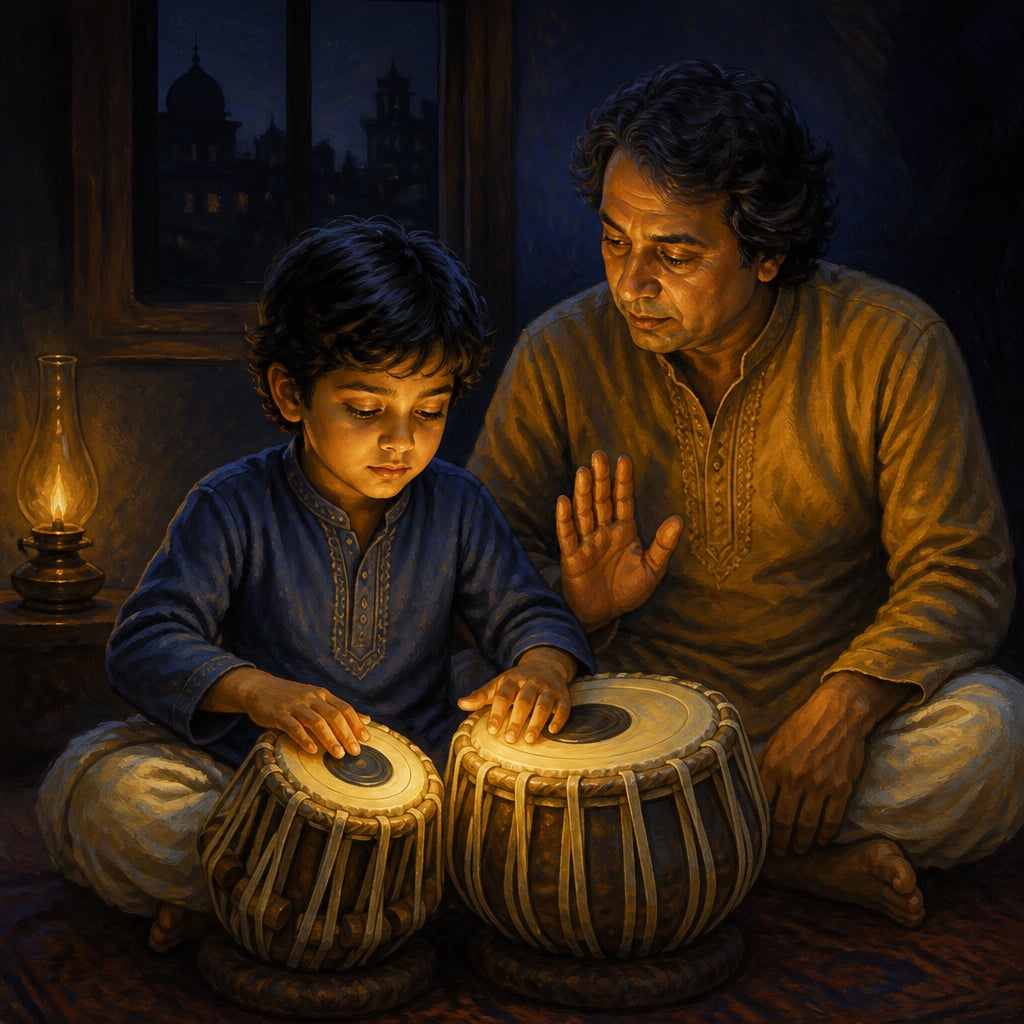
For most of his childhood, Zakir Hussain was woken by his father at three in the morning. Ustad Alla Rakha, one of the great tabla masters of the twentieth century, would sit his son down in the dark of their Mumbai home. No drum at first. The father would sing rhythms, and the boy would recite them back, hour after hour, before school, every single day.
Decades later, concert audiences would watch Zakir Hussain's hands move faster than the eye could follow and call it magic. He always corrected them. It was riyaz: daily practice, repeated so long that the response lived deeper than decision. On stage, in the fraction of a second between a singer's phrase and his answer, there was no time to think. Whatever his hands did in that instant was whatever they had done at three in the morning for forty years.
Hold that thought: in the moment that matters most, you do not rise to the occasion. You fall to your practice. The Garuda Purana builds its entire account of dying on exactly this principle.
The Winds Withdraw
We have reached the chapter this text is famous for. Garuda has asked the question the whole course has circled: what actually happens when we die? Vishnu's answer begins not with courts or rivers but with a single quiet moment inside the body.
The tradition describes the living body as run by the pranas, the vital winds: the currents that drive breath, digestion, circulation, speech. Dying, in this model, is not a switch flipping off. It is a withdrawal. One by one the winds retreat from the limbs, gather, and prepare to leave with the subtle body, the part of the person that travels. The senses close like doors down a corridor: the eyes stop reporting, then the ears, until only the mind remains, holding whatever it holds.
And here the text plants its flag. What the mind holds in that final moment matters enormously. The departing thought sets the direction of the departure, the way the last push of an oar sets a boat's line into the current. This is not only the Garuda Purana's position. The Bhagavad Gita, the philosophical heart of the same Vaishnava tradition, states it as plainly as anything in scripture:
यं यं वापि स्मरन्भावं त्यजत्यन्ते कलेवरम् । तं तमेवैति कौन्तेय सदा तद्भावभावितः ॥
yaṃ yaṃ vāpi smaran bhāvaṃ tyajaty ante kalevaram taṃ tam evaiti kaunteya sadā tad-bhāva-bhāvitaḥ
Whatever one remembers while leaving the body at the end, that alone one reaches, O son of Kunti, having been shaped by that state always.
Bhagavad Gita 8.6
Read the verse to its last word, because the last word carries the mechanism. Not simply "the final thought decides." The final thought arrives because one has been shaped by it always. Sada: always. The verse is not about death. It is about every day before it.
You Cannot Bluff the Last Moment
A first reading of this teaching invites a lazy plan: live however you like, then think the right thought at the end. The text has met this student before, and it closes the loophole without raising its voice.
The last moment, in the text's account, is the least controlled moment of a life. The winds are withdrawing, the senses are closing, the will is loose in its socket. Nobody composes a thought there. The mind, unsupervised, does what it has always done. It goes where it has been trained to go, like Zakir Hussain's hands, like your own thumb finding a familiar app before you have decided anything.
The Garuda Purana's own survey of a human life makes the point with an honesty that still stings:
पितृमातृमयो बाल्ये यौवने दयितामयः । पुत्रपौत्रमयश्चान्ते मूढो नात्ममयः क्वचित् ॥
pitṛ-mātṛ-mayo bālye yauvane dayitā-mayaḥ putra-pautra-mayaś cānte mūḍho nātma-mayaḥ kvacit
In childhood one is absorbed in one's parents, in youth in one's beloved, in old age in one's children and grandchildren. Never, the deluded one, in the Self.
Garuda Purana, Preta Khanda 12.19
The verse is a portrait of attention across a whole lifetime. Each stage of life hands the mind a new absorption, and the mind takes it. The decades pass, and the one subject that was supposed to be yours goes unvisited. Then the final moment arrives and asks the mind for its deepest habit. The answer was written across sixty years of ordinary afternoons.
Every Thought Is a Rehearsal
So the teaching turns around and faces life, which is where this text always ends up pointing. If the last thought is simply the most practiced thought, then there are no throwaway thoughts. The resentment you rehearse on the commute is training. The gratitude you practice at dinner is training. The name of the divine repeated each morning, the grudge repeated each night: both are riyaz, and both are building the reflex that will answer when everything else has withdrawn.

This is why the tradition takes daily remembrance, smarana, so seriously. Japa with a mala, the name spoken at waking, the verse before food: from outside these look like small rituals. From inside the text's model they are rehearsals for the one performance that cannot be rehearsed directly. The Stoic philosopher Seneca reached a version of the same discipline from his own direction, ending each day by reviewing it as if closing an account. The instinct is identical: attend daily to what you want to be true of you finally.
And notice what the teaching does to the present moment, this one, now. It does not say your life will be judged at the end. It says your life is accumulating toward the end, thought by thought, the way a raga practiced at three in the morning accumulates in the hands. The question this chapter opened with was: what happens when we die? The text's first answer is disarmingly practical. What happens at the end is whatever you are doing right now, repeated.
The winds withdraw. The mind holds what it holds. And the traveler departs. Where the road leads next, and why the text says the just and the cruel do not leave the same way, is the next lesson.
Case studies
Riyaz at Three in the Morning
Ustad Alla Rakha woke his son Zakir Hussain at three in the morning through his childhood years in Mumbai and sang rhythm syllables to him in the dark, hours of recitation before school, long before the boy was allowed serious time on the drum itself. The regimen continued in one form or another for decades, and Zakir Hussain maintained daily riyaz throughout his performing life, even at the height of global fame.
Riyaz is the performing tradition's version of smarana: repetition continued until the response no longer passes through decision. The text's claim about the final thought rests on the same law of mind. What is practiced daily becomes what happens automatically, and the moments that matter most are always automatic.
Audiences experienced his speed as supernatural. He insisted, in interview after interview, that nothing on stage was invented in the moment; it surfaced from the practice. The magic was the visible edge of forty years of unwitnessed mornings.
The decisive instant reveals the training and nothing else. Build the reflex you want to be found in you when there is no time to choose.
Zakir Hussain gave his first public tabla performance at age seven and continued the discipline of daily practice across more than five decades of concerts.
Seneca Closes the Day's Account
In his treatise On Anger, Seneca describes his nightly discipline: when the lamp was out and his wife had fallen silent, he examined his entire day, act by act and word by word, hiding nothing from himself and passing over nothing. What was done badly was noted, forgiven, and marked for correction; what was done well was banked.
Seneca treated each evening as a small rehearsal of the final accounting, on the logic that a person who audits daily is never ambushed by the total. The dharma tradition institutionalized the same insight from the other end: attend daily to what you want the mind to hold finally, because the final holding cannot be arranged on the day.
The practice, recorded almost in passing two thousand years ago, became one of the most imitated exercises in the history of self-cultivation, surviving in everything from monastic examen to the modern journal.
A day reviewed is a day banked toward character. The end of a life is compound interest on the ends of its days.
Seneca describes the nightly self-review in On Anger, Book 3, written in the first decade of the Common Era's fifth emperor, before 52 CE.
Living traditions
The practice of dying with the divine name on the lips remains living instruction across Hindu households: families still softly recite the name of Rama or Krishna, or play the Gita's eighth chapter, beside a departing elder. And the daily disciplines built on the same logic, japa at dawn, the mala carried in a pocket, the sentence spoken on waking, remain among the most widely kept practices in the tradition, each one a rehearsal deposited toward a moment no one can rehearse directly.
Reflection
- If your mind, unsupervised, went tonight to its most practiced thought, where would it go? Is that where you would choose to have it go at the end?
- The Preta Khanda maps a life's absorptions: parents, beloved, children, never the Self. Which absorption owns your current stage, and what would five daily minutes for the unvisited subject look like?
- The teaching says you cannot bluff the last moment, in dying or anywhere: the unprepared mind defaults to habit. Where in your life are you currently planning to rise to an occasion you have not trained for?